


 June 18, 2026
Most farm management apps fail for a reason that has nothing to do with the technology.
They get built for a farmer who has reliable internet, a recent smartphone, and time to learn a new interface. That farmer is the exception in most agricultural markets, not the rule. The apps that actually get adopted are the ones built for spotty connectivity, ageing devices, and someone whose attention is split between the app and an actual field.
India's agritech sector is a useful lens for this. According to the Indian Agritech Market Landscape Report from Inc42 and StarAgri, the sector is set to grow from $9 billion in 2025 to $28 billion by 2030. That is a 25% annual growth rate. Mordor Intelligence separately projects the global farm management software market growing from $2.80 billion in 2025 to $5.10 billion by 2030.
This guide covers what a farm management app actually needs, what it costs to build in 2026, and how to take it to market once it exists.
What Is a Farm Management App?
A farm management app is a digital platform that helps farmers and agribusinesses plan, monitor, and record everything happening across their operation. Crop cycles, soil conditions, equipment, labour, expenses, and sales all live in one place instead of scattered across notebooks, memory, and separate spreadsheets.
The category spans a wide range of complexity. At one end sits a simple task and expense tracker for a smallholder farm. At the other sits a full precision agriculture platform pulling in satellite imagery, IoT sensor feeds, and AI-driven yield prediction for a large commercial operation.
What separates a useful farm management app from one that gets uninstalled after a week is not feature count. It is whether the app respects the actual conditions a farmer works in. Patchy signal. A phone that is three years old. Limited patience for a complicated interface during a busy planting season.
What Features Does a Farm Management App Actually Need?
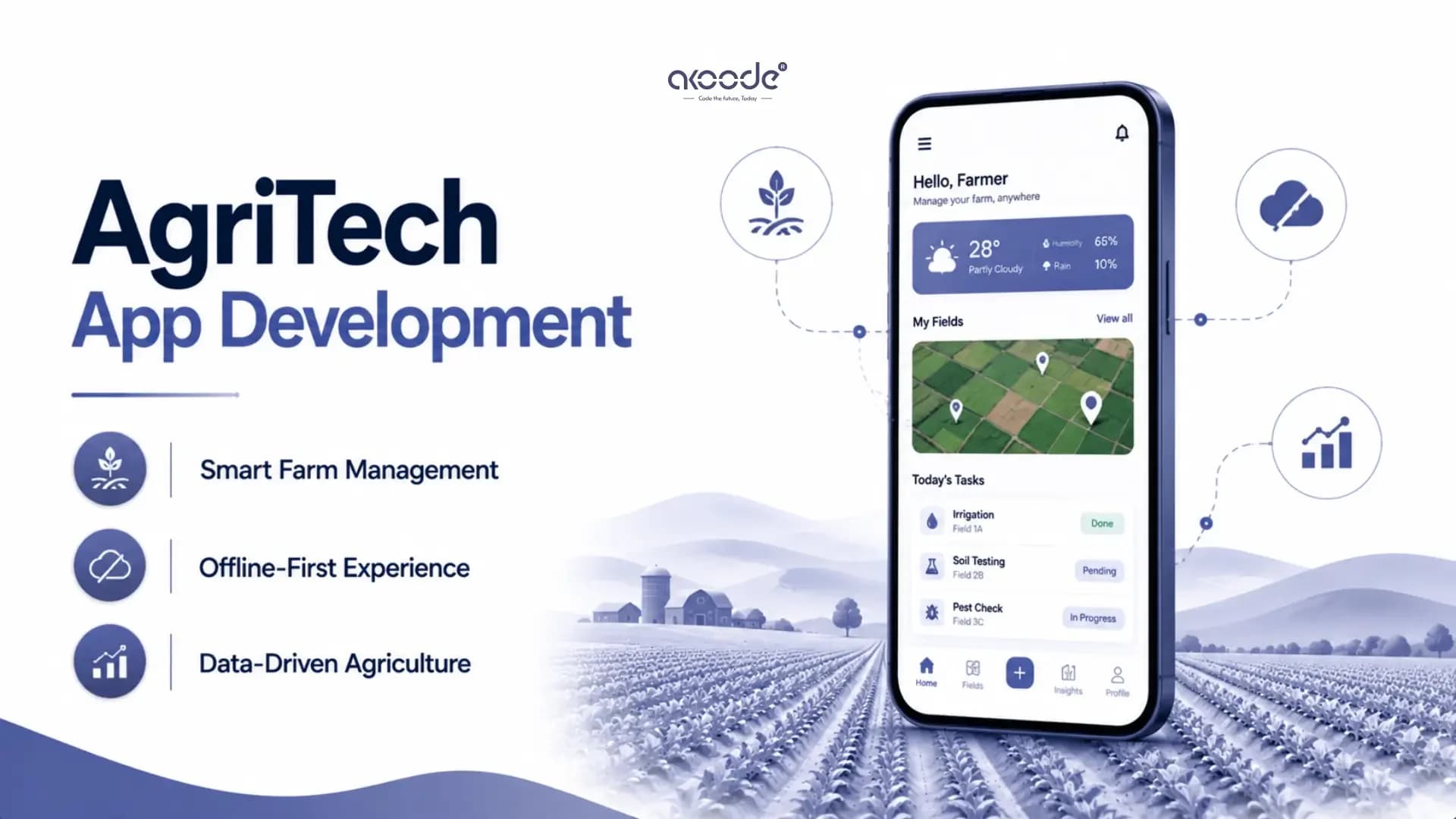
Offline-first architecture is not optional. It is the single most important design decision in this entire category. A farmer entering data in a remote field with no signal needs that data captured locally and synced automatically once connectivity returns. Apps built assuming constant connectivity fail in exactly the environment they were built for.
Crop and field tracking lets farmers record what is planted where, track growth stages, and log field-level activity. GPS-based field mapping ties this data to actual geographic boundaries, which becomes the foundation that everything else builds on.
Weather integration pulls forecast and historical data relevant to specific field locations rather than generic regional forecasts. This sounds straightforward. In practice it means stitching together multiple weather API providers and presenting the output in a way that supports actual planting and irrigation decisions, not just a five-day forecast widget.
Expense and financial tracking covers input costs, labour, equipment, and revenue. For many farmers, this single feature is what turns farming from a set of seasonal activities into something they can actually manage as a business with visible margins.
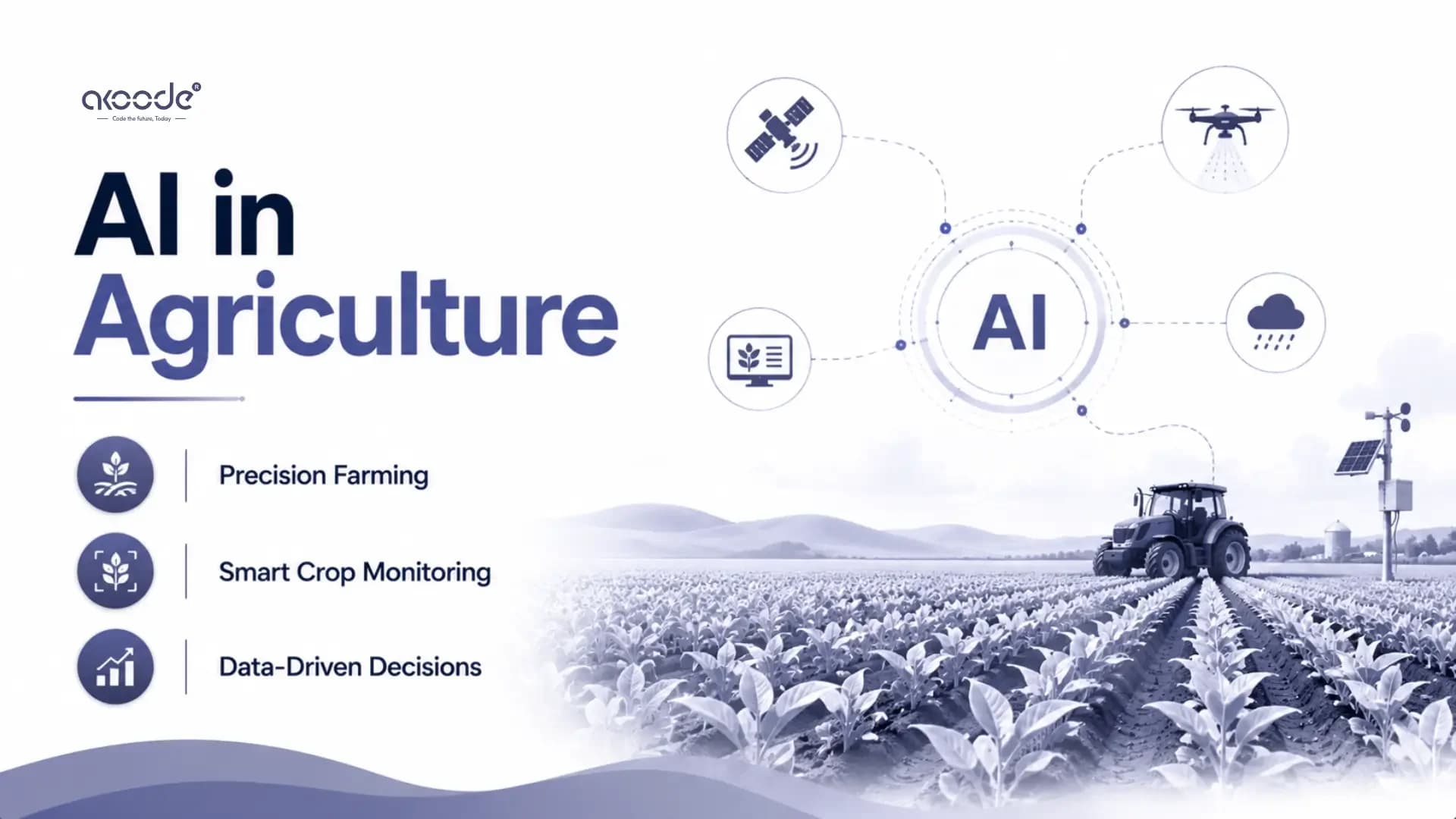
Pest and disease alerts, increasingly AI-driven, flag risk based on weather patterns, crop stage, and regional outbreak data. Some platforms now support photo-based diagnosis, where a farmer photographs an affected leaf and gets an immediate identification.
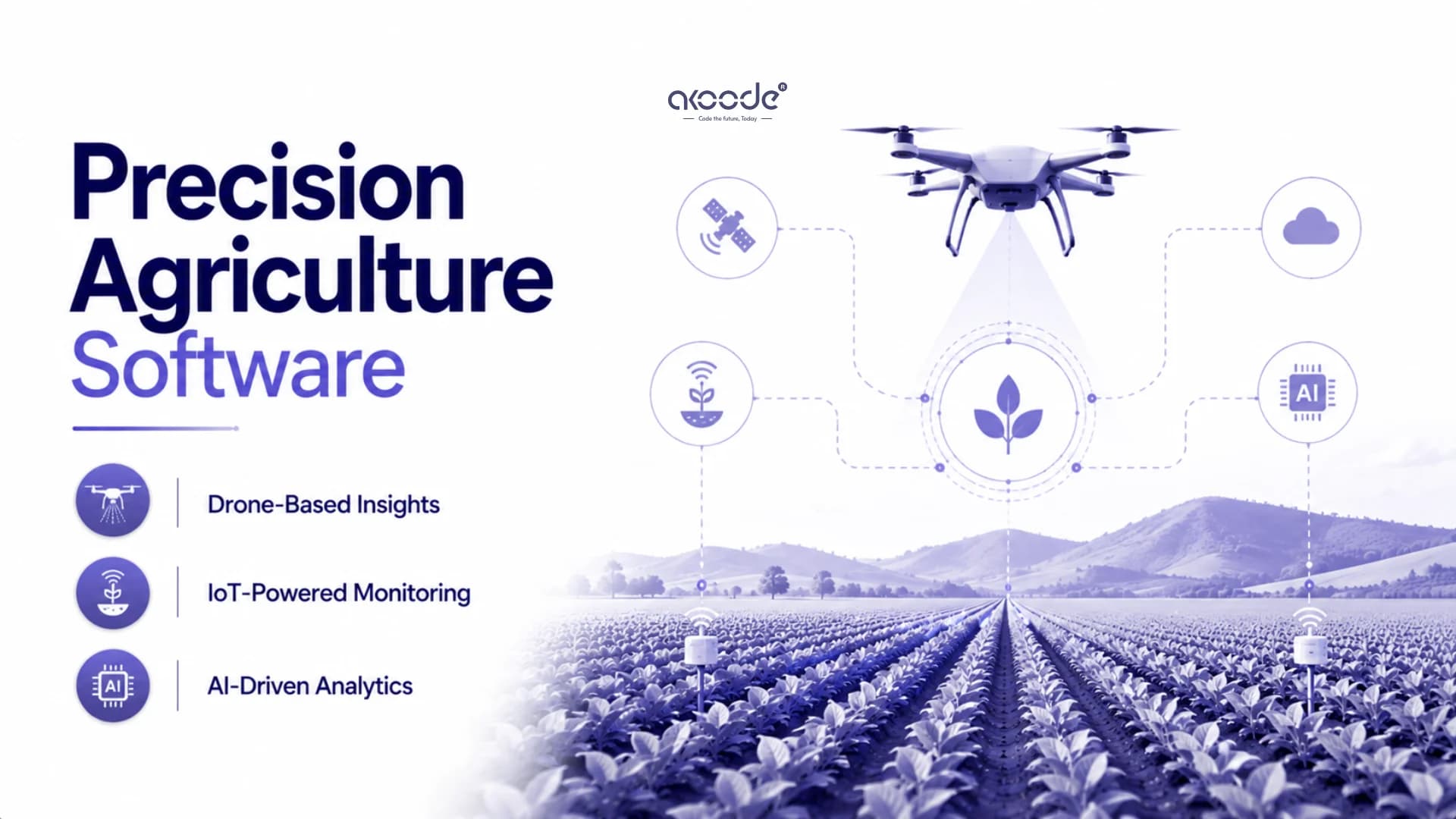
IoT sensor integration, where budget allows, connects soil moisture, temperature, and equipment sensors directly into the app. This is where farm management apps start overlapping with the broader precision agriculture technology stack, and it is usually a phase-two feature rather than something to build into version one.
Market access and pricing data has become a genuine differentiator in markets like India. Apps that show real-time mandi prices and connect farmers to buyers directly are solving a distinct problem from crop monitoring, and the strongest platforms in the Indian market increasingly bundle both rather than picking one.
Embedded finance features, including access to crop loans and working capital, are showing up more frequently in 2026 builds. This adds real development and compliance complexity, but it also creates a stickiness that a pure monitoring tool does not have on its own.
What Does Farm Management App Development Cost in 2026?
App Tier | Cost Range (USD) | What It Covers |
|---|---|---|
Basic tracker (tasks, expenses, simple crop log) | $15,000 to $40,000 | Core CRUD features, basic offline support, single platform |
Mid-tier farm management app | $40,000 to $90,000 | Field mapping, weather integration, multi-platform, basic analytics |
Advanced platform with AI features | $90,000 to $180,000 | Pest detection, predictive insights, IoT integration, marketplace features |
Enterprise / multi-tenant agritech platform | $180,000 to $400,000+ | Full feature set, embedded finance, multi-language, large-scale data pipelines |
These ranges sit consistent with what UK-based development cost analyses put at £50,000 for a basic solution rising past £500,000 for a comprehensive enterprise platform, once converted and adjusted for typical US market rates.
One detail worth calling out specifically. In a real mid-sized cooperative build, the UI was not where the budget went. The synchronisation engine, the piece of infrastructure ensuring a farmer's offline data entry reaches the central server accurately once they reach connectivity, was the single most expensive component. That is a pattern worth planning around rather than discovering mid-project.
By development team location:
Region | Senior Developer Rate | Mid-Level Rate |
|---|---|---|
United States | $150 to $250/hour | $100 to $150/hour |
United Kingdom | $80 to $140/hour | $55 to $85/hour |
India | $25 to $65/hour | $18 to $35/hour |
A mid-tier farm management app costing $90,000 with a US-based team typically lands at $25,000 to $40,000 with an experienced India-based development partner.
What Drives the Cost Up Beyond the Base Build?
GPS and field mapping accuracy
Processing location data correctly for large, irregularly shaped parcels requires more sophisticated algorithms than a typical mapping integration. This is consistently one of the most underestimated line items in agritech app budgets.
Offline sync infrastructure
As noted above, this is frequently the largest single technical investment in the entire app. Building a robust conflict-resolution system, what happens when the same field record gets edited both offline and on the server, takes real engineering time.
Native versus hybrid development
Native apps for iOS and Android separately cost 60 to 80 percent more than a hybrid build using a shared codebase. For farm management apps relying heavily on GPS, camera input, and offline data sync, native development often performs noticeably better in real field conditions. That performance gap matters more here than it does for most consumer app categories.
Third-party API costs at scale
Weather and satellite data providers increasingly use volume-based pricing in 2026. An app that requests data too frequently, rather than caching it locally and refreshing only critical layers, can see its monthly operating bill climb steadily without any change in user count. This is a design decision, not just an infrastructure cost.
AI feature integration
On-device computer vision for pest and disease detection, using frameworks suited to low-power devices, adds meaningfully to development cost but is also what makes an app work reliably without a constant connection, which circles back to the offline-first requirement that defines this entire category.
What Tech Stack Fits a Farm Management App?
1. Mobile
React Native or Flutter for cross-platform builds where budget is the primary constraint. Native Swift and Kotlin where camera-based features, GPS precision, or offline performance are critical to the core use case.
2. Offline data layer
SQLite or Realm for local on-device storage, paired with a conflict-resolution sync layer that reconciles offline edits once connectivity returns. This pairing is the backbone of any serious agritech app and deserves more design attention than most other technical decisions in the build.
3. Backend
Node.js or Python for API services. PostgreSQL for structured operational data, paired with a time-series database where continuous sensor data is involved.
4. AI and on-device inference
Lightweight ML frameworks designed for microcontrollers and low-power mobile devices support on-device computer vision for crop disease detection, allowing the feature to function even without an internet connection at the moment of use.
5. Mapping and weather
A geospatial data platform for field mapping, plus aggregated weather API providers feeding location-specific forecasts rather than relying on a single source.
How Should You Go to Market with a Farm Management App?
Building the app is the easier half of this. Getting farmers to actually use it, consistently, across a full growing season, is where most agritech products struggle.
Start with one specific, painful problem rather than a comprehensive platform. An app trying to solve crop monitoring, market access, financial tracking, and pest detection simultaneously, for a first-time user, asks for too much trust too early. Pick the single workflow causing the most pain for your target user and lead with that.
Distribution through existing trust networks consistently outperforms direct-to-farmer marketing. Cooperatives, agricultural extension officers, input suppliers, and local agritech resellers already have farmer trust built up over years. A new app borrowing that trust adopts faster than one asking farmers to evaluate it cold.
Language and literacy-appropriate design is not optional in most emerging agricultural markets. Multilingual support, voice input where literacy is a barrier, and visual rather than text-heavy interfaces meaningfully widen who can actually use the product.
Pricing models matter more here than in most software categories. A monthly subscription that feels reasonable to a software buyer can feel genuinely risky to a smallholder farmer working on thin margins. Freemium models, seasonal pricing tied to harvest cycles, or bundling the app free alongside input or equipment purchases all tend to convert better than a flat subscription pitched cold.
For agritech founders building toward the kind of platform that integrates AI-driven crop insights from day one, the go-to-market strategy and the product roadmap need to move together. A feature that delivers genuine value but requires three extra steps to access will lose to a simpler feature that gets used.
Conclusion
A farm management app is not won on a feature checklist. It is won on whether it works reliably for someone with patchy signal, an older phone, and very little patience for a complicated interface during the busiest weeks of their season.
The market opportunity is real and growing fast, with India's agritech sector alone projected to nearly triple by 2030 according to Inc42 and StarAgri's joint research. But the apps capturing that growth are the ones built around real field conditions rather than a polished demo environment.
Akoode Technologies is a leading AI and software development company headquartered in Gurugram, India, with a US office in Oklahoma. From mobile app development and AI-powered platforms to IoT solutions and custom enterprise software, Akoode builds agritech and farm management applications for startups, agribusinesses, and enterprise clients across 15+ industries globally. If you are building a farm management app and want a team that understands both the engineering and the field-level realities it needs to work in, that conversation starts here.
Frequently Asked Questions
1. What is a farm management app?
A farm management app is a digital platform that helps farmers and agribusinesses plan, monitor, and record farming operations including crop tracking, weather data, expenses, equipment, and labour, replacing notebooks and spreadsheets with one connected system.
2. How much does agritech app development cost in 2026?
A basic tracker app costs $15,000 to $40,000. A mid-tier farm management app with field mapping and weather integration costs $40,000 to $90,000. Advanced platforms with AI features cost $90,000 to $180,000. Enterprise multi-tenant platforms start at $180,000 and can exceed $400,000.
3. What features should every farm management app have?
Offline-first architecture is the most critical feature, since farmers frequently work without reliable connectivity. Core features beyond that include crop and field tracking, weather integration, expense tracking, pest and disease alerts, and increasingly, market access and embedded finance features.
4. Why is offline functionality so important in agriculture apps?
Farms often have inconsistent or no internet connectivity in the field. An app that requires constant connectivity fails in exactly the environment it was built for. Offline-first design with reliable data sync once connectivity returns is consistently one of the most expensive but most necessary components of a farm management app.
5. What is the farm management software market size in 2026?
According to Mordor Intelligence, the global farm management software market is projected to grow from $2.80 billion in 2025 to $5.10 billion by 2030, a 12.7 percent annual growth rate. India's broader agritech sector is projected to grow from $9 billion in 2025 to $28 billion by 2030 according to Inc42 and StarAgri's joint market research.
6. Should a farm management app be built native or cross-platform?
Cross-platform frameworks like React Native or Flutter reduce cost and suit apps without heavy camera or GPS precision requirements. Native development costs 60 to 80 percent more but performs more reliably for apps depending heavily on GPS accuracy, camera-based features, and offline data sync, which matters significantly in real field conditions with inconsistent connectivity.