


 June 17, 2026
Farmers have always worked with data. Weather patterns. Soil conditions. Crop cycles. Market prices. None of this is new.
What is new is the precision.
A farmer used to decide when to water a field based on instinct or a fixed calendar. Now a model reads soil moisture sensors, satellite imagery, and weather forecasts. It tells them exactly when and how much. The decision used to be a guess refined by experience. It is becoming a calculation refined by data.
This shift is happening at real scale. The global AI in agriculture market sits at $3.37 billion in 2026. North American Community Hub's agriculture statistics research projects it reaching $8.23 billion by 2030. In India specifically, the government's IndiaAI initiative has backed something significant. PIB data shows over 2,282 agritech startups supported since 2019, with grants exceeding ₹186 crore.
This guide covers what AI actually does in agriculture, where it is already working, and what role it plays specifically in Indian farming.
What Is the Role of AI in Agriculture?
AI in agriculture means using machine learning, computer vision, and predictive analytics for decisions that used to rely on experience alone.
The role breaks into four functions. Sensing collects data from soil, weather, crops, and equipment. Analysis processes that data into patterns. Prediction forecasts yield, pest risk, and timing. Action automates physical tasks like spraying, harvesting, and irrigation.
None of these work well alone. A sensor without analysis is just data collection. A prediction nobody acts on is just a forecast sitting unused. The platforms delivering real value in 2026 connect all four into one workflow a farmer can actually use day to day.
How Does AI Power Precision Farming?
Precision farming treats every section of a field as its own decision unit. Not the whole field managed uniformly.
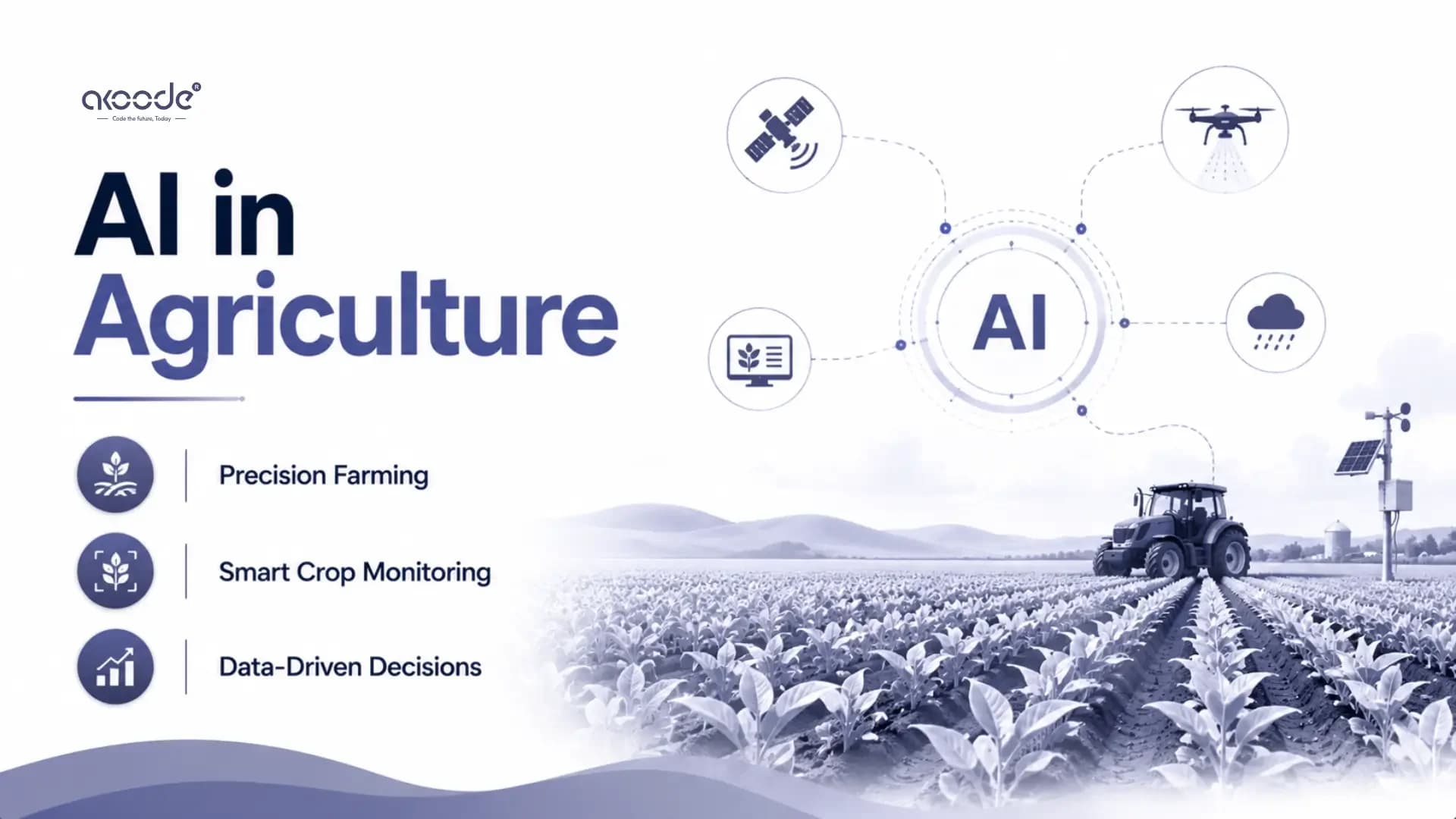
Soil sensors measure moisture, nutrients, and pH at different points. Satellite and drone imagery captures crop health signals invisible to the eye. Weather data feeds irrigation and planting models. AI combines all of this into recommendations specific to each part of the field.
John Deere's See & Spray technology shows this working at commercial scale. The system uses computer vision to identify weeds individually. It applies herbicide only where needed. The Data Community's January 2026 research found this reduces chemical use by up to 90 percent in some deployments. That is not a marginal efficiency gain. It changes the economics of an entire input category.
Climate FieldView, built by Bayer, applies machine learning to satellite imagery and yield data. It flags crop stress early, often before visible symptoms appear. Corteva Agriscience uses AI models to optimise seed selection based on soil and climate conditions specific to each field.
In India, farmers use GPS-enabled smartphones to mark field boundaries. That data feeds tailored advice back to them directly. A pilot in Khammam district, Telangana, combined AI-powered soil testing with crop quality assessment and a digital marketplace. The World Economic Forum's Centre for the Fourth Industrial Revolution led the project. Over 18 months, chilli farmers saw yields rise 21 percent. Selling prices rose 8 percent. IndiaAI's government data confirms both figures.
How Is AI Used for Pest and Disease Detection?
Catching an infestation early is the difference between a manageable problem and a lost harvest.
Computer vision models trained on crop images spot early pest damage and disease symptoms a human eye would miss. The detection happens fast enough to act before the problem spreads across a field.
India's National Pest Surveillance System runs on this principle. The Ministry of Agriculture and Farmers Welfare built it specifically to detect crop issues linked to shifting climate patterns. IndiaAI's published research on the programme confirms it has enabled faster intervention and measurably reduced pest-related losses in participating regions.
The numbers extend beyond India too. StartUs Insights' 2025 to 2030 strategic guide documents a 50% reduction in pest losses across some farming operations using AI detection paired with precision intervention.
Here is how it actually works for a farmer. They photograph an affected leaf on their phone. The model identifies the pest or disease within seconds. It recommends a specific intervention immediately. What used to require a visit from an agricultural extension officer, sometimes days after damage was first noticed, now happens in the time it takes to take a photo.
How Does AI Improve Yield Forecasting and Crop Planning?
Yield forecasting used to rely on historical averages and farmer experience. AI models now pull in far more variables. The forecasts update continuously through the growing season rather than sitting static from planting day.
Satellite imagery tracks growth stages across a region. Weather models project conditions for the rest of the season. Historical yield data from comparable soil and climate conditions sets a baseline. Put together, the forecast gets sharper as the season progresses.
This changes planning in practical ways. A farmer who knows a likely yield range two months before harvest can plan storage, transport, and sales contracts with real confidence. For large agribusinesses managing thousands of hectares, accurate forecasting touches everything from labour scheduling to financing decisions.
AI also shapes crop rotation. Models analyse soil health data and historical cropping patterns. They suggest rotations that maintain fertility and reduce pest pressure across multiple seasons. Not just the current one.
What Is the Economic Impact of AI in Agriculture?
The return on investment data here is more concrete than most emerging technology categories can offer.
StartUs Insights research documents a 25 percent increase in crop yields tied to AI adoption. Large-scale farming operations have seen 150 percent ROI. Small farmholders have achieved 120 percent ROI. Slightly lower than large operations. Still a strong return given how constrained capital typically is on smaller farms.
Adoption is not even across farm sizes. That gap is worth understanding properly.
Large farms over 5,000 acres show 81% willingness to adopt AI. Medium farms between 2,000 and 5,000 acres sit at 76 percent. Small farms under 2,000 acres drop to just 36 percent.
The gap reflects a real constraint. Not just caution. Hardware and integration costs are harder for small operations to absorb relative to their revenue. OECD research cites a 10-hectare vineyard owner who took three years before trusting and applying new agricultural technology. That hesitation is rational. Smaller margins leave less room for a failed experiment.
This is exactly where India's agritech ecosystem fills a gap that pure hardware vendors cannot reach. Government-backed programmes and agritech startups are building tools specifically priced and designed for smallholder farmers, who make up the overwhelming majority of India's agricultural workforce.
What Role Does AI Play Specifically in Indian Agriculture?
India presents a distinct version of this transformation. Agriculture employs over half the country's workforce. Most farms are small, family-run, and historically dependent on monsoon timing, manual labour, and knowledge passed down rather than documented anywhere formally.
That context shapes what adoption actually looks like on the ground.
Smartphones have reached rural India at a scale earlier agricultural technology never managed. Agritech apps are using that reach to deliver personalised advice directly to smallholder farmers. IEEE Spectrum's reporting on Indian agritech describes predictive models now advising farmers on irrigation and fertiliser timing. This replaces the intuition-or-calendar approach that dominated for generations.
India's broader AI standing supports this shift. The country ranks third globally in AI competitiveness according to Stanford University's 2025 Global AI Vibrancy Tool. That ranking reflects strength in AI talent, research output, and startup investment. The national capability is translating directly into agricultural applications on the ground.
Labour shortage is a specific, growing problem in Indian farming. AI-powered robotic harvesters are starting to address it. These systems detect ripe crops and harvest with precision. They reduce dependency on manual labour exactly when labour availability is most constrained, during peak harvest windows.
Supply chain inefficiency has cost Indian farmers real money for years through spoilage and poor market timing. Companies like StarAgri are using AI-based logistics optimisation to get fresh produce to market faster and in better condition. That directly affects what farmers get paid.
For agritech businesses building in this space, India represents one of the most active and fastest-growing markets globally for AI-powered farming tools.
What Are the Barriers to AI Adoption in Agriculture?
The technology works. Adoption still faces real friction.
Cost and infrastructure for smallholders
Sensor hardware, connectivity, and integration costs hit small farms proportionally harder. This is the biggest reason adoption skews toward large operations globally and stays uneven in India despite strong government support.
Trust and proof of value
Farmers run on tight margins and long seasonal cycles. A failed experiment is not a minor setback. It can cost an entire year's income. The OECD's three-year trust timeline for a vineyard owner is not an outlier. It reflects how cautiously this sector adopts anything new, however promising it looks on paper.
Data quality and consistency
AI models need clean, consistent field data. Many farms, smaller ones especially, lack the historical data infrastructure that makes models accurate from day one. Building that data foundation often takes longer than building the model itself.
Connectivity gaps
Rural connectivity remains inconsistent in parts of India and other major agricultural economies. AI tools that depend on real-time data transmission need a hybrid approach. Edge processing on local devices combined with centralised cloud analytics. That combination keeps the system functioning where connectivity is not guaranteed.
What Comes Next for AI in Agriculture?
Carbon farming is worth watching closely. AI-driven measurement, reporting, and verification platforms are becoming the infrastructure that makes carbon credit systems credible and auditable. StartUs Insights research flags this as a growing area. As carbon markets mature, this measurement layer becomes central to how farms generate revenue beyond crop sales.
Ag robotics is entering a different adoption phase. Labour shortages are pushing farms toward automation evaluated on ROI rather than novelty, according to 2026 agriculture statistics research. Computer vision systems automating fruit and flower counting for yield estimation show this shift clearly. Practical. Immediately useful. Easy to justify financially rather than experimental.
For agribusinesses and agritech companies building the next generation of these tools, the lesson from current adoption data is clear. Start with high-ROI use cases like precision spraying and yield forecasting. They deliver fast, visible payback. Invest in data infrastructure before chasing more advanced algorithms. Build for explainability. Farmers need clear, actionable insight, not an opaque prediction they are asked to trust blindly.
Most AI agriculture applications depend on sensor networks, connected equipment, and real-time data pipelines as their foundation. IoT infrastructure is what makes the data layer possible in the first place. The AI model is only as good as the data feeding it, and that data increasingly comes from connected field hardware. Computer vision systems specifically power the pest detection and crop monitoring applications covered earlier in this guide.
For businesses exploring the broader landscape, the role of AI across other industries shows similar adoption patterns. High-ROI use cases first. Data infrastructure investment before algorithm sophistication. The pattern holds whether the industry is agriculture, healthcare, or manufacturing.
Conclusion
AI in agriculture has moved past the pilot stage into measurable production value. Reduced chemical use. Higher yields. Better-timed harvests. Real income improvements for farmers who have adopted it, from large commercial operations down to smallholder chilli farmers in Telangana.
India's position in this shift is significant. Strong national AI capability, an active agritech startup ecosystem, and deep government investment are converging at exactly the moment when smartphone penetration and rural connectivity have reached a level that makes farmer-facing AI tools genuinely practical at scale.
The barriers that remain, cost for smallholders, trust, data quality, and connectivity, are solvable problems. Not fundamental limits. The agribusinesses and technology companies solving them first will shape how Indian and global agriculture operates for the next decade.
Akoode Technologies is a leading AI and software development company headquartered in Gurugram, India, with a US office in Oklahoma. From AI-powered software development and computer vision systems to IoT solutions and custom enterprise platforms, Akoode builds agritech and precision farming technology for startups, agribusinesses, and enterprise clients across 15+ industries globally. If you are building an AI-powered agriculture product and want a team that understands both the technology and the field-level realities it operates in, that conversation starts here.
Frequently Asked Questions
1. What is the role of AI in agriculture?
AI covers four functions: sensing data from soil, weather, and crops, analysing it for patterns, predicting yield and pest risk, and automating tasks like spraying and harvesting. Together these help farmers move from intuition-based decisions to data-driven ones.
2. What are real examples of AI in farming?
John Deere's See & Spray uses computer vision to target weeds, cutting chemical use by up to 90 percent in some deployments. Climate FieldView analyses satellite imagery to detect crop stress early. India's National Pest Surveillance System detects crop issues linked to climate change.
3. How is AI used in Indian agriculture specifically?
Indian agritech apps deliver personalised irrigation and fertiliser advice through smartphones. AI-powered robotic harvesters address labour shortages. AI-based supply chain tools cut spoilage and improve market timing. Government programmes have backed over 2,282 agritech startups with grants exceeding ₹186 crore as of January 2026.
4. What is the market size for AI in agriculture in 2026?
The global market is valued at $3.37 billion in 2026, projected to reach $8.23 billion by 2030 according to North American Community Hub research. A separate StartUs Insights analysis projects the broader market reaching $4.7 billion by 2028 at a 23.1 percent annual growth rate.
5. What is the ROI of adopting AI in agriculture?
StartUs Insights research shows large farms achieving roughly 150 percent ROI alongside a 25 percent yield increase. Small farmholders achieve around 120 percent ROI. Adoption willingness is 81 percent among large farms over 5,000 acres versus just 36 percent among small farms under 2,000 acres.
6. What are the main barriers to AI adoption in agriculture?
Cost and infrastructure burden for smallholder farms, the time required to build farmer trust, inconsistent historical field data needed to train accurate models, and rural connectivity gaps that limit real-time data transmission in parts of India and other major agricultural markets.