


 September 15, 2026
A radiologist used to read every scan cold, spend twenty minutes on documentation for every ten minutes of actual diagnosis, and hope nothing slipped through on a busy Friday. Today an AI system pre-flags the scan that needs urgent attention, drafts the report while the radiologist reviews the images, and the radiologist signs off with edits instead of writing from a blank page. The diagnosis is still theirs. The twenty minutes of documentation mostly isn't anymore.
That shift — AI absorbing the repetitive, structured, high-volume parts of clinical and administrative work so clinicians spend more time on judgment calls that actually need a human — is why healthcare has moved from cautious AI pilots to genuine operational deployment faster than almost any other regulated industry. This guide covers what AI in healthcare actually means in 2026, every category of AI agent a hospital, clinic, diagnostics company, or digital health platform can realistically build, how they're engineered safely, and what's different about building for Gurgaon/NCR, India, and global markets.
Why Healthcare Is Moving on AI Faster Than the Industry's Reputation Suggests
Healthcare has a long-standing reputation for being slow and risk-averse with new technology, and for good reason — the cost of a wrong answer is categorically higher here than in most industries. But the adoption numbers for 2026 tell a different story than the reputation. Estimates for the global AI-in-healthcare market cluster in the $45-55 billion range for 2026, up sharply from roughly $36 billion a year earlier, with most forecasts pointing toward $500 billion-plus by the early 2030s regardless of which analyst firm's methodology is used.
Physician-level adoption has accelerated even faster than the market-size numbers. Recent physician surveys put AI usage in professional practice above 60%, more than double the rate reported just two years earlier, and roughly three-quarters of U.S. health systems now report using at least one AI application in production, not a pilot. Clinical documentation — AI scribes that draft notes during a patient visit — has become one of the single fastest-adopted use cases in the industry, alongside literature search and administrative automation, precisely because the return is immediate, measurable, and low-risk to a patient outcome.
India's healthcare AI market is scaling on a distinct trajectory shaped by its own drivers: a large patient population relative to available clinicians, a fast-growing digital health infrastructure anchored by the government's Ayushman Bharat Digital Mission, and rising investment in health-tech startups. India's AI-in-healthcare market is projected to grow at a CAGR in the high-30s percent range through the early 2030s — among the fastest of any major healthcare AI market globally — with North India, including the Delhi-NCR corridor, already holding the largest regional share thanks to its concentration of major hospitals, diagnostic chains, and health-tech companies. Gurgaon specifically sits inside this cluster as a hub for digital health startups and diagnostics companies serving both the domestic market and international patients.
What "AI in Healthcare" Actually Means
AI in healthcare spans work that happens in three distinct places, each with a different risk profile and regulatory bar: clinical (diagnosis support, treatment planning, imaging analysis — where an error can directly harm a patient and regulatory oversight is highest), administrative (documentation, scheduling, billing, prior authorization — where AI has the fastest, lowest-risk adoption path), and patient-facing (virtual assistants, triage, remote monitoring — where trust and clear escalation paths to a human clinician matter as much as accuracy).
An AI agent, in this context, owns a specific job end-to-end within one of these three areas — not just flagging a possible finding, but completing a defined task with the right human checkpoints built in: drafting a clinical note for physician sign-off, triaging an incoming patient message to the right care pathway, or processing a prior-authorization request against payer rules without a staff member manually re-keying the same information across three systems.
The Complete List: AI Agents You Can Build for a Healthcare Business
Clinical Decision Support Agents
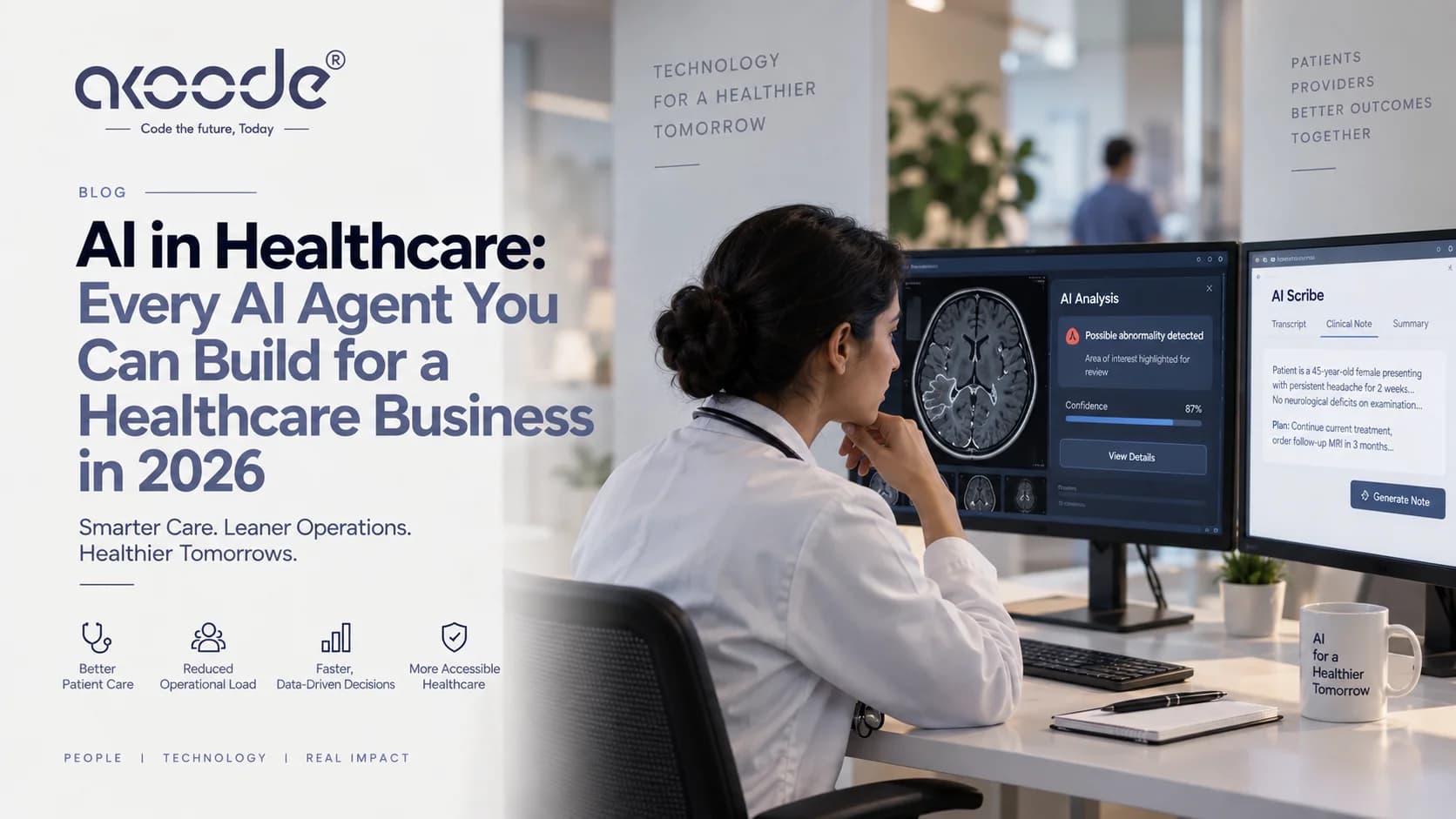
Diagnostic imaging analysis agent. Flags likely findings in radiology, pathology, or dermatology images for clinician review, prioritizing urgent cases in a busy queue rather than working through scans strictly in the order they arrived. This is the most heavily regulated and most extensively FDA-cleared category of clinical AI, with well over a thousand AI-enabled medical devices now cleared for use, concentrated heavily in radiology.
Clinical documentation and AI scribe agent. Listens to or reads a patient encounter and drafts a structured clinical note for the physician to review and sign, directly addressing one of healthcare's most persistent burnout drivers: the hours clinicians spend on documentation after seeing patients rather than during the visit itself.
Differential diagnosis and clinical decision-support agent. Surfaces relevant differential diagnoses, drug interactions, or treatment guideline recommendations at the point of care, grounded in a patient's actual chart data rather than generic reference material.
Risk stratification and early-warning agent. Continuously monitors patient vitals and chart data to flag early signs of clinical deterioration — sepsis risk, readmission risk — before it becomes an emergency, particularly valuable in inpatient and ICU settings where a few hours of early warning materially changes outcomes.
Patient-Facing Agents
Symptom triage and virtual assistant agent. Helps a patient describe symptoms conversationally and routes them to the appropriate level of care — self-care guidance, a telehealth visit, or urgent in-person care — with a clear, unambiguous escalation path to a human clinician whenever the agent isn't confident, which is a non-negotiable design requirement for any patient-facing clinical agent.
Appointment scheduling and reminder agent. Handles booking, rescheduling, and reminders conversationally across chat, voice, and SMS, reducing no-show rates without a front-desk team manually calling every patient on the schedule.
Remote patient monitoring agent. Analyzes data from wearables and connected devices to track chronic disease markers between visits, flagging concerning trends to a care team rather than requiring the patient to self-report symptoms accurately days or weeks later.
Multilingual patient communication agent. Provides consultations, instructions, and follow-up communication in a patient's preferred language — a capability with outsized value in markets like India, where a single hospital system may need to serve patients across a dozen or more languages.
Administrative and Operations Agents
Prior authorization and insurance verification agent. Automates the notoriously slow, form-heavy prior-authorization process by extracting the required clinical data and submitting it against payer-specific rules, removing one of the most cited sources of both physician frustration and delayed patient care.
Medical billing and coding agent. Extracts diagnosis and procedure codes from clinical documentation automatically, reducing claim denials caused by coding errors and freeing billing staff from manually reading every chart note.
Revenue cycle and claims-denial agent. Identifies patterns in denied claims, flags likely denial risk before submission, and manages the appeals workflow for claims that are denied — a direct financial-recovery use case for hospitals and clinics operating on thin margins.
Staff scheduling and capacity-planning agent. Predicts patient volume by department, day, and shift, and optimizes clinical staffing accordingly, addressing a scheduling problem that most hospitals still solve with a spreadsheet and a lot of manual adjustment.
Supply chain and inventory agent. Monitors medical supply and pharmaceutical inventory levels across departments, automating reordering based on actual usage patterns and forecasted demand rather than fixed par levels.
Compliance, Data, and Fraud Agents
Regulatory compliance and audit-readiness agent. Tracks a healthcare organization's compliance obligations under HIPAA, India's DPDP Act, or equivalent regional frameworks, and flags documentation or process gaps before an audit surfaces them.
Fraud and billing-anomaly detection agent. Identifies unusual billing patterns, duplicate claims, or upcoding risk across a large claims volume, a use case with direct relevance for both payers and large multi-location provider groups.
Clinical trial matching and recruitment agent. Matches eligible patients to relevant clinical trials based on their diagnosis and history, a process that today mostly happens through manual chart review and misses a meaningful share of eligible candidates.
Orchestration: When Multiple Agents Work the Same Patient Journey
The healthcare organizations getting the most value from AI aren't deploying isolated point tools — they're connecting agents across a patient's journey: a triage agent routes an incoming patient, a scheduling agent books the right visit type, a documentation agent drafts the note during the encounter, a coding agent extracts billing codes from that same note, and a claims agent submits the resulting bill — all referencing the same patient record rather than five disconnected systems each doing their own thing. Roughly half of health system executives surveyed in 2026 report running three or more AI applications simultaneously, which signals the industry is already past single-tool experimentation, even where full orchestration across those tools is still uneven.
How These Agents Are Actually Built
The underlying architecture is consistent across every agent type above, with the data sources, models, and — critically — the regulatory posture changing per use case:
A large language model (GPT, Claude, or Gemini class, selected per use case) handles the language and reasoning layer — drafting a clinical note, explaining a triage decision, summarizing a patient's history.
Specialized clinical models — computer vision models for imaging, structured clinical prediction models for risk scoring — handle the tasks that require domain-specific accuracy beyond what a general-purpose language model can reliably provide, particularly in diagnostic imaging.
Retrieval-augmented generation (RAG) grounds every clinical response in a patient's actual chart data and approved clinical guidelines, never letting a model answer from general medical knowledge alone when a specific patient's record should govern the answer.
EHR and health-system integrations connect the agent to the systems that actually hold patient data — Epic, Cerner, or India's ABDM-linked health records — since an agent that can't read or write to the real EHR isn't usable in a real clinical workflow.
A compliance and guardrail layer enforces HIPAA or DPDP-compliant data handling, defines exactly what an agent can act on autonomously versus what requires clinician sign-off, and maintains the audit trail regulators and hospital compliance teams require — this layer is non-negotiable in healthcare in a way it isn't in most other industries, and it's usually the difference between a system that passes a hospital's procurement review and one that doesn't.
This is also where healthcare AI engineering diverges most sharply from other industries. A generic AI vendor can wire a model to a form. Building an agent that's genuinely safe for clinical use requires the guardrails, escalation paths, and compliance architecture built in from day one — not layered on after a pilot succeeds and the organization decides to actually deploy it.
Building AI Agents for Healthcare Businesses in Gurgaon and the NCR
Gurgaon and the wider NCR sit inside North India's largest AI-in-healthcare cluster, and a few things are specific to building here:
DPDP Act compliance needs to be architected into any agent handling patient data from the start, with the core compliance deadline for most healthcare organizations landing in 2027 — which makes this the window to build compliant data architecture rather than retrofit it under deadline pressure later.
ABDM integration — India's federated health data infrastructure, which has already enrolled hundreds of millions of health accounts — is increasingly a practical requirement for any patient-facing or EHR-adjacent agent aiming for genuine India-market reach, not just single-hospital deployment.
Multilingual triage and patient communication matter more here than in most global markets, since a single NCR hospital or diagnostics chain routinely serves patients across Hindi, English, and multiple regional languages in the same day.
Diagnostics and health-tech company density in Gurgaon means a meaningful share of the local opportunity is B2B — AI systems built for diagnostics labs, hospital chains, and health-tech platforms — rather than direct-to-consumer health apps, which changes both the integration requirements and the sales motion for anyone building in this space.
Building for the Indian Market Broadly
Beyond Gurgaon-specific detail, three things matter for AI healthcare agents built for the wider Indian market: regulatory clarity is still evolving, with no single unified digital-health regulator today, so agents need to be built for a multilayered compliance landscape (DPDP, ABDM's consent architecture, state-level rules) rather than a single clean framework; rural and tier-2/tier-3 reach depends heavily on multilingual voice-first interfaces, since a meaningful share of India's next wave of digital health users are not comfortable with English-first text interfaces; and telemedicine-specific workflows need to account for India's own reimbursement and prescribing rules, which differ meaningfully from US or European telehealth regulation.
Building for a Global Market
For healthcare organizations operating internationally, the same agent categories apply, but the compliance and integration layer shifts substantially: HIPAA compliance and BAA (Business Associate Agreement) requirements for any US-facing agent that touches protected health information, GDPR for European deployments, FDA clearance pathways for any agent that functions as a medical device (most diagnostic-support agents fall into this category), and integration with the dominant EHR platforms in each target market — Epic and Cerner in the US, differing systems across the UK's NHS and European markets.
What to Actually Prioritize First
Not every healthcare organization needs the full stack above on day one. A practical build sequence for most hospitals, clinics, and digital health platforms:
Clinical documentation / AI scribe agent — because it's the fastest to deploy, directly addresses clinician burnout, and doesn't require FDA clearance since it drafts rather than diagnoses.
Appointment scheduling and patient communication — because it's low-risk and immediately reduces administrative load and no-show rates.
Prior authorization and billing/coding automation — because it addresses a genuine financial and operational bottleneck with a clear, measurable ROI.
Symptom triage and remote monitoring — once the operational agents are stable and the organization has the escalation infrastructure to handle a patient-facing clinical agent safely.
Diagnostic imaging and clinical decision support — the highest-value but highest-regulatory-bar category, best approached once an organization has real deployment experience with the lower-risk agents above.
Proof This Works: What's Already Been Built
An AI-powered diagnostic system Akoode built for Sahayak Diagnostic Orchestrator, an Indian healthcare client, combines a dual-stream deep learning architecture for spine and chest imaging with sub-50-millisecond inference and built-in explainability (Grad-CAM visualization, so a radiologist can see exactly what the model weighted in its finding rather than trusting a black-box output) — the kind of clinically defensible, review-friendly design that distinguishes a genuinely deployable diagnostic support agent from a research prototype.
A biomechanical feedback app built for M2 Method, a US-based pelvic health client, uses on-device pose estimation to deliver real-time movement feedback with a strict maximum latency requirement, running entirely on-device rather than round-tripping to a server — proof of the same real-time, safety-conscious engineering discipline that patient-facing clinical and rehabilitation agents require.
Both projects share the same underlying lesson: a healthcare AI agent earns clinical trust through explainability, speed, and safety margins built into the architecture from day one — not through a demo that looks impressive and falls apart under real clinical scrutiny.
Choosing a Partner to Build This
A few questions separate a real healthcare AI engineering partner from a generic AI vendor applying a healthcare label:
Can they explain how their agent handles HIPAA or DPDP-compliant data flows specifically, not just "we take security seriously"?
Do they understand which of your use cases require FDA clearance (or equivalent) as a medical device, and which don't?
Can they show a live, production clinical or health-tech system with real explainability and audit-trail features, not a demo?
Do they have a clear answer for how their agent escalates to a human clinician, and where that line sits?
Have they built for EHR integration specifically, or only against a sample dataset?
Where to Start
AI in healthcare has moved well past the single-chatbot pilot phase. The organizations pulling ahead in 2026 — in Gurgaon's diagnostics and health-tech cluster, across India's fast-scaling digital health market, and globally — are the ones building documentation, triage, billing, and clinical decision support as connected, compliant systems, not disconnected pilots that never make it past a proof-of-concept review.
Akoode has delivered AI-powered clinical and health-tech platforms for clients across India and the USA, with a 4.9 Google rating from 110+ reviews and a 97% client retention rate. If you're scoping an AI agent — or a full agent portfolio — for a hospital, clinic, diagnostics company, or digital health platform, book time with Akhil Verma, Founder & CEO of Akoode, and bring a short brief on what you're building. The first call is where we map which agents matter most for your organization, not a generic list.
If you're evaluating AI agents across more than one industry, see our companion guides on AI agents for real estate, AI agents for travel and hospitality, and AI agents for retail and e-commerce.
Frequently Asked Questions
What AI agents can a healthcare business build? Healthcare businesses can build diagnostic imaging agents, clinical documentation and AI scribe agents, symptom triage agents, appointment scheduling agents, remote patient monitoring agents, prior authorization agents, medical billing and coding agents, and clinical trial matching agents, each covering a distinct clinical or administrative workflow.
Is AI in healthcare regulated differently from other industries? Yes. AI agents that function as medical devices or influence diagnosis typically require FDA clearance or equivalent regional approval, and any agent handling patient data must comply with frameworks like HIPAA in the US or the DPDP Act in India, which is stricter than most other industries' AI compliance requirements.
Will AI replace doctors? Current evidence points toward augmentation, not replacement. AI is absorbing documentation, administrative, and preliminary-screening work, while diagnosis, treatment decisions, and patient relationships remain physician-led, with AI systems required to escalate to a human clinician whenever confidence is uncertain.
What makes healthcare AI agent development different for Gurgaon and the NCR? Gurgaon sits inside North India's largest healthcare AI cluster, which means agents built here benefit from DPDP Act-compliant architecture from day one, ABDM integration for genuine India-market reach, and multilingual support for the diverse patient populations NCR hospitals and diagnostics chains typically serve.
Which AI agent should a healthcare business build first? Most healthcare organizations see the fastest, lowest-risk return from a clinical documentation or AI scribe agent, since it directly reduces physician burnout without requiring medical-device regulatory clearance, followed by appointment scheduling and prior-authorization automation.
Get In Touch Now
View More Our Blog