



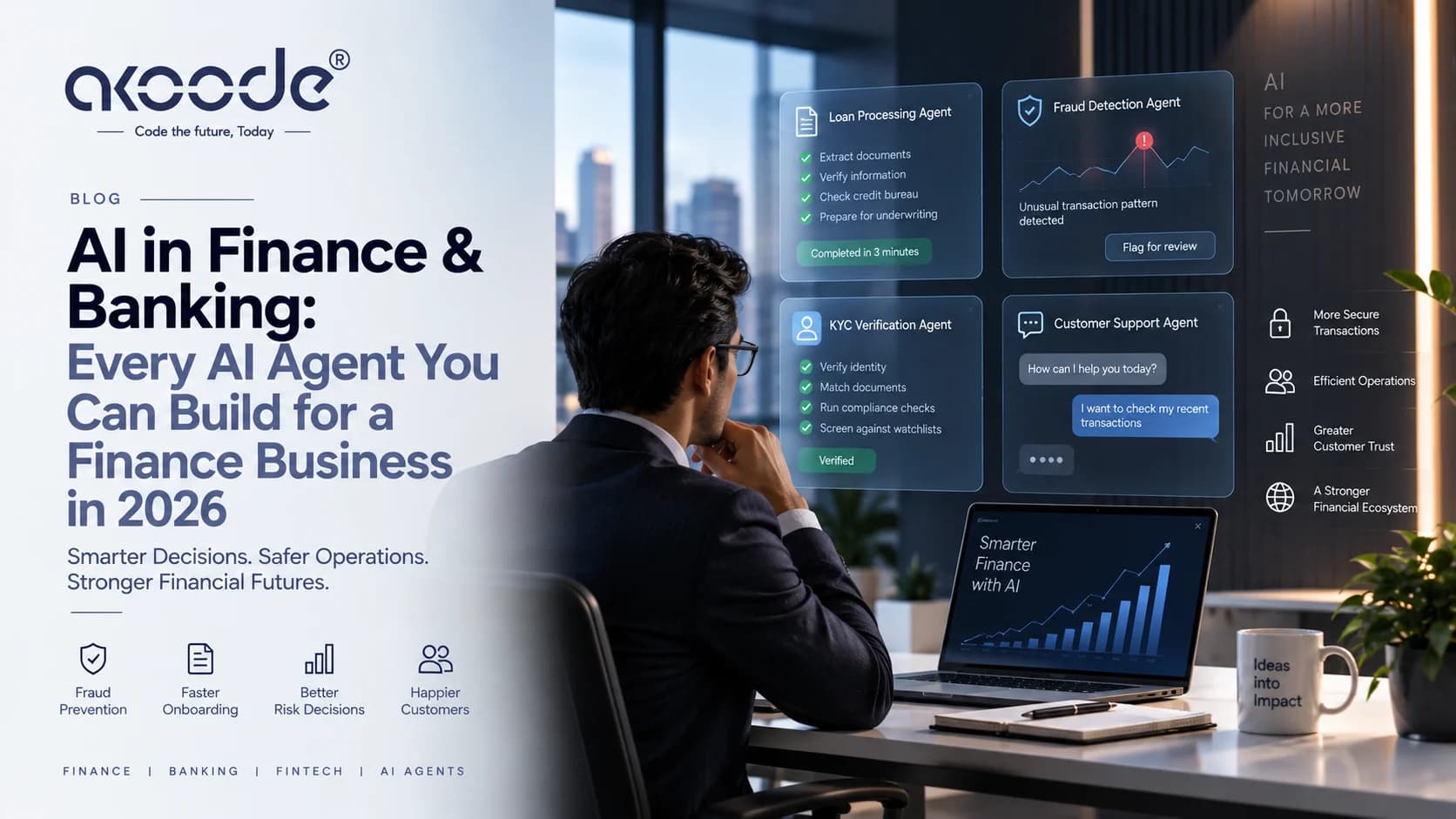
 September 15, 2026
A loan officer used to spend two days manually verifying income documents, cross-checking a credit bureau report, and calling a borrower back with questions before an application even reached underwriting. Today an AI agent extracts and verifies the same documents in minutes, flags the two inconsistencies that actually need a human look, and hands underwriting a clean, structured file instead of a stack of PDFs. The credit decision is still a human's call where it should be. The two days of document chasing mostly isn't anymore.
Finance and banking is one of the highest-stakes environments for AI to operate in — the cost of an error is measured in real money, real regulatory exposure, and real customer trust — which is exactly why the industry has been simultaneously cautious and, in 2026, moving faster than almost any other sector once it commits. This guide covers what AI in finance and banking actually means today, every category of AI agent a bank, NBFC, fintech, or financial services business can realistically build, how they're engineered to meet a regulator's bar, and what's different about building for Gurgaon/NCR, India, and global markets.
Why Finance Is Investing in AI Faster Than Its Cautious Reputation Suggests
Financial services has gone from AI as a competitive experiment to AI as operational baseline faster than most analysts expected. Roughly two-thirds of financial services institutions now report actively deploying AI, with capital markets firms leading adoption, and generative AI usage specifically has climbed from about half of firms in 2024 to well over 60% in 2025. Sector-wide AI spending is on track to reach roughly $75 billion in 2026, with banking alone accounting for over $50 billion of that and growing at around 30% annually.
The more specific "agentic AI" category — AI systems that complete multi-step financial tasks autonomously rather than just answering questions — is still early relative to the hype, but the trajectory is unmistakable. Agentic use cases made up close to a third of newly announced bank AI deployments in early 2026, up from roughly 15% just a quarter earlier, and finance-team adoption of agentic AI specifically is projected to grow several-fold within the year. At the same time, the industry's own data is honest about the gap between ambition and deployment: nearly every institution surveyed says it plans to put AI agents into production, but only a small fraction actually have, largely due to data quality, governance, and security hurdles rather than model capability.
India's finance and banking sector is scaling its own distinct AI story, anchored heavily by regulation rather than pure market pull. Digital payment volumes in India surpassed 180 billion transactions in the last fiscal year, driven overwhelmingly by UPI, and the Reserve Bank of India has pushed through one of its most significant regulatory overhauls in over a decade in 2026 — mandatory two-factor authentication for all digital payments, a new digital fraud compensation framework, and a hard compliance deadline for digital lending platforms. That regulatory tightening is, paradoxically, accelerating AI adoption rather than slowing it: automating KYC verification, fraud monitoring, and compliance reporting is becoming the only realistic way for fintechs and NBFCs to keep pace with the new rules without proportionally scaling compliance headcount.
What "AI in Finance" Actually Means
AI in finance and banking spans work with sharply different risk profiles, and that distinction should drive what gets built and how much autonomy it's given: customer-facing (support, onboarding, financial advice — where trust and clear disclosure matter as much as accuracy), risk and compliance (fraud detection, credit decisioning, regulatory reporting — where errors carry direct financial and legal consequences and audit trails are mandatory), and back-office operations (reconciliation, document processing, reporting — where AI has the fastest, lowest-risk adoption path because mistakes are cheap to catch and correct before they reach a customer or a regulator).
An AI agent, in this context, owns a defined task end-to-end with the right checkpoints built in for its risk tier — not a chatbot that answers a balance inquiry, but a system that verifies a document, flags a fraud pattern, or completes a compliance filing, with a clear, auditable trail of what it decided and why.
The Complete List: AI Agents You Can Build for a Finance or Banking Business
Customer-Facing Agents
Conversational banking and support agent. Handles account inquiries, transaction disputes, and general support across chat and voice, resolving the high-volume repetitive questions that otherwise consume the majority of a contact center's capacity, and escalating cleanly to a human for anything involving a financial decision or a distressed customer.
Customer onboarding and KYC agent. Automates identity verification, document collection, and know-your-customer checks during account opening, cutting onboarding time from days to minutes while maintaining the audit trail regulators require.
Personalized financial advisory (robo-advisory) agent. Provides investment recommendations and portfolio guidance based on a customer's goals and risk profile, a category that's scaled from roughly $1.4 trillion in assets under management a couple of years ago toward a multiple of that by the early 2030s as trust in algorithmically managed advice grows.
Financial wellness and budgeting agent. Analyzes spending patterns to give personalized budgeting guidance, savings nudges, and early warnings about account activity that could lead to an overdraft or missed payment.
Credit and Lending Agents
Loan origination and document processing agent. Extracts and verifies data from income proofs, bank statements, and identity documents automatically, feeding a clean, structured file into underwriting instead of a stack of PDFs a human has to read and re-key.
Credit risk assessment agent. Scores creditworthiness using a broader set of signals than a traditional bureau score alone, particularly valuable for underwriting borrowers with thin or no traditional credit history — a significant use case in a market like India where a large share of the addressable lending population isn't well served by conventional bureau data.
Loan servicing and collections agent. Manages payment reminders, restructuring conversations, and early-stage collections communication with a tone and cadence appropriate to a customer's situation, rather than a one-size-fits-all dunning sequence.
Regulatory compliance agent for digital lending. Tracks direct-disbursal requirements, Key Fact Statement disclosure timestamps, and cooling-off period logic against evolving regulator requirements — a genuinely urgent build category in India specifically, where the RBI's 2026 digital lending framework has already led to co-lending arrangements being suspended over non-compliance at more than one NBFC.
Risk, Fraud, and Compliance Agents
Real-time fraud detection agent. Monitors transaction patterns to flag likely fraud in real time rather than after the fact, a use case with immediate and measurable financial return given that generative AI-enabled fraud itself is projected to more than triple over the next few years, making faster detection an arms race rather than a one-time investment.
Anti-money laundering (AML) and transaction monitoring agent. Continuously screens transactions against AML rules and sanctions lists, reducing the false-positive rate that traditionally buries compliance teams in manual review queues while still catching genuine risk.
Regulatory reporting and compliance-filing agent. Automates the generation and submission of recurring regulatory filings, tracking changing requirements across jurisdictions so compliance teams aren't manually rebuilding reports every time a regulator updates a disclosure format.
Multi-factor authentication and transaction-risk agent. Dynamically assesses transaction risk to determine authentication requirements in real time — directly relevant in India following the RBI's 2026 mandate requiring at least one dynamic authentication factor for every digital payment transaction.
Trading, Investment, and Wealth Management Agents
Algorithmic trading and market-signal agent. Analyzes market data to identify trading signals and execute strategies within defined risk parameters — a category where major global institutions are already running hundreds of production AI use cases across trading desks.
Portfolio rebalancing agent. Continuously monitors portfolio allocation against target parameters and executes rebalancing trades automatically within a client's defined risk tolerance and tax constraints.
Research summarization and analyst-copilot agent. Synthesizes earnings reports, market research, and financial filings into structured briefs, cutting the hours an analyst spends reading source documents before actually forming a view.
Back-Office and Operations Agents
Reconciliation and financial-close agent. Automates the matching of transactions across ledgers and systems during month-end close, a process most finance teams still handle largely manually with spreadsheets and a lot of cross-checking.
Document and contract review agent. Extracts key terms, obligations, and risk clauses from loan agreements, insurance policies, and financial contracts, flagging anomalies for a human reviewer instead of requiring a full manual read-through of every document.
Expense and invoice processing agent. Automates invoice matching, approval routing, and payment processing, reducing the manual data entry that consumes a disproportionate share of back-office finance headcount.
Orchestration: When Multiple Agents Work the Same Financial Workflow
The financial institutions capturing the most value from AI aren't deploying isolated tools — they're connecting agents across a workflow: an onboarding agent verifies a new customer, a credit-risk agent scores the application, a compliance agent checks it against current regulatory requirements, and a servicing agent takes over post-approval, all referencing the same customer record with a full audit trail rather than five disconnected systems. This orchestrated approach is exactly what's behind the production scale some of the largest global institutions have already reached — hundreds of live AI use cases running across a single major bank's operations, coordinated rather than siloed.
How These Agents Are Actually Built
The underlying architecture is consistent across every agent type above, with the compliance posture changing sharply depending on which risk tier the agent sits in:
A large language model (GPT, Claude, or Gemini class, selected per use case) handles the language and reasoning layer — understanding a customer's support question, summarizing a research report, explaining a credit decision in plain language.
Specialized risk and scoring models — fraud-detection models, credit-scoring models trained on financial data — handle the tasks that require statistical rigor and explainability a general-purpose language model can't reliably provide on its own, particularly for credit decisions that carry fair-lending obligations.
Retrieval-augmented generation (RAG) grounds every response in a customer's actual account and transaction data plus current regulatory requirements, never letting an agent answer a compliance question from general knowledge when the actual current regulation should govern the answer.
Core banking, payment gateway, and credit bureau integrations connect the agent to the systems that actually hold financial data, since an agent that can't read from or write to the core banking platform isn't usable in a real financial workflow.
A compliance, audit-trail, and guardrail layer enforces exactly what an agent can act on autonomously (a routine KYC check, a standard fraud flag) versus what requires human sign-off (a credit decision above a threshold, an AML alert), and maintains the immutable audit trail that a regulator will eventually ask to see — this layer is the difference between a system a bank's risk committee approves for production and one that never leaves a sandbox.
This is also where finance and banking AI engineering diverges most sharply from most other industries. Anyone can wire a model to a FAQ page. Building an agent with the explainability, audit trail, and fair-lending-compliant logic a regulator will actually accept is the real engineering work — and it's the reason the gap between "99% of firms plan to deploy agents" and the much smaller share that actually have is as wide as it currently is.
Building AI Agents for Finance Businesses in Gurgaon and the NCR
Gurgaon and the wider NCR host a dense concentration of NBFCs, fintech companies, and digital lending platforms, and a few things are specific to building here:
RBI's 2026 digital lending compliance requirements — direct disbursal to borrower accounts, Key Fact Statement disclosure with viewing timestamps, mandatory cooling-off periods, and prominent APR display — need to be built into any lending or loan-servicing agent from day one, not retrofitted after a compliance audit flags a gap, particularly given that enforcement has already resulted in suspended co-lending arrangements at more than one NBFC in the past year.
Two-factor authentication with a dynamic component is now mandatory for every digital payment transaction processed in India, which any payment or transaction-risk agent needs to account for structurally, not as an optional feature.
DPDP Act compliance applies to any agent handling customer financial data, running on the same regulatory timeline affecting other data-sensitive industries in India.
NBFC and fintech density in Gurgaon means a meaningful share of the local opportunity is B2B infrastructure — lending, KYC, and compliance systems sold to other financial institutions — rather than direct-to-consumer banking apps, which changes both the integration requirements and the buyer conversation for anyone building here.
Building for the Indian Market Broadly
Beyond Gurgaon's NBFC and digital-lending concentration, three things matter for AI finance agents built for the wider Indian market: alternative credit-scoring models matter more here than in most developed markets, since a large share of India's addressable lending population has thin or no traditional bureau history; UPI-native payment and fraud-detection logic is essential given UPI's dominance in transaction volume; and the regulatory pace itself is a build consideration — RBI has issued multiple significant framework updates in the past two years alone, which means compliance logic needs to be built as a configurable, updatable layer rather than hardcoded once and assumed stable.
Building for a Global Market
For finance and banking businesses operating internationally, the same agent categories apply, but the regulatory and integration layer shifts substantially: SOC 2 and PCI-DSS compliance for payment and data handling, fair-lending regulations (like the Equal Credit Opportunity Act in the US) that place real constraints on how a credit-scoring agent can weight variables to avoid discriminatory outcomes, GDPR for European customer data, and integration with the core banking platforms and payment rails dominant in each target market. Institutions in the US and Europe are also further along the production-scale curve for agentic AI than most other global markets, which raises the competitive bar for what "good" looks like in a vendor evaluation.
What to Actually Prioritize First
Not every finance or banking business needs the full stack above on day one. A practical build sequence for most banks, NBFCs, and fintechs:
Customer support and conversational banking agent — because it deploys fast, reduces contact-center load immediately, and carries low regulatory risk since it isn't making financial decisions.
Document processing for onboarding or loan origination — because it directly cuts processing time and is easy to review before full autonomy is granted.
Fraud detection and transaction monitoring — because the ROI is immediate and measurable, and the cost of not moving fast on this specific category is actively rising.
Regulatory compliance and reporting automation — because it removes a genuine, recurring operational bottleneck with clear audit-trail requirements that are easier to build in early than retrofit.
Credit risk and algorithmic decisioning agents — the highest-value but highest-regulatory-bar category, best approached once an institution has real production experience with the lower-risk agents above and the fair-lending compliance groundwork in place.
Proof This Works
Akoode's engineering discipline for finance-adjacent systems shows up across projects that share the same underlying requirements a banking or lending platform demands: rigorous data handling, precise transactional logic, and systems that have to be right the first time because money is moving through them. That's the same bar a credit-decisioning agent or a payment-risk agent has to clear — not a demo that looks good, but a system engineered for the audit trail and precision a financial institution's risk committee will actually scrutinize.
Choosing a Partner to Build This
A few questions separate a real finance and banking AI engineering partner from a generic AI vendor applying a fintech label:
Can they explain how their credit or fraud-scoring agent maintains an audit trail a regulator would actually accept, not just "we log everything"?
Do they understand RBI's current digital lending framework specifically, or India's regulatory requirements generically?
Can they show a system that integrates with a real core banking platform or payment gateway, not just a demo against sample transaction data?
Do they have a clear answer for how their agent handles fair-lending or anti-discrimination constraints in credit decisioning?
Have they built for the specific risk tier your use case sits in — customer-facing, risk/compliance, or back-office — since the engineering bar is very different across those three?
Where to Start
AI in finance has moved past the pilot phase for the institutions serious about it, and the gap between those institutions and everyone else is widening fast. The businesses pulling ahead in 2026 — in Gurgaon's NBFC and fintech corridor, across India's rapidly regulating digital lending market, and globally — are the ones building compliant, auditable agent systems across onboarding, fraud, and credit decisioning, not disconnected pilots stuck waiting for a risk committee's sign-off.
Akoode has delivered AI-powered platforms for clients across India, the UK, and the USA, with a 4.9 Google rating from 110+ reviews and a 97% client retention rate. If you're scoping an AI agent — or a full agent portfolio — for a bank, NBFC, fintech, or financial services business, book time with Akhil Verma, Founder & CEO of Akoode, and bring a short brief on what you're building. The first call is where we map which agents matter most for your organization and your compliance obligations, not a generic list.
If you're evaluating AI agents across more than one industry, see our companion guides on AI agents for real estate, AI agents for travel and hospitality, AI agents for retail and e-commerce, and AI agents for healthcare.
Frequently Asked Questions
What AI agents can a finance or banking business build? Finance and banking businesses can build conversational banking agents, KYC and onboarding agents, credit risk assessment agents, fraud detection agents, AML and transaction monitoring agents, regulatory compliance agents, robo-advisory agents, and reconciliation and back-office agents, each owning a distinct part of a financial workflow.
Is AI in finance regulated differently from other industries? Yes. Credit-scoring and lending agents must comply with fair-lending regulations that constrain how variables can be weighted, fraud and AML agents must meet regulatory audit-trail requirements, and any agent handling customer financial data must comply with frameworks like GDPR, DPDP, and sector-specific rules like RBI's digital lending directions in India.
Will AI replace bank employees or financial advisors? Current evidence points toward augmentation rather than replacement in most roles. AI is absorbing document processing, fraud monitoring, and routine customer support, while credit decisions above defined thresholds, complex advisory relationships, and regulatory sign-off remain human-led.
What makes AI agent development different for Gurgaon and NCR finance businesses? Gurgaon and the NCR host a dense NBFC and fintech ecosystem, which means agents built here need RBI's 2026 digital lending compliance built in from day one (direct disbursal, Key Fact Statement disclosure, cooling-off periods), mandatory dynamic two-factor authentication for payments, and DPDP Act-compliant data handling.
Which AI agent should a finance business build first? Most banks, NBFCs, and fintechs see the fastest, lowest-risk return from a customer support or document-processing agent, since these don't make financial decisions directly, followed by fraud detection, where the ROI is immediate and the cost of delay is actively rising.
Get In Touch Now
View More Our Blog