


 September 19, 2026
A network engineer used to get paged at 2 a.m. because a cell site's performance dipped, spend an hour cross-referencing logs to find the cause, and dispatch a truck roll the next morning to fix a problem that had probably already resolved itself. Today an AI agent has already detected the anomaly, identified the likely root cause, and either fixed it automatically or scheduled the field visit before the engineer's phone even rings. The engineer still makes the call on anything genuinely unusual. The 2 a.m. page for a problem the network could have diagnosed itself mostly isn't happening anymore.
Telecommunications runs some of the most complex, highest-volume infrastructure of any industry — networks carrying billions of connections, generating a continuous stream of performance data no human team could review manually — which makes it one of the clearest cases for AI adoption anywhere. It's also an industry where customer patience is thin: a single bad network moment makes a customer up to five times more likely to churn, which turns network-quality AI directly into a revenue metric, not just an operational one. This guide covers what AI in telecommunications actually means in 2026, every category of AI agent a telecom operator, tower company, ISP, or telecom-tech business can realistically build, how they're engineered, and what's different about building for Gurgaon/NCR, India, and global markets.
Why Telecom Is Racing Toward Autonomous Networks
Market sizing for AI in telecom varies by scope, as it does across most fast-moving categories, but the direction is unusually consistent: most credible estimates put the global 2026 market in the $6-9 billion range, growing at a striking 40%+ CAGR toward $27 billion or more by 2030 as 5G deployment complexity, edge computing, and the eventual 6G transition make AI-driven network automation less of an optimization and more of an operational necessity. The specific ROI numbers already being reported by operators running mature AI deployments are concrete: 15-30% opex reductions on network operations, 10-25% churn reductions, and customer-service cost reductions exceeding 40% where automated support has scaled properly. AI-powered fault detection and resolution systems are already identifying and fixing network faults up to 50% faster than human-only processes, and AI-driven RAN energy optimization is delivering roughly 30% energy savings in live deployments — a meaningful number given how much of a telecom operator's opex sits in network energy costs.
Churn prediction specifically has become one of the most commercially significant AI use cases in the industry, and the mechanism is straightforward: models that identify at-risk customers 30-60 days before they're likely to leave, triggering individualized retention offers, are delivering churn-rate reductions in the 15-25% range — directly protecting the recurring revenue telecom business models depend on. Major equipment vendors have embedded AI throughout their network stacks as standard rather than premium functionality: Ericsson launched an Explainable AI system in 2024 that identifies network-issue root causes and suggests corrective actions, and in March 2026 Ericsson signed an agreement with SK Telecom specifically to advance AI-RAN and network innovation from 5G toward 6G, signaling how central AI has become to the industry's next-generation network roadmap.
India's telecom sector is scaling on its own enormous trajectory — the country's wireless subscriber base crossed 1.29 billion in mid-2026, with 5G fixed wireless access subscribers alone surpassing 12.7 million and growing fast. Both of India's largest private operators are treating AI as core infrastructure rather than an add-on: Bharti Airtel rolled out India's first 5G network-slicing service for postpaid users in 2026, and Airtel's AI-powered "Airtel Thanks" chatbot has meaningfully improved customer engagement and cut service-resolution time, while Reliance Jio and Airtel both use AI for self-optimizing networks specifically to reduce call drops and improve data speeds at nationwide scale. Google's $15 billion, five-year commitment to build an AI infrastructure hub in partnership with Airtel and AdaniConnex is a further signal of how tightly AI infrastructure investment and telecom capacity expansion are now linked in the Indian market. Gurgaon specifically sits at the center of India's telecom-technology ecosystem in a very concrete way: Nokia's India headquarters is based in Gurgaon, and Indus Towers — the world's largest telecom tower company, with over 267,000 towers nationwide — is also headquartered in Gurugram, making the city a genuine hub for both telecom equipment innovation and passive infrastructure management.
What "AI in Telecommunications" Actually Means
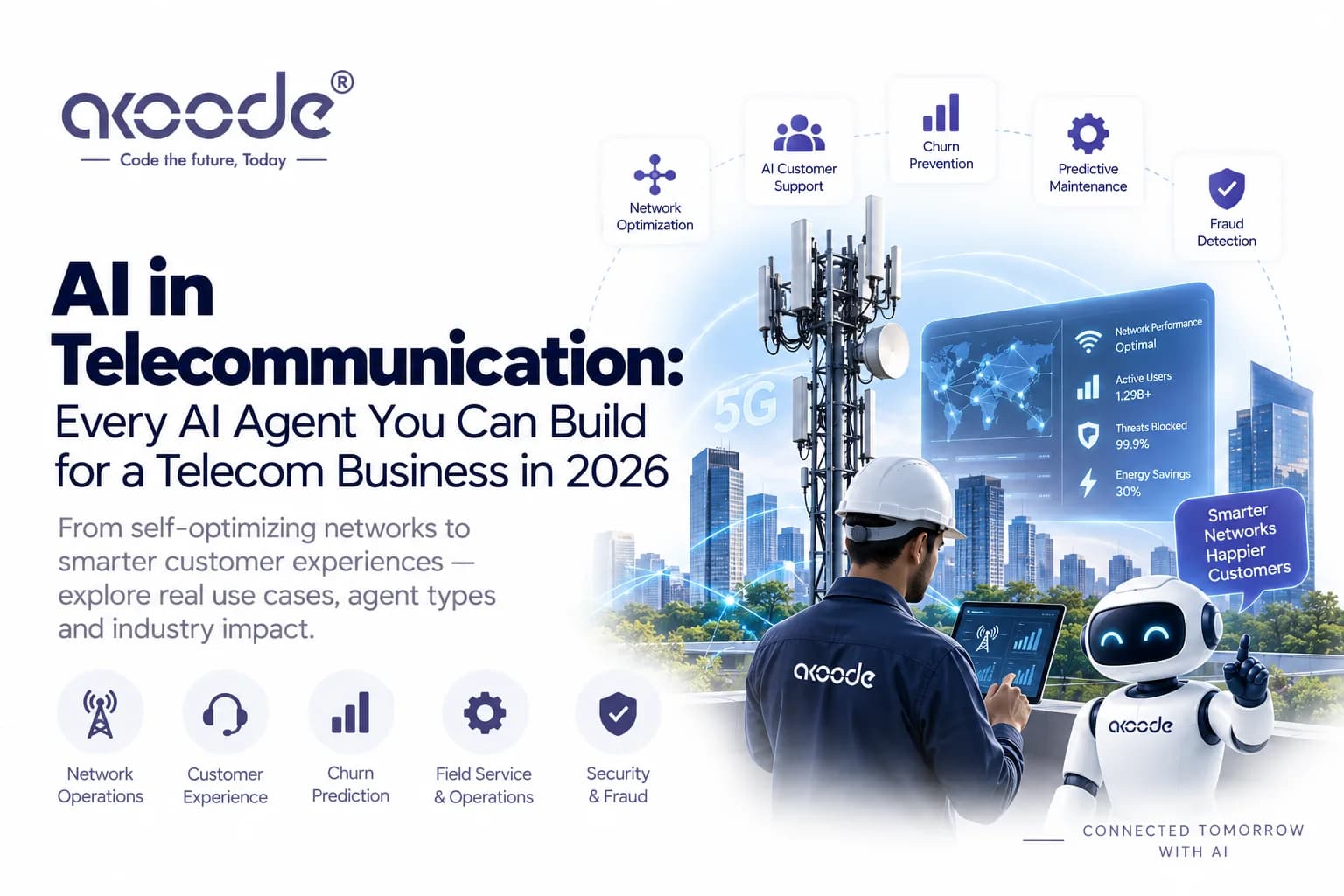
AI in telecom spans four connected operational domains, and each carries a different technical and business priority: network operations (optimization, fault detection, capacity planning — where AI's impact on cost and reliability is most direct), customer experience (support, churn prediction, personalization — where AI's revenue impact is most direct), security and fraud (threat detection, SIM fraud, spam filtering — where the cost of inaction compounds quickly at telecom's transaction volume), and field operations and infrastructure (predictive maintenance, tower monitoring, workforce dispatch — where AI turns reactive maintenance into proactive management).
An AI agent, in this context, owns a defined task end-to-end within one of these domains — not a dashboard showing a network anomaly, but a system that identifies the root cause and either resolves it automatically or dispatches the right technician with the right context already assembled; not a churn-risk score sitting in a spreadsheet, but an agent that triggers the retention offer at the moment it matters.
The Complete List: AI Agents You Can Build for a Telecommunications Business
Network Operations and Optimization Agents
Self-optimizing network (SON) agent. Continuously tunes network parameters — antenna tilt, power levels, handover thresholds — in real time based on live traffic and performance data, replacing periodic manual network tuning with continuous, automated optimization.
AI-driven fault detection and root-cause agent. Identifies network anomalies and diagnoses the likely root cause automatically, cutting fault detection and resolution time by up to half compared to manual troubleshooting, and explaining its reasoning in a way network engineers can actually verify and trust rather than treating the recommendation as a black box.
Predictive network maintenance agent. Analyzes equipment telemetry to predict hardware failures before they cause an outage, cutting fiber-optic fault detection time from hours to minutes in documented deployments and converting reactive maintenance into scheduled, proactive intervention.
5G network slicing management agent. Dynamically allocates and manages network slices for different service tiers and enterprise customers, an increasingly critical capability as operators like Airtel roll out network slicing commercially for postpaid and enterprise customers with distinct quality-of-service requirements.
RAN energy optimization agent. Continuously adjusts radio access network power consumption based on real-time traffic load, delivering roughly 30% energy savings in live deployments — a direct, measurable opex reduction given how much of a telecom operator's cost base sits in network energy consumption.
Capacity planning and spectrum management agent. Forecasts network capacity needs and optimizes spectrum allocation based on traffic patterns and growth projections, replacing periodic manual capacity-planning cycles with continuous, data-driven forecasting.
Customer Experience and Retention Agents
Conversational customer service agent. Handles billing questions, plan changes, and technical support across chat and voice in multiple languages, the same category of AI behind large-scale deployments like Airtel's AI chatbot, which has measurably cut service-resolution time and improved customer engagement at national scale.
Churn prediction and retention agent. Identifies customers likely to leave 30-60 days in advance based on usage patterns, network-experience signals, and support interactions, then triggers individualized retention offers — the mechanism behind the 15-25% churn reductions operators are reporting from mature deployments.
Personalized plan and offer-recommendation agent. Recommends tariff plans, add-ons, and upgrades based on actual usage behavior rather than generic upsell campaigns, improving both conversion and customer satisfaction by matching the offer to genuine need.
Billing and revenue-assurance agent. Automatically detects billing anomalies, usage discrepancies, and revenue leakage across a large subscriber base, a category with direct and measurable financial return given the transaction volume telecom billing systems process.
Multilingual and regional-language support agent. Provides customer service in regional languages, essential for telecom operators serving linguistically diverse subscriber bases at the scale India's market operates at.
Security and Fraud Detection Agents
Network security and threat-detection agent. Monitors network traffic for anomalous patterns indicating a cybersecurity intrusion, with AI-powered security operations centers now handling a large majority of security alerts autonomously and escalating only genuinely ambiguous threats to a human analyst.
SIM fraud and account-takeover detection agent. Identifies fraudulent SIM swaps, account takeovers, and identity-fraud patterns in real time, a critical category given how often SIM-swap fraud serves as the entry point for broader financial fraud against a victim's other accounts.
International roaming fraud detection agent. Flags anomalous roaming usage patterns associated with fraud, a category where AI-driven detection is projected to cut roaming fraud losses substantially industry-wide as models improve at distinguishing genuine travel patterns from fraudulent usage.
Spam and robocall detection agent. Identifies and filters spam calls, robocalls, and SMS fraud at the network level before they reach a subscriber, a customer-experience and trust issue that compounds directly into complaint volume and regulatory scrutiny if left unaddressed.
Field Operations and Infrastructure Agents
Tower and infrastructure health-monitoring agent. Continuously monitors passive infrastructure — towers, power systems, environmental conditions — for signs of degradation or failure, a category with particular relevance for tower companies managing hundreds of thousands of physical sites across diverse and often remote terrain.
Field workforce dispatch and optimization agent. Optimizes technician scheduling and routing based on predicted maintenance needs and real-time issue reports, reducing unnecessary truck rolls by resolving what can be resolved remotely and dispatching efficiently when a physical visit is genuinely needed.
Predictive equipment-failure agent for network hardware. Forecasts equipment failure across base stations, routers, and network hardware using telemetry and historical failure data, feeding directly into the workforce-dispatch agent so maintenance visits are scheduled before a failure causes an outage rather than after.
Enterprise, IoT, and Emerging Agents
IoT and M2M device-management agent. Monitors and manages the large and growing base of connected IoT and machine-to-machine devices on a network, a category scaling quickly as 5G and edge computing expand what's practical to connect.
Network digital-twin and simulation agent. Maintains a live virtual model of network infrastructure, letting operators test configuration changes, capacity scenarios, and new service rollouts in simulation before committing to changes on the live network.
AI-RAN and 6G research agent. Supports the ongoing research and standards work moving the industry from AI-assisted 5G toward AI-native 6G network architecture, an area where major vendors are actively investing in joint innovation labs and cross-industry partnerships.
Orchestration: When Multiple Agents Run the Same Network and Customer Base
The telecom operators capturing the most value from AI aren't deploying isolated point tools — they're connecting agents across operations and customer experience simultaneously: a fault-detection agent identifies a degrading cell site, a predictive-maintenance agent schedules the fix before it causes an outage, a churn-prediction agent flags which customers in that coverage area are now at elevated churn risk because of the degraded experience, and a retention agent proactively reaches out — all working off the same network and customer data rather than the network team and the customer-experience team operating from entirely separate systems that never talk to each other. This connected approach is exactly what turns the well-documented link between network quality and churn into something an operator can actually act on in real time rather than discover after the fact in a quarterly report.
How These Agents Are Actually Built
The underlying architecture is consistent across every agent type above, with the data sources and models swapped per use case:
A large language model (GPT, Claude, or Gemini class, selected per use case) handles the language and reasoning layer — powering conversational customer service, explaining a network fault's root cause, summarizing a security alert for a human analyst.
Specialized network and time-series models — anomaly-detection models for network faults, predictive models for equipment failure and churn — handle the tasks that require statistical rigor a general-purpose language model isn't built to provide on its own, particularly for real-time network telemetry at telecom scale.
Retrieval-augmented generation (RAG) grounds customer-service and billing agents in a subscriber's actual account, plan, and usage data, never letting an agent answer a billing question from generic policy knowledge when the specific account details should govern the answer.
OSS/BSS and network-management-system integrations connect the agent to the systems that actually hold operational and business data — operations support systems for network telemetry, business support systems for billing and customer data — since an agent that can't read from or write to these core systems isn't usable in a real telecom workflow.
A guardrail and escalation layer defines exactly what an agent can act on autonomously (a routine network parameter adjustment, a standard retention offer) versus what needs human sign-off (a major network configuration change, an unusual security escalation) — the difference between a system trusted to run live network operations and one that creates a costly outage or customer-trust failure the first time it acts outside its actual competence.
This is where telecom AI engineering diverges from most other industries in one specific way: the sheer data volume and real-time performance requirements at network scale mean an agent's inference speed and reliability under load matter as much as its accuracy — a fault-detection agent that's brilliant but too slow to act before an outage cascades isn't actually solving the problem it was built for.
Building AI Agents for Telecom Businesses in Gurgaon and the NCR
Gurgaon sits at the center of India's telecom-technology ecosystem in a genuinely concrete way, not just as a general tech hub:
Nokia's India headquarters is based in Gurgaon, anchoring the city as a center for 5G and IoT technology development and innovation, which makes network-equipment-adjacent AI work — RAN optimization, network slicing, fault detection — a natural local specialization.
Indus Towers, the world's largest telecom tower company with over 267,000 towers nationwide, is headquartered in Gurugram, making tower and passive-infrastructure health-monitoring AI a distinctively strong local build category that most other Indian tech hubs don't share to the same degree.
Enterprise telecom and B2B connectivity services have a strong presence in the NCR corridor given its concentration of large enterprise headquarters, making enterprise-facing network-slicing and IoT device-management agents a genuine local opportunity alongside consumer-facing telecom AI.
Multilingual customer service matters for any NCR-based telecom AI platform serving India's linguistically diverse subscriber base, following the same regional-language pattern that's driven adoption of AI chatbots at national telecom operators.
Building for the Indian Market Broadly
Beyond Gurgaon's telecom-equipment and tower-infrastructure concentration, three things matter for AI telecom agents built for the wider Indian market: scale is a defining constraint and opportunity simultaneously, since India's telecom operators manage subscriber bases in the hundreds of millions, meaning any AI agent needs to be architected for that volume from the start rather than scaled up from a pilot designed for a much smaller market; TRAI's regulatory framework and DPDP Act data-protection requirements apply directly to how customer and network data can be used in AI systems, particularly for churn-prediction and personalization agents that process subscriber behavioral data; and rural and semi-urban network expansion, an active national priority as 5G fixed wireless access reaches into areas previously underserved by fixed broadband, creates a growing need for network-planning and capacity-forecasting agents tuned to expansion economics rather than mature-market optimization alone.
Building for a Global Market
For telecom businesses operating internationally, the same agent categories apply, but the regulatory and competitive landscape shifts: GDPR governs how European operators can use customer data in personalization and churn-prediction models, established telecom operators like AT&T, Verizon, and Deutsche Telekom are investing heavily in AI partnerships — Deutsche Telekom entered a long-term AI partnership with OpenAI in late 2025 specifically to bring advanced AI capabilities to millions of customers and businesses across Europe — and network-equipment vendor partnerships (Ericsson, Nokia, Huawei) increasingly embed AI throughout their management stacks as standard rather than a separately purchased add-on, which changes the build-versus-buy calculus for operators evaluating custom AI development against vendor-native capabilities already available in their existing network infrastructure.
What to Actually Prioritize First
Not every telecom business needs the full stack above on day one. A practical build sequence for most operators, tower companies, and telecom-tech businesses:
Conversational customer service and churn prediction — because the ROI is immediate and directly tied to the well-documented link between customer experience and retention.
AI-driven fault detection and predictive maintenance — because it delivers a fast, measurable reduction in resolution time and unplanned outages.
Billing and revenue-assurance automation — because it addresses direct financial leakage with a clear, quantifiable return.
Network security and fraud detection — because the cost of inaction compounds quickly at telecom's transaction and subscriber volume.
Network slicing, RAN optimization, and capacity planning — the highest-value but most technically complex category, appropriate once an operator has real production experience with the lower-complexity agents above.
Proof This Works
Akoode hasn't yet published a telecom-specific case study, and it's more useful to say that plainly than to stretch an unrelated project to fit. What does carry over directly is the engineering discipline telecom AI depends on most: real-time data processing at scale and conversational AI systems that need to work reliably under genuine production load — the same underlying capabilities demonstrated across Akoode's broader AI and software development work. If telecom AI is what you're evaluating a partner for, the questions below will tell you more than a case study from an unrelated industry would about whether a team actually understands the scale and reliability bar this industry runs at.
Choosing a Partner to Build This
A few questions separate a real telecom AI engineering partner from a generic AI vendor applying a telecom label:
Can they explain how their agent handles telecom-scale data volume and real-time performance requirements, not just a demo running against a small sample dataset?
Have they integrated with real OSS/BSS systems, not just built a proof-of-concept against sample network telemetry?
Do they understand the difference between network-operations AI, which requires real-time reliability at scale, and customer-experience AI, which has a different but equally real accuracy and trust bar?
Can they show a working conversational or fraud-detection system handling genuine production volume, not a scripted demo?
Do they have a clear answer for how their agent complies with TRAI regulations and DPDP Act data-protection requirements, if you're operating in the Indian market?
Where to Start
AI in telecommunications is moving toward genuinely autonomous networks — systems that detect, diagnose, and resolve issues before a human ever needs to intervene, and customer-experience systems that act on churn risk before a customer has decided to leave. The telecom businesses pulling ahead in 2026 — in Gurgaon's telecom-equipment and tower-infrastructure corridor, across India's massive and rapidly expanding network, and globally — are the ones connecting network operations and customer experience into one system, not treating them as separate problems solved by separate teams.
Akoode has delivered AI-powered and real-time data platforms for clients across India, the UK, and the USA, with a 4.9 Google rating from 110+ reviews and a 97% client retention rate. If you're scoping an AI agent — or a full agent portfolio — for a telecom operator, tower company, ISP, or telecom-tech business, book time with Akhil Verma, Founder & CEO of Akoode, and bring a short brief on what you're building. The first call is where we map which agents matter most for your network and your customers, not a generic list.
If you're evaluating AI agents across more than one industry, see our companion guides on AI agents for real estate, AI agents for travel and hospitality, AI agents for retail and e-commerce, AI agents for healthcare, AI agents for finance and banking, AI agents for logistics and supply chain, AI agents for manufacturing, AI agents for insurance, AI agents for media and entertainment, AI agents for automotive, and AI agents for agriculture.
Frequently Asked Questions
What AI agents can a telecom business build? Telecom businesses can build self-optimizing network agents, AI-driven fault detection agents, predictive maintenance agents, conversational customer service agents, churn prediction agents, network security and fraud detection agents, and tower infrastructure health-monitoring agents, each owning a distinct part of network operations or customer experience.
How much can AI actually reduce telecom operating costs? Operators running mature AI deployments report opex reductions of 15-30% on network operations, customer-service cost reductions exceeding 40%, and RAN energy savings of roughly 30% in live deployments, alongside churn reductions of 10-25% from AI-driven retention programs.
What is the connection between network quality and customer churn? Research shows customers are up to five times more likely to churn after a poor network experience, which makes network-quality AI a direct revenue-protection tool rather than purely an operational efficiency measure.
What makes AI agent development different for Gurgaon and NCR telecom businesses? Gurgaon hosts Nokia's India headquarters and Indus Towers, the world's largest telecom tower company, making network-equipment-adjacent AI and tower infrastructure health-monitoring particularly strong local build categories.
Will AI replace network engineers and customer service representatives? Current evidence points toward augmentation rather than replacement. AI is absorbing routine fault diagnosis, repetitive customer queries, and predictable maintenance scheduling, while engineers and representatives increasingly focus on genuinely unusual issues and complex customer situations AI escalates to them.
How is 5G changing the role of AI in telecom networks? 5G's increased complexity — network slicing, massive MIMO, ultra-low latency requirements — makes AI-driven automation less of an optimization and more of an operational necessity, since the scale and complexity of managing 5G networks manually isn't practical at the density and performance levels 5G is designed to deliver.
Which AI agent should a telecom business build first? Most telecom operators see the fastest return from conversational customer service combined with churn prediction, since the ROI is immediate and directly tied to retention, followed by AI-driven fault detection and predictive network maintenance.
Get In Touch Now
View More Our Blog