


 September 19, 2026
A car buyer used to walk into a dealership, get handed a brochure, wait for a salesperson to run the numbers, and come back three days later for a trade-in appraisal. Today the same buyer configures their car online, gets an instant AI-generated trade-in value from a photo of their current vehicle, and drives home the same afternoon in a car whose onboard assistant already knows their preferred seat position, music, and drive mode from the test drive. The finance and delivery paperwork is still someone's job. The three-day wait mostly isn't anymore.
Automotive is going through the same transition the smartphone industry went through fifteen years ago: value is shifting from hardware to software, and AI sits at the center of that shift, from the perception stack that lets a car see the road to the sales and service systems that run the dealership behind it. This guide covers what AI in automotive actually means in 2026, every category of AI agent an OEM, dealer network, mobility platform, or automotive techcompany can realistically build, how they're engineered, and what's different about building for Gurgaon/NCR, India, and global markets. If you're looking specifically for AI in vehicle manufacturing and plant operations, see our companion guide on AI agents for manufacturing — this piece focuses on the OEM software, dealer, and mobility side of the business.
Why Automotive Is Betting Heavily on AI, and Why the Numbers Vary So Widely
Automotive AI market sizing is genuinely inconsistent across analyst firms — estimates for the 2026 global market alone range from roughly $6 billion to over $20 billion depending on what's counted, which says more about definitional scope than about uncertainty in the underlying trend. What's consistent across every major estimate is the direction and speed: strong double-digit to high-20s percent CAGR through the early 2030s, driven by ADAS adoption, software-defined vehicle architectures, and the shift toward centralized AI compute that can run cockpit, driver-assistance, and automated-driving workloads on shared hardware. The qualitative signals back this up unambiguously: 85% of automotive companies plan to increase AI investment over the next three years, 75% of automotive C-suite executives now rank AI among their top three strategic priorities, and industry analysts estimate more than $200 billion in annual value could be generated for automotive OEMs through AI by 2030.
The specific application areas seeing the fastest growth tell the real story: ADAS and driver-monitoring systems dominate current deployment volume because they scale faster and cheaper than full autonomy, while the autonomous vehicle market itself — heavily AI-dependent — is projected to reach roughly $67 billion by 2027. In January 2026, NVIDIA released an open-source family of AI models and simulation datasets specifically aimed at accelerating Level 4 autonomous development, a signal of how quickly the underlying model and tooling layer is maturing even as full autonomy adoption itself remains gradual.
India's automotive AI market is scaling on its own substantial trajectory, projected to grow from roughly $37 billion in 2024 to nearly $57 billion by 2030, and automotive already leads AI adoption among Indian manufacturing verticals at around 26% in 2026, ahead of most other industrial sectors. India's largest OEMs are moving well beyond pilot projects: Maruti Suzuki has stated a plan to use AI, machine learning, and advanced simulation to cut its vehicle development cycle from 48 months to roughly 36 months, using AI-driven virtual testing and validation to reduce dependence on slow, expensive physical prototyping. Gurgaon specifically sits at the center of this shift in a very concrete way — Maruti Suzuki's flagship Gurgaon plant is one of India's largest passenger-vehicle production facilities, and Cars24, one of India's largest organized used-car marketplaces, is headquartered in Gurgaon, making the city a genuine hub for both automotive manufacturing scale and automotive-tech innovation simultaneously.
What "AI in Automotive" Actually Means
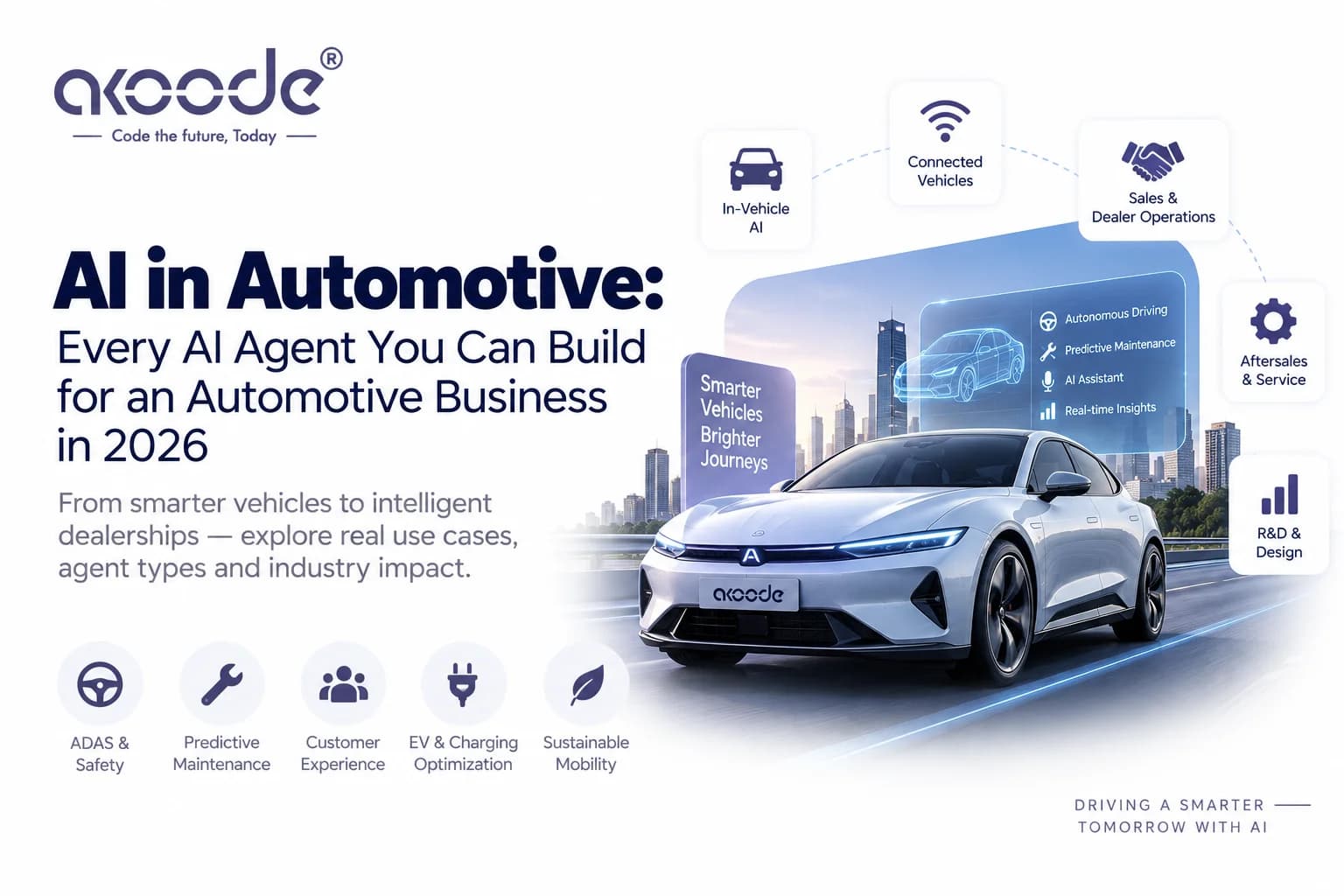
AI in automotive spans work happening in five distinct places across the vehicle and business lifecycle, and each carries a different technical and safety bar: in-vehicle (ADAS, driver monitoring, in-car assistants — where functional safety standards apply directly), connected vehicle and telematics (predictive vehicle health, over-the-air updates, usage data — where cybersecurity is as critical as functionality), sales and dealer operations (lead qualification, configuration, trade-in valuation — the fastest, lowest-risk adoption path), aftersales and service (predictive service scheduling, warranty, parts forecasting — where operational efficiency compounds directly into customer retention), and R&D and design (simulation, generative design, digital twins — where AI is compressing development cycles that used to take years).
An AI agent, in this context, owns a defined task end-to-end at the appropriate safety and risk tier for its function — not a dashboard showing a battery-health trend, but a system that schedules the service appointment automatically; not a chatbot that answers a spec question, but an agent that qualifies a lead, configures a vehicle, and hands a sales-ready buyer to a human closer.
The Complete List: AI Agents You Can Build for an Automotive Business
In-Vehicle and Driver Experience Agents
Conversational in-car assistant agent. Handles voice-driven navigation, climate control, media, and vehicle-function requests naturally, going beyond fixed voice-command grammars toward genuinely conversational interaction — one of the fastest-growing segments of in-vehicle AI as software-defined vehicle platforms make richer voice interfaces feasible across a whole model lineup rather than a single flagship trim.
Driver monitoring and safety agent. Uses in-cabin cameras and sensors to detect drowsiness, distraction, or impairment in real time, a category directly tied to ADAS safety mandates and increasingly a regulatory requirement rather than a premium feature in several major markets.
ADAS perception and decision-support agent. Processes camera, radar, and lidar data to power lane-keeping, adaptive cruise control, and automatic emergency braking — the highest-volume, most mature application of AI in the vehicle itself, and the segment achieving faster market penetration than full autonomy specifically because it scales at lower cost and complexity.
Personalized navigation and route-planning agent. Learns driver habits and preferences to suggest routes, stops, and timing, going beyond generic traffic-optimized routing toward genuinely personalized trip planning.
Connected Vehicle and Telematics Agents
Predictive vehicle-health and telematics agent. Continuously monitors onboard sensor and diagnostic data to predict component issues before they cause a breakdown, feeding directly into a service-scheduling agent so the vehicle owner gets a proactive appointment offer instead of a warning light and a guess.
EV battery health and degradation-prediction agent. Models battery state of health and remaining useful life based on real usage patterns, charging behavior, and thermal history — a category with outsized importance as EV adoption scales and battery longevity becomes a primary purchase and resale-value consideration.
EV charging optimization and range-prediction agent. Recommends optimal charging times and locations based on route, battery state, and electricity pricing, and predicts real-world range accounting for driving style, terrain, and climate rather than a fixed manufacturer estimate that rarely matches actual conditions.
Over-the-air (OTA) update management agent. Manages the rollout, sequencing, and rollback logic for software updates across a connected vehicle fleet, a genuinely complex orchestration problem as software-defined vehicles ship an increasing share of their functionality as updatable code rather than fixed hardware.
Connected-vehicle cybersecurity and intrusion-detection agent. Monitors vehicle network traffic for anomalous patterns that could indicate a cybersecurity intrusion, a non-negotiable requirement as vehicles become more connected and expose a larger attack surface than earlier, largely isolated vehicle electronics architectures.
Sales and Dealer Operations Agents
Conversational lead qualification and sales agent. Engages website and showroom inquiries instantly, answers configuration and financing questions, and qualifies genuine purchase intent before handing off to a human salesperson — directly addressing the same speed-to-lead problem that determines conversion in most high-consideration purchases.
Digital configurator and recommendation agent. Helps a buyer configure a vehicle and compares trims and options against their actual stated needs and budget, replacing a static configurator tool with something that actively guides rather than just displays options.
AI-powered trade-in and used-vehicle valuation agent. Generates an instant, defensible trade-in or resale valuation from vehicle details and condition photos, the exact capability that's made organized used-car marketplaces a major disruption force in markets like India, where instant, transparent valuation was historically the hardest part of a used-car transaction to trust.
Finance and insurance (F&I) qualification agent. Pre-qualifies a buyer for financing and relevant insurance products conversationally, shortening the gap between "interested" and "loan-ready" that otherwise costs a dealership momentum on a hot lead.
Aftersales and Service Agents
Predictive service scheduling agent. Converts the telematics agent's health predictions into a proactive service appointment offer, timed to the vehicle's actual condition rather than a fixed mileage or calendar interval.
Technician diagnostic-copilot agent. Assists service technicians by cross-referencing symptom data, vehicle history, and technical service bulletins to suggest likely root causes, reducing diagnostic time on complex or intermittent issues that would otherwise require extensive manual troubleshooting.
Warranty claims processing agent. Automates warranty claim intake, validation against coverage terms, and documentation, reducing the manual review overhead that both OEMs and dealer networks carry on high claim volumes.
Dealer parts inventory and demand-forecasting agent. Predicts parts demand across a dealer network based on the vehicle parc, service history, and seasonal patterns, reducing both stockouts that delay repairs and excess inventory tying up dealer working capital.
Mobility and Marketplace Agents
Used-vehicle marketplace pricing and listing agent. Prices used-vehicle inventory dynamically based on condition, market demand, and comparable sales — the core AI capability behind the organized used-car marketplace model that's scaled rapidly in markets like India.
Ride-hailing and mobility-matching agent. Optimizes driver-rider matching, dynamic pricing, and fleet allocation for mobility platforms, a distinct problem from the freight and logistics fleet management covered in our companion guide on AI agents for logistics and supply chain.
Usage-based insurance telematics agent. Analyzes real driving behavior data to support usage-based insurance pricing models, a category that increasingly sits at the intersection of automotive and insurance AI — see our companion guide on AI agents for finance and banking for the underwriting side of this same data.
R&D, Design, and Compliance Agents
Generative vehicle design and simulation agent. Generates and evaluates component and system designs against engineering constraints, directly enabling the kind of development-cycle compression India's largest OEM is targeting — cutting a 48-month development timeline toward 36 months by replacing slow physical-prototype iteration with AI-driven virtual testing and validation.
Digital twin and virtual testing agent. Maintains a live simulation model of a vehicle or subsystem, letting engineers test thousands of scenario variations digitally before committing to expensive physical prototype builds.
Recall management and regulatory compliance agent. Tracks safety-recall obligations, regulatory filing requirements, and compliance documentation across markets, maintaining the audit trail regulators expect when a safety issue requires a coordinated response across a large, geographically distributed vehicle fleet.
Orchestration: When Multiple Agents Run the Same Vehicle-and-Customer Journey
The automotive businesses capturing the most value from AI aren't running isolated point tools — they're connecting agents across the ownership lifecycle: a sales agent qualifies and configures a buyer's purchase, a telematics agent monitors the vehicle post-delivery, a predictive-service agent turns a health signal into a scheduled appointment, a parts-forecasting agent makes sure the part is in stock when the appointment happens, and a trade-in valuation agent picks up the relationship again when the owner is ready for their next vehicle — all referencing the same customer and vehicle record rather than five disconnected systems run by different departments.
How These Agents Are Actually Built
The underlying architecture varies meaningfully across the categories above, since in-vehicle perception AI and dealer-facing conversational AI draw on genuinely different engineering disciplines:
A large language model (GPT, Claude, or Gemini class, selected per use case) handles the language and reasoning layer — powering in-car conversational assistants, dealer chatbots, and technician-copilot explanations.
Specialized perception models — computer vision and sensor-fusion models for ADAS, ML models for battery-health and telematics prediction — handle the safety-critical, real-time inference tasks that a general-purpose language model isn't built to provide, particularly anything touching driver-assistance functions.
Retrieval-augmented generation (RAG) grounds dealer and service agents in actual vehicle specifications, service history, and inventory data, so a configurator or diagnostic agent never recommends an option or a fix that doesn't apply to the specific vehicle in front of it.
DMS, telematics platform, and OEM backend integrations connect the agent to the systems that actually hold dealer, vehicle, and customer data — dealer management systems for sales and service, telematics platforms for connected-vehicle data, OEM backend systems for warranty and parts.
A functional-safety and guardrail layer is the layer that matters most distinctly here: any agent that influences a driving-relevant function needs to meet the functional-safety standards (ISO 26262 and equivalent) that govern automotive software, while non-safety-critical agents like sales chatbots or parts forecasting carry a much lower — but still real — bar for reliability and escalation logic.
This is where automotive AI engineering diverges sharply by category. A dealer-facing lead-qualification chatbot and an ADAS perception agent are both "AI in automotive," but they sit at completely different points on the safety-and-reliability spectrum, and treating them with the same engineering rigor either over-engineers the chatbot or dangerously under-engineers the safety system.
Building AI Agents for Automotive Businesses in Gurgaon and the NCR
Gurgaon sits at the intersection of two distinct automotive opportunities that are worth being specific about:
Manufacturing-adjacent AI benefits from Gurgaon's status as home to Maruti Suzuki's flagship production plant and the wider Manesar Auto Hub, though the plant-floor AI use cases specifically — predictive maintenance, computer vision quality control — are covered in depth in our manufacturing industry guide.
Automotive-tech and marketplace AI has an equally strong local footprint, with Cars24 — one of India's largest organized used-car marketplaces — headquartered in Gurgaon, making valuation, listing, and marketplace-pricing AI a genuinely strong local build category alongside OEM-side work.
Dealer network density across the NCR's large automotive retail corridor makes conversational sales, service-scheduling, and parts-forecasting agents a practical, fast-payback build for dealer groups operating multiple locations across Delhi, Gurgaon, Noida, and Faridabad.
Hindi-English code-switched customer communication, exactly how NCR car buyers and service customers actually message dealerships on WhatsApp, needs to be handled natively by any conversational sales or service agent, not bolted on as a translation layer.
Building for the Indian Market Broadly
Beyond Gurgaon's specific dual manufacturing-and-marketplace advantage, three things matter for AI automotive agents built for the wider Indian market: two-wheeler and commercial-vehicle AI use cases matter proportionally more here than in most Western markets, given how much larger India's two-wheeler and light commercial vehicle segments are relative to passenger cars; used-vehicle marketplace AI has an unusually large addressable opportunity given how underdeveloped organized, trust-based used-car transactions were before AI-driven valuation and inspection tools scaled the category; and regional-language support for dealer-facing conversational agents matters more here than in most developed automotive markets, since a large share of India's car-buying population outside major metros isn't English-first.
Building for a Global Market
For automotive businesses operating internationally, the same agent categories apply, but the regulatory and integration layer shifts substantially: functional-safety compliance under ISO 26262 and equivalent regional standards for any agent touching a driving-relevant function, National Highway Traffic Safety Administration and equivalent regional-authority requirements for ADAS and autonomous-feature disclosure, integration with the dominant dealer-management-system platforms in each target market, and increasing regulatory attention on connected-vehicle data privacy, since telematics data touching location and driving-behavior information falls under GDPR in Europe and an expanding set of state-level privacy laws in the US.
What to Actually Prioritize First
Not every automotive business needs the full stack above on day one. A practical build sequence for most OEMs, dealer networks, and mobility platforms:
Conversational sales and lead qualification — because it's the fastest to deploy, addresses the highest-leverage speed-to-lead problem, and carries the lowest technical and safety risk.
Predictive service scheduling and telematics — because it directly improves service-revenue capture and customer retention without touching a driving-relevant function.
Trade-in and used-vehicle valuation — because it removes a genuine trust bottleneck in the transaction and has proven, scaled market validation already.
Parts forecasting and warranty processing — because it removes a real operational cost center with a clear, measurable ROI.
In-vehicle ADAS and driver-monitoring agents — the highest-value but highest-regulatory-bar category, appropriate only for OEMs and Tier 1 suppliers building at the vehicle-platform level with the functional-safety engineering discipline that category requires.
Proof This Works
Akoode's software and AI engineering discipline spans the exact categories most relevant to automotive's dealer and mobility side — conversational agents, computer vision pipelines, and real-time data platforms — demonstrated across projects like a confidential AI player-performance-tracking system (real-time computer vision detection and tracking) and the AI-powered quantity-takeoff platform built for Qualis Construction (computer vision applied to precise physical measurement). We haven't yet published a named automotive-specific case study; if you're evaluating a partner for automotive AI work, the questions below will tell you more than any case study would about whether an engineering team actually understands this space.
Choosing a Partner to Build This
A few questions separate a real automotive AI engineering partner from a generic AI vendor applying an automotive label:
Can they explain the difference between a safety-critical, ISO 26262-relevant agent and a non-safety-critical dealer or service agent, and do they engineer each to the appropriate bar?
Have they integrated with a real dealer management system or telematics platform, not just built a demo against sample vehicle data?
Do they understand the difference between OEM-side, dealer-side, and mobility-platform AI use cases, which require very different data access and integration approaches?
Can they show a working conversational sales or service agent handling genuine, messy customer conversations, not a scripted demo?
Do they have a clear answer for how a connected-vehicle or telematics agent handles data privacy and cybersecurity requirements specifically?
Where to Start
AI in automotive is advancing on every front at once — in the vehicle, in the dealership, in the marketplace, and in the design studio. The businesses pulling ahead in 2026 — in Gurgaon's dual manufacturing-and-marketplace corridor, across India's fast-scaling automotive AI market, and globally — are the ones treating sales, service, telematics, and vehicle-development AI as connected systems with the right safety bar applied to each, not a single generic AI layer applied uniformly regardless of the risk involved.
Akoode has delivered AI-powered and computer vision platforms for clients across India, the UK, and the USA, with a 4.9 Google rating from 110+ reviews and a 97% client retention rate. If you're scoping an AI agent — or a full agent portfolio — for an OEM, dealer network, mobility platform, or automotive tech business, book time with Akhil Verma, Founder & CEO of Akoode, and bring a short brief on what you're building. The first call is where we map which agents matter most for your business, not a generic list.
If you're evaluating AI agents across more than one industry, see our companion guides on AI agents for real estate, AI agents for travel and hospitality, AI agents for retail and e-commerce, AI agents for healthcare, AI agents for finance and banking, AI agents for logistics and supply chain, AI agents for manufacturing, AI agents for insurance, and AI agents for media and entertainment.
Frequently Asked Questions
What AI agents can an automotive business build? Automotive businesses can build conversational in-car assistants, driver monitoring agents, predictive vehicle-health and telematics agents, EV battery and charging-optimization agents, conversational sales and lead-qualification agents, trade-in valuation agents, predictive service-scheduling agents, and recall-management agents, each owning a distinct part of the vehicle and customer lifecycle.
What's the difference between AI in automotive manufacturing and AI in automotive sales and service? AI in manufacturing focuses on plant-floor use cases like predictive maintenance and computer vision quality inspection during vehicle production. AI in automotive sales and service focuses on the OEM software, dealer, and mobility side — conversational sales agents, telematics, trade-in valuation, and service scheduling — which is what this guide covers in depth.
How is AI changing automotive dealerships specifically? AI is compressing the sales cycle through instant conversational lead qualification, automating trade-in valuation that previously required an in-person appraisal, and converting reactive service scheduling into a proactive process driven by real vehicle telematics data rather than fixed mileage intervals.
Is AI in ADAS and autonomous driving regulated differently from other automotive AI use cases? Yes. Any AI agent that influences a driving-relevant function must meet functional-safety standards like ISO 26262 and comply with regional automotive-safety authority requirements, which is a materially higher engineering and compliance bar than dealer-facing or back-office automotive AI carries.
What makes AI agent development different for Gurgaon and NCR automotive businesses? Gurgaon combines genuine automotive manufacturing scale, anchored by Maruti Suzuki's flagship plant, with a strong automotive-tech and marketplace presence, exemplified by Cars24's headquarters in the city — making both OEM-adjacent and used-vehicle marketplace AI strong local build categories.
Will AI replace car salespeople and service advisors? Current evidence points toward augmentation rather than replacement. AI is absorbing repetitive lead qualification, configuration, and appointment-scheduling work, while complex negotiations, trust-building, and judgment calls on unusual service issues remain human-led.
Which AI agent should an automotive business build first? Most OEMs, dealers, and mobility platforms see the fastest return from conversational sales and lead qualification, since it directly addresses the speed-to-lead problem with low technical and safety risk, followed by predictive service scheduling and trade-in valuation.
Get In Touch Now
View More Our Blog