


 September 18, 2026
A claims adjuster used to open a folder of scanned documents, cross-reference a policy manually, call the policyholder for missing information, and take days to reach a settlement decision on a straightforward claim. Today an AI agent extracts the claim details, checks them against the policy and prior claims history, flags the two claims in a thousand that show genuine fraud signals, and settles the rest in minutes instead of days. The adjuster still makes the call on anything unusual or contested. The days of manual document shuffling on routine claims mostly aren't theirs anymore.
Insurance is an industry built on processing information to price and manage risk, which makes it unusually well suited to AI — and unusually exposed when AI gets it wrong, since a biased underwriting model or a mishandled claim carries real regulatory and reputational consequences. That tension is exactly why insurance AI adoption in 2026 looks the way it does: nearly universal at the "evaluating or piloting" stage, concentrated heavily in fraud detection and claims, and advancing carefully rather than recklessly on underwriting decisions that touch fair-treatment obligations. This guide covers what AI in insurance actually means today, every category of AI agent an insurer, broker, or insurtech business can realistically build, how they're engineered to meet a regulator's bar, and what's different about building for Gurgaon/NCR, India, and global markets.
Why Insurance Is Investing Heavily in AI While Still Moving Carefully
Adoption in insurance is close to universal at the evaluation stage — roughly 9 out of 10 insurers are evaluating or actively implementing AI — with fraud detection the single most mature use case, at adoption rates around 84%, ahead of claims, underwriting, and customer experience. The global AI-in-insurance market is estimated in the $13-26 billion range for 2026 depending on methodology, with virtually every forecast agreeing on a trajectory toward well over $100 billion by the early 2030s and underwriting identified as the fastest-growing individual application, expanding at over 40% annually as insurers extend AI from claims into the risk-pricing decision itself.
The operational results being reported are substantial where AI has actually been deployed at scale: automated claims processing has cut processing time by roughly 65% at major insurers, AI-assisted underwriting has improved policy evaluation accuracy by double digits, and large carriers are running fraud-detection systems that screen well over a billion claims transactions annually with accuracy rates above 88%. Fraud specifically is where the dollar case is largest — the global cost of insurance fraud runs into the hundreds of billions annually, and the industry's own research suggests the real bottleneck isn't detecting suspicious claims anymore but investigating them: a large majority of flagged claims are never actually investigated due to capacity constraints, which is why the next wave of insurance AI is shifting from flagging alone toward AI investigation agents that can process ten to twenty times more cases per investigator.
India's insurance market is scaling on its own substantial trajectory — expected to reach roughly $222 billion in premium value in 2026, with health insurance now the largest segment in the non-life market, ahead of motor insurance for the first time. The regulatory environment is moving in step rather than lagging: the Insurance Regulatory and Development Authority of India formed a dedicated seven-member AI working group in mid-2026 specifically to build India's first formal AI governance framework for claims, fraud, and underwriting use cases, and IRDAI has already launched Bima Sugam, a unified digital marketplace for comparing, buying, and settling claims across insurers on one platform. Gurgaon sits inside this shift as a genuine insurance and insurtech hub, alongside Mumbai and Bengaluru, hosting a meaningful concentration of the general insurers, brokers, and insurtech startups actively deploying these systems today.
What "AI in Insurance" Actually Means
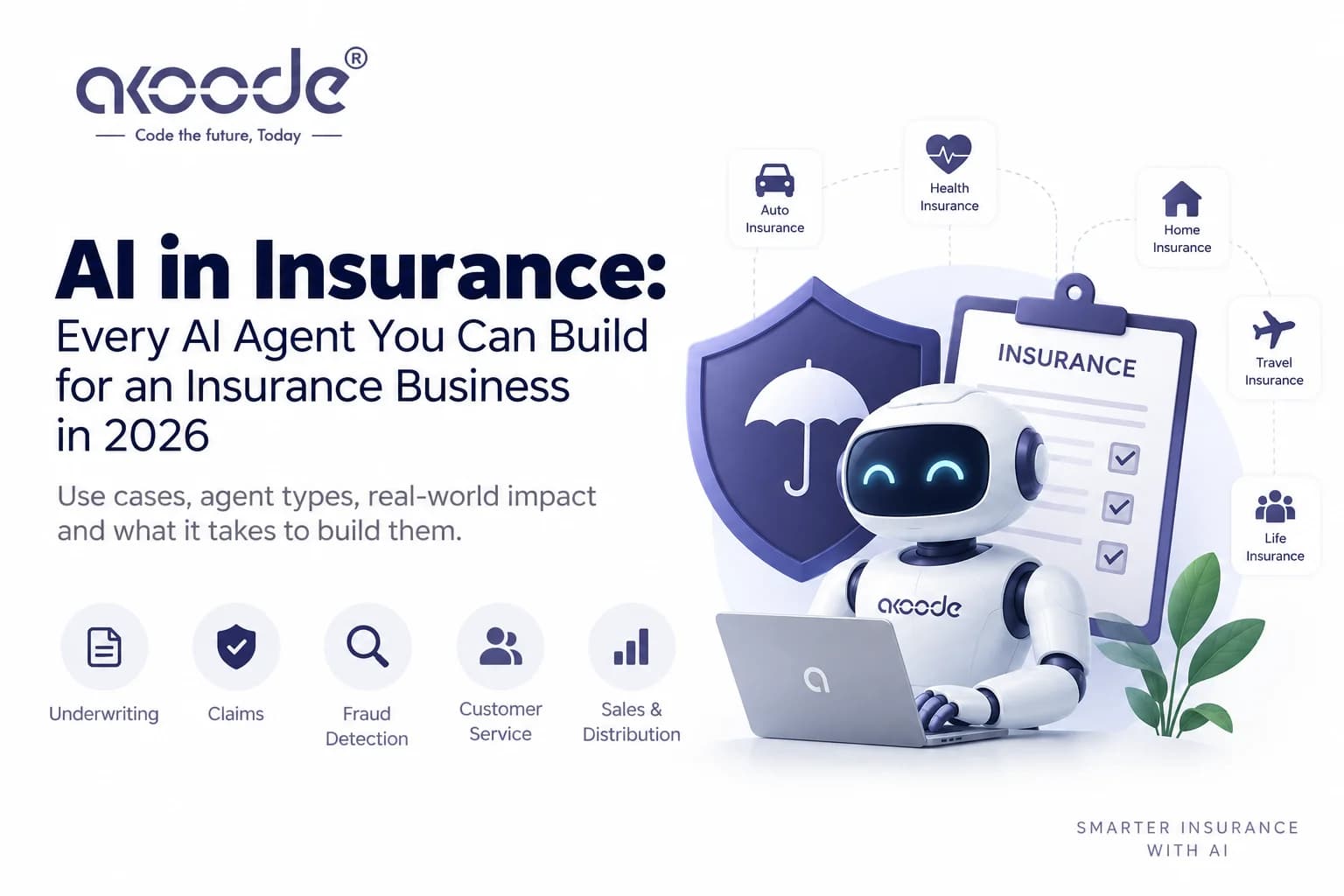
AI in insurance spans work across the full policy lifecycle, and each stage carries a different regulatory bar that should directly inform how much autonomy an agent is given: distribution and sales (quoting, policy recommendation — where personalization matters and the regulatory bar is comparatively lower), underwriting (risk assessment, pricing — where fair-treatment and anti-discrimination obligations place real constraints on how a model can be built and used), claims (intake, adjudication, fraud detection — the highest-volume, most mature category), and customer service and retention (policy servicing, renewals — where trust and clear communication matter as much as speed).
An AI agent, in this context, owns a defined task end-to-end at the appropriate risk tier for its function — not a chatbot that quotes a policy, but a system that verifies a claim against policy terms, flags a genuine fraud pattern, or processes a renewal, with the audit trail a regulator will eventually want to review.
The Complete List: AI Agents You Can Build for an Insurance Business
Distribution and Sales Agents
Conversational quoting and policy-recommendation agent. Helps a prospective customer understand coverage options and generates an instant, personalized quote based on their actual risk profile, replacing a multi-step manual quoting process that otherwise takes days for anything beyond the simplest policy type.
Cross-sell and personalization agent. Identifies relevant additional coverage for existing policyholders based on life events and behavior signals, surfacing genuinely relevant options rather than a generic renewal upsell.
Embedded insurance integration agent. Powers instant policy issuance at the point of another transaction — a purchase, a loan, a travel booking — a rapidly growing distribution channel as insurers increasingly embed coverage directly into banking, e-commerce, and mobility platforms rather than relying solely on standalone insurance sales.
Underwriting and Risk Assessment Agents
Automated underwriting agent. Assesses risk and prices a policy using a broader set of signals than traditional actuarial tables alone, with underwriting now the fastest-growing AI application category in insurance specifically because the accuracy gains compound directly into loss-ratio improvement.
Risk scoring and predictive-modeling agent. Continuously refines risk models using claims outcomes and external data, catching risk patterns that static, periodically-updated actuarial tables miss between review cycles.
Property and asset risk assessment agent. Uses satellite imagery, computer vision, and geospatial data to assess property risk for underwriting — flood exposure, roof condition, wildfire proximity — at a scale and speed manual property inspection can't match.
Document and application processing agent. Extracts and verifies data from applications, medical records, and supporting documents automatically, feeding underwriting a clean, structured file instead of a stack of forms a human has to read and re-key.
Claims Processing Agents
Claims intake and triage agent. Captures claim details conversationally across chat, voice, or a photo upload, and routes the claim to the appropriate processing path — automated settlement for straightforward cases, human review for anything complex or contested.
Automated claims adjudication agent. Settles straightforward claims automatically against policy terms and claim evidence, a category already handling roughly half of all claims volume at insurers running mature deployments, cutting settlement time from days to minutes for the cases it can confidently resolve.
Computer vision damage assessment agent. Analyzes photos of vehicle or property damage to estimate repair costs and validate claim consistency, a use case major carriers are already running against hundreds of millions of images annually for auto and property claims.
Claims status and communication agent. Proactively updates policyholders on claim status and handles routine follow-up questions, reducing the "where is my claim" support volume that otherwise consumes significant contact-center capacity.
Fraud Detection and Investigation Agents
Real-time fraud scoring agent. Analyzes claims patterns and flags suspicious activity at the point of submission using behavioral and pattern-based models, catching fraud signals that a rules-based system misses because genuine fraud patterns evolve faster than static rules can be updated.
Document fraud and tampering detection agent. Uses natural language processing and image analysis to detect linguistic inconsistencies and document tampering, catching a category of fraud that's specifically difficult for a human reviewer to spot reliably at scale.
AI investigation agent. Goes beyond flagging to actually build an audit-ready case file — gathering supporting evidence, cross-referencing prior claims, and preparing documentation for a human investigator — directly addressing the industry's real bottleneck, since most flagged claims currently never get investigated due to capacity constraints rather than a lack of detection.
Network and collusion-detection agent. Identifies organized fraud rings by analyzing connections across claims, providers, and claimants that wouldn't be visible when each claim is reviewed in isolation.
Customer Service and Retention Agents
24/7 policy servicing agent. Handles policy changes, coverage questions, and general servicing across chat and voice, resolving high-volume routine requests without a human touching every ticket.
Renewal and retention agent. Identifies policyholders at risk of lapsing or switching providers and triggers personalized retention outreach before the renewal date, rather than a generic renewal reminder sent to everyone equally.
Complaint and sentiment-analysis agent. Monitors customer complaints and service interactions to surface recurring service issues — a specific claims-process friction point, a communication gap — before they show up as a churn trend a retention team has to chase down manually.
Orchestration: When Multiple Agents Work the Same Policy Lifecycle
The insurers seeing the most value from AI aren't running isolated tools — they're connecting agents across the policy lifecycle: a quoting agent captures a new customer, an underwriting agent prices the risk, a claims-intake agent handles the eventual claim, a fraud-detection agent screens it in real time, and an investigation agent builds the case file for anything flagged, all referencing the same policyholder record with a full audit trail. This connected approach is exactly what separates the roughly 55% of insurers already in early or full-scale AI deployment from the larger group still stuck evaluating pilots that never connect to the rest of the operation.
How These Agents Are Actually Built
The underlying architecture is consistent across every agent type above, with the compliance posture shifting sharply depending on which stage of the policy lifecycle the agent touches:
A large language model (GPT, Claude, or Gemini class, selected per use case) handles the language and reasoning layer — understanding a policyholder's claim description, summarizing an investigation file, explaining a coverage decision in plain language.
Specialized risk and fraud models — actuarial and predictive risk models for underwriting, pattern-detection models for fraud — handle the tasks that require statistical rigor and explainability a general-purpose language model can't reliably provide on its own, particularly for underwriting decisions that carry fair-treatment obligations.
Computer vision models power property and damage assessment specifically, analyzing satellite imagery and claim photos with the accuracy needed to actually inform a pricing or settlement decision.
Retrieval-augmented generation (RAG) grounds every response in a policyholder's actual policy terms and claims history, never letting an agent answer a coverage question from general knowledge when the actual policy language should govern the answer.
Policy administration and claims-management system integrations connect the agent to the systems that actually hold policy and claims data, since an agent that can't read from or write to the core policy admin system isn't usable in a real insurance workflow.
A compliance, audit-trail, and guardrail layer enforces exactly what an agent can act on autonomously (a routine claim within defined parameters, a standard renewal) versus what requires human sign-off (a contested claim, an underwriting decision above a risk threshold), and maintains the audit trail a regulator will eventually ask to see — the difference between a system a compliance team approves for production and one that never leaves a sandbox.
This is where insurance AI engineering diverges most sharply from most other industries. Anyone can wire a model to a claims form. Building an agent with the explainability, fair-treatment compliance, and audit trail a regulator will actually accept — particularly for underwriting, where anti-discrimination obligations place real constraints on which variables can influence a decision — is the real engineering work.
Building AI Agents for Insurance Businesses in Gurgaon and the NCR
Gurgaon hosts a genuine concentration of general insurers, brokers, and insurtech startups, and a few things are specific to building here:
IRDAI's evolving AI governance framework — actively being built by the regulator's dedicated AI working group formed in mid-2026 — needs to be tracked closely by any underwriting or claims agent operating in India, since the compliance bar for AI in claims, fraud, and underwriting is being defined in real time rather than sitting in a stable, finalized rulebook.
Bima Sugam integration — IRDAI's unified digital insurance marketplace for comparing, buying, and settling claims across insurers — is increasingly relevant for any distribution or claims-servicing agent aiming for genuine platform-level reach rather than a single insurer's standalone channel.
Health insurance's dominant local share — now the largest segment of India's non-life market, ahead of motor insurance — makes health-specific claims processing and fraud detection a higher-priority build for NCR insurers than in markets where motor or property still leads.
Hindi-English code-switched customer communication, exactly how NCR policyholders actually message on WhatsApp, needs to be handled natively by any conversational servicing or claims-intake agent, not bolted on as a translation layer.
Building for the Indian Market Broadly
Beyond Gurgaon's insurtech concentration, three things matter for AI insurance agents built for the wider Indian market: micro-insurance and embedded insurance distribution matter more here than in most developed markets, since affordable smartphone access and UPI-based micro-policies are unlocking a genuinely underserved rural and semi-urban insurance population that a traditional agent-led distribution model doesn't reach efficiently; regional-language support is essential given how much of India's insurance growth is coming from semi-urban and rural markets that aren't English-first; and the country's real AI-skills gap — roughly 416,000 available AI professionals against demand for closer to 629,000 — means most Indian insurers are better served partnering with an experienced engineering team than trying to build every agent in-house from scratch.
Building for a Global Market
For insurance businesses operating internationally, the same agent categories apply, but the regulatory and integration layer shifts substantially: fair-treatment and anti-discrimination regulations (like state-level insurance regulations in the US restricting which variables can inform pricing) place hard constraints on underwriting-agent design, GDPR governs customer data handling for European operations, and integration with the dominant policy administration and claims platforms in each target market varies significantly between the US, UK, and other major insurance markets. Insurers operating globally also need to account for the fact that AI adoption itself varies by region and line of business — health insurers, for instance, lead sector adoption globally — which should inform where to prioritize a first deployment in a multi-market operation.
What to Actually Prioritize First
Not every insurance business needs the full stack above on day one. A practical build sequence for most insurers, brokers, and insurtechs:
Claims intake and automated adjudication for straightforward claims — because it's the most mature, best-documented use case, and the time-to-settlement improvement is immediately visible to policyholders.
Real-time fraud scoring — because the ROI is direct and measurable given how much fraud currently goes undetected or uninvestigated.
Conversational customer service and policy servicing — because it deploys fast and reduces contact-center load without touching underwriting or claims decisions directly.
Document and application processing for underwriting — because it removes a genuine operational bottleneck while keeping the actual risk decision human-reviewed.
Automated underwriting and AI investigation agents — the highest-value but highest-regulatory-bar category, best approached once an insurer has real production experience with the lower-risk agents above and the fair-treatment compliance groundwork in place.
Proof This Works
Akoode's engineering discipline for document-processing and computer-vision-driven assessment systems shows up in projects that share the core requirements an insurance claims or underwriting platform demands: extracting structured, accurate data from real-world visual and document input, at a level of precision that a downstream decision can actually rely on. The AI-powered quantity-takeoff platform built for Qualis Construction applies exactly this discipline — computer vision translating physical, visual input into precise, structured measurement data — the same underlying capability a property-risk assessment or damage-estimation agent depends on, applied to a different domain.
Choosing a Partner to Build This
A few questions separate a real insurance AI engineering partner from a generic AI vendor applying an insurtech label:
Can they explain how their underwriting or fraud model maintains an audit trail a regulator would actually accept, not just "we log everything"?
Do they understand fair-treatment and anti-discrimination constraints on underwriting-model design, or treat it as a generic compliance checkbox?
Can they show a system that integrates with a real policy administration or claims-management platform, not just a demo against sample claims data?
Do they have a clear answer for how their agent distinguishes routine, autonomous decisions from ones that need human sign-off?
Do they understand IRDAI's evolving AI governance approach specifically, if you're operating in the Indian market, rather than applying a generic global compliance framework?
Where to Start
AI in insurance has moved well past the pilot phase for fraud detection and claims, and the next frontier — underwriting, investigation, and truly connected policy-lifecycle agents — is where the real competitive separation is opening up in 2026. The insurers and insurtechs pulling ahead — in Gurgaon's growing insurtech hub, across India's fast-scaling and increasingly AI-governed insurance market, and globally — are the ones building auditable, connected agent systems across quoting, claims, and fraud detection, not disconnected pilots that never make it past a compliance review.
Akoode has delivered AI-powered and computer vision platforms for clients across India, the UK, and the USA, with a 4.9 Google rating from 110+ reviews and a 97% client retention rate. If you're scoping an AI agent — or a full agent portfolio — for an insurer, broker, or insurtech business, book time with Akhil Verma, Founder & CEO of Akoode, and bring a short brief on what you're building. The first call is where we map which agents matter most for your organization and your compliance obligations, not a generic list.
If you're evaluating AI agents across more than one industry, see our companion guides on AI agents for real estate, AI agents for travel and hospitality, AI agents for retail and e-commerce, AI agents for healthcare, AI agents for finance and banking, AI agents for logistics and supply chain, and AI agents for manufacturing.
Frequently Asked Questions
What AI agents can an insurance business build? Insurance businesses can build conversational quoting agents, automated underwriting agents, claims intake and adjudication agents, computer vision damage assessment agents, fraud scoring and investigation agents, and policy servicing and retention agents, each owning a distinct part of the policy lifecycle.
How much of the claims process can AI actually automate today? Insurers running mature AI deployments report roughly 50% of claims now processed automatically, with automated claims processing cutting overall processing time by around 65%, though complex or contested claims still require human adjudication.
Is AI underwriting regulated differently from other AI use cases in insurance? Yes. Underwriting models must comply with fair-treatment and anti-discrimination regulations that constrain which variables can influence pricing and risk decisions, which is why underwriting AI generally requires more rigorous explainability and audit-trail architecture than customer service or servicing agents.
What makes AI agent development different for Gurgaon and NCR insurance businesses? Gurgaon hosts a genuine concentration of insurers, brokers, and insurtech startups, which means agents built here benefit from tracking IRDAI's evolving AI governance framework, Bima Sugam marketplace integration, and health-insurance-specific claims logic given health's position as India's largest non-life insurance segment.
Which AI agent should an insurance business build first? Most insurers see the fastest, best-documented return from automated claims intake and adjudication for straightforward claims, since it's the most mature use case with clear time-to-settlement improvements, followed by real-time fraud scoring.
Get In Touch Now
View More Our Blog