


 September 18, 2026
A post-production team used to spend weeks manually tagging footage, cutting a trailer by hand, and dubbing a show into each new market language one recording session at a time. Today an AI agent tags thousands of hours of footage by scene, character, and mood in minutes, assembles a rough trailer cut for an editor to refine, and generates a lip-synced dubbed version in a new language before the human localization team even starts their pass. The creative decisions — what story to tell, which cut actually works, which performance to use — are still made by people. The weeks of manual, repetitive production work mostly aren't.
Media and entertainment sits at an unusual point in the AI adoption curve: it's simultaneously one of the industries generating the most excitement about AI's creative potential and one of the most anxious about what that potential displaces — a tension that shows up directly in the writers' and actors' strikes, likeness-rights legislation, and AI-disclosure debates that have followed the technology into nearly every corner of the industry. This guide covers what AI in media and entertainment actually means in 2026, every category of AI agent a studio, streaming platform, publisher, or content business can realistically build, how they're engineered, and what's different about building for Gurgaon/NCR, India, and global markets.
Why Media and Entertainment Is Moving Fast Despite the Controversy
The numbers behind AI adoption in media and entertainment are large by any measure, even accounting for wide variance across how different analysts define the category. The broader AI-in-media-and-entertainment market sits somewhere in the $35-85 billion range for 2026 depending on scope, growing at a consistent 20-26% annually across most estimates, while the narrower generative AI segment specifically — content creation tools rather than the full AI stack — is scaling even faster, roughly tripling from $2.8 billion to somewhere near $8 billion by 2030 on some estimates. Nearly 90% of new content-creation initiatives now incorporate generative AI in some form, spanning video synthesis, voice cloning, and automated scriptwriting, and AI-driven personalization is credited with the large majority of measurable audience-engagement improvements platforms have reported.
The honest complication the industry's own data surfaces is that AI adoption here isn't purely a capability story — it's also a trust and rights story in a way most other industries don't have to navigate as directly. Deepfakes, unauthorized likeness use, and content-authenticity concerns are named consistently as a primary constraint on AI adoption in advertising, journalism, and talent management specifically, which is why the agent categories in this guide split cleanly into two groups: creative and operational agents that most media businesses can adopt with relatively low controversy, and a smaller set of agents — synthetic voice and likeness generation chief among them — that carry real legal and reputational exposure and need contractual and disclosure guardrails built in from day one, not bolted on after a dispute.
India's media and entertainment sector is scaling on its own substantial trajectory, projected to grow from roughly $25.7 billion in 2025 to $36.7 billion by 2030 — nearly double the global industry growth rate — driven specifically by AI, regional-language content, and digital ecosystem expansion. India already produces close to 200,000 hours of content and over 1,900 films annually, more than any other country, and OTT viewership has crossed 665 million users, with regional-language originals in Tamil, Telugu, Malayalam, Bengali, and Marathi now a mainstream growth driver rather than a niche strategy. India's animation and VFX sector specifically is projected to reach roughly $2.2 billion by FY26, backed by a 100% FDI limit and a government-funded AVGC (Animation, Visual Effects, Gaming, and Comics) initiative that's setting up content-creator labs in 15,000 schools nationwide.
What "AI in Media & Entertainment" Actually Means
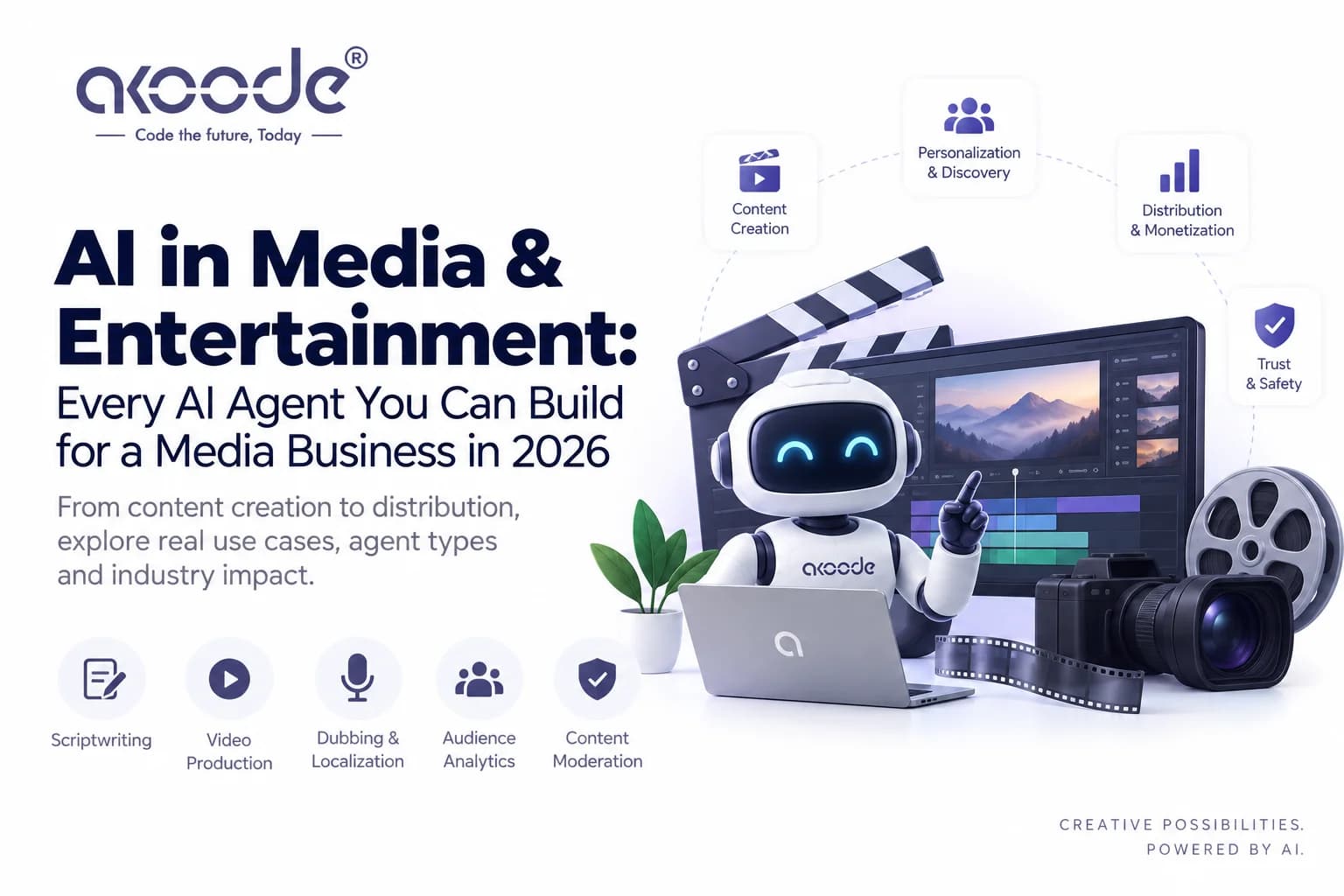
AI in media and entertainment spans four connected areas, and each carries a meaningfully different risk and rights profile: content creation and production (scriptwriting assistance, video and image generation, VFX, dubbing — where creative and legal guardrails matter most), personalization and discovery (recommendations, content tagging, search — the most mature and least controversial category), distribution and monetization (ad targeting, dynamic ad insertion, audience analytics — where privacy and advertising regulation apply), and trust and safety (content moderation, deepfake detection, rights and royalty management — where the industry's credibility is directly at stake).
An AI agent, in this context, owns a defined task end-to-end within one of these areas — not a tool that generates a video clip, but a system that produces a rough cut ready for human review with proper attribution and rights metadata attached; not a filter flagging possible synthetic content, but an agent that verifies authenticity and routes a flagged asset to a human reviewer with the evidence already assembled.
The Complete List: AI Agents You Can Build for a Media or Entertainment Business
Content Creation and Production Agents
Script and story development agent. Assists with outlining, dialogue drafting, and story-structure analysis, functioning as a drafting and iteration tool for writers rather than a replacement for creative authorship — a distinction that matters as much contractually as it does technically in the current industry environment.
AI video and image generation agent. Generates rough-cut footage, concept visuals, or B-roll from a text or storyboard prompt, dramatically compressing the pre-visualization and concept-development stage of production before a full shoot or animation pipeline commits real budget.
Automated dubbing and lip-sync localization agent. Generates dubbed audio with matched lip movement for a new language market, cutting the time and cost of localizing a title for a new territory — directly relevant given how much of India's OTT growth specifically depends on serving multiple regional-language audiences from a single source production.
Subtitle and translation agent. Automates subtitle generation and translation with contextual accuracy, going beyond literal translation to preserve idiom, tone, and cultural context that a naive machine-translation pass misses.
VFX and CGI automation agent. Automates repetitive visual-effects tasks — rotoscoping, background removal, compositing assistance — freeing VFX artists to focus on the shots that need genuine creative and technical judgment rather than the mechanical frame-by-frame work.
Music and audio generation agent. Generates score, sound design, or audio variations for a scene, particularly valuable for high-volume content categories like advertising and short-form video where custom-composed music at scale would otherwise be cost-prohibitive.
Virtual production and digital-twin agent. Maintains a live virtual environment for LED-wall and virtual-set production, letting a production team test lighting, camera angles, and set changes in simulation before committing to a physical or virtual shoot day.
Personalization and Discovery Agents
Content recommendation agent. Personalizes content suggestions based on viewing history, engagement patterns, and stated preferences — the single most mature and highest-adoption AI use case in media, credited with driving the large majority of measurable audience-engagement gains platforms report.
Content tagging and metadata agent. Automatically tags footage and content assets by scene, character, mood, and theme at ingest, replacing manual cataloguing that otherwise takes a human archivist significant time per hour of content and becomes a genuine bottleneck at the content volumes major studios and platforms now produce.
Natural-language content search agent. Lets an internal production team or an end viewer search a content library conversationally — "find the scene where the two characters argue in the rain" — rather than relying on manually maintained keyword tags alone.
Audience sentiment and trend-analysis agent. Analyzes social and review sentiment around released content to inform marketing spend, sequel decisions, and content strategy faster than a manual review of critic and audience reaction.
Distribution and Monetization Agents
Programmatic ad targeting and optimization agent. Optimizes ad placement and targeting in real time based on audience and content-context signals, a core application area for AI investment specifically in advertising and marketing content within media and entertainment.
Dynamic ad insertion agent. Inserts and personalizes advertising into streaming content in real time based on viewer segment, replacing static ad breaks with placements matched to the actual audience watching.
Churn prediction and retention agent. Identifies subscribers showing early signs of disengagement on a streaming platform and triggers targeted retention content or offers before they cancel, directly relevant given how price-sensitive and option-rich the subscription streaming market has become.
Content licensing and rights-management agent. Tracks usage rights, licensing terms, and territory restrictions across a content library, flagging expiring or non-compliant usage before it becomes a legal or contractual problem rather than after.
Royalty calculation and reporting agent. Automates royalty and residual calculations across complex rights-holder agreements, a process that's traditionally manual, error-prone, and a recurring source of dispute between studios, platforms, and talent.
Trust, Safety, and Compliance Agents
Content moderation agent. Screens user-generated and licensed content for policy violations, harmful content, or age-inappropriate material at a scale no human moderation team could sustain alone, escalating genuinely ambiguous cases to human review.
Deepfake and synthetic-media detection agent. Verifies content authenticity and flags likely synthetic or manipulated media, a category with rapidly growing importance as generative video and voice tools make convincing fabrication accessible at a scale that erodes audience trust in unlabeled content.
Copyright and plagiarism detection agent. Scans content and scripts for unauthorized use of copyrighted material, protecting a media business from the same infringement risk it needs to enforce against others.
Talent and likeness-rights compliance agent. Tracks consent and usage boundaries for any AI-generated content involving a real performer's voice or likeness, an area where contractual protections have become a central, hard-won term in recent industry labor agreements and where getting the compliance architecture wrong carries direct legal exposure.
Orchestration: When Multiple Agents Work the Same Production Pipeline
The media businesses capturing the most value from AI aren't deploying isolated creative tools — they're connecting agents across the pipeline: a script-development agent supports early drafting, a virtual-production agent lets the team previsualize before the shoot, a tagging agent catalogues footage as it comes in, a localization agent handles dubbing and subtitles for each target market, and a rights-management agent tracks usage across every version — all coordinated rather than five disconnected tools each solving one production problem in isolation. That connected pipeline approach is what's letting some studios compress localization timelines from weeks to days for multi-market releases, which matters enormously in a market like India's OTT ecosystem where a single title routinely needs five or more regional-language versions to reach its full addressable audience.
How These Agents Are Actually Built
The underlying architecture varies more by function here than in most other industries, since content-creation agents and operational agents draw on genuinely different model families:
Generative models — text-to-video, text-to-image, voice synthesis, and large language models, selected per creative use case — handle the actual content-generation tasks, from rough-cut video to dubbed audio to draft dialogue.
Computer vision and audio models handle content tagging, deepfake detection, and moderation, since these tasks require specialized visual and audio analysis beyond what a general-purpose language model provides on its own.
Retrieval-augmented generation (RAG) grounds personalization, search, and rights-management agents in actual content-library metadata and licensing terms, rather than letting an agent recommend content it doesn't have rights to serve in a given territory.
DAM, MAM, and rights-management system integrations connect agents to the systems that actually hold content assets and licensing data — digital asset management and media asset management platforms for content, rights databases for licensing and royalty terms.
A rights, consent, and disclosure guardrail layer is the layer that matters most distinctively in this industry: it enforces what an agent can generate autonomously (a rough cut, a tagged asset) versus what requires explicit rights clearance and disclosure (any use of a real performer's voice or likeness, any AI-generated content presented as human-created without disclosure) — the layer that determines whether a media business avoids the legal and reputational disputes that have already reshaped labor agreements across the industry.
This is where media AI engineering diverges most sharply from most other industries: the technical build is often the easier half. Getting the rights, consent, and disclosure architecture right — and building it in from the start rather than retrofitting it after a dispute — is what actually determines whether an AI system is safe to deploy in production.
Building AI Agents for Media Businesses in Gurgaon and the NCR
Gurgaon and the NCR aren't India's primary film and core VFX production hub — that concentration sits mainly in Mumbai, Hyderabad, Bengaluru, Chennai, and Pune — but the region has a genuine and growing role in media-adjacent AI that's worth being specific about rather than overstating:
Advertising and marketing content generation is a strong local fit, given Gurgaon's dense concentration of advertising agencies, D2C brands, and marketing technology companies, making AI-driven ad-creative generation and programmatic optimization a higher-value build here than core film-production tooling.
Noida's animation and VFX training ecosystem, anchored by institutions training the next generation of animation and VFX professionals, means NCR is building a genuine talent pipeline for AI-augmented production work, even if the largest studios remain headquartered elsewhere.
Corporate and OTT-adjacent digital content production — explainer video, branded content, streaming-platform marketing assets — is a meaningful and growing category for NCR-based production and marketing agencies, distinct from feature film or premium episodic production.
Hindi and regional-language content localization matters for any NCR-based platform or agency serving India's OTT audience, given how central regional-language originals have become to subscriber growth industry-wide.
Building for the Indian Market Broadly
Beyond NCR's specific positioning, three things matter for AI media agents built for the wider Indian market: regional-language dubbing and localization is arguably the single highest-value AI use case in the Indian context specifically, since serving India's linguistically diverse OTT audience from a single source production depends on fast, high-quality multi-language versions at a cost traditional dubbing studios struggle to match at scale; the government's AVGC push is actively expanding the talent and infrastructure base for AI-augmented animation and VFX work, which changes the calculus on building versus outsourcing production-pipeline AI tools domestically; and content moderation needs to account for India's specific regulatory framework under the IT Rules and Digital Media Ethics Code, which differs in meaningful ways from content-moderation obligations in the US or Europe.
Building for a Global Market
For media and entertainment businesses operating internationally, the same agent categories apply, but the legal and compliance layer shifts substantially: performer likeness and voice-rights protections that have become central, negotiated terms in recent industry labor agreements in the US specifically constrain how AI-generated content involving real performers can be produced and disclosed; the EU AI Act imposes transparency and disclosure obligations on AI-generated content that a global platform needs to account for by market; and copyright law around AI-generated content itself remains genuinely unsettled in several major jurisdictions, which means any content-generation agent's output needs a clear internal policy on rights ownership and disclosure rather than an assumption that existing copyright frameworks cleanly apply.
What to Actually Prioritize First
Not every media or entertainment business needs the full stack above on day one. A practical build sequence for most studios, platforms, and content businesses:
Content recommendation and personalization — because it's the most mature, best-documented use case with directly measurable engagement impact, and carries the least legal complexity.
Content tagging and metadata — because it removes a genuine production bottleneck and creates the structured data foundation that search, licensing, and rights-management agents depend on later.
Localization: dubbing, subtitling, and translation — because the ROI is immediate for any business serving multiple language markets, which describes most of the Indian OTT ecosystem specifically.
Ad targeting and monetization agents — once the content and audience data foundation from the earlier stages is clean enough to ground targeting decisions accurately.
Generative content-creation and synthetic-media agents — the highest-value but highest-legal-complexity category, best approached only once the rights, consent, and disclosure guardrail architecture is genuinely in place, not as an afterthought.
Proof This Works
An AI-powered advertisement catalogue generator Akoode built automates product imagery and ad-variant generation at scale — a direct, working example of the generative content-creation category described above, running as a structured pipeline rather than a single-prompt tool, and squarely within the advertising and marketing content-generation application area that sits inside the media and entertainment industry as a whole.
Choosing a Partner to Build This
A few questions separate a real media AI engineering partner from a generic AI vendor applying a creative-industry label:
Can they explain how their content-generation agent handles rights, consent, and disclosure for anything involving a real performer's voice or likeness?
Do they distinguish between low-controversy operational agents (tagging, recommendations) and high-exposure creative agents (synthetic voice, likeness generation) in how much autonomy each is given?
Have they built for real DAM, MAM, or rights-management system integration, not just a demo against sample media files?
Can they show a working localization or dubbing pipeline handling genuine multi-language output, if that's relevant to your content strategy?
Do they understand India's specific content-moderation and IT Rules obligations, if you're operating in the Indian market, rather than applying a generic global framework?
Where to Start
AI in media and entertainment is advancing on two tracks at once: rapid, low-controversy adoption in personalization, tagging, and localization, and much more careful, guardrail-heavy adoption in generative content creation involving real performers. The businesses pulling ahead in 2026 — in NCR's advertising and content-adjacent ecosystem, across India's fast-growing and increasingly AI-native OTT market, and globally — are the ones building both tracks deliberately, with the rights and disclosure architecture treated as core engineering, not a legal afterthought.
Akoode has delivered AI-powered content and creative platforms for clients across India, the UK, and the USA, with a 4.9 Google rating from 110+ reviews and a 97% client retention rate. If you're scoping an AI agent — or a full agent portfolio — for a studio, streaming platform, publisher, or content business, book time with Akhil Verma, Founder & CEO of Akoode, and bring a short brief on what you're building. The first call is where we map which agents matter most for your content and your rights obligations, not a generic list.
If you're evaluating AI agents across more than one industry, see our companion guides on AI agents for real estate, AI agents for travel and hospitality, AI agents for retail and e-commerce, AI agents for healthcare, AI agents for finance and banking, AI agents for logistics and supply chain, AI agents for manufacturing, and AI agents for insurance.
Frequently Asked Questions
What AI agents can a media or entertainment business build? Media and entertainment businesses can build content recommendation agents, content tagging and metadata agents, dubbing and localization agents, ad targeting agents, churn prediction agents, content moderation agents, deepfake detection agents, and rights and royalty management agents, each owning a distinct part of the content lifecycle.
Will AI replace writers, editors, and other creative professionals? Current evidence and recent industry labor agreements point toward AI functioning as a drafting and production tool rather than a replacement for creative authorship, with contractual protections around consent and disclosure for AI-generated content involving real performers now a standard feature of major industry agreements.
What is the biggest risk in deploying generative AI in media and entertainment? Unauthorized use of a real performer's voice or likeness, and undisclosed synthetic content, are the two risks with the most direct legal and reputational exposure, which is why rights-clearance and disclosure architecture needs to be built into any content-generation agent from the start rather than added after a dispute.
What makes AI agent development different for Gurgaon and NCR media businesses? Gurgaon and the NCR aren't India's primary film and VFX production hub, but the region has a strong fit for advertising and marketing content generation, corporate and OTT-adjacent digital content, and benefits from Noida's growing animation and VFX training ecosystem.
Which AI agent should a media business build first? Most media and entertainment businesses see the fastest, lowest-risk return from content recommendation and personalization, since it's the most mature use case with directly measurable engagement impact, followed by content tagging and metadata automation.
Get In Touch Now
View More Our Blog