


 September 19, 2026
A farmer used to walk the field every few days, eyeball the crop for stress, and irrigate on a fixed schedule whether the soil actually needed it or not. Today a satellite pass and a soil-moisture sensor feed an AI agent that flags the exact three-acre patch showing early water stress, before it's visible to the eye, and adjusts the irrigation schedule for that patch alone. The farmer still decides what to plant and when to harvest. The guesswork of walking the whole field to find the one patch that needs attention mostly isn't theirs anymore.
Agriculture is one of the industries where AI's promise and agriculture's oldest constraint — thin margins, fragmented land, and a workforce that can't easily absorb expensive new tools — collide most directly. That tension is exactly why the agriculture-AI story in 2026 is really two stories: rapid, well-funded innovation at the top of the market (autonomous tractors, satellite-driven precision platforms, AI-as-a-Service subscriptions), and a much larger effort to get AI's benefits down to the hundreds of millions of smallholder farms that don't fit that model, particularly in a market like India. This guide covers what AI in agriculture actually means in 2026, every category of AI agent an agribusiness, agritech platform, farm operation, or agri-input company can realistically build, how they're engineered, and what's different about building for Gurgaon/NCR, India, and global markets.
Why Agriculture's AI Story Splits Into Two Very Different Markets
Market sizing for AI in agriculture is unusually inconsistent even by the standards of a fast-moving category — 2026 estimates for the global market range from roughly $3 billion to $85 billion depending on scope and methodology, largely because some estimates count only software while others include the full hardware-plus-software stack of sensors, drones, and autonomous machinery. What's consistent across nearly every estimate is a CAGR in the mid-20s to high-20s percent range through the early 2030s, and a clear shift in how the technology reaches the field: AI-as-a-Service subscription models are increasingly replacing the capital-heavy hardware purchase that used to be the only way for a mid-size or small farm to access precision agriculture at all.
The concrete deployments already in production tell the real story of what's working. John Deere's See & Spray Ultimate system, launched for broadacre crops in early 2026, uses real-time weed detection to cut herbicide use by 77% — a genuinely large, verifiable input-cost and environmental-impact reduction, not a marketing estimate. Bayer's AgPowered AI platform added a disease-prediction module for corn and soybeans achieving 94% accuracy in field trials, and Climate FieldView's generative AI crop advisor now generates hyperlocal planting recommendations from live soil and weather data rather than a static regional guideline. These are the concrete signals that AI in agriculture has moved well past pilot demonstrations into measurable, deployed impact on input costs and yield.
India's agriculture-AI story runs on a genuinely distinct track, anchored heavily by a large, deliberate government digital-infrastructure push rather than market forces alone. The Digital Agriculture Mission has built AgriStack, a unified digital identity system that has already issued over 7.63 crore Farmer IDs against a target of 11 crore, alongside a mobile-based Digital Crop Survey that has mapped 23.5 crore crop plots. Kisan e-Mitra, a voice-enabled AI chatbot operating in 11 regional languages, now answers over 8,000 farmer queries a day and has handled more than 93 lakh queries total on government schemes like PM-KISAN and crop insurance. An AI-based monsoon-forecasting initiative reached 3.88 crore farmers across 13 states during the last Kharif season, with a meaningful share reporting they actually changed sowing decisions based on the forecast — real evidence that AI-driven advisory is changing farmer behavior at scale, not just sitting unused in an app. India's agritech sector itself has scaled to nearly 5,000 startups with over $6 billion in cumulative funding, and Delhi-NCR — specifically Gurugram and Noida — is named among India's top agritech hubs alongside Bengaluru, Hyderabad, and Pune, with DeHaat, one of India's largest agritech platforms, headquartered in Gurugram.
What "AI in Agriculture" Actually Means
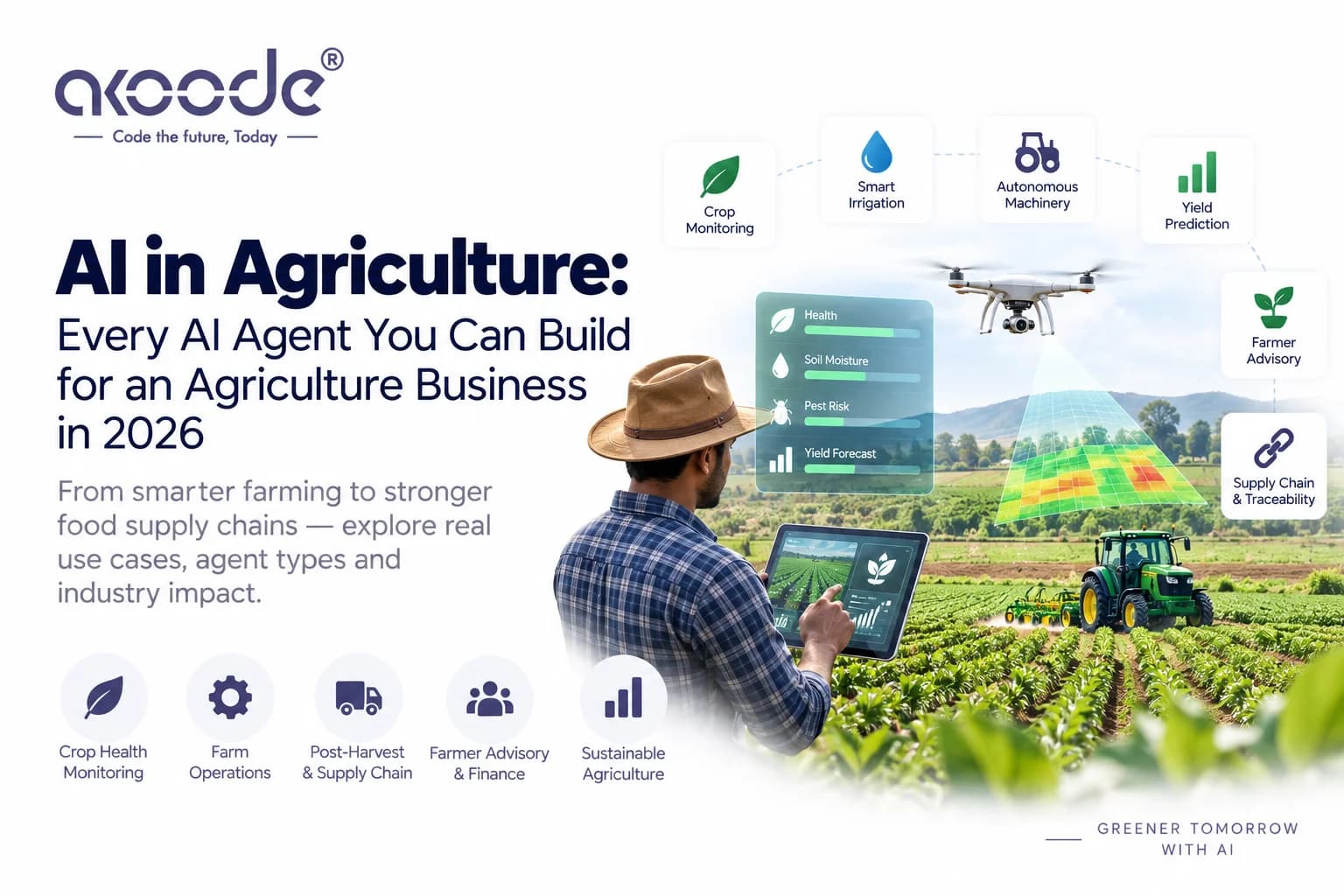
AI in agriculture spans work across the full agricultural value chain, and each stage calls for a different kind of agent: in-field monitoring (crop health, soil, pest, and weather signals — the foundation every other decision depends on), farm operations (irrigation, spraying, autonomous machinery — turning monitoring insight into action), post-harvest and supply chain (grading, traceability, market access — getting the crop to a buyer at a fair price), and farmer-facing advisory and finance (conversational advisory, credit scoring, insurance — reaching the farmer with the right information and financial access at the right time).
An AI agent, in this context, owns a defined task end-to-end — not a dashboard showing a soil-moisture reading, but a system that actually adjusts the irrigation schedule for the affected zone; not an alert flagging a possible pest, but an agent that recommends the specific, targeted intervention and the right timing to apply it.
The Complete List: AI Agents You Can Build for an Agriculture Business
Crop Monitoring and Precision Farming Agents
Satellite and drone crop-health monitoring agent. Analyzes multispectral imagery to detect crop stress, nutrient deficiency, or disease before it's visible to the human eye, feeding zone-specific alerts rather than a single farm-wide health score that hides where the actual problem is.
Yield prediction agent. Forecasts expected yield at the field or zone level using historical data, current crop condition, and weather patterns, informing everything from harvest logistics planning to forward-selling decisions well before the crop is actually in the ground.
Soil health and nutrient-analysis agent. Continuously analyzes soil sensor and sample data to recommend precise fertilization rates by zone, replacing a single blanket fertilization plan applied uniformly across a field with genuinely variable-rate recommendations.
Pest and disease detection agent. Identifies pest infestations and disease outbreaks from image data — a leaf photo taken on a phone, a drone pass, or a fixed field camera — early enough for a targeted intervention rather than a reactive, field-wide treatment after the damage is already visible, echoing the kind of accuracy gains already being demonstrated in large-scale commercial disease-prediction deployments.
Weather-based advisory agent. Translates hyperlocal weather forecasts into specific planting, irrigation, and harvest-timing recommendations, the same category of AI-driven monsoon advisory that's already reaching tens of millions of farmers in India and measurably changing sowing decisions.
Irrigation optimization agent. Continuously adjusts irrigation scheduling and volume by zone based on real soil-moisture data, crop stage, and weather forecast, replacing fixed-schedule irrigation that wastes water on zones that don't need it and under-waters zones that do.
Farm Operations and Automation Agents
Autonomous machinery coordination agent. Manages fleets of autonomous or semi-autonomous tractors and harvesters, optimizing field coverage patterns and coordinating multiple machines working the same operation simultaneously, a category moving rapidly from pilot to commercial deployment across broadacre farming.
Precision spraying and variable-rate application agent. Directs targeted, real-time pesticide or fertilizer application based on plant-level detection rather than uniform field-wide spraying, the exact mechanism behind the input-cost reductions already demonstrated in commercial deployments.
Livestock health and monitoring agent. Tracks livestock health, feeding patterns, and behavioral indicators through sensors and computer vision, flagging early signs of illness or distress before they become visible to a human handler doing periodic checks.
Farm labor and task-scheduling agent. Optimizes labor allocation and task sequencing across a farm operation based on weather windows, crop stage, and available workforce, a genuinely significant category given how much of agricultural productivity is still constrained by labor timing rather than land or capital.
Post-Harvest and Supply Chain Agents
Computer vision quality-grading agent. Automates produce grading and sorting by size, ripeness, and defect detection, replacing manual visual grading that's slower, less consistent, and harder to scale during peak harvest volume.
Market price forecasting and intelligence agent. Predicts commodity price movements using historical data, supply signals, and demand patterns, helping farmers and agribusinesses time selling decisions rather than accepting whatever the market offers on harvest day.
Agri-marketplace matching agent. Connects farmers directly with buyers based on quality, quantity, and location, the core mechanism behind the digital marketplace platforms that have scaled rapidly across India's agritech ecosystem to shorten a traditionally long and opaque intermediary chain.
Farm-to-fork traceability agent. Tracks a product's journey from field to retail, increasingly relevant as both regulatory requirements and consumer demand for verified sourcing and sustainability claims grow, particularly for export-oriented agribusinesses.
Cold-chain and post-harvest logistics agent. Monitors and optimizes cold-chain conditions and routing for perishable produce, a category that overlaps directly with the broader logistics and supply chain agents covered in our companion guide on AI agents for logistics and supply chain, applied specifically to the time- and temperature-sensitive constraints of fresh produce.
Farmer-Facing Advisory and Finance Agents
Multilingual conversational farmer-advisory agent. Answers farmer questions on crop management, government schemes, and market conditions in regional languages via voice and chat, the same model behind India's Kisan e-Mitra chatbot, which already operates in 11 regional languages and handles thousands of queries a day.
Alternative credit-scoring agent for farmers. Assesses creditworthiness using farm-specific signals — crop history, land records, weather risk, market access — rather than traditional credit bureau data alone, a significant use case given how large a share of smallholder farmers globally have thin or no conventional credit history.
Crop insurance underwriting and claims agent. Assesses crop risk for insurance pricing and automates claims processing using satellite and weather data to verify losses, a category that connects directly to the underwriting agents covered in our companion guide on AI agents for insurance.
Government scheme navigation agent. Helps farmers identify and apply for relevant subsidy, credit, and insurance schemes based on their specific situation, directly addressing the accessibility gap that's historically kept eligible farmers from benefiting from programs they qualify for simply because navigating the paperwork was too complex.
Sustainability and Climate Agents
Carbon farming and credit-tracking agent. Tracks regenerative farming practices and quantifies carbon sequestration for carbon-credit programs, an increasingly well-funded category as climate-focused agritech investment accelerates.
Water-usage optimization agent. Models water allocation across a farm or region against actual crop water needs and available supply, a critical category in water-stressed agricultural regions where irrigation efficiency directly determines what can be planted at all.
Climate-risk forecasting agent. Models longer-horizon climate risk — drought probability, shifting growing seasons — to inform crop-selection and planting-calendar decisions further ahead than a single-season weather forecast can support.
Orchestration: When Multiple Agents Work the Same Farming Season
The agribusinesses seeing the most value from AI aren't deploying isolated point tools — they're connecting agents across a season: a crop-monitoring agent flags a stress zone, an irrigation agent adjusts water delivery to that zone specifically, a pest-detection agent catches an emerging outbreak before it spreads, a yield-prediction agent updates its forecast based on the intervention, and a market-intelligence agent times the eventual sale — all working off the same field-level data rather than five disconnected apps a farmer has to check separately. This connected approach is what separates a genuinely useful precision-agriculture platform from a collection of point tools that each require their own login and never talk to each other.
How These Agents Are Actually Built
The underlying architecture is consistent across every agent type above, with the data sources and models swapped per use case:
A large language model (GPT, Claude, or Gemini class, selected per use case) handles the conversational and reasoning layer — powering multilingual farmer advisory, explaining a fertilization recommendation, summarizing a season's yield-prediction trend.
Specialized computer vision and remote-sensing models handle crop-health, pest-detection, and quality-grading tasks, processing satellite, drone, and camera imagery with the accuracy a general-purpose language model can't provide on its own.
IoT sensor integration connects the agent to real-time soil-moisture, weather-station, and equipment telemetry data, grounding every recommendation in what's actually happening in the field rather than a historical average.
Retrieval-augmented generation (RAG) grounds advisory and government-scheme agents in current, region-specific agricultural guidance and scheme eligibility rules, rather than letting an agent answer from generic agricultural knowledge that doesn't reflect local conditions or current program rules.
Farm management platform and marketplace integrations connect the agent to the systems that actually hold field, transaction, and yield data, since an agent that can't read from or write to a farmer's actual farm-management records isn't usable in a real operational workflow.
A connectivity and accessibility layer matters more distinctly in agriculture than in most other industries: any farmer-facing agent needs to function reliably over low-bandwidth rural connectivity and through voice interfaces for farmers who aren't comfortable with a text-heavy app, which is a genuine engineering constraint, not just a nice-to-have localization feature.
This is where agriculture AI engineering diverges from most other industries: the hardest part often isn't the model, it's making the system work for a user with unreliable connectivity, a non-English-first language preference, and a device that might be a basic smartphone rather than a high-end one — constraints that a system designed first for an enterprise agribusiness buyer typically doesn't handle well without deliberate redesign.
Building AI Agents for Agriculture Businesses in Gurgaon and the NCR
Gurgaon and the wider Delhi-NCR region sit inside one of India's recognized agritech hubs, alongside Bengaluru, Hyderabad, and Pune, and a few things are specific to building here:
Agri-fintech is a genuinely strong local category, exemplified by DeHaat, one of India's largest agritech platforms, headquartered in Gurugram — reflecting a broader pattern where NCR-based agritech companies tend to combine farm-advisory services with embedded financial products (credit, insurance) rather than building pure agronomy tools alone.
AgriStack and Digital Agriculture Mission integration is increasingly a practical requirement for any farmer-facing platform aiming for genuine India-scale reach, since Farmer ID and Digital Crop Survey data are becoming the connective infrastructure other agri-services build on top of.
Multilingual, voice-first design is essential for any NCR-based agritech platform serving farmers beyond its immediate metro area, following the same 11-regional-language model that's let Kisan e-Mitra reach farmers who wouldn't engage with an English, text-only interface.
B2B agri-fintech and supply chain infrastructure, rather than direct farmer-facing consumer apps, represents a meaningful share of the Gurgaon-based agritech opportunity, given the concentration of financial and enterprise software expertise in the NCR corridor.
Building for the Indian Market Broadly
Beyond NCR's agri-fintech concentration, three things matter for AI agriculture agents built for the wider Indian market: smallholder-appropriate design is not optional, since a large share of India's roughly 140 million farming households operate small, fragmented landholdings that most Western precision-agriculture tools were never designed to serve economically; AI-as-a-Service and subscription pricing models matter more here than in markets where large commercial farms can absorb capital-intensive hardware purchases; and integration with government digital infrastructure — AgriStack, Farmer ID, the Kisan Credit Card ecosystem — increasingly determines whether a private agritech platform can actually reach farmers at scale or remains a niche tool for the small share of larger, more digitally engaged farms.
Building for a Global Market
For agriculture businesses operating internationally, the same agent categories apply, but the integration and market context shifts substantially: large-scale commercial farming in the US, Europe, and Latin America supports capital-intensive autonomous machinery and hardware-heavy precision agriculture at a scale India's fragmented landholding pattern doesn't easily support; integration with established platforms like John Deere Operations Center, Climate FieldView, and Bayer's digital agriculture tools matters for any agritech business serving commercial farmers in developed markets; and EU Common Agricultural Policy compliance and sustainability-reporting requirements are increasingly pushing European agribusinesses toward AI-driven carbon and resource-usage tracking as a compliance necessity rather than an optional sustainability initiative.
What to Actually Prioritize First
Not every agriculture business needs the full stack above on day one. A practical build sequence for most agribusinesses and agritech platforms:
Crop monitoring and weather-based advisory — because it's the foundation every other decision depends on, and the ROI is visible within a single growing season.
Multilingual conversational advisory — because it deploys fast and directly addresses the accessibility gap that keeps AI's benefits from reaching smallholder farmers who won't use a text-heavy app.
Irrigation and input optimization — once monitoring data is stable enough to ground precise, zone-level recommendations rather than field-wide guesses.
Market intelligence and marketplace matching — because it directly improves farmer income by shortening the intermediary chain and improving price transparency.
Autonomous machinery and precision spraying — the highest-value but most capital-intensive category, appropriate for larger commercial operations once the data foundation from the earlier agents is solid.
Proof This Works
Akoode hasn't yet published an agriculture-specific case study, and we'd rather say that plainly than stretch an unrelated project to fit. What does carry over directly from Akoode's broader work is the engineering discipline agriculture AI depends on most: computer vision pipelines that process real-world visual data accurately (demonstrated in projects like the AI-powered quantity-takeoff platform built for Qualis Construction and a confidential AI player-performance-tracking system), and multilingual, low-bandwidth-tolerant conversational systems — the same core capabilities a crop-monitoring or farmer-advisory agent depends on, applied to a different domain.
Choosing a Partner to Build This
A few questions separate a real agriculture AI engineering partner from a generic AI vendor applying an agritech label:
Can they explain how their advisory agent handles low-bandwidth rural connectivity and voice-first interaction, not just a polished app demo on a fast office wifi connection?
Have they built genuinely multilingual systems, or does "multilingual" mean a translation layer bolted onto an English-first product?
Do they understand the difference between smallholder-appropriate design and enterprise commercial-farm tooling, which require very different pricing models and interface assumptions?
Can they show real computer vision or remote-sensing work applied to a physical, real-world detection problem, not just a demo against clean sample imagery?
Do they have a clear answer for integrating with government digital agriculture infrastructure, if reaching Indian farmers at scale is part of the goal?
Where to Start
AI in agriculture is genuinely two markets moving at two speeds: rapid, well-funded innovation in large-scale commercial farming, and a much larger, harder problem of reaching hundreds of millions of smallholder farmers who need AI's benefits delivered through a different design entirely — voice-first, multilingual, low-bandwidth, and priced for thin margins. The agribusinesses and agritech platforms pulling ahead in 2026 — in Gurgaon's agri-fintech corridor, across India's government-backed digital agriculture push, and globally — are the ones building for the market they're actually serving, not porting a Western precision-agriculture playbook wholesale.
Akoode has delivered AI-powered and computer vision platforms for clients across India, the UK, and the USA, with a 4.9 Google rating from 110+ reviews and a 97% client retention rate. If you're scoping an AI agent — or a full agent portfolio — for an agribusiness, agritech platform, or agri-input company, book time with Akhil Verma, Founder & CEO of Akoode, and bring a short brief on what you're building. The first call is where we map which agents matter most for your operation and the farmers you're serving, not a generic list.
If you're evaluating AI agents across more than one industry, see our companion guides on AI agents for real estate, AI agents for travel and hospitality, AI agents for retail and e-commerce, AI agents for healthcare, AI agents for finance and banking, AI agents for logistics and supply chain, AI agents for manufacturing, AI agents for insurance, AI agents for media and entertainment, and AI agents for automotive.
Frequently Asked Questions
What AI agents can an agriculture business build? Agriculture businesses can build satellite and drone crop-monitoring agents, yield prediction agents, irrigation optimization agents, pest and disease detection agents, autonomous machinery coordination agents, quality-grading agents, market price forecasting agents, and multilingual farmer-advisory agents, each owning a distinct part of the agricultural value chain.
How is AI adoption different for smallholder farmers versus large commercial farms? Large commercial farms typically adopt capital-intensive hardware like autonomous tractors and precision-spraying equipment, while smallholder farmers are better served by AI-as-a-Service subscription models, voice-first multilingual advisory tools, and platforms integrated with government digital infrastructure like India's AgriStack.
Can AI actually reduce input costs like fertilizer and pesticide use? Yes, with documented, verifiable results. John Deere's See & Spray Ultimate system has demonstrated a 77% reduction in herbicide use through real-time weed detection, and similar precision-application systems deliver comparable reductions in fertilizer and pesticide use by targeting only the areas that actually need treatment.
What makes AI agent development different for Gurgaon and NCR agriculture businesses? Gurgaon and the wider Delhi-NCR region are recognized as one of India's top agritech hubs, with a particular strength in agri-fintech — exemplified by DeHaat's headquarters in Gurugram — which means agents built here benefit from combining agronomy advisory with embedded credit and insurance products.
Will AI replace farmers or agronomists? Current evidence points toward augmentation rather than replacement. AI is absorbing routine monitoring, forecasting, and advisory work, while farmers and agronomists retain the final decisions on planting, crop selection, and how to respond to conditions AI flags.
How does India's government digital agriculture infrastructure affect private AI agritech platforms? Programs like AgriStack, Farmer ID, and the Digital Crop Survey are becoming foundational infrastructure that private agritech platforms increasingly need to integrate with to reach farmers at scale, rather than building parallel, disconnected farmer databases from scratch.
Which AI agent should an agriculture business build first? Most agribusinesses and agritech platforms see the fastest return from crop monitoring combined with weather-based advisory, since it's the foundation every other decision depends on and the ROI is visible within a single growing season, followed by multilingual conversational advisory for farmer-facing platforms.
Get In Touch Now
View More Our Blog