


 October 8, 2026
Short answer
to hire a dedicated AI developer in India, name the exact role first (ML engineer, AI/ML software engineer, MLOps, computer vision or forward-deployed), choose an engagement structure that matches how long you need the person, and screen on shipped production systems and evaluation habits rather than on tool lists. Then run a short paid trial sprint on a real problem, and settle IP, data handling and replacement terms in writing before day one. Most single-engineer placements through an engineering-led partner take a few weeks, and scarce AI skills can take longer.
Most hiring plans for AI talent fail in the same quiet way. Someone writes "AI developer, 3 to 5 years, Python, LLMs" into a requisition, three vendors send back overlapping resumes, and the interviews turn into a trivia contest about transformer internals. The person who gets hired can explain attention heads beautifully and has never had to keep a retrieval pipeline working when the source documents changed.
A dedicated AI developer is a different kind of hire from a freelancer you rent for a sprint or a vendor you hand a project to. You are asking one person, or a small team, to learn your product, your data and your habits, and to stay long enough for that learning to pay off. That is worth doing carefully. This guide covers how to decide whether a dedicated hire is right, how to define the role, how to screen for it, how to structure the engagement and the contract, and how to manage the first ninety days so the hire actually sticks.
What "dedicated" actually means
The word gets stretched by sales teams, so it helps to pin it down. A dedicated AI developer works on your product and only your product for the length of the engagement. They are not split across several client accounts, and they are not swapped out for a different person when another project gets busy. The practical result is continuity: the same engineer carries context from one sprint to the next.
Arrangement | Whose work is it | Continuity | Who directs the work |
|---|---|---|---|
Dedicated AI developer or team | Exclusively yours | High, same people month after month | You, or shared against your roadmap |
Freelancer or marketplace hire | One of several clients | Varies with their other commitments | You |
Pooled staffing or shared bench | Allocated from a pool | Lower, people rotate | You |
Fixed-scope project vendor | The vendor's delivery team | Ends with the project | The vendor, against a specification |
One more distinction matters for AI work in particular. A dedicated developer is usually directed by you. That is a strength if you already have technical leadership and a weakness if you do not. If nobody on your side can judge whether a model's output is good enough, a dedicated hire alone will not fix it, and a managed arrangement or a project vendor may serve you better.
When a dedicated AI developer is the right call
It usually is when most of these are true:
The roadmap runs longer than a quarter. The cost of learning your data and domain is only worth paying if the person stays.
You have someone who can set direction. A CTO, an engineering lead or a product owner who can say what "good" looks like.
The work is continuous, not a one-off. Retrieval pipelines, agents and models drift, and someone has to own them after launch.
Permanent hiring is too slow for the roadmap. The role has been open for months and the product has moved twice since.
It usually is not the right call when you need a single prototype to test an idea, when nobody on your side can evaluate AI output, or when the real problem is unclear and you need discovery before you need a developer. In those cases, a short project engagement or a paid discovery phase is a cheaper way to find out what you actually need. Our guide on staff augmentation vs outsourcing walks through that choice, and the one on fixed cost, dedicated team and staff augmentation extends it.
Why this hire is harder than it looks in 2026
The numbers explain why so many teams reach for outside partners.
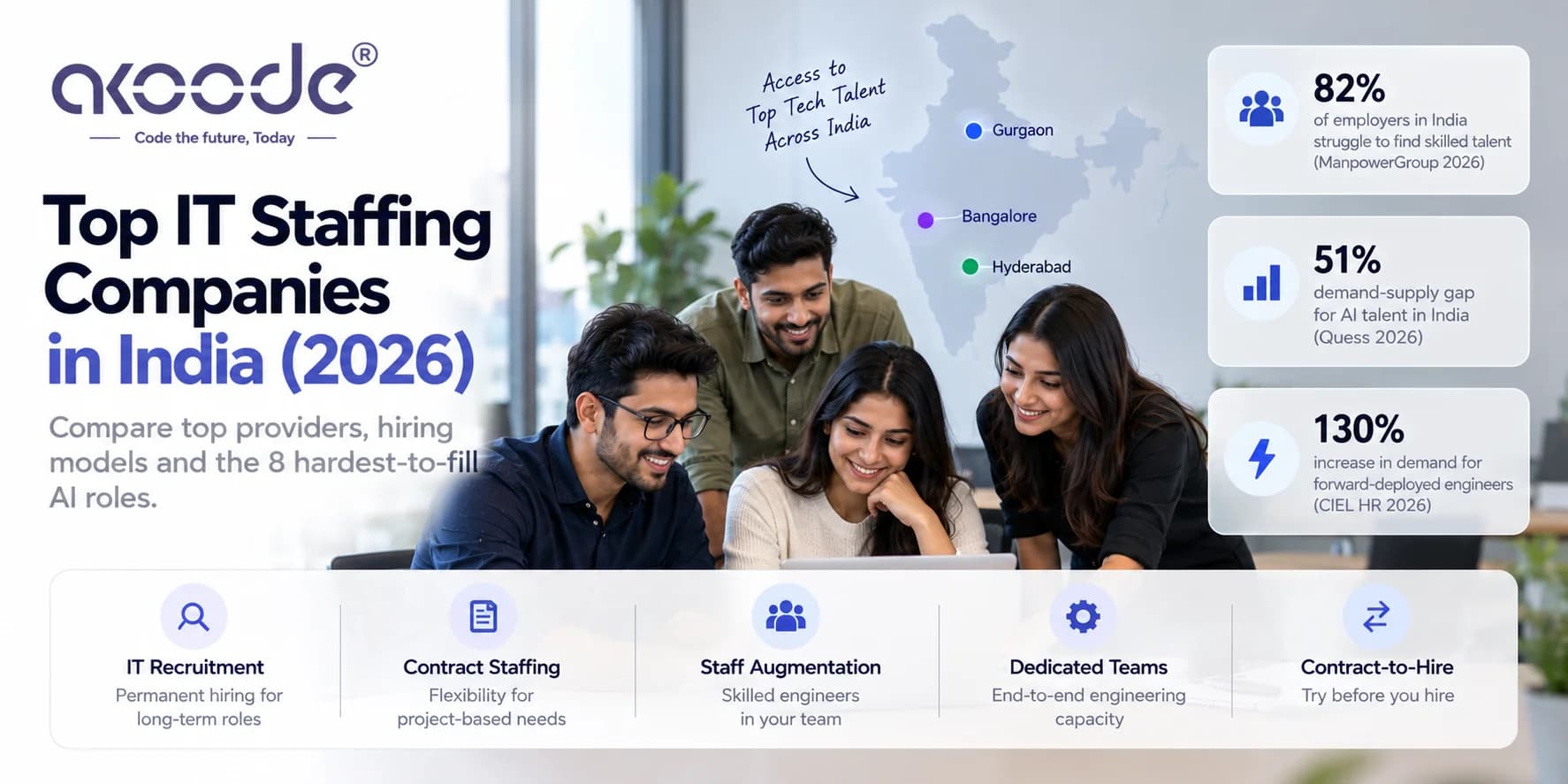
Quess Corp's report on India's AI talent counted about 416,000 AI professionals and a 51% gap between demand and supply, with demand for AI and data talent up roughly 45% between March 2024 and March 2025.
ManpowerGroup's 2026 Talent Shortage Survey found 82% of employers in India struggling to find skilled people, against 72% globally.
Naukri data reported by Reuters showed AI-related hiring in India's IT sector up 16% year on year in June 2026, even while broader IT hiring stayed restrained.
A CIEL HR analysis from August 2026 found demand for forward-deployed engineers up 130% over the year to July 2026, with 52 organisations recruiting for them.
The last point is the telling one. The hardest AI hire is no longer someone who can train a model. It is someone who can put AI into a messy real system and keep it working. Companies are not short of applicants. They are short of people who have done that before, and the normal hiring cycle is slower than the market.
Pick the role before you pick the person
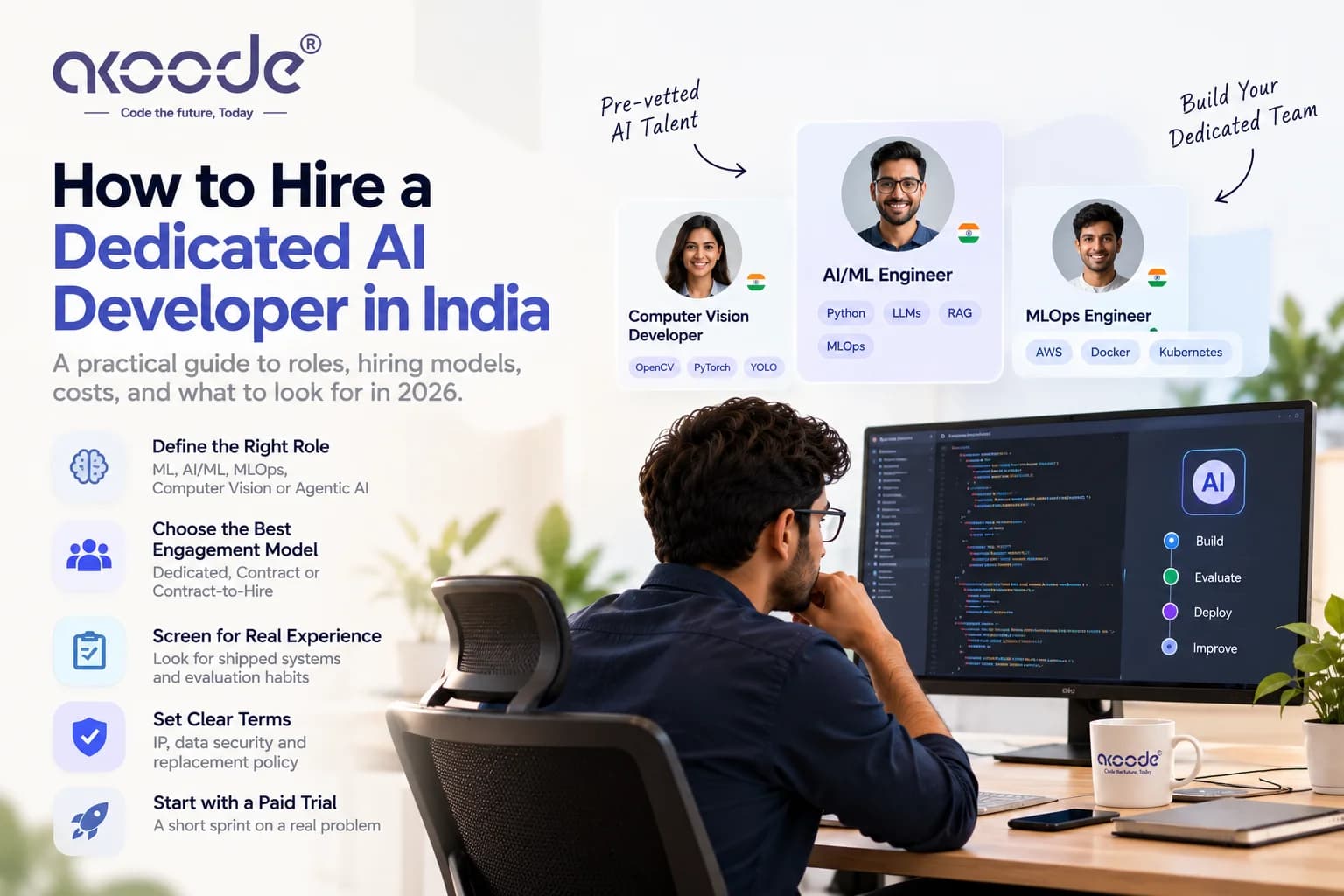
"AI developer" is not a job title anyone can staff precisely. The role you actually need decides the skills, the interview and the engagement. These six cover most dedicated hires.
Role | What they own | A sensible first-30-days deliverable | Common mix-up |
|---|---|---|---|
Machine learning engineer | Training, evaluating and shipping models | A reproducible baseline with an honest evaluation set | Confused with a data scientist |
AI/ML software engineer | The product around the model: APIs, retrieval, agents, integrations | One working workflow with tests and an evaluation harness | Hired as an ML researcher by mistake |
MLOps / AI infrastructure engineer | Pipelines, deployment, monitoring, GPU and cost control | Monitoring and rollback for one live model endpoint | Treated as generic DevOps |
Computer vision engineer | Detection, segmentation, tracking, edge deployment | A cleaned dataset and a baseline model on real footage | Judged on benchmark scores, not live accuracy |
Forward-deployed engineer | Integrating AI into a customer's real systems | A scoped integration plan against one customer workflow | A support engineer with a new title |
Data scientist | Framing questions, experiments, interpretation | A defined analysis with a clear recommendation | Expected to productionise models |
If your need is closer to a software engineer who builds around language models, read how to build an AI app to see what the work involves end to end. If your need is agentic systems, what agentic AI is and our AI agent development practice give useful context. For computer vision, the guide to choosing a computer vision development company covers what good looks like.
The skills that actually separate strong AI developers in 2026
Knowing the tools is table stakes now. What separates people who have shipped AI from people who have studied it is a short list of habits.
They evaluate before they build. They can describe how they decided an output was good enough, with a test set, a metric and an honest view of its limits.
They know where retrieval breaks. Chunking, stale sources, permissions and ranking cause most failures in retrieval-based systems, not the model.
They treat cost and latency as design inputs. A system that works but costs too much per task, or takes too long, does not ship.
They monitor in production. They can describe drift, silent failures and how they found out something had degraded.
They handle data carefully. They know what leaves your environment when a model API is called, and what the contract says about it.
They can explain limits plainly. This matters most for forward-deployed work, where the person talks to non-technical buyers.
For teams building larger agent systems, the guide to enterprise AI agent architectureshows the surrounding engineering a dedicated hire will be expected to understand.
How to hire a dedicated AI developer in India: the seven steps
Write the requirement as a problem, not a title. State the stack, the data you have, what the system must do and what "working" means. A vague brief produces a vague shortlist, however large the candidate pool.
Choose the engagement structure. Individual augmentation, a dedicated team, contract-to-hire or a managed arrangement. The next sections compare them.
Shortlist against the stack. Ask for two or three profiles who have worked on something close to yours, not a dozen general ones.
Run a technical interview on a real problem. Use a question drawn from your own system, and attend the round yourself.
Check references on similar work. One conversation with someone who managed the person on an AI project tells you more than a resume.
Run a paid trial sprint. One to two weeks on a bounded task, scored against criteria you set in advance.
Plan the first ninety days before they start. Access, data, tooling and a first deliverable should be ready on day one.
For the broader version of this process across all developer roles, our guide to how to hire developers in India applies the same logic.
Eight interview questions that reveal real AI experience
Question | A strong answer sounds like | A weak answer sounds like |
|---|---|---|
Tell me about an AI system you shipped that is still running. | Specific users, a number it moved, and what they maintain now | A demo, a notebook or a pilot that ended |
How did you decide the output was good enough? | A test set, a metric, failure categories and a threshold | "We checked a few examples and it looked right" |
What broke after launch? | A concrete incident, how it was detected and what changed | "Nothing major" |
How would you cut the cost per request without hurting quality? | Caching, smaller models for easy cases, routing, prompt trimming, measured against evals | "Use a cheaper model" |
What happens to our data when you call a model API? | Retention terms, region, what is logged, and options to avoid sending sensitive fields | "It should be fine" |
How would you test a feature whose output changes every run? | Evaluation sets, sampling, pass thresholds and regression checks | Manual spot checks only |
Describe a time requirements were unclear and you moved anyway. | A scoping step, a cheap experiment and a decision with evidence | Waiting for a perfect specification |
What would you not build with AI here? | A concrete case where rules or a simple model beat a language model | Everything is a use case |
You do not need to be an AI specialist to run this round. You need to listen for specifics. People who have done the work give details without being prompted, and people who have only read about it give the textbook answer.
Designing a paid trial sprint that tells you the truth
An interview shows how someone talks. A trial sprint shows how they work. Keep it short, paid and tied to a real task.
Pick a bounded problem with its own test. For example, add a retrieval step to an existing support workflow and show answer quality before and after. Or put monitoring and rollback around an existing model endpoint.
Agree the scoring criteria in advance. Problem framing, whether they built an evaluation first, code quality, awareness of cost and latency, security hygiene and how clearly they communicated.
Give them real access, not a sandbox. You learn nothing about integration skill from a toy environment.
Review the work with your own engineers. A second opinion catches both false positives and false negatives.
The contract-to-hire model suits this well, since it turns the trial into a working period with a defined option to convert. It is one of several structures worth comparing.
Engagement structures compared
Structure | Best for | Main trade-off |
|---|---|---|
Single-engineer augmentation | One named skill gap on a team that already has leadership | You provide the direction and the management |
Dedicated team extension | A roadmap bigger than your headcount | Needs enough scope to keep the team busy |
Contract-to-hire | Roles where fit is uncertain | Conversion terms must be agreed up front |
Managed augmentation | Capacity without management overhead on your side | You give up some day-to-day control |
Direct permanent hire | A core role you want on your own payroll | Slow, and hard for scarce AI skills |
Freelance marketplace | A small, well-defined task | Continuity and accountability depend on one person |
A vendor that offers all of these is more likely to recommend the one that fits, rather than the one that closes fastest. If you are weighing augmentation specifically, what staff augmentation services are and how they work explains the mechanics, and our staff augmentation case studies show it in practice.
Contracts, IP and data protection for an AI hire
AI work raises questions that ordinary developer contracts do not cover. Settle these in writing before anyone starts.
Ownership of work product. Code, prompts, evaluation sets, fine-tuned models and weights should be assigned to you from day one, not licensed back.
Training data use. State that your data cannot be used to train anyone else's models, and that the developer will not paste it into tools you have not approved.
Model and API subprocessors. List which model providers and cloud services the developer may use, and where data is processed.
Confidentiality and access. NDAs signed, access provisioned on a least-privilege basis and removed cleanly at the end.
Replacement and notice. How fast a replacement happens if the fit is wrong, and what notice either side owes.
Conversion rights. If you may hire the person permanently, on what terms.
Two Indian regulatory points deserve a place in this conversation. First, the Digital Personal Data Protection Rules were notified in November 2025, and the substantive obligations, including those affecting vendor and processor arrangements, apply from mid-May 2027 under a phased timeline. Law firms advise reviewing vendor and processor contracts well before then, so build the right clauses in now rather than renegotiating later.
Second, India's four Labour Codes took effect on 21 November 2025. Published summaries note that fixed-term employment is now a recognised category and that fixed-term employees become eligible for pro-rata gratuity after one year rather than five. If a provider employs your developer, ask who the employer of record is and how the new rules affect the arrangement. Treat both topics as questions for your legal counsel, not as settled advice from a blog post.
Onboarding and managing a remote dedicated AI developer
The hire does not succeed or fail at the offer. It succeeds or fails in the first ninety days.
Before day one: repository access, CI, project tools, data access and security onboarding ready, so week one is not spent waiting for permissions.
Days one to thirty: a first small deliverable that ships, plus a written understanding of your data and your definition of "good".
Days thirty to sixty: ownership of one workflow end to end, including its evaluation set and monitoring.
Days sixty to ninety: a review against the scoring criteria you set at the start, and a decision on scope, team size or conversion.
Agree overlap hours explicitly, since a few hours of shared working time is worth more than any tool. Manage by outcomes you can observe: evaluation pass rate, latency, cost per task, incidents handled and work merged. Avoid hours logged and lines written, which say little about AI work.
What moves the price of a dedicated AI developer
Quotes vary widely, and a number given without context is rarely reliable. These factors move it:
Seniority and the depth of production AI experience
How scarce the specific skill is, for example MLOps or computer vision versus general application work
Engagement length and structure, whether a single engineer, a team or a managed arrangement
Working-hour overlap with your team and any on-site requirement
Whether the provider includes management, replacement cover and security onboarding
Ask any vendor for a fully loaded quote against your specific role and compare what each one includes. Our guide to what it costs to hire a developer in India covers the budget side, and the one on AI agent development cost helps if you are comparing a hire against a build.
Red flags when a vendor says "dedicated AI developer"
They will not let you interview the specific person you would get.
The profile shown is a representative one, and the real engineer is named later.
Every claim is about tools, none about a shipped system or a number it moved.
They accept "AI engineer" as a complete requirement and never ask about your data.
No clear replacement process, or one that needs lengthy renegotiation.
Vague answers on where your data goes and who can see it.
They cannot explain who the employer of record is.
Pressure to sign quickly, with a discount that expires.
A partner that answers these plainly is usually one you can work with. If you are comparing providers more broadly, how to choose a software development companyand the list of top AI development companies in India may help.
Where Akoode fits, and where it does not
Akoode is a software and AI engineering company in Gurugram with a US office in Jenks, Oklahoma. It holds a 4.9 rating from 126 Google reviews and a 5.0 on GoodFirms, and has delivered 180+ projects across more than 15 industries. Its AI engineers are placed from the same bench that builds client products, and they have shipped systems such as an AI medical diagnostic platform and an AI instructor product for M2 Method in the USA.
By its own published timelines, a single-engineer placement typically goes from requirement to start date in two to three weeks, and a multi-person team takes three to five. Scarce skills can take longer, and Akoode says so up front rather than stretching a weak match to hit a date. You can sit in on the technical screen, and replacement is fast if a placement does not work. The models, process and engagement terms are on the staff augmentation page, and the underlying capability sits in its AI development, RAG application development and cloud and DevOps practices.
It is not the right fit if you need dozens of junior hires, payroll outsourcing, or a pure recruitment mandate. It also works poorly when there is no technical leadership on your side to direct the work, and Akoode will say that in the first call rather than three months in.
Frequently asked questions
What is a dedicated AI developer?
A dedicated AI developer works exclusively on your product for the length of the engagement, rather than being split across several clients. They stay long enough to learn your data and domain, which makes them a better fit for continuous work like retrieval pipelines, agents and model maintenance than for a one-off prototype.
How do I hire a dedicated AI developer in India?
Define the exact role, choose an engagement structure, shortlist engineers who have shipped similar systems, run a technical interview on a real problem, check references, and run a short paid trial sprint. Then agree IP, data handling and replacement terms in writing before the person starts.
How long does it take to hire a dedicated AI developer in India?
By Akoode's own published timelines, a single-engineer placement typically takes two to three weeks and a multi-person team three to five. Scarce skills such as MLOps or computer vision can take longer, and a permanent hire often takes several months.
Dedicated AI developer or AI development company: which should I choose?
Choose a dedicated developer if you have technical leadership and a long roadmap. Choose a development company if you want a vendor to own delivery of a defined outcome, or if nobody on your side can judge whether AI output is good enough.
What skills should a dedicated AI developer have?
Beyond Python and a deep learning or LLM toolkit, look for evaluation habits, knowledge of where retrieval systems fail, attention to cost and latency, production monitoring and careful handling of data. The strongest signal is a shipped system they can still describe in detail.
Can I interview the AI developer before they start?
Yes, and you should. A reputable provider lets you sit in on the technical screening or run your own interview with the exact person you would get, and a short paid trial sprint adds further evidence before you commit.
How much does it cost to hire a dedicated AI developer in India?
It depends on seniority, skill scarcity, engagement length and what the provider includes, such as management, replacement cover and security onboarding. Ask for a fully loaded quote against your specific role rather than relying on a headline rate.
How do I protect my IP and data when hiring an AI developer remotely?
Assign all work product, including prompts, evaluation sets and models, to your company from day one. Restrict data use and approved model providers in writing, provision access on a least-privilege basis, and review vendor terms against India's DPDP Rules, whose substantive obligations apply from mid-May 2027.
Where to go from here
Name the role precisely, test for shipped work and evaluation habits, run a short paid trial, and put IP and data terms in writing. That order protects you better than any rate comparison.
If you are weighing a dedicated AI hire and want a plain answer on whether it fits your situation, or a referral if it does not, you can book a slot with our founder. No pitch deck, just a conversation about the problem you are trying to solve.
Get In Touch Now
View More Our Blog