


 September 3, 2026
How to Choose a Computer Vision Development Company in 2026
Search "computer vision development firm" on Reddit and you'll find the same thread pattern repeating across r/computervision, r/technoyuga, and half a dozen city and industry subreddits: someone has a real problem — a defect-detection line that needs to stop shipping bad parts, a diagnostic tool that needs FDA-adjacent rigor, a fleet of cameras generating footage nobody has time to watch — and they're getting proposals from agencies that clearly built their last three projects with a chatbot wrapper and a stock object-detection model.
The gap isn't a lack of vendors. It's a lack of vendors who can tell you, specifically, why a particular model architecture fits your accuracy and latency budget, how they'll handle the data annotation pipeline no one budgeted for, and what happens six months after deployment when the camera angle changes and the model quietly starts getting worse.
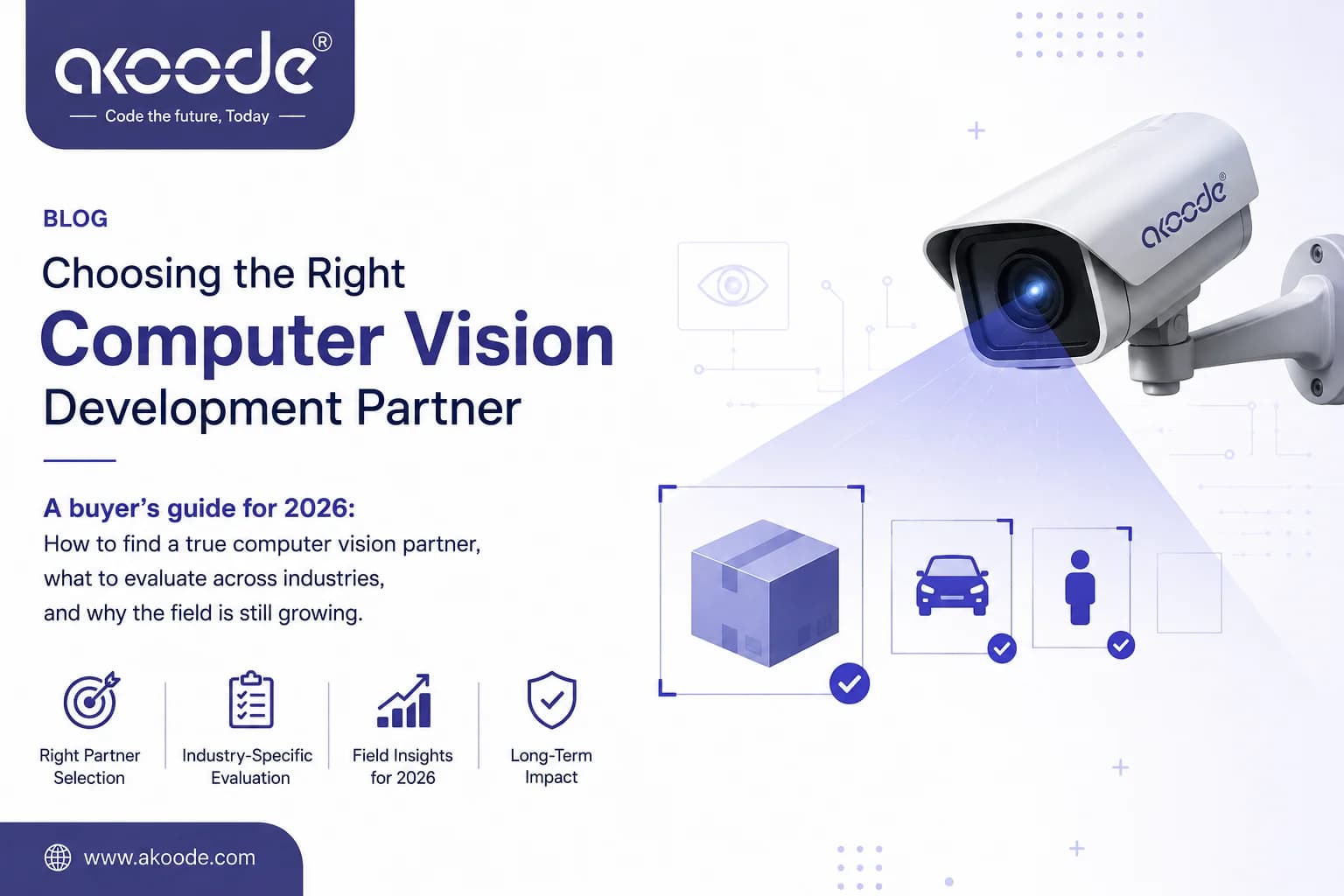
This is a buyer's guide. If you want the technical architecture behind modern CV systems — model families, edge vs. cloud inference, explainability — that's covered in depth in our technical breakdown of computer vision architecture and use cases. Here, the focus is narrower: how to tell a genuine computer vision partner from a generalist AI shop, what that evaluation should look like industry by industry, and whether the field is still worth betting on in the first place.
Is Computer Vision Still a Growing Field in 2026?
Short answer: yes, and the growth curve is arguably steeper now than it was two years ago.
Independent market forecasts published through 2026 diverge on the exact number — estimates for the global computer vision market this year range roughly from the low $20 billions to the high $20 billions, with the AI-specific slice of that market (as opposed to traditional machine vision hardware) growing meaningfully faster. Multiple analysts put compound annual growth somewhere between 12% and 20% through the early 2030s, and the AI-in-computer-vision sub-segment specifically has been tracked growing even faster than that, driven by the shift from rules-based inspection systems to deep learning models that generalize across conditions.
What's actually driving that number, in plain terms:
Manufacturing automation is no longer optional in competitive supply chains. A large majority of facilities running Industry 4.0 initiatives now have some form of vision-based inspection or robotic guidance in place, and that adoption curve is still climbing in mid-market manufacturers who were priced out five years ago.
Multimodal models changed what "computer vision" even means. Systems that combine visual input with text and contextual data can now answer questions about an image rather than just classify it, which has opened use cases — visual quality audits with natural-language reporting, for example — that weren't practical with classification-only models.
Edge hardware caught up. Running real-time inference on a camera-side device without a round trip to the cloud is now commodity-priced, which matters enormously for anything with a latency requirement: safety systems, autonomous navigation, live sports analytics.
Healthcare imaging is a distinct growth pocket of its own, driven less by cost savings and more by the fact that diagnostic-support tools are hitting accuracy benchmarks that make them genuinely useful in high-volume, high-stakes settings like emergency radiology.
So if you're asking whether to build a career in it, start a consulting practice around it, or invest in it as a buyer — the field isn't cooling off. The bar for what counts as a credible vendor in it, however, has gone up considerably, which is the actual problem most of those Reddit threads are describing.
Why So Many "AI Development" Agencies Fail at Computer Vision Specifically
Computer vision gets bundled into general AI development proposals more than almost any other AI discipline, and it's the discipline where that bundling causes the most damage. A few reasons why:
The data problem is different, and it's usually invisible in a proposal. A generative AI chatbot project can often ship with a pretrained model and some prompt engineering. A computer vision project almost never can — it needs a labeled dataset specific to your visual domain, an annotation pipeline (often ongoing, not one-time), and someone who understands class imbalance, occlusion, and lighting variance well enough to know when the dataset itself is the reason accuracy is stuck at 80%.
Deployment context changes the entire architecture decision. A model that hits 99% accuracy on a validation set in a cloud notebook can be functionally useless if it needs to run at 30 frames per second on a $200 edge device on a factory floor. Vendors who haven't shipped real-time CV in physical environments tend to discover this the hard way, on your budget.
Model drift is a computer vision problem more than a text-AI problem. Camera angles shift, lighting changes seasonally, new product SKUs get introduced, and a model that was accurate at launch degrades silently unless someone is monitoring it. Agencies that treat CV like a one-time software delivery rather than a maintained system tend to disappear right around the point drift becomes visible.
Domain vetting matters more here than in most AI work. A computer vision engineer who has shipped retail shelf-analytics systems is not automatically qualified to build a cervical-spine fracture detector, and a firm that presents both under the same generic "AI/ML engineer" bench is telling you something about how they staff projects.
A Vendor Evaluation Framework for Computer Vision Projects
Before you shortlist anyone, get specific, verifiable answers to these questions. Vague answers here are the strongest predictor of a stalled project six months in.
1. What does their annotation and data pipeline actually look like?
Ask who labels the data, how inter-annotator agreement is measured, and what happens when the model encounters an edge case the training set didn't cover. "We use a data labeling tool" is not an answer. "We run active learning to prioritize the frames our model is least confident about, and we re-annotate on a defined cadence" is.
2. Can they justify the model architecture, not just name-drop one?
Any vendor can say "we'll use YOLO" or "we'll fine-tune a vision transformer." Ask why that architecture fits your accuracy, latency, and hardware constraints specifically, and what the fallback plan is if it doesn't hit target performance after the first training run.
3. Do they have real experience with your deployment environment?
Cloud inference, on-premise servers, and edge devices are three different engineering problems with different failure modes. A vendor who has only shipped cloud-based image classification APIs is not the right fit for a real-time factory-floor inspection system, regardless of how strong their model-building skills are.
4. What's their plan for post-deployment monitoring?
A production computer vision system needs drift detection, retraining triggers, and a defined process for when accuracy degrades. If a vendor's proposal ends at "deployment" with no mention of what happens in month four, that's the gap that eventually becomes your emergency.
5. Do they understand the compliance layer for your industry?
Healthcare imaging, automotive safety systems, and financial document verification all carry regulatory weight that a generic AI vendor rarely accounts for at the architecture stage. Ask specifically how they've handled explainability, audit trails, or validation requirements in your sector before, not hypothetically.
6. Can you talk to the engineer, not just the account manager?
For a technically deep discipline like this, insist on a scoping conversation with whoever will actually build the model. If a firm routes every technical question through a non-technical intermediary, you're buying a relay, not a partner.
Computer Vision Use Cases by Industry
The right vendor conversation looks different depending on your industry — not just the use case, but the specific technical risk that matters most. Here's what to prioritize in each.
Healthcare
The dominant use cases are diagnostic image analysis (radiology, pathology, dermatology), surgical guidance, and patient-monitoring systems that flag falls or vital-sign anomalies from video. What to vet for: explainability the clinician can actually act on — a confidence score alone isn't enough, they need to see what the model is responding to — and specialist-comparable accuracy benchmarks validated against real clinical data, not a curated demo set. Akoode's own diagnostic system work, covering vertebra-level spine fracture detection and chest pathology classification with explainable output, is representative of what this bar actually looks like in practice.
Manufacturing
Automated visual inspection, defect detection, and robotic guidance are the core applications, and the majority of Industry 4.0-aligned facilities now run some version of this. What to vet for: real-time performance on the factory floor (not a lab benchmark), and a plan for retraining when a new product line or packaging change alters what "normal" looks like to the model.
Retail
Shelf-analytics, checkout-free store systems, footfall and dwell-time analytics, and loss-prevention monitoring are the common builds. What to vet for: privacy-conscious architecture (especially for anything involving customer-facing cameras) and integration with existing POS and inventory systems, since a vision system that can't talk to inventory data is a novelty, not a tool.
Agriculture
Crop health monitoring, yield estimation, and livestock tracking, often running on drone or fixed-camera footage over large, connectivity-poor areas. What to vet for: lightweight models that can run on constrained infrastructure, since a vendor optimizing purely for cloud accuracy will build something that's unusable in the field it's meant for.
Automotive & Logistics
Driver-assistance systems, in-cabin monitoring, warehouse robotics, and package-condition inspection at scale. What to vet for: latency guarantees (safety-relevant systems have near-zero tolerance for lag) and a track record with the specific sensor stack involved — camera-only pipelines and LiDAR-fused pipelines require genuinely different engineering experience.
Security & Surveillance
Anomaly detection, perimeter monitoring, and access control built on top of existing camera infrastructure. What to vet for: false-positive rates under real operating conditions, not staged demos, and a clear answer on data retention and privacy compliance for whichever jurisdiction you operate in.
Sports & Performance Analytics
Player tracking, movement analysis, and automated tagging from raw match footage, replacing hours of manual video review with structured, queryable data. This is a genuinely narrow specialty — it demands real-time multi-object tracking across a moving camera or wide field of view, which is a different problem from single-frame classification. Akoode built an AI player performance tracking system that turns unstructured game footage into structured coaching data in real time — the case study is a useful reference point for what "real-time multi-object tracking done properly" actually requires from a vendor.
Real Estate & Construction
Site-progress monitoring from drone or fixed-camera footage, property condition assessment, and automated floor-plan or listing-image analysis. What to vet for: the vendor's ability to combine CV output with existing property or project-management data, since raw detections are far less useful than detections tied back into a workflow someone actually uses.
Should You Build an In-House Team or Hire a Computer Vision Partner?
The Reddit threads asking about starting a computer vision consulting business are really asking the flip side of the buyer question: is there enough unmet demand to justify specializing? Given the vendor quality gap described above, yes — but the businesses succeeding in that space aren't generalist AI consultancies. They're teams that pick a narrow domain (medical imaging, industrial inspection, retail analytics) and go deep enough to be the obvious answer when someone searches for it.
For buyers, the build-vs-partner decision usually comes down to three questions:
Is this a core, ongoing capability or a defined project? A retailer building shelf-analytics as a permanent competitive asset has a different calculus than a manufacturer that needs one inspection line automated.
Do you have the annotation and MLOps muscle to maintain a model after launch? If not, a vendor relationship that includes ongoing monitoring is worth more than a one-time model handoff, no matter how good the initial accuracy number looks.
How scarce is the specific skill you need right now? AI and computer vision specialists remain one of the harder roles to hire permanently in most markets, which is exactly why staff augmentation and specialist partnerships have become the default path for teams that need this capability without a multi-quarter hiring cycle.
Red Flags When Vetting a Computer Vision Vendor
They can't explain their annotation process beyond "we label the data"
Every case study is a demo on a public dataset, not a deployed production system
No mention of drift monitoring, retraining cadence, or post-launch support
The same "AI engineers" are pitched for computer vision, chatbots, and predictive analytics work with no domain distinction
Compliance and data-handling questions get generic answers instead of sector-specific ones
Pricing is quoted before scoping — a real computer vision engagement can't be priced accurately without understanding your data, environment, and accuracy requirements first
Why Teams Choose Akoode for Computer Vision Development
Akoode holds a 4.9 Google rating from 110+ reviews and a 5.0 out of 5 on GoodFirms, built on delivery across 15+ industries rather than a narrow niche. On computer vision specifically, that includes real-time multi-object tracking for sports performance analytics and diagnostic imaging systems built to specialist-comparable accuracy with explainable output clinicians can actually act on — the kind of domain-specific, production-grade work the evaluation framework above is designed to filter for.
If you're scoping a computer vision project and want a technical conversation rather than a sales pitch, our AI development services page covers the broader engineering bench, and Akhil, Akoode's founder, takes scoping calls directly.
Frequently Asked Questions
How do I find a good computer vision development company? Start by filtering out generalist AI agencies that list computer vision as one line item among many. Ask for production case studies (not dataset demos), get specific answers on their annotation pipeline and post-deployment monitoring process, and insist on a scoping conversation with the engineer who would actually build the model, not just an account manager.
Is computer vision still a growing field in AI, or is the opportunity gone? It's still growing, and by most 2026 forecasts, growing faster than the broader software market. The AI-specific segment of computer vision in particular is expanding quickly as multimodal models and cheaper edge hardware open use cases that weren't practical a few years ago. The bar for vendor quality has risen alongside it, which is the real shift.
What should healthcare companies look for in a computer vision vendor? Explainable output the clinician can act on, accuracy benchmarked against specialist-level performance rather than a generic validation set, and demonstrated experience with the specific compliance and data-handling requirements of medical imaging — not general AI development experience stretched to fit.
What's the difference between a general AI development agency and a computer vision specialist? A general AI agency can usually handle chatbots, predictive analytics, and light automation competently. Computer vision specifically requires domain expertise in data annotation pipelines, model architecture trade-offs for latency and hardware constraints, and post-deployment drift monitoring — skills that don't transfer automatically from other AI disciplines.
Can I hire computer vision developers for a short, defined project rather than a long-term engagement? Yes. Project-based staff augmentation is common for computer vision specifically, since the skill is scarce enough that most teams don't need it as a permanent headcount line. A defined scope, a clear handover plan, and post-launch monitoring built into the engagement from the outset are the details that separate a clean short-term project from one that quietly becomes a support burden nobody budgeted for.
Do computer vision projects need ongoing maintenance after launch? Almost always. Camera angles shift, lighting changes, and new product or process variations appear over time, all of which can degrade model accuracy silently. A credible vendor will build monitoring and a retraining cadence into the engagement rather than treating deployment as the finish line.
Get In Touch Now
View More Our Blog