


 August 22, 2026
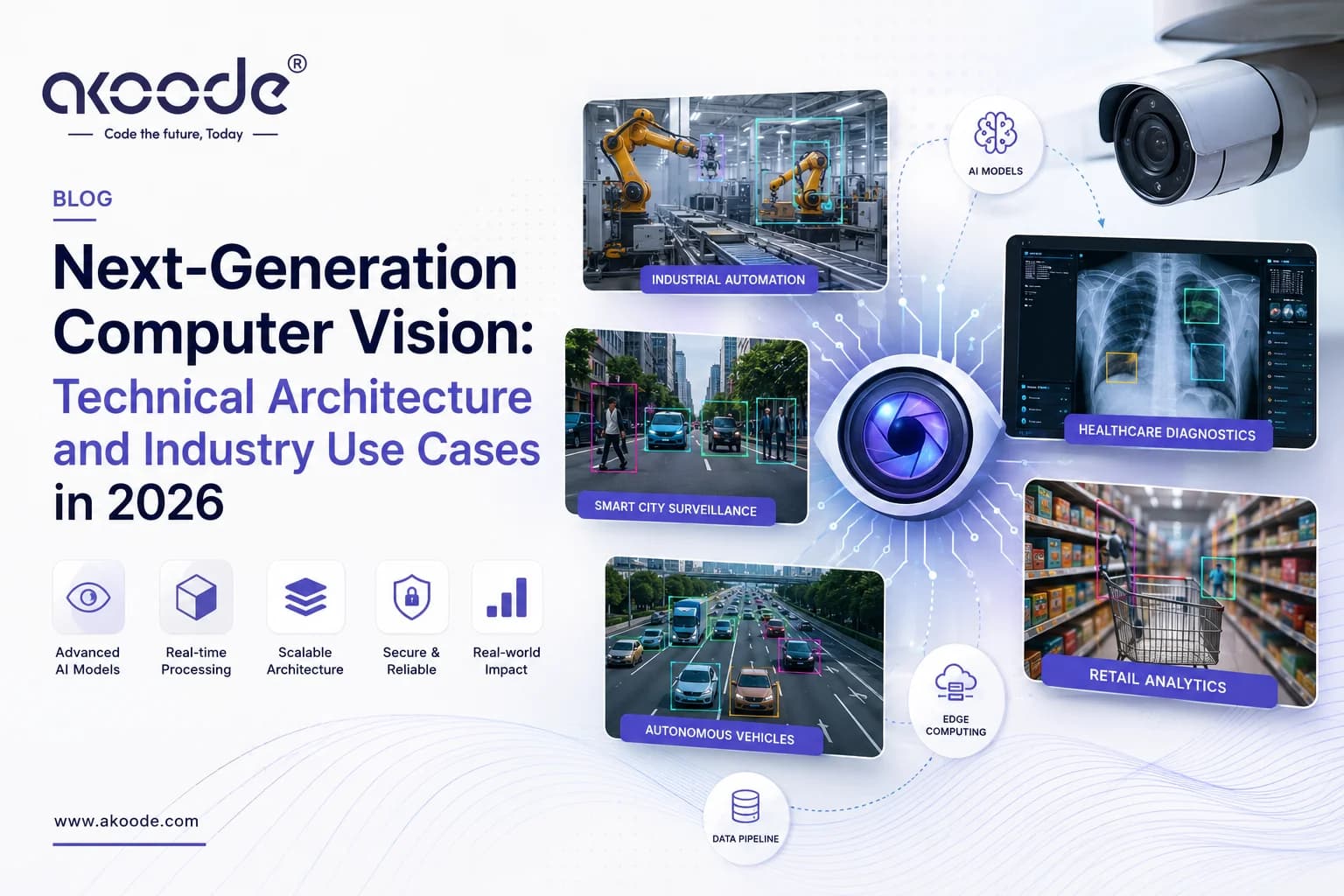
Computer vision stopped being a research topic a while ago. What's changed more recently is the shape of what's being built: fewer narrow, single-purpose detectors, more systems that combine detection, tracking, language, and reasoning into a single pipeline that can actually operate in the messy, inconsistent conditions of the real world — a factory floor, a stadium, a construction site, a hospital. It's one of the fastest-moving areas within AI development right now, precisely because the underlying models have gotten good enough to handle real-world variability rather than just clean lab conditions.
This article isn't about pricing. It's about what's technically different in computer vision systems being built now versus three or four years ago, how the architecture behind a production-grade system is actually put together, and where the strongest industry use cases are heading next.
What's Actually New in Computer Vision Right Now
A few shifts define what "next-generation" means in practice:
Vision-language models (VLMs). Instead of a detector trained to recognize a fixed list of object classes, newer systems can be prompted in natural language — "flag any pallet blocking the emergency exit" — and reason about a scene rather than just classify it against a predefined label set. This collapses a category of work that used to require retraining a model for every new detection target.
Foundation models fine-tuned for narrow tasks. Rather than training detection models from scratch, most production systems now start from a large pretrained vision model and fine-tune it on a smaller, domain-specific dataset. This cuts development time significantly and tends to generalize better to conditions the original training data didn't cover.
Edge inference. Running detection models directly on-device — a camera, a local server, an industrial controller — rather than sending every frame to the cloud. This matters for latency-sensitive applications and for environments where sending raw footage off-site isn't acceptable for privacy or connectivity reasons.
Multi-sensor and multimodal fusion. Combining camera input with other sensor types — depth cameras, LiDAR, thermal imaging, audio — to get a more reliable read on a scene than vision alone can provide, particularly in safety-critical applications.
Synthetic data generation. Generating realistic synthetic training images to cover rare edge cases (a specific defect type, an unusual lighting condition, a low-frequency safety event) that would otherwise take a long time to collect naturally.
Self-supervised and few-shot learning. Reducing how much labeled data a system needs before it performs reliably — increasingly relevant for domains where labeled examples are scarce or expensive to produce, like specialized industrial inspection or medical imaging.
None of these replace the fundamentals — detection, tracking, segmentation are still the backbone of most systems. What's changed is how fast a system can be adapted to a new use case, and how well it holds up outside a clean lab environment.
The Architecture Behind a Production Computer Vision System
A real-world computer vision pipeline has more moving parts than the detection model that usually gets all the attention. Five layers show up consistently across serious builds:
1. Ingestion Layer
Raw visual data — live camera feeds, uploaded video, batches of images — has to get into the system reliably before anything else can happen. For live, multi-camera systems, this means a streaming pipeline that can handle several simultaneous high-resolution sources without dropping frames. For batch systems, it's a processing queue that scales with volume without creating a backlog.
2. Detection and Tracking Layer
This is where the core AI models run — object detection, classification, segmentation, and, where objects move across frames, tracking and re-identification. Re-identification matters specifically in any scene with multiple similar-looking objects or people: it's what keeps a system from losing or swapping identities when two people cross paths or a product passes behind another on a conveyor.
3. Contextual Reasoning Layer
Increasingly, this is where vision-language models sit — taking raw detections and reasoning about what they mean in context. A detection model can identify "person" and "forklift." A reasoning layer can flag "person within two meters of an active forklift," which is the actual safety condition anyone cares about.
4. Output and Decision Layer
Detections and reasoning outputs get translated into something usable: an alert, a structured record, a dashboard metric, a triggered workflow. This layer is frequently underestimated in scoping — it's often as much engineering effort as the detection model itself, and it's where the actual business value gets delivered.
5. MLOps and Monitoring Layer
Production computer vision systems degrade over time if nobody watches them — new camera hardware, a repainted facility, a new product line, or a seasonal lighting change can all quietly reduce detection accuracy. A monitoring layer that tracks confidence scores and flags drift, paired with a retraining pipeline, is what separates a system that stays reliable for years from one that needs a full rebuild every time conditions shift.
Engineering Challenges That Actually Determine System Quality
Occlusion and overlap. Real scenes involve objects and people blocking each other constantly. Standard frame-to-frame tracking breaks down here — re-identification models that assign persistent identities surviving temporary visual obstruction are what keep tracking accurate through collisions and crowding.
Lighting and environmental variance. A model trained on a narrow set of lighting conditions will degrade the moment conditions shift — different time of day, weather, or venue. Training data augmented across a realistic range of conditions is what keeps detection accurate outside the lab.
Latency at scale. Real-time systems processing many simultaneous high-resolution feeds need a genuinely parallel, GPU-accelerated pipeline — this is an infrastructure problem as much as a model problem, and it's usually where naive implementations fail first.
Data volume. High-resolution video at high frame rates generates enormous amounts of raw data. Systems that don't plan a tiered storage strategy — fast access for recent, frequently queried footage; cost-efficient archiving for older sessions — hit bottlenecks fast.
Edge deployment constraints. Running inference on local hardware instead of the cloud means the model itself often needs to be optimized — quantized or distilled — to run efficiently within the compute and power limits of the device it's deployed on.
Industry-Wise Use Cases: Where Computer Vision Is Heading Next
Manufacturing and Quality Inspection
Beyond simple pass/fail defect detection, next-generation systems are moving toward predictive quality — flagging subtle process drift (a slight change in a weld pattern, a gradual shift in material consistency) before it produces a defective unit, rather than catching the defect after the fact. Vision-language reasoning is also starting to replace rigid rule-based inspection logic, letting inspection systems be reconfigured with a natural-language description of a new defect type instead of a full retraining cycle.
Retail and Inventory
Modern retail vision systems increasingly combine shelf-monitoring cameras with point-of-sale and inventory data to catch out-of-stock conditions in near real time, rather than relying on periodic manual counts. Multimodal fusion — combining vision with weight sensors on smart shelves, for example — is improving accuracy on notoriously hard problems like small or visually similar items.
Security and Safety Monitoring
The shift here is from passive recording to active, reasoning-based monitoring: instead of a human reviewing footage after an incident, vision-language models can flag context-specific conditions in real time — a restricted area breach, unsafe proximity between people and machinery, unattended objects in sensitive zones — dramatically reducing the volume of footage a human ever needs to review directly.
Healthcare Imaging Support
Computer vision is increasingly used to support — not replace — clinical review, flagging regions of interest in medical images for a specialist's attention and helping prioritize case review order. Data privacy requirements make on-premise or edge deployment particularly relevant in this industry, since imaging data often can't leave a clinical environment.
Construction and Engineering
Document and drawing-based computer vision — detecting materials, fixtures, and measurements directly from architectural and engineering drawings — is replacing manual quantity takeoff processes that used to consume hours per project. Because these drawings frequently contain proprietary project data, offline processing (no cloud dependency) is a common requirement in this space, which shapes both the model architecture and the deployment approach.
Sports and Performance Analytics
Real-time, multi-camera player tracking is moving from a novelty for top-tier professional teams toward a broader tool for performance analysis at more levels of competitive sport. The technical bar is high: tracking many players simultaneously through fast movement, collisions, and changing camera angles, then converting raw tracking data into structured performance metrics coaches can act on immediately rather than after a lengthy manual review.
Logistics and Transportation
Vision systems are increasingly used for automated damage inspection at intake and dispatch points, load verification, and dock-door monitoring, cutting the manual inspection time that used to be a fixed bottleneck in high-volume logistics operations. Real-time tracking of assets moving through a facility is a natural extension of the same underlying detection and re-identification technology used in other industries.
Document Processing and Finance
Optical character recognition combined with layout understanding is powering next-generation document processing that goes beyond simple text extraction — understanding table structure, form context, and cross-referencing extracted data against existing records automatically, which is a meaningfully different (and more useful) capability than OCR alone provided a few years ago.
Case Study: Real-Time Multi-Camera Player Tracking
A useful illustration of several of the technical themes above is a platform Akoode built for a professional American football coaching organization — the full AI player performance tracking case study is on our site.
The technical brief combined nearly every hard problem covered in this article at once: ingest raw footage from up to 15 simultaneous camera feeds at 4K resolution and 60fps, detect and track every player on the field through constant overlap and collision, maintain consistent player identity through that occlusion using re-identification models, and calculate speed, acceleration, distance, and movement angle for each player — all fast enough for coaching staff to receive structured results the same day footage is captured.
Each of the core engineering challenges in this article showed up directly in the build. Latency at scale was solved with a GPU-accelerated streaming pipeline processing every camera feed in parallel with sub-second latency. Occlusion and player overlap — a near-constant condition in live football — required re-identification models that preserve a player's tracked identity through collisions and crowding rather than losing or swapping it. Lighting variance across different stadiums and match conditions meant training data had to be deliberately augmented across a wide range of lighting scenarios rather than a single clean baseline. And the sheer data volume from 4K footage at 60fps across 15 feeds required a tiered storage architecture to keep recent, frequently accessed sessions fast to retrieve while archiving older footage efficiently.
The system now maintains 94% multi-player tracking accuracy across play types, including high-speed movement and full-contact collisions, and delivers structured performance data in the time it used to take an analyst to manually review a fraction of the same footage. It's a good reference point for what "next-generation" actually means in computer vision: not a single breakthrough model, but detection, tracking, real-time infrastructure, and a monitoring/output layer all engineered to hold up under real, unpredictable conditions.
What to Evaluate in a Computer Vision Development Partner
Depth in the full pipeline, not just model training — ingestion, tracking, and output engineering typically carry as much risk and effort as the detection model itself
Evidence of systems running in production, not just proof-of-concept demos, since real-world conditions expose gaps a controlled test never will
Specific experience with your constraints — real-time processing, offline/edge deployment, or multi-sensor fusion all require prior, hands-on experience with those exact problems
A monitoring and retraining plan, since detection accuracy degrades over time as real-world conditions shift
Comfort working across vision-language and traditional detection models, since most next-generation systems now combine both rather than relying on one approach alone
Akoode Technologies builds computer vision systems across industries where the visual data is complex and off-the-shelf tools don't fit the problem — from real-time, multi-camera sports analytics to offline, document-based detection for construction and engineering workflows. We work with manufacturing, security, sports, and engineering organizations across the US, UK, and Canada, and the engineering considerations above — real-time infrastructure, edge deployment, monitoring for drift — hold regardless of market.
Frequently Asked Questions
What makes a computer vision system "next-generation" compared to older approaches?
The combination of vision-language reasoning (not just fixed-category detection), foundation models fine-tuned for narrow tasks instead of trained from scratch, edge inference for latency and privacy-sensitive use cases, and multimodal fusion combining vision with other sensor types.
What's the difference between object detection and object tracking?
Detection identifies and locates an object within a single frame. Tracking follows that same object's movement and identity across multiple frames over time — most real-world systems need both working together.
Why do computer vision systems perform worse in production than in testing?
Usually because training and validation happened on clean, controlled data that doesn't reflect real-world lighting variance, occlusion, camera angle changes, or edge cases the system will actually encounter once deployed.
What is re-identification, and why does it matter?
Re-identification is what allows a system to maintain a consistent identity for a tracked object or person even when they're temporarily blocked from view or overlap with something else — without it, tracking breaks every time two objects cross paths.
Can computer vision run without sending data to the cloud?
Yes — edge or on-premise deployment is increasingly common, particularly where data privacy, connectivity, or latency requirements make cloud processing impractical. It requires optimizing the model to run efficiently on local hardware.
How do vision-language models change what's possible?
They let a system reason about a scene using natural-language instructions rather than requiring retraining for every new detection target, which significantly speeds up how quickly a computer vision system can be adapted to new use cases.
Do computer vision models need retraining over time?
Generally yes. Real-world conditions shift — new hardware, new environments, seasonal changes — and a monitoring layer that tracks detection confidence over time is what signals when retraining is needed.
What industries are adopting next-generation computer vision fastest?
Manufacturing, security, logistics, sports analytics, and construction/engineering are seeing some of the fastest adoption, largely because each has high-volume visual data and a manual review bottleneck that vision-language and real-time tracking capabilities directly address.
Final Thoughts
The technical bar for computer vision has moved. It's no longer just about whether a model can detect an object in a clean test image — it's about whether a full pipeline can hold up in real, unpredictable conditions: constant occlusion, shifting lighting, high data volume, and the need to translate raw detections into something a business can actually act on. The industries getting the most value right now are the ones treating computer vision as a systems-engineering problem, not just a model-selection one.
If you're exploring a computer vision project — whatever the industry or technical constraints — it's worth talking through the specific conditions, data, and reliability requirements before scoping anything. Book a time to talk it through.
Get In Touch Now
View More Our Blog