


 September 7, 2026
The first two guides in this series covered how to hire developers in India without the outsourcing horror stories, and what it actually costs once you account for rates, engagement models, and the hidden line items most budgets miss. Both guides say the same thing in different ways: the number one predictor of a good outcome is verifiable delivery history, not a polished pitch.
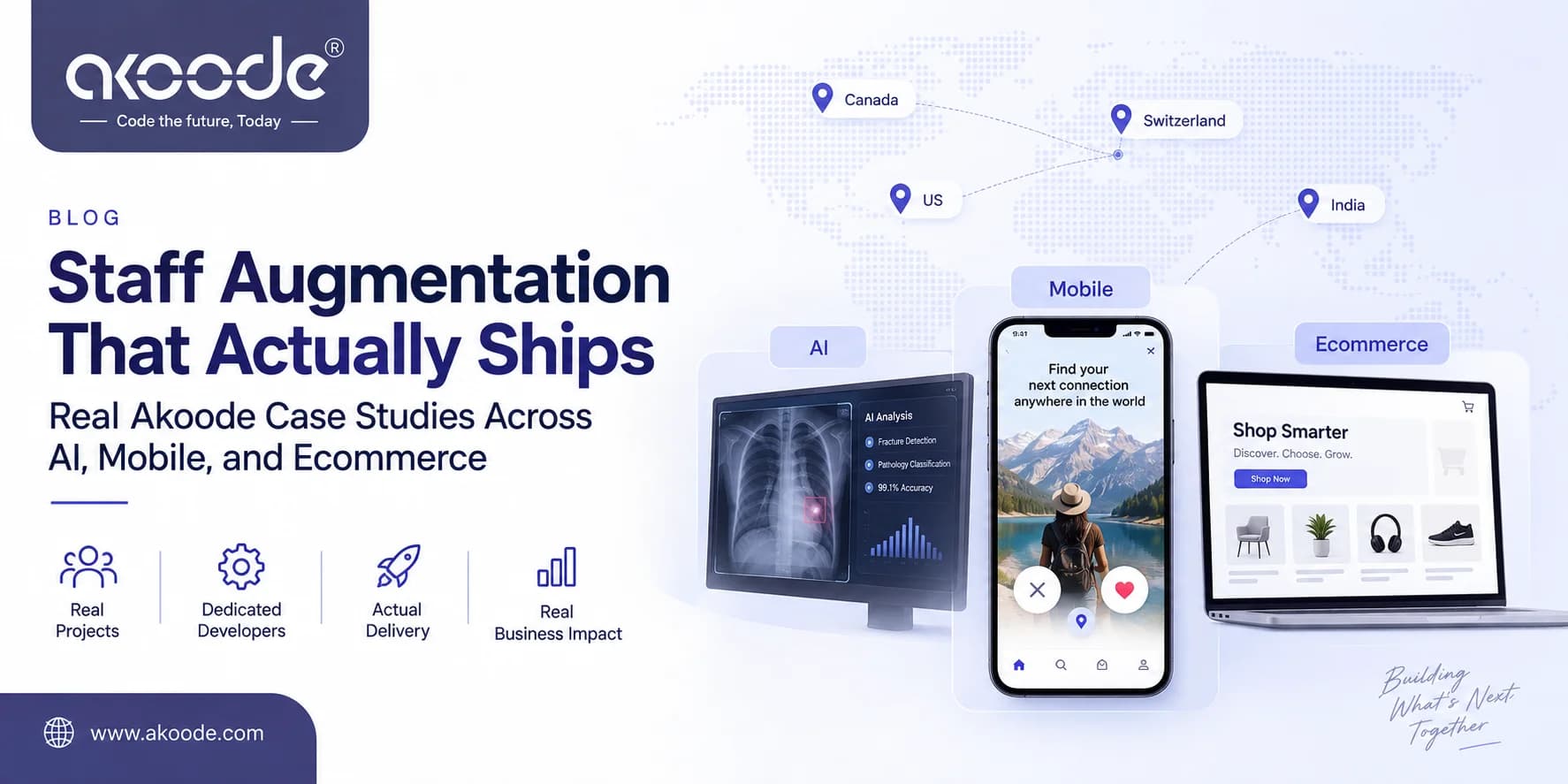
So here's the delivery history. Not a logo wall — six real engagements, across AI, mobile, and ecommerce, for clients in the US, Canada, Switzerland, and India, each with the actual problem, the actual build, and what shipped. If you're evaluating a staff augmentation partner and want to know what "verifiable delivery history" is supposed to look like when you ask a vendor for it, this is the shape of the answer.
Why Breadth Across Domains Actually Matters for Staff Augmentation
A staff augmentation bench that can only do one kind of project is a red flag disguised as a specialty. The whole premise of dedicated developer engagements is that you get the right skill set matched to your specific need — which only works if the bench genuinely spans different domains, stacks, and problem types, not just different client logos wrapped around the same template build.
The six projects below aren't chosen because they're the flashiest. They're chosen because they represent genuinely different engineering problems — real-time video infrastructure, volumetric medical imaging, offline document analysis, subscription commerce, ML-driven matching — solved by the same team, under the same delivery standard, for clients who found Akoode through exactly the kind of vetting process the earlier guides in this series describe.
A Travel Dating App With No Existing Reference Implementation
Mifever, Switzerland came to Akoode with a genuinely novel product brief: a dating app that matches users on where they're traveling next, not just where they currently are. No existing dating platform had built anything like it — there was no reference implementation to adapt, which meant every core mechanic had to be engineered from scratch.
Akoode built the full cross-platform iOS and Android application: an ML recommendation engine incorporating travel destinations and future trip dates, a real-time "thermometer" compatibility scoring system that updates live as users interact with profiles, WebRTC-powered speed-dating video calls that initiate within seconds of a mutual match, and a full three-tier freemium subscription system with native Apple and Google billing. Every feature defined in the original specification shipped — 100% of scope, across both platforms, without deferring any of the harder mechanics to a later phase. Read the full case study.
For anyone evaluating a partner for genuinely novel product work — not a template rebuild — this is the relevant proof point: the willingness and technical depth to build mechanics with no existing playbook, delivered to spec.
An AI Diagnostic System Where a Missed Detection Has Real Clinical Cost
For a confidential healthcare client in India, Akoode built the Sahayak Diagnostic Orchestrator — a dual-stream clinical decision support system detecting cervical spine fractures and chest pathologies directly from CT scans and X-rays in emergency radiology settings, where diagnostic delay carries genuine clinical risk. The system combines a hybrid EfficientNetV2-B3 and BiGRU architecture for volumetric spine analysis with ensemble classification for chest pathology, running at 99.1% and 98.4% accuracy respectively, with a 41-millisecond inference time and Grad-CAM visual explainability on every finding so a radiologist can see exactly what drove a given classification. Read the full case study.
This is the standard worth holding any AI staff augmentation candidate to: not a demo notebook, a system deployed where the accuracy benchmark has real consequences attached to it.
An AI Quantity Takeoff Platform Built Around a Hard No-Cloud Constraint
Qualis Construction Ltd., Canada, needed to automate a manual, hours-per-project process: detecting materials, fixtures, and measurements directly from architectural and engineering drawings. The binding constraint wasn't speed — it was data sensitivity. Architectural drawings routinely contain proprietary project information that legally and contractually couldn't leave the client's own environment, which made offline, on-premise processing a hard requirement rather than a nice-to-have.
Akoode built the detection system around that constraint from the start, rather than building a cloud-first solution and retrofitting it for offline use. Read the full case study.
This is a useful proof point specifically for the vetting question raised in the cost and hiring guides: does the partner start from your actual constraint, or from their default architecture? Here, the constraint shaped the entire build from day one.
An AI Mobile App Rebuilt From a Desktop Prototype in Days, Not Months
M2 Method, USA, a California pelvic health programme, had already validated an AI pose-detection proof of concept in Python, running on a desktop with OpenCV. What they needed was a production mobile application — a genuinely different engineering problem, since the validated logic had to be rebuilt for on-device inference on consumer smartphones with a hard 300-millisecond feedback ceiling, given that a correction that arrives late doesn't help someone mid-exercise.
Akoode rebuilt the pose-detection and correction logic as an on-device system using pre-trained MediaPipe models within a Flutter application, converting the desktop Python prototype into a production app now live on both the Apple App Store and Google Play Store, with real-time audio and visual corrective feedback for a therapeutic exercise context where accuracy carries real safety weight. Read the full case study.
For anyone evaluating a partner on the specific question of "can you productionize a validated prototype without losing what made it work" — this is exactly that engagement.
Connecting a Full Commerce Journey, Not Just a Storefront
For a precious metals retailer serving customers in Canada, Akoode designed and built a complete OpenCart ecommerce platform — product catalogue, cart, checkout, payment gateway integration, customer accounts, and order history — treated as one connected buying journey rather than a set of screens reviewed in isolation. The engineering challenge wasn't any single screen; it was keeping cart state, checkout, payment response, and order records consistently linked as a customer moved through the purchase flow, while also giving the business's service-based offerings (refinery support, storage, buy-back) a distinct navigational path from the product catalogue. Read the full case study.
This is a good example of unglamorous, high-stakes ecommerce engineering — the kind of work that doesn't produce a flashy feature list but determines whether customers can actually complete a purchase without the journey breaking somewhere in the middle.
A Player Tracking System Processing 15 Camera Feeds in Real Time
For a professional American football coaching organization, Akoode built a real-time player tracking system processing up to 15 simultaneous 4K camera feeds at 60 frames per second, with results delivered the same day footage was captured rather than after a multi-day manual review cycle. The system runs on a GPU-accelerated streaming pipeline with re-identification logic to maintain consistent player tracking through collisions and occlusion, now operating at 94% multi-player tracking accuracy across play types including full-contact collisions. Read the full case study.
This is the reference point for anything genuinely latency-bound and compute-intensive — the kind of real-time computer vision work that separates a team that's built production systems from one that's only trained models in a notebook.
What These Six Projects Have in Common
Different stacks, different countries, different industries — the technology choices in each case study were driven entirely by the specific constraint of that project, not a house template applied regardless of fit. What's consistent across all six is the standard: full scope delivered as specified, the specific binding constraint (latency, data residency, clinical accuracy, novel product mechanics) addressed as the starting point of the architecture rather than an afterthought, and a named point of contact accountable for the outcome rather than a project disappearing into an anonymous delivery queue.
That consistency is what a staff augmentation relationship is actually supposed to buy you. The vetting framework in our hiring guide and the engagement-model breakdown in our cost guide both point at the same underlying question — can this partner show you real, specific, verifiable delivery — and this is Akoode's answer to that question in practice rather than in promises.
Why Companies Work With Akoode for Staff Augmentation
Akoode runs dual offices in Gurugram, India and Jenks, Oklahoma, USA, holds a 4.9 Google rating from 110+ reviews and a 5.0 out of 5 on GoodFirms, and has delivered 180+ projects across 15+ industries. The engineers behind the six projects above are the same bench available through Akoode's staff augmentation service — not a separate, less-vetted tier shown to prospects versus what's actually staffed on projects.
That bench spans software development, AI and machine learning engineering, and ecommerce platform development— the same three service areas covered across the case studies above. If you're evaluating a dedicated developer or team for an upcoming project and want to talk through the specifics, Akhil, Akoode's founder, takes scoping calls directly — the same conversation any of the clients above started with.
Frequently Asked Questions
What kinds of projects has Akoode delivered through staff augmentation and dedicated development? Projects spanning AI diagnostic systems, real-time computer vision, mobile app development, ecommerce platforms, and novel consumer product builds — for clients in the US, Canada, Switzerland, and India. The common thread is full scope delivered against a real, specific constraint (latency, data residency, clinical accuracy, or genuinely novel product mechanics) rather than a generic template applied across every engagement.
Can I see examples of Akoode's work before committing to a staff augmentation engagement? Yes — the case studies referenced throughout this guide, along with the full library at Akoode's case studies page, are public and detail the actual problem, engineering approach, and delivered outcome for each project, including named clients where the client has agreed to be identified.
Does Akoode work with international clients outside India? Yes. The case studies above include clients in the United States, Canada, and Switzerland, and Akoode maintains a dual-office structure in Gurugram, India and Jenks, Oklahoma specifically to support international clients with a point of contact in their own time zone.
How do I know if Akoode's staff augmentation model fits my project? The clearest signal is whether your project has a real binding constraint — a latency requirement, a data-residency rule, an accuracy bar with real consequences, or a genuinely novel product mechanic with no existing template. If so, a scoping conversation is the fastest way to find out whether the fit is right, without committing to anything upfront
Get In Touch Now
View More Our Blog