



 September 6, 2026
The honest answer is a range, not a number, and anyone who quotes you a single flat rate before understanding your project is skipping a step. In 2026, hiring a developer in India typically costs somewhere between $15 and $80 per hour depending on seniority, specialization, and engagement model — with junior developers at the low end, mid-level engineers in the middle, and senior specialists in AI, cloud, or architecture-heavy roles at the top. A full-time equivalent hire, structured as a dedicated developer through a company rather than an hourly freelancer, typically lands in the $1,500 to $7,000-a-month range depending on the role and experience level.
That headline range is where most articles stop, and it's also where most budgeting mistakes start. The number that actually matters is the fully-loaded cost after project management, onboarding, quality assurance, and the difference between a raw offshore rate and a rate that includes real accountability — and that's the gap this guide is built to close, along with the practical questions that come right after the cost question: where to actually source developers, how to vet them, and what the process looks like for the specific roles companies ask about most.
India Developer Hourly Rates in 2026
Rates vary by role and seniority more than by city at this point — Tier-1 hubs like Bengaluru, Mumbai, and Hyderabad command a premium over Tier-2 cities, but the bigger driver of price is what the developer actually does and how many years of production experience they carry.
General software development:
Junior developers (0–2 years): $15–$25/hour
Mid-level developers (3–5 years): $25–$50/hour
Senior developers and architects (6+ years): $40–$80+/hour
By specialization:
Frontend developers (HTML/CSS, React, Angular, Vue): $18–$40/hour
Backend developers (Node.js, Python, PHP, Java, .NET): $20–$45/hour
Full-stack developers: $25–$55/hour depending on stack and seniority
Mobile developers (React Native, Flutter, native iOS/Android): $20–$60/hour
AI and machine learning engineers: $40–$90+/hour, with senior specialists in LLM, computer vision, or applied ML work commanding the top of that range given how scarce the skill set is globally, not just in India
These figures are billing rates — what a client pays — not what the individual developer takes home, since a portion covers the company's overhead, project management, and the accountability structure around the engagement. A freelancer on an open marketplace will often quote lower than these ranges, and a large enterprise IT services firm will often quote higher; the ranges above reflect the middle ground where most legitimate boutique and mid-size Indian development companies actually price.
One nuance worth flagging early: the commonly repeated "save 40–70% by hiring in India" figure is usually comparing a raw India billing rate against a fully-loaded US contractor rate, which overstates the real gap. Once you add project management, onboarding time, and any rework from a mismatched engagement, realistic net savings for most companies land closer to 30–50% rather than the headline number — still substantial, but worth budgeting for accurately rather than expecting the best-case figure by default.
How Engagement Models Are Actually Priced
The hourly rate is only meaningful once you know which pricing structure it sits inside, and the three common models carry genuinely different trade-offs, not just different math.
Hourly billing. You pay for time logged, typically with a monthly cap or estimate. This fits well for short, well-defined tasks or when scope is genuinely uncertain and you want to pay only for actual work done. The risk is less predictability on total spend, and it can incentivize slower work if the vendor relationship isn't built on trust and transparent time tracking.
Dedicated monthly retainer. You pay a flat monthly rate for one or more developers allocated fully to your project, regardless of exact hours logged in a given week. This is the standard structure for an ongoing staff augmentation relationship, and it's generally the best fit once an engagement moves past the first few weeks — it removes the friction of itemized time tracking and aligns the developer's incentive with your outcomes rather than your clock.
Fixed-price project. You pay an agreed total for a defined scope and deliverable, with the vendor managing their own time internally. This works well for a tightly specified project with little expected change — a defined MVP build, a specific migration — and works badly for anything iterative, since any scope change becomes a renegotiation rather than a natural adjustment.
For most of the situations this guide addresses — an ongoing development need, a skill gap that needs filling for months rather than days, a project that will genuinely evolve as you learn — a dedicated monthly retainer is the model that best matches both cost predictability and the flexibility to adjust direction without a formal change order every time.
Hidden Costs Most Companies Forget to Budget For
The rate card is the visible part of the cost. A few line items that regularly get missed in the initial budget, and then show up as an unpleasant surprise:
Project management and QA overhead. Industry estimates commonly put this at an additional 18–30% on top of raw development hours for a typical agile engagement, covering coordination, sprint planning, and quality assurance that a pure hourly developer rate doesn't include unless explicitly scoped in.
Onboarding and ramp-up time. A new developer, however senior, needs time to understand your codebase, your domain, and your existing conventions before they're operating at full productivity. Budgeting zero ramp time is the single most common reason a "fast start" engagement feels slow in its first month.
Knowledge transfer and documentation. If the engagement will eventually transition back in-house or to a different vendor, the cost of producing clean documentation and running a proper handover needs to be planned for from the start, not treated as an afterthought when the relationship ends.
Currency and payment structure. Rates quoted in USD from an India-based vendor are typically stable, but if you're negotiating in INR or dealing with a vendor whose costs are INR-denominated, currency movement can shift effective pricing over a long engagement — worth clarifying which currency the contract is actually denominated in.
The cost of a mismatched hire. This is the least visible and most expensive hidden cost: a developer who doesn't fit the role, discovered after weeks of ramp time and integration effort, costs far more than the hourly rate difference between a properly vetted hire and a rushed one. This is exactly why the vetting process matters more than shaving a few dollars off the hourly rate.
India Developer Salary Guide 2026
For companies considering a direct full-time hire in India (through an Employer of Record, a local entity, or a permanent staff augmentation arrangement) rather than an hourly engagement, annual compensation is typically quoted in lakhs per annum (LPA) — one lakh being ₹100,000, so ₹25 LPA works out to roughly ₹2.08 lakh a month before tax.
Typical full-time compensation bands in 2026:
Junior developers (0–2 years): ₹4.5–10 LPA (roughly $5,400–$12,000 annually)
Mid-level developers (3–5 years): ₹10–20 LPA (roughly $12,000–$24,000 annually)
Senior developers (6+ years): ₹20–45 LPA (roughly $24,000–$54,000 annually)
AI/ML and cloud specialists at senior level: often 15–25% above the general senior band, reflecting the same global scarcity premium that shows up in hourly rates
The national median across all software roles in India sits closer to ₹8–9 LPA, which is why the band any specific developer falls into depends heavily on the employer type — product companies and global capability centers of multinational firms pay meaningfully above the median, while smaller local firms and service companies tend to sit closer to it.
Full-time employment costs also carry benefits and overhead that a straight hourly rate doesn't — typically adding 20–30% on top of base compensation once statutory benefits, provident fund contributions, and standard perks are included. This is the same category of hidden cost that makes a raw hourly comparison misleading in either direction: a $25/hour freelance rate and a ₹15 LPA full-time salary aren't directly comparable without normalizing for what's included.
Indian Developer vs US Developer: Cost & Quality
The cost gap is real and substantial. US Bureau of Labor Statistics data puts the average US software developer rate at roughly $62–$90 per hour, with many outsourcing comparisons citing a US national average closer to $94/hour for a mid-level engineer doing comparable work — against India's $25–$50/hour range for the same seniority band. That's a genuine 2 to 3x difference even before accounting for the fact that India's talent pool, at roughly 6 million software developers, is one of the largest in the world.
The quality question is where most of the actual risk lives, and it doesn't map cleanly to geography. India produces excellent senior engineers and mediocre junior ones, exactly like the US does — the variance within the Indian market is wide, and the mistake companies make most often is treating "Indian developer" as a single quality tier rather than a spectrum as broad as any other country's. A senior engineer at a reputable Indian product company or established development firm is genuinely comparable in output quality to a US senior engineer at the same experience level; a developer sourced through an unvetted freelance listing at the bottom of the price range is a different risk profile entirely, regardless of country.
What actually predicts quality, in order of importance: verifiable delivery history at a company with real accountability, direct access to interview the specific individual before committing, and a structured onboarding and IP process — not the country the developer is based in. The cost advantage of hiring in India is real and durable; the quality outcome depends entirely on who you hire it through.
A practical way to think about the trade-off: a US senior engineer at $90/hour and an Indian senior engineer at $45/hour aren't actually competing on the same axis once you factor in availability. The US hiring market for senior and specialized roles — particularly AI and cloud — is tight enough that finding an available, qualified US senior engineer on your timeline can be harder than finding the budget for one. India's larger talent pool means the constraint shifts from "can we find someone" to "can we vet them properly," which is a solvable problem with the right process, whereas talent scarcity in a tight market isn't something more careful vetting fixes on its own.
Staff Augmentation vs Dedicated Developers
These two terms get used almost interchangeably, and the overlap is real, but there's a useful distinction worth understanding before you commit to either.
Staff augmentation is the broader model: extending your existing team with external talent that works inside your processes, tools, and priorities, for as long or as short a duration as the project needs. It's a category, not a specific commitment level — it covers everything from one part-time specialist filling a skill gap for a few weeks to an entire embedded team running for years.
Dedicated developers describes a specific arrangement within staff augmentation: one or more named individuals allocated 100% to your project, typically on a monthly retainer rather than variable hourly billing, functioning as if they were your own direct hires in every respect except payroll and employment paperwork. The "dedicated" part is the commitment — the developer isn't splitting time across multiple clients, which is precisely what prevents the "team of five who are actually one overworked person" problem that shows up in outsourcing horror stories.
In practice, most staff augmentation engagements that actually work well are structured as dedicated arrangements, because full allocation is what makes the developer genuinely available to your team's cadence rather than fitting your work in around other commitments. The distinction matters most when you're comparing quotes: a lower hourly rate attached to a shared, non-dedicated arrangement can end up costing more in elapsed time and context-switching overhead than a slightly higher dedicated rate with full attention.
A concrete way to spot the difference during a sales conversation: ask directly whether the developer being proposed is currently allocated to any other client, and if so, what percentage of their time. A vendor offering a genuinely dedicated arrangement will answer this without hesitation, because the answer is simply "zero, they're 100% on your project." A vague or evasive answer to this specific question is one of the clearest early signals that what's being sold as "dedicated" is actually a shared resource being marketed with dedicated-sounding language.
Best Websites to Hire Developers in India
Where you source from should match what you're actually trying to do:
For short, well-defined freelance tasks: Upwork and similar open marketplaces offer the fastest start and the widest price range, since anyone can list a profile. The trade-off is that the vetting burden sits entirely with you — reviews and ratings on these platforms are a starting signal, not a substitute for your own technical interview, and continuity is fragile since a freelancer can move on to another contract between engagements with little notice.
For pre-vetted individual specialists: Toptal and Turing both run their own screening processes — technical assessments, live interviews, background checks — before a developer is listed on their platform, which meaningfully reduces your own vetting workload at the cost of a rate premium over an open marketplace. Worth it when you need one strong specialist fast and don't have the internal bandwidth to run a full technical screen yourself.
For direct full-time hiring: LinkedIn remains the standard for outbound sourcing and works well if you're hiring through a local entity or EOR and want to build a genuine long-term relationship with an individual. Naukri, Instahyre, and Hirist are the dominant India-specific job platforms for inbound applications, and tend to surface a higher volume of candidates actively looking for full-time roles specifically, as opposed to contract or freelance work.
For evaluating development companies rather than individuals: Clutch and GoodFirms both aggregate verified client reviews of agencies and staff augmentation providers, filterable by service type, industry, and location — a genuinely useful starting point for company-level due diligence. Look for a consistent review pattern across dozens of clients with specific, detailed feedback rather than a handful of five-star reviews with no substance, which is a common sign of incentivized or fabricated reviews.
For an embedded, accountable dedicated-developer relationship: this is where working directly with a boutique or mid-size Indian development company — rather than a platform search — tends to outperform, since you get a company standing behind the individual's continuity, IP terms, and replacement guarantee rather than managing all of that entirely yourself. Akoode's staff augmentation service is built around exactly this model.
How to Hire a Remote Developer in India
The process, done properly, follows a consistent sequence regardless of role:
Scope the actual need before sourcing. Define the specific stack, seniority level, and whether the role is project-bound or ongoing. Write down what "done" looks like for the first month, not just the job title — a vague brief ("need a full-stack developer") produces a vague shortlist, while a specific one ("need a mid-level Node.js developer to build and maintain a payment integration alongside our existing team") produces candidates who can actually speak to the work.
Choose the right channel for the commitment level. A one-off task fits a freelance marketplace where you're optimizing for speed and price over continuity. An ongoing, embedded role fits a staff augmentation company where continuity and accountability matter more than the lowest possible rate. A permanent local hire fits an EOR or local entity arrangement, which trades a slower start for a genuinely long-term employment relationship.
Interview the specific individual, not a profile. Confirm they can speak concretely about relevant past work — architecture decisions, trade-offs, what went wrong on a real project and how it was resolved — rather than a rehearsed list of technologies. A candidate who can only describe what they built, not why they built it that way, hasn't necessarily done the kind of independent engineering work your project needs.
Confirm IP ownership and confidentiality terms in writing before any code is written. This should never be assumed, verbally agreed, or negotiated after a dispute arises. A legitimate partner puts this in a signed agreement before the first commit, as a standard term rather than a negotiated concession.
Structure onboarding deliberately. A remote developer needs access to your repos, documentation, communication tools, and relevant context about your codebase before day one, plus a defined ramp period — typically one to two weeks depending on codebase complexity — rather than an expectation of full production output from the first day.
Set a communication cadence that accounts for time zones. Overlapping core hours (even two to three hours of genuine daily overlap is usually enough), async written updates that don't require real-time presence to consume, and a clear escalation path for urgent issues matter more than raw time zone alignment. A well-structured process makes a 9.5-hour gap between India and the US West Coast a manageable non-issue; a poorly structured one makes even a 3-hour gap with a nearshore team feel disruptive.
How to Hire an Indian Software Development Company
Hiring a company rather than an individual shifts the diligence up a level — you're vetting an organization's ability to staff, manage, and stand behind a relationship, not just one person's skills.
Check for: verifiable client reviews with real detail (not just star ratings) on Clutch or GoodFirms, a track record you can independently confirm rather than take on faith, a physical presence or point of contact in your own time zone if continuity of communication matters to you, and transparent engagement terms — hourly, dedicated monthly, or fixed-scope — presented clearly before you commit rather than negotiated ambiguously.
Akoode, for example, runs dual offices in Gurugram, India and Jenks, Oklahoma, holds a 4.9 Google rating from 110+ reviews and a 5.0 out of 5 on GoodFirms, and has delivered 180+ projects across 15+ industries — the kind of verifiable footprint worth confirming for any company you're evaluating, regardless of who you ultimately choose. Qualis Construction Ltd., a Canadian estimating firm, is one example of that delivery record: Akoode's team built an AI-powered quantity takeoff platform for them, detecting materials and measurements directly from architectural drawings — a real, named, verifiable engagement rather than an anonymized case study.
How to Hire React Developers in India
React remains one of the most commonly requested stacks, which means the talent pool is deep but the quality spread is wide. Rates typically run $18–$40/hour for frontend-focused React work, moving toward $25–$55/hour when the role includes full-stack responsibility across a Node.js or similar backend.
What to verify beyond general React familiarity: real production experience with state management at scale (not just component-level React knowledge), performance optimization on a real user-facing application rather than a tutorial project, and — increasingly relevant in 2026 — comfort integrating AI-powered features (chat interfaces, streaming responses, recommendation widgets) into a React frontend, since that's become a common ask even on projects that aren't primarily AI-focused. Akoode's software development team works across this exact stack as part of broader product builds.
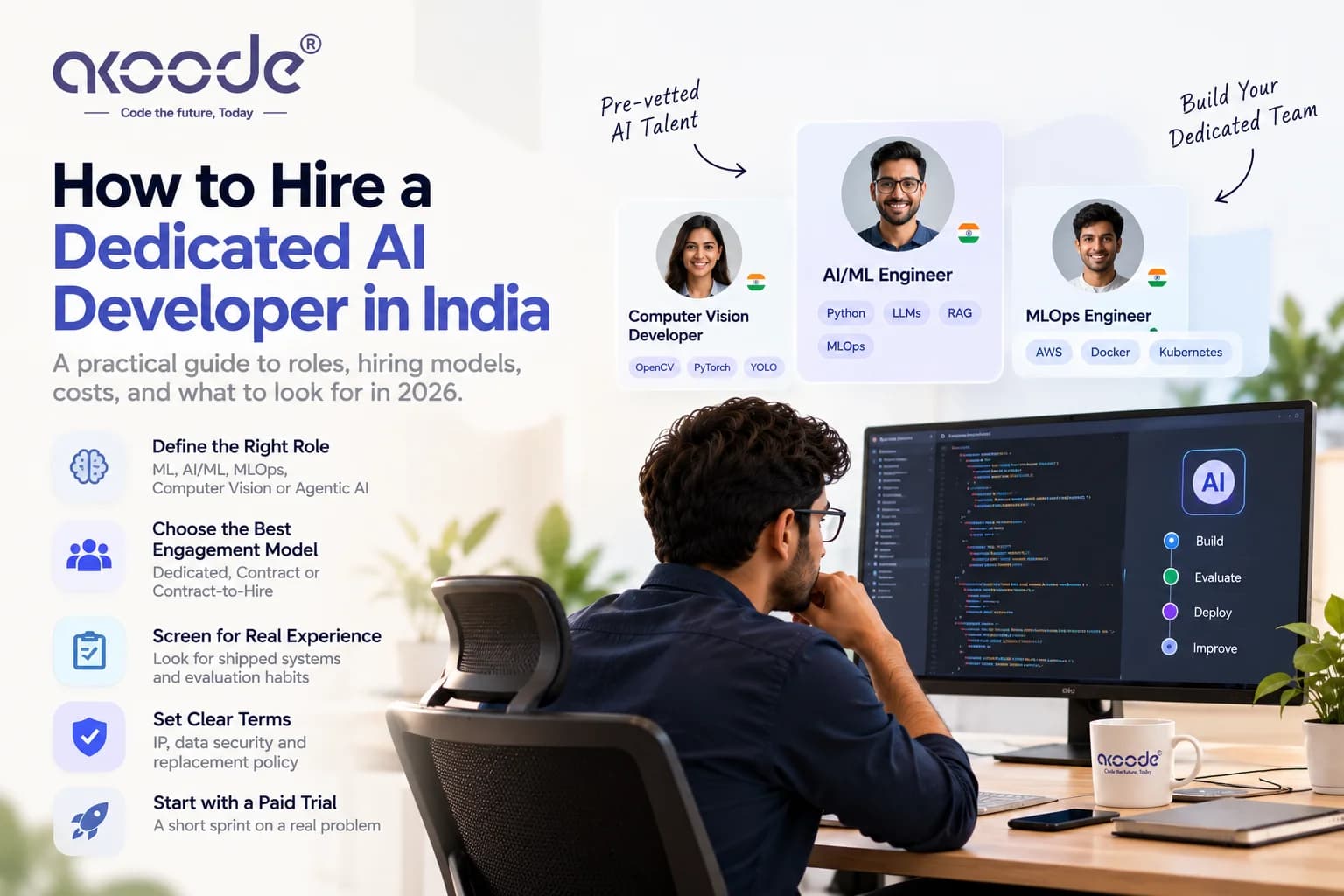
How to Hire AI Developers in India
AI hiring deserves its own process because "AI developer" covers genuinely different specializations — LLM and RAG engineering, computer vision, classical machine learning, and MLOps — and treating them as interchangeable is the fastest way to end up with a mismatched hire. Rates for AI-specialized engineers in India run $40–$90+/hour depending on specialization and seniority, reflecting a global talent scarcity that pushes AI compensation well above general software development rates even in a lower-cost market.
The vetting bar is different too: ask candidates to walk through a model they actually deployed to production, not just trained in a notebook, and confirm they can explain which evaluation metric matters for a given use case rather than defaulting to a single accuracy number. A candidate who can discuss what happened after a model shipped — how it was monitored, what broke, how retraining was handled — has done a different, more valuable kind of work than one who can only describe a training run in isolation.
Timelines are also worth setting expectations on. Given how scarce genuinely production-experienced AI talent is globally, a direct-hire search for a senior AI engineer commonly runs eight to twelve weeks or longer even in a large market like the US, which is exactly why staff augmentation has become the default path for AI capability that's needed on a shorter timeline — a properly resourced partner can typically match a vetted AI engineer to your project within about a week rather than months. Akoode's AI engineering work includes the Sahayak Diagnostic Orchestrator, a dual-stream clinical decision support system detecting cervical spine fractures and chest pathologies at specialist-comparable accuracy with 41-millisecond inference — the kind of production-grade delivery worth using as your own benchmark when evaluating an AI hire. For a deeper breakdown of hiring AI talent specifically, including a full 7-day deployment timeline, see our dedicated guide on hiring AI developers in India.
How to Hire Flutter Developers in India
Flutter has become the default choice for teams that want one codebase shipping to iOS, Android, and web simultaneously, and India holds the largest global pool of Flutter talent as a result. Rates typically run $20–$60/hour depending on seniority, or roughly $1,500–$7,000 a month for a dedicated developer — well below the $100–$150/hour typical for equivalent Flutter work in the US.
Vetting should focus on real shipped apps in production (App Store and Play Store listings you can actually check), experience with native platform integration where Flutter's cross-platform abstraction hits its limits (camera access, background processing, and device-specific APIs are common places where a Flutter-only developer without native experience gets stuck), and — for anything with real-time or performance-sensitive requirements — direct experience with on-device processing rather than only cloud-dependent features.
The core appeal of Flutter for a cost-conscious build is genuine: one codebase and one QA cycle instead of maintaining separate iOS and Android teams, which roughly halves long-term maintenance overhead compared to native development for most product types. The trade-off shows up specifically at the edges — highly custom platform-specific interactions or deep native SDK integrations — which is exactly why checking for native experience alongside Flutter experience matters more than it might seem for a "cross-platform" hire. Akoode's own Flutter work includes the M2 Method platform, an AI-powered pelvic health app rebuilt from a Python proof of concept into a production Flutter application with on-device pose detection and sub-300-millisecond real-time feedback, live on both app stores — a genuinely demanding real-time performance requirement that a general "Flutter experience" claim doesn't guarantee on its own.
Why Companies Choose Akoode for Developer Hiring in India
Across every role covered above — general software, React, AI, and Flutter — the same underlying standard applies: verifiable delivery history, a named individual you can interview before committing, IP terms confirmed in writing, and continuity backed by a real company rather than a single freelancer's availability. Akoode's dual-office structure in Gurugram and Jenks, Oklahoma exists specifically to give international clients a point of contact in their own time zone, and the 4.9 Google rating (110+ reviews) and 5.0 GoodFirms rating reflect that standard held consistently across software development, AI development, and ecommerce development engagements, in addition to staff augmentationit self.
For a broader look at vetting any development partner in India beyond the cost question — the specific red flags behind the "outsourcing horror story" pattern — our staff augmentation hiring guide covers that in full. If you're ready to scope a specific hire, Akhil, Akoode's founder, takes calls directly.
Frequently Asked Questions
How much does it cost to hire a developer in India?
Typically $15 to $80 per hour depending on seniority and specialization in 2026, or roughly $1,500 to $7,000 a month for a dedicated full-time developer. Junior developers sit at $15–$25/hour, mid-level at $25–$50/hour, and senior or specialized engineers (AI, cloud, architecture) at $40–$80+/hour.
What are India developer hourly rates in 2026?
Frontend developers run $18–$40/hour, backend developers $20–$45/hour, full-stack developers $25–$55/hour, mobile developers (Flutter, React Native) $20–$60/hour, and AI/ML engineers $40–$90+/hour. Rates scale primarily with seniority and specialization rather than city alone, though Tier-1 hubs like Bengaluru and Mumbai command a modest premium over Tier-2 cities.
What are the best websites to hire developers in India?
Upwork for short freelance tasks, Toptal and Turing for pre-vetted individual specialists, LinkedIn and Naukri/Instahyre/Hirist for direct full-time hiring, and Clutch or GoodFirms for evaluating development companies through verified client reviews. For an embedded, accountable dedicated-developer relationship, working directly with a vetted staff augmentation company generally outperforms a platform search.
How do I hire a remote developer in India?
Scope the specific stack and seniority you need, choose the sourcing channel that matches your commitment level, interview the actual individual rather than relying on a profile, confirm IP ownership in writing before work starts, and structure a defined onboarding period rather than expecting immediate production output.
Indian developer vs US developer: how do cost and quality actually compare?
Cost is roughly 2 to 3x lower in India for comparable seniority — US rates average $62–$94/hour against India's $25–$50/hour for mid-level work. Quality doesn't map cleanly to geography; the variance within India's talent pool is wide, and verifiable delivery history and direct access to interview the individual predict outcome quality far better than country alone.
What's the difference between staff augmentation and dedicated developers?
Staff augmentation is the broader model of extending your team with external talent inside your own processes. A dedicated developer is a specific arrangement within staff augmentation where a named individual is allocated 100% to your project on a monthly retainer, rather than splitting time across multiple clients — the full allocation is what prevents the shared-team problems common in lower-quality outsourcing arrangements.
How do I hire an Indian software development company rather than an individual developer?
Check verifiable client reviews with real detail on Clutch or GoodFirms, confirm a track record you can independently verify, look for a point of contact in your own time zone if communication continuity matters, and get transparent engagement terms before committing.
How do I hire React developers in India?
Look beyond general React familiarity to real production experience with state management at scale, performance optimization on a live application, and increasingly, comfort integrating AI-powered features into a React frontend. Rates run $18–$55/hour depending on scope and seniority.
How do I hire AI developers in India?
Get specific about which AI specialization you actually need — LLM/RAG, computer vision, classical ML, or MLOps — since they're genuinely different skill sets, and verify candidates against real deployed production work rather than notebook experiments. Rates run $40–$90+/hour given the global scarcity premium on AI skills.
How do I hire Flutter developers in India?
Verify real shipped apps in production on the App Store or Play Store, ask about native platform integration experience for anything beyond Flutter's standard abstraction, and check for real-time or on-device processing experience if your app has performance-sensitive requirements. Rates run $20–$60/hour, or $1,500–$7,000 a month for a dedicated developer.
What is the India developer salary guide for 2026?
Full-time compensation typically runs ₹4.5–10 LPA for junior developers, ₹10–20 LPA for mid-level, and ₹20–45 LPA for senior developers, with AI and cloud specialists commanding 15–25% above the general senior band. The national median across all software roles sits near ₹8–9 LPA, with product companies and global capability centers paying well above that median.
Get In Touch Now
View More Our Blog