


 August 26, 2026
Search "AI for ecommerce" and you'll find two contradictory conversations happening at once. One says AI is now table stakes — the fastest-growing brands are running hyper-personalized discovery and 24/7 autonomous support, and everyone else is working twice as hard for half the results. The other says most of it is expensive theater: chatbots that answer FAQs nobody asked, personalization engines nobody measured, and AI agents that quietly stop working three months after launch while leadership loses confidence in the whole category.
Both conversations are describing something real. The gap between them isn't about whether AI works — it's about implementation. This is a practical breakdown of which AI use cases in ecommerce have measurable ROI today, which ones are still mostly marketing, and why so many AI agent projects fail even when the underlying technology is sound.
Is AI Actually Crucial for Ecommerce Right Now, or Is It Hype?
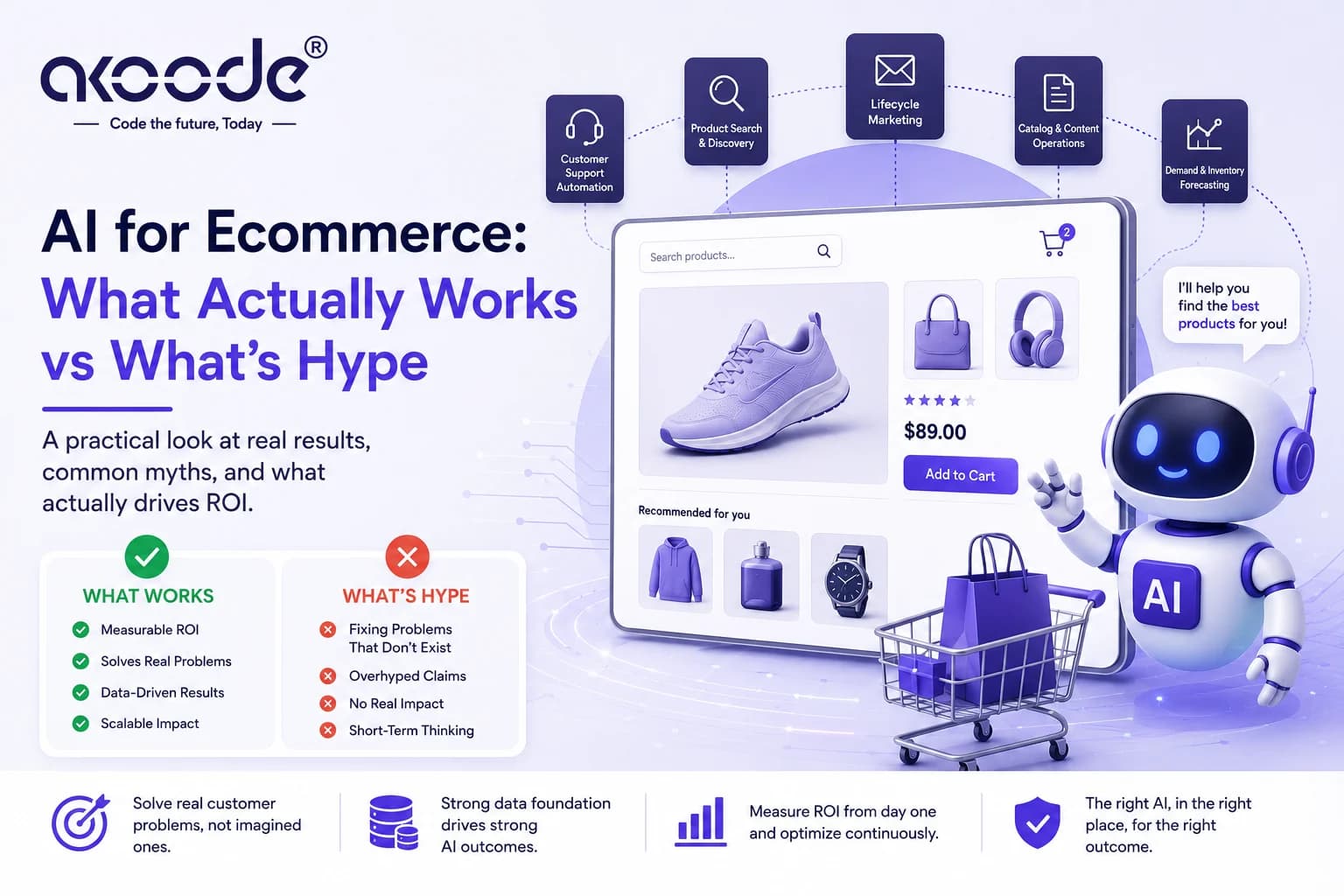
Neither answer is honest on its own. AI is genuinely delivering measurable results in a specific, narrow set of ecommerce functions — support automation, product search, lifecycle marketing, and catalogue operations. It is not delivering broad, automatic value everywhere it's been bolted on, and a large share of deployed AI in ecommerce today is underperforming its pitch specifically because it was deployed without a clear problem to solve.
The useful question isn't "is AI hype." It's "which specific function, with which specific data foundation, is this AI actually improving." Answered function by function, the picture is much clearer than the industry-wide debate suggests.
The AI Use Cases With Real, Measurable ROI
Customer support automation is consistently the fastest-paying-back category, because the ROI is direct: every conversation an AI agent resolves without escalation is measurable cost saved, and resolution-focused agents that connect to backend order and inventory systems — not just scripted chatbots — show meaningfully lower cost per contact than human-only support.
Product search and discovery is the second clearest win, particularly for catalogues large enough that keyword search creates real friction. AI-driven search that understands intent and behavioral signals, rather than exact keyword matching, directly affects conversion rate and average order value — and the quality of these systems scales with how much clean behavioral and catalogue data feeds them.
Lifecycle and retention marketing — predictive churn modeling, purchase-pattern-driven email and SMS timing — has some of the longest track record of any AI application in ecommerce and the most mature tooling, because it's built on a well-understood data problem (repeat purchase behavior) rather than open-ended generation.
Catalogue and content operations — product description generation, tagging, and image-to-asset workflows — deliver the least glamorous but often highest-leverage ROI for growing catalogues, because the alternative is genuinely manual, doesn't scale, and produces inconsistent output across a large SKU count. This is the category where practical value is easiest to demonstrate and hardest to overhype, because the before/after is simply "did this get done consistently or not."
Inventory and demand forecasting works well specifically for businesses with enough transaction history to train against — it's a data-volume-gated use case, not something that helps a brand-new store with three months of sales data.
Where AI in Ecommerce Is Genuinely Overhyped Right Now
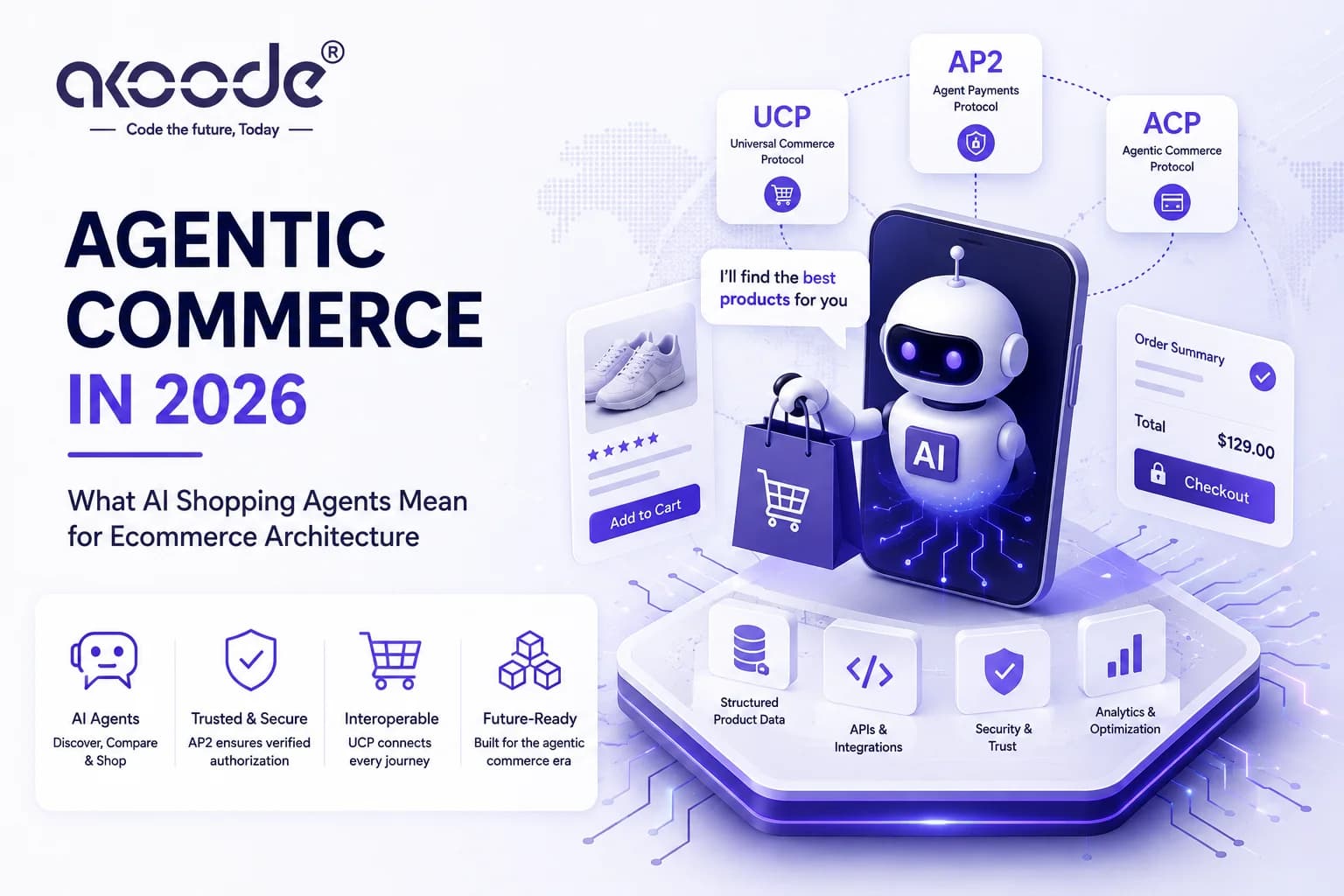
Fully autonomous checkout and agentic purchasing, discussed in more detail in our breakdown of the agentic commerce protocol stack, is real infrastructure with real momentum, but consumer trust in unsupervised AI purchasing remains low. Most current "agentic commerce" activity is AI-assisted discovery with a human confirming checkout — treating full autonomy as already mainstream overstates where adoption actually is.
Generic AI features solving problems customers don't have. A recurring pattern is teams shipping an AI capability because it was available, not because a customer pain point demanded it — an AI stylist quiz nobody asked for, a chat widget answering questions the FAQ page already answered clearly. The AI itself isn't the problem; the absence of a real customer need behind it is.
"AI-powered" as a blanket marketing claim. Plenty of tools now market themselves as AI-powered where the actual capability is a modest rules engine with a language model wrapped around the copy. This matters practically: when evaluating any AI tool or vendor, ask what specifically the model is doing — ranking, generating, classifying — rather than accepting the label.
Setup automation making ecommerce meaningfully easier. AI can speed up individual tasks — drafting a product description, generating a starter theme layout — but it hasn't removed the underlying complexity of catalogue architecture, integration planning, and platform choice covered in our buyer's framework for choosing an ecommerce development partner. Faster first draft isn't the same as a solved problem.
Why Most AI Agent Projects in Ecommerce Fail
This is worth being specific about, because the failure pattern is consistent enough to be predictable — and avoidable.
They're deployed without a clear, prioritized problem. The most common root cause across AI agent failures generally, not just in ecommerce, is unrealistic expectations paired with poor use case prioritization — teams deploy an agent because AI is available, not because a specific, measured business problem justified it.
The underlying data was never clean. An AI agent making product recommendations, answering order-status questions, or managing inventory is only as good as the catalogue, order, and inventory data it's reading from. Bad data quality is one of the most frequently cited causes of agentic AI failure across industries, and ecommerce catalogues — with inconsistent attributes, stale variants, and disconnected inventory feeds — are a common offender.
Chatbots got built instead of agents. There's a meaningful difference between a scripted FAQ bot and an agent that connects to real backend systems and takes action — processing a refund, updating an order, checking real inventory. Teams that stop at the scripted layer end up with an expensive FAQ machine that doesn't move revenue, then conclude "AI doesn't work" when the actual issue was scope.
No real-time integration. An agent quoting stock levels or delivery estimates from a nightly batch sync will be wrong often enough to erode trust fast. This is the same integration-reliability problem that shows up across ecommerce architecture generally — see our note on why real-time backend integration matters more than frontend polish for agent-facing and human-facing experiences alike.
Too many parallel pilots, none trained properly. A common failure mode is running several AI vendor trials simultaneously to "test everything" before committing — which in practice means no agent gets the training data, feedback loops, or attention needed to actually perform, and every trial produces mediocre results that get read as "the category doesn't work."
No governance or human fallback. Agents deployed with no escalation path, no review of edge cases, and no plan for what happens when the agent is wrong tend to erode trust quickly, especially in support contexts where a wrong answer has a visible, immediate customer impact.
The pattern across all of these: the technology usually isn't the limiting factor. Clean data, a clearly scoped problem, real backend integration, and a realistic rollout — training and refining one agent properly rather than piloting five superficially — are what separate the projects that actually move revenue from the ones that quietly get switched off.
A Practical Framework for Evaluating Any AI Tool or Agent
Before adopting an AI tool for your store, four questions do most of the filtering:
What specific problem is this solving, and how will you measure it? "Improve customer experience" isn't measurable. "Reduce average first-response time on order-status questions" is.
What data does it need, and is that data actually clean? If the answer requires inventory, pricing, or order data that's stale, inconsistent, or siloed, fix that first — the AI layer will inherit every one of those problems.
Is it reading real-time data or a batch sync? For anything customer-facing — stock availability, delivery estimates, order status — batch-synced data is a reliability risk, not a minor detail.
What happens when it's wrong? A defined escalation path to a human, and a way to review and correct mistakes, is what separates a tool that improves over time from one that quietly damages trust.
Tools that can't clear these four questions honestly are the ones most likely to end up in the "we tried AI and it didn't work" pile a year from now.
Where This Connects to the Rest of the Ecommerce Stack
None of these use cases exist in isolation from the platform and architecture decisions underneath them. A recommendation engine, a support agent, or a catalogue-automation tool is only as effective as the commerce backend it's reading from and writing to — which is why AI tooling decisions and platform/integration decisions are really the same conversation, not two separate ones. Our guide on evaluating an ecommerce development partner and our breakdown of where agentic commerce protocols are headed both come back to the same underlying point: clean data and reliable integrations are the prerequisite, not an afterthought, for AI to deliver anything measurable.
Akoode's AI development work sits in the categories with demonstrated, working ROI rather than speculative ones — structured, deterministic pipelines instead of open-ended generative bets. The AI-powered advertisement catalogue generator is a direct example: it turns a single product image into consistent, production-ready ad assets across channels, solving the catalogue-content bottleneck described above rather than adding a generic chat widget nobody asked for. That work sits alongside the team's ecommerce development practice across Shopify, WooCommerce, Magento, and OpenCart — including the custom Shopify build for a multi-brand luxury accessories catalogue — because the AI layer and the commerce backend are engineered by the same team rather than handed to separate vendors that don't talk to each other.
Best AI Use Cases for Ecommerce Sellers, Ranked by Realistic ROI
For a business deciding where to start, roughly in order of fastest, most measurable payback:
Customer support automation connected to real order/inventory data — fastest, most directly measurable ROI
Product search and discovery improvements — high impact for catalogues large enough that search friction is a real conversion drag
Catalogue content automation — product descriptions, tagging, ad asset generation — highest leverage per hour saved for growing SKU counts
Lifecycle/retention marketing — mature tooling, strong ROI, but needs sufficient customer history to train against
Demand forecasting — valuable but gated by transaction volume; not a starting point for a new store
Agentic commerce/protocol readiness — worth preparing the data foundation for now, but treat actual autonomous checkout as an emerging capability, not a near-term revenue lever
Starting at the top of that list and doing it properly — one use case, clean data, real integration, measured outcome — consistently outperforms deploying five AI features at once and hoping one of them sticks.
If you're trying to figure out which of these actually fits your catalogue, your team's capacity, and your current data quality, talk it through before committing budget to a tool or agent build.
FAQs
Is AI actually necessary for ecommerce businesses right now?
It's necessary for specific functions — support automation, search, catalogue operations, lifecycle marketing — where the data foundation is clean enough to support it. It's not universally necessary for every function, and forcing AI into a use case without a clear problem is the most common cause of failed projects.
What are the best AI use cases for ecommerce sellers?
Customer support automation and product search/discovery deliver the fastest, most measurable ROI. Catalogue content automation and lifecycle marketing follow closely. Demand forecasting and full agentic checkout are valuable but depend on data volume or trust infrastructure that's still maturing.
Why do so many AI agent implementations in ecommerce fail?
Most failures trace back to unclear objectives, poor data quality, agents built as scripted chatbots instead of real backend-connected agents, and running too many shallow pilots instead of training one agent properly.
Is AI making ecommerce setup easier?
It's making individual tasks faster — drafting content, generating starter designs — but it hasn't removed the underlying complexity of catalogue architecture, platform choice, and integration planning. Faster drafts aren't the same as a simpler project.
How do I know if an AI tool is genuinely useful or just marketing?
Ask what specific problem it solves and how you'll measure it, what data it depends on, whether that data is real-time or batch-synced, and what happens when it's wrong. Tools that can't answer these clearly are higher-risk bets.
Has anyone had real success with agentic commerce yet?
Early infrastructure — Shopify's Agentic Storefronts, Google's Universal Cart, the ACP/UCP/AP2 protocol stack — is live and merchants are seeing measurable AI-referred traffic growth. Full autonomous checkout adoption is still early; the more established wins right now are in AI-assisted discovery and comparison.
What's the difference between an AI chatbot and an AI agent?
A chatbot typically answers from scripts or help-center content. An agent connects to real backend systems — inventory, orders, CRM — and can take action: process a refund, check real stock, update a subscription. Many failed ecommerce AI projects stopped at the chatbot layer while marketing themselves as agents.
Should a small ecommerce business invest in AI before a larger platform rebuild?
Usually the reverse is more reliable: clean, well-integrated backend data makes any AI layer perform better, so catalogue and integration hygiene is worth prioritizing alongside — not after — AI tooling decisions.
Get In Touch Now
View More Our Blog