


 August 26, 2026
Ecommerce spent two decades optimizing for a human clicking through a storefront. In 2026, a growing share of that traffic isn't human at all — it's an AI agent reading a product feed, evaluating it against a shopper's criteria, and deciding whether to recommend, cart, or buy on their behalf. Adobe Analytics tracked AI-referred traffic to US retail sites growing nearly 4x year-over-year in Q1 2026, and by March that traffic was converting meaningfully better than traditional organic sessions — a full reversal from a year earlier, when AI-referred visitors converted worse than average.
That reversal is the signal worth paying attention to. It means the infrastructure caught up faster than most merchants expected, and the businesses treating this as a 2027 problem are already behind. This piece is a technical look at what's actually shipped, which standards are winning, and what it changes about how an ecommerce platform needs to be built — not another "AI is transforming retail" think piece.
What Agentic Commerce Actually Means
Agentic commerce is shopping where an AI agent — inside ChatGPT, Google's Gemini app, Microsoft Copilot, or a merchant's own assistant — handles discovery, comparison, and increasingly checkout on a shopper's behalf, querying structured product data and transacting through standardized APIs rather than a human browsing a webpage.
It's a distinct category from two things it's often confused with. It isn't the same as on-site AI personalization (recommendation widgets, chatbots) — those still assume a human is looking at your website. And it isn't fully autonomous shopping with no human involvement — trust in unsupervised AI purchasing is still low; one industry survey found most consumers are only somewhat comfortable with an agent completing a purchase on their behalf, and a small fraction have actually done it. What's real today sits between those two points: agents doing discovery and comparison at scale, with checkout increasingly agent-assisted but still shopper-confirmed.
The Protocol Stack: ACP, UCP, and AP2
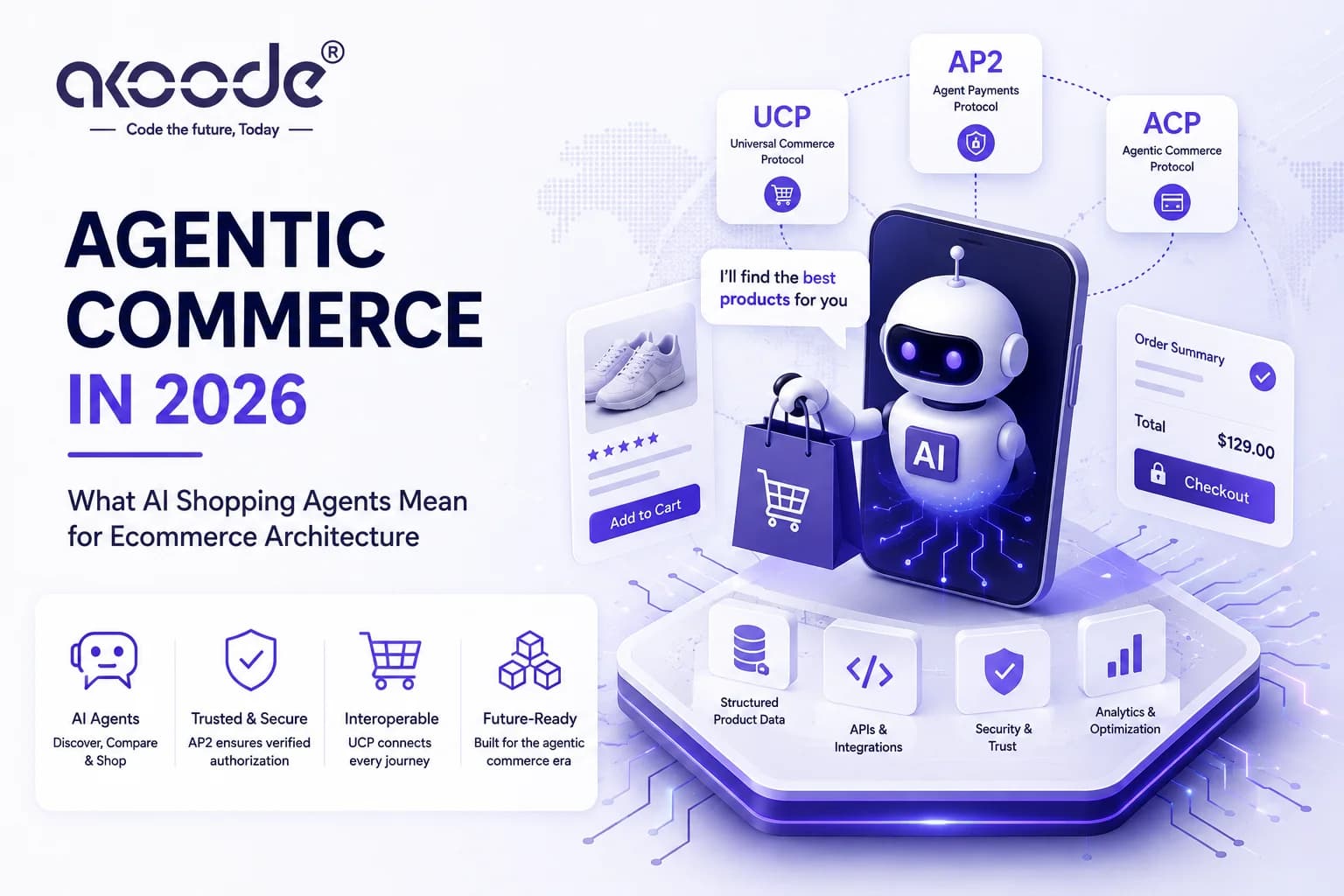
Three open standards emerged in the past year to make agent-to-merchant commerce interoperable, and they sit at different layers of a transaction rather than competing head-on.
ACP (Agentic Commerce Protocol), maintained by OpenAI and Stripe with Meta and PayPal also participating, standardizes the in-chat checkout flow — how an agent creates a cart, updates it, and completes a purchase using a scoped, single-use payment token while the merchant stays the system of record for the order. ACP launched alongside ChatGPT's Instant Checkout in September 2025. That specific consumer feature was quietly retired in March 2026 after limited merchant adoption, but the underlying protocol kept shipping — Stripe's Agentic Commerce Suite went live in December 2025, and the spec itself has continued through several revisions since, most recently adding Model Context Protocol compatibility.
UCP (Universal Commerce Protocol), co-developed by Google and Shopify with more than twenty backing companies including Amazon, Microsoft, Salesforce, Etsy, Target, and Wayfair, covers the full journey from discovery through post-purchase support rather than just checkout. Shopify built UCP support directly into its Agentic Storefronts feature, which went live for US merchants in March 2026 — meaning most Shopify merchants don't touch the protocol directly at all; Shopify's admin handles the plumbing and merchants toggle which AI channels they want to be discoverable on. Google's Universal Cart, announced at I/O 2026, sits on top of UCP and lets a shopper build a single cart across Search, Gemini, YouTube, and Gmail that spans multiple merchants at once.
AP2 (Agent Payments Protocol), Google-initiated with over sixty partners and now moving toward broader industry governance, is the layer underneath both — it defines cryptographically signed "mandates" that prove an agent is acting with a shopper's actual authorization, creating a verifiable, tamper-proof record of who approved what. This is the piece addressing the trust gap: fraud teams have flagged that agent-driven purchasing patterns (rapid sequential orders, unusual category-hopping) look exactly like the behavior traditional fraud models are built to catch, so authentication frameworks like AP2 are becoming necessary infrastructure, not a nice-to-have.
A single purchase in late 2026 can realistically touch all three: UCP for discovery and cart-building, AP2 for authorization, ACP or a payment processor's own rails for settlement. Merchants betting on only one protocol are making a distribution decision, not a technical inevitability — Walmart, Etsy, and Shopify are already hedging by supporting more than one.
What This Changes About Ecommerce Architecture
The practical shift for a merchant isn't "add a chatbot." It's that structured, machine-readable product data now matters as much as the storefront UI itself, because an agent — not a person scrolling — is often the one reading and deciding.
A few concrete implications:
Product feeds became infrastructure, not a marketing afterthought. UCP introduces a machine-readable manifest — a structured file published at a standardized path on a merchant's domain — that declares catalog endpoints, supported payment methods, shipping capabilities, and return policies so an agent can discover what a store offers without a human navigating to it. ChatGPT Shopping, Google AI Mode, and Perplexity's merchant program each ingest their own feed formats. An industry analysis of feed quality found the majority of ecommerce catalogs still have inconsistent attribute naming, missing GTINs, or stale inventory data — all of which cause agents to quietly downgrade or skip a product rather than surface it.
Data freshness now competes with content depth. Agents evaluating a product weight real-time price and availability accuracy far more heavily than long-form product descriptions. This is a genuine inversion for teams that spent years investing in content-first SEO — a beautifully written product page attached to a stale inventory feed is close to invisible to an agent, while accurate structured data on a plain page gets surfaced.
Headless and API-first architecture stopped being an enterprise luxury. When your catalog, checkout, and inventory need to be queryable by ACP, UCP, and a merchant's own storefront simultaneously — potentially through REST, GraphQL, and MCP transports at once — a tightly coupled monolithic theme becomes a genuine constraint rather than just a technical preference. This is one of the clearer arguments for investing in custom or headless commerce architecture even for mid-sized catalogs, not just enterprise replatforms.
Schema markup and structured data are now dual-purpose. JSON-LD product schema was already a Google Rich Results input; it's now also what AI crawlers read directly when evaluating a product page outside of a formal feed. Getting this right serves both traditional SEO and agent visibility from the same implementation work.
The Trust Gap Is Real, and It Changes the Rollout Order
It's worth being honest about where the trust gap actually sits, because it changes what a business should build first. Survey data consistently shows a split: a large majority of shoppers are comfortable using AI for product discovery and comparison, but a small minority have actually completed a purchase through an agent, and trust drops further specifically at the payment step. Fraud teams report elevated concern that AI-driven purchasing volume will strain existing fraud models built around human behavioral patterns.
That gap is exactly why AP2-style authorization mandates matter architecturally — they're not a compliance checkbox, they're the mechanism that makes autonomous or semi-autonomous checkout defensible enough for a merchant to actually enable it. For most businesses in 2026, the realistic near-term posture is: get discoverable and accurately represented to agents now (feed quality, structured data, protocol readiness), while checkout stays either agent-assisted-but-human-confirmed or fully human, until trust infrastructure matures further. Chasing full autonomous checkout before the foundation is solid is optimizing for a capability most shoppers aren't ready to use yet.
Where the Foundation Work Actually Sits
None of this is a frontend problem. The businesses positioned to benefit as agentic channels scale are the ones that treated it as a data and integration problem first:
Catalog and PIM hygiene — consistent attribute naming, complete GTINs, accurate variant data, structured category taxonomy
Real-time inventory and pricing sync — agents penalize stale data far more than they penalize a plain design
Structured data implementation — JSON-LD product schema, offers, reviews, and return policy markup done properly, not as an afterthought plugin
API-first backend design — a commerce backend that can serve a traditional storefront and multiple agent-facing feeds from the same source of truth, rather than maintaining parallel data exports
ERP/CRM integration reliability — the data agents evaluate (inventory, pricing, order status) usually lives in systems the storefront has to stay synchronized with in real time, not on a nightly batch job
This is squarely software engineering and systems integration work, not a bolt-on AI feature — which is also why it tends to expose weak architecture decisions that a template storefront was able to hide for years.
Beyond Checkout: The Other AI Shifts Worth Building For
Agentic checkout is the most-discussed shift, but it's arriving alongside a handful of related capabilities worth the same architectural attention:
Semantic and visual product search. Moving past exact-keyword matching so a query like "something warm for a winter trip" returns relevant results without literal title overlap — this depends on the same clean, well-tagged catalogue data that agent readiness requires.
Hyper-personalization at the merchandising layer. AI-driven recommendation and merchandising logic that adapts to browsing behavior in ways static category rules can't, which increasingly needs to be exposed consistently across both the human-facing storefront and any agent-facing surface.
Predictive commerce and demand signals. Forecasting and dynamic pricing models that depend on the same real-time data pipeline investment as agent-readiness — another reason this is infrastructure work with compounding returns, not a single-purpose project.
Automated content and creative generation. As catalogs need to stay fresh across more surfaces — a storefront, multiple agent feeds, social and marketplace channels — the manual cost of producing accurate, on-brand product content for every SKU across every channel becomes the real bottleneck. This is a specific, practical use of AI that doesn't require betting on any particular checkout protocol to pay off immediately.
A Practical Starting Point, Not a Full Rebuild
For most mid-market businesses, the honest sequencing looks less like "integrate ACP and UCP this quarter" and more like:
Audit catalog and feed quality first. Inconsistent attributes and stale data are the most common reason products get skipped by agents entirely — and it's also the highest-leverage fix, because it improves traditional SEO simultaneously.
Get structured data genuinely correct, not just technically present — accurate JSON-LD product, offer, and policy markup, validated rather than assumed.
Confirm the backend can serve real-time inventory and pricing, not batch-synced data, to whatever storefront and channel integrations exist today.
Evaluate protocol exposure through your existing platform where possible — Shopify merchants, for instance, get UCP exposure through Agentic Storefronts without custom protocol integration work — before considering custom protocol implementation.
Treat checkout automation as a later-stage decision, gated by the trust and authorization infrastructure actually being ready for a given business's risk tolerance, not by competitive pressure alone.
That sequencing matters because most of the work — catalog hygiene, integration reliability, structured data — pays off regardless of which specific protocol ends up dominant. Betting the entire strategy on one checkout standard before the underlying data foundation is solid is the more common mistake than being slow to adopt.
Where This Leaves Ecommerce Development Work
The technical skillset this shift actually rewards is the same one that's always separated a template storefront from a properly engineered one: clean data architecture, reliable API and integration work, and the ability to keep multiple systems — storefront, ERP, CRM, and now agent-facing feeds — in sync without manual reconciliation. Akoode's ecommerce development and AI development work already sits at that intersection — custom integration work across ERP, CRM, and payment systems on the commerce side, and structured, deterministic AI pipelines on the AI side, including an AI-powered advertisement catalogue generator built to turn a single product image into consistent, production-ready catalogue assets across channels — the same kind of structured-output discipline that agent-facing product data now demands.
The businesses that treat this moment as primarily a data and systems integration problem, rather than a single feature to bolt on, are the ones positioned to benefit as agentic channels mature — regardless of which specific protocol ends up dominant.
If you're assessing whether your current catalog, integrations, and backend architecture are actually ready for this shift, talk through where the gaps are.
FAQs
What is agentic commerce?
Agentic commerce is shopping where an AI agent handles product discovery, comparison, and increasingly checkout on a shopper's behalf, using structured product data and standardized APIs instead of a human browsing a website directly.
What's the difference between ACP, UCP, and AP2?
ACP (OpenAI/Stripe) standardizes in-chat checkout flows. UCP (Google/Shopify) covers the full discovery-through-purchase journey across a broader partner network. AP2 (Google-initiated) is the authorization layer underneath both, using cryptographic mandates to verify an agent is acting with real shopper consent.
Is ChatGPT's Instant Checkout still active?
No — OpenAI retired the in-chat Instant Checkout consumer feature in March 2026 after limited merchant adoption. The underlying ACP protocol continues to be developed and is used for product discovery and merchant redirect flows.
Do I need to integrate agentic commerce protocols manually?
Often not directly. Shopify merchants, for example, get UCP exposure through the platform's Agentic Storefronts feature without custom protocol work. Direct protocol integration matters more for custom or headless builds not on a platform with native support.
What should an ecommerce business actually do first?
Start with catalog and product feed hygiene — consistent attributes, accurate GTINs, real-time inventory sync, and correct structured data markup. This improves both traditional SEO and AI agent visibility, and it's foundational to everything else.
Is fully autonomous AI checkout common yet?
Not really. Consumer trust drops significantly at the payment step even when people are comfortable with AI-assisted discovery. Most current activity is agent-assisted discovery and comparison, with checkout still typically shopper-confirmed.
Does this require a headless commerce architecture?
Not always, but tightly coupled, template-based storefronts make it harder to serve consistent data across a storefront and multiple agent-facing feeds simultaneously. API-first backend design is becoming more valuable even for mid-sized catalogs, not just enterprise builds.
How does this affect ecommerce SEO strategy?
It doesn't replace SEO, but it does shift emphasis — structured data and feed accuracy now carry weight that used to sit more heavily on long-form content and backlinks, because agents evaluate structured signals more than editorial content.
Get In Touch Now
View More Our Blog