


 October 3, 2026
Short Answer
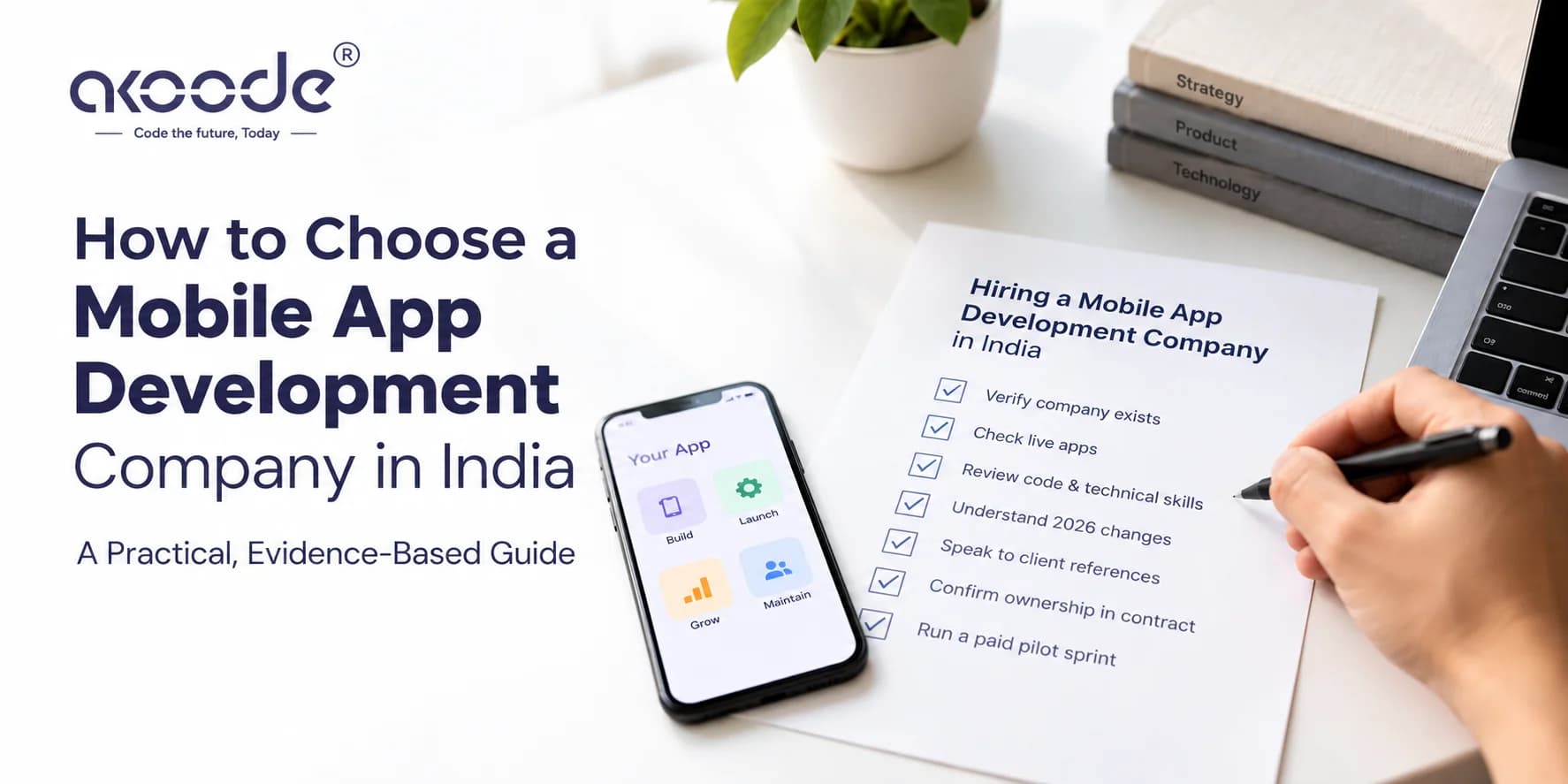
To choose a mobile app development company in India, verify instead of compare. Confirm the company legally exists, inspect the apps it says it shipped, have an engineer review real code, test whether it knows what changed in 2026, check references properly, put ownership in the contract, and run a paid pilot sprint before you commit to the full build.
That's the whole method, and the rest of this guide is how to do each step. We won't rank companies or tell you which one to pick. Plenty of pages do that already, and many of them are written by companies on the list. This one is about evidence: what to ask for, where to look it up, and what a strong or weak answer sounds like. For services, technology and timelines, see our buyer's guide to mobile app development companies in India. If you're hiring in Gurgaon specifically, see how to hire a mobile app development company in Gurgaon.
Why verifying beats comparing
Every agency says it has experienced developers, transparent processes and on-time delivery. Pitch decks sound alike because they're written to. Ratings help, but they're a signal, not proof, and "top 10" lists are marketing more often than research.
Verification works because it asks for things a weak vendor can't fake cheaply: a government record, a live app in a store, a repository, a named engineer, a signed clause. Each check below takes anywhere from a few minutes to a few days. Together they rule out the worst options quickly, and they leave you comparing two or three companies on real evidence instead of ten on brochures.
One honest limit before we start. These checks tell you whether a company is real, current and competent at the basics. They can't tell you whether it's the right fit for your product. That's what the last check, the pilot sprint, is for.
Check 1: Confirm the company exists and is who it claims to be
This one costs nothing and takes minutes.
MCA record. On the Ministry of Corporate Affairs portal, open MCA Services, then View Company/LLP Master Data, and search by company name or CIN. Basic master data is free and needs no login. Look at:
Status. You want Active. Strike Off, Dormant or Under Liquidation each deserve a direct question.
Incorporation date. Compare it with the "10 years of experience" on the website. A younger entity can be the successor to an older brand, which is fine, but ask.
Registered office and directors. Do they match the offices and leadership the pitch describes?
Charges. Registered charges show loans secured against the company's assets.
GST record. On the GST portal, use Search Taxpayer with the GSTIN from the vendor's invoice or proposal. Confirm the registration is active, the trade name matches the legal name in your contract, and the PAN embedded in the GSTIN matches the PAN on the MCA record.
Sole proprietorships and some other structures don't appear in MCA master data, so if you can't find the vendor there, ask what legal form it operates under. And make sure the entity named on the contract is the entity you checked. A different name on the signature page is a common and avoidable surprise.
Check 2: Inspect the apps they say they shipped
Ask for three live store links, not screenshots or case-study PDFs. Then spend ten minutes on each listing:
The developer name. Apps are often published under the client's own account, so a different name isn't a red flag by itself. Ask who published it and why.
The last update date. An app updated in the last few months is being maintained. One untouched for two years may be abandoned.
Version history. Regular releases with specific notes suggest a working process.
The one-star reviews. Look for patterns: login failures, crashes, payment problems. Check whether anyone replies.
Then ask for a live walkthrough on a real phone, led by someone who worked on the app. Ask which parts the company built and which it inherited from another team. A good engineer can explain a decision in the app they built. Someone reading from a script can't.
Some apps are private, internal or enterprise-only and never appear in a store. For those, ask for a demo build and a reference instead. A missing store link needs an explanation, not an automatic rejection.
Check 3: Make them show the engineering
Slides cost nothing. Engineering is harder to fake. Ask for these, and ask in writing so the answers can be compared:
An architecture diagram from a past app and the reasons behind its main choices
Their branching, review and release process
A demonstration of their build pipeline
How they test, including on real devices
How they find out about a production crash
The names, roles and tenure of the engineers who would work on your app
Then do the single most valuable thing on this list: pay for a code review. Ask the vendor for a sanitized module, or a supervised session on a live repository, and have your own senior engineer or a fractional CTO read it. One hour of a neutral expert reading real code tells you more than any proposal. Look at how the project is structured, how state and errors are handled, whether tests exist, whether secrets sit in the repository, and how old the dependencies are.
Here's what separates strong answers from weak ones:
Ask | Strong answer | Weak answer |
|---|---|---|
"Walk me through a release from merge to store." | Automated builds, signed artifacts, staged rollout, a rollback plan | "We upload it when it's ready." |
"How do you test on real devices?" | A device matrix, automated tests, and named low-end Android phones | "We test on our own phones." |
"How do you know the app crashed in production?" | Crash reporting, alerts, and a stated response time | "Customers tell us." |
"Who will work on our app, and how long have they been here?" | Names, roles, tenure, and a continuity commitment | "Our pool of experts." |
"Why this stack for our app?" | Trade-offs, including what you'd give up | The same answer for every client |
"What would you leave out of version one?" | Pushback that protects your budget | Agrees to everything |
If the stack decision is still open, our guide to native, cross-platform and hybrid apps covers the trade-offs, and our mobile app security checklist gives you a list to hold their security answers against.
Check 4: Test whether they know what changed in 2026
This is the check almost nobody includes, and it's the quickest way to tell a current team from one working from last year's playbook. Four things changed or are changing, and each one touches almost every app built in India.
Topic | What changed | Ask | A strong answer sounds like |
|---|---|---|---|
Google Play | Since 31 August 2026, new apps and updates must target Android 16 (API 36), and an extension was available to 1 November 2026 | "How would you bring our app to API 36?" | Edge-to-edge screens, back-button handling, large-screen behaviour, an SDK audit, staged rollout |
UPI payments | Per gateway documentation, UPI Collect has been phased out for most merchant payments on Android and desktop since February 2026 in favour of Intent and QR. From 15 October 2026, a 0.4% merchant fee applies to UPI payments above ₹2,000, capped at ₹300 | "How do you handle UPI payments and settlement reconciliation?" | Intent flow, server-side payment confirmation, a proper pending state, the fee reflected in reconciliation |
Data protection | India's DPDP Rules were notified in November 2025, and the main duties apply from around 13 May 2027 | "How will you capture consent, handle withdrawal and delete data?" | A consent record per purpose, SDKs that stay quiet until consent, deletion jobs, breach logging |
ISO 27001 | Certificates issued to the 2013 edition stopped counting for accredited purposes after 31 October 2025 | "Send us the certificate." | It cites ISO/IEC 27001:2022, comes from an accredited certification body, and its scope covers the team that will build your app |
On the DPDP date, a proposal to shorten the window was floated earlier in 2026 and, as of early September, hadn't been notified. Recheck the date before you rely on it.
On ISO, verify the certificate yourself. IAF CertSearch is the global database of accredited certificates, and it shows the status, standard, scope and certified sites. A certificate that exists but doesn't cover the delivery location, or was issued by a body that isn't accredited, tells you much less than the logo on a website suggests.
Don't treat this table as an exam. A vendor that hasn't yet handled all four isn't disqualified. What you're looking for is how specifically and how quickly it answers. A team that has been doing the work gives concrete steps. A team that hasn't gives generalities, or says "we'll look into it" and then does, which is also a fine answer. Vague confidence is the one to worry about.
Check 5: Call references the right way
Reference calls fail when the vendor picks the references and the buyer asks soft questions. Change both.
Choose better references. Ask for at least three, with one project older than eighteen months and one that ran into trouble. Every agency has had a rough project. How it handled one tells you more than a clean record.
Ask specific questions:
Did the team hit the dates it promised? If not, what happened?
How were scope changes handled, and did the invoice match the agreement?
Who was your day-to-day contact, and are they still there?
What broke after launch, and how fast was it fixed?
Did you receive the full source code and all accounts at the end?
Would you hire them again for version two?
Use review platforms as a supporting signal. Look at how recent the reviews are, how many there are, whether reviewers are named, and whether the vendor responds to criticism. Then check the team on LinkedIn. If the engineers in the pitch joined three months ago, that's worth knowing.
Check 6: Put ownership in the contract
This is the check with an India-specific trap, and it catches many buyers who are otherwise careful.
Paying for software does not transfer copyright. Under India's Copyright Act, an assignment is valid only if it's in writing and signed, and it must identify the work and specify the rights assigned, the duration and the territory. If the duration isn't stated, the law deems it to be five years. If the territory isn't stated, it's presumed to be India only. And if the assignee doesn't exercise the rights within a year, the assignment lapses unless the document says otherwise.
This isn't theoretical. In a dispute between Pine Labs and Gemalto, the Delhi High Court applied the five-year default, and copyright in the software reverted to the developer because the agreement hadn't stated a period. For most commissioned work, including software, the person who wrote the code is the first owner unless the contract assigns it.
A contract sentence like "all IP belongs to the client upon payment" can therefore leave you with less than you think. Ask your lawyer to check these points:
A signed assignment that identifies the work, states the duration as perpetual and the territory as worldwide, and addresses royalty and consideration.
A warranty that the vendor can assign, meaning its own employees and freelancers have assigned their rights to it, plus an indemnity for third-party IP claims.
Accounts in your name from day one. Your Apple Developer account, Google Play account, cloud account, domain, analytics and payment keys should be yours, with the vendor given delegated access.
Your repository from day one. Code should live in an organization you own, not be handed over at the end.
A list of third-party licences used in the app.
Exit terms. Documentation, build instructions and a short transition-support period if either side leaves.
This is general information, not legal advice. Have a lawyer familiar with Indian IP law review the agreement before you sign it.
Check 7: Run a paid pilot sprint
Everything above reduces risk. Only working together shows fit. Before the full commitment, buy a short pilot, usually two to three weeks.
Scope it as one thin, end-to-end slice: sign-in, one core flow, a call to a real backend, and a build delivered to an internal test track or TestFlight. It should look like the smallest useful version of your product. Our guide to building an MVP helps you decide what belongs in that slice.
Specify the deliverables: a working build, the code in a repository you own, tests running in the pipeline, a short architecture note, and a demo.
Score what you can only learn by watching:
Did the estimate match the result?
Did the team ask good questions, or just nod?
Was communication steady, or did it go quiet?
How did it handle a surprise? Introduce one small, realistic scope change in the second week and watch.
Agree the exit up front. After the pilot, you should be free to stop, pay only for the work done, and keep the code. A vendor that resists that doesn't believe in its own pilot.
A scoring sheet you can copy
Put your two or three finalists through the same sheet. These weights are a starting point. A payments-heavy app might raise the 2026 readiness weight, and a regulated product might raise ownership terms.
Criterion | Weight | What earns full marks |
|---|---|---|
Records and legal standing | 10 | MCA status active, GST matches, contracting entity is the entity you checked |
Shipped apps | 20 | Live store links, a walkthrough on a real device, recent updates |
Engineering depth | 25 | Code review passed, clear release, testing and monitoring answers |
2026 readiness | 15 | Specific answers on API 36, UPI, DPDP and ISO |
Team and continuity | 10 | Named engineers, tenure, a continuity commitment in writing |
References | 10 | Three calls, including an older project and one that hit trouble |
Ownership terms | 10 | IP assignment, accounts and repository in your name |
Total | 100 |
Use the pilot sprint to confirm your top choice, not as a ninth row. If the pilot contradicts the score, trust the pilot.
Red flags that only show up when you verify
Some warning signs never appear in a pitch. They appear when you ask for proof:
The vendor can't share its CIN or GSTIN, or the entity on the contract differs from the one in the pitch.
Store links are missing, apps have been removed, or nothing has been updated in years.
It refuses any independent code or architecture review.
An ISO certificate cites the 2013 edition, comes from an unaccredited body, or excludes the delivery site.
Answers to the 2026 questions stay vague.
The senior people in the presentation aren't named in the contract.
The contract is silent on IP duration and territory.
It wants the store or cloud accounts registered under its own name.
It pushes you to skip the pilot and sign the whole scope now.
One of these may have a good explanation. Three of them together is your answer.
Working with India from the US or UK
Time zones are a practical question, not a dealbreaker. Indian Standard Time is UTC+5:30. That puts India 4.5 hours ahead of the UK in summer and 5.5 hours ahead in winter, and 9.5 hours ahead of US Eastern time in summer and 10.5 hours in winter.
Whatever your location, settle these before the contract is signed:
A fixed daily overlap window, and whether the team will shift its hours to protect it
A short written status update at the end of each Indian working day
A demo on the same weekly slot
One named product owner on your side with authority to make decisions
An escalation path when something blocks work overnight
Most delays across time zones come from waiting on an answer. A product owner who can reply inside the overlap window saves more time than any tool.
Getting help with your shortlist
If you want a second opinion on proposals you've received, our mobile app development team can read them with you. If you're searching for a mobile app development company in India, we'd rather you verify us than take our word for it, and we'll answer every question in this guide. For pricing context, see our guide to mobile app development cost in India.
If you'd like to work with a team in your own city, we have pages for Gurgaon, Delhi NCR, Noida, Mumbai, Pune, Bangalore, Hyderabad, Chennai, Kolkata, Ahmedabad, Jaipur and Lucknow. If you're a company in the US, UK, Canada or UAE hiring an Indian team, see our mobile pages for the USA, UK, Canada and UAE. For the wider picture, see our piece on mobile app development trends and our mobile app development strategy guide.
Frequently Asked Questions
How do I check that an Indian app development company is real?
Search its name or CIN on the MCA portal's View Company/LLP Master Data page, which is free and needs no login, and confirm the status is Active. Then search its GSTIN on the GST portal and check that the trade name matches the contract and the PAN matches the MCA record.
If I pay for my app, do I own the code?
Not automatically. Under India's Copyright Act, ownership transfers only through a written, signed assignment. If the assignment doesn't state a duration, the law deems it five years, and if it doesn't state a territory, it's presumed to be India only. Have a lawyer check the assignment.
How do I verify an ISO 27001 certificate?
Check that it cites the 2022 edition, that an accredited certification body issued it, and that the scope covers the team and site that will build your app. Then confirm it on IAF CertSearch or with the certification body.
What should a pilot sprint include?
One thin, end-to-end slice: sign-in, a core flow, a real backend call and a build on an internal test track. Add a repository in your name, tests in the pipeline, an architecture note and a demo. Agree in advance that you can stop afterwards and keep the code.
Which questions show a vendor is current in 2026?
Ask how it would move your app to Android 16 (API 36), how it handles UPI Intent and QR payments and settlement reconciliation after the 15 October fee change, and how it would build DPDP consent, withdrawal and deletion. Specific answers matter more than perfect ones.
Who should own the app store and cloud accounts?
You should. Publish under your own Apple Developer and Google Play accounts, keep the cloud account and domain in your name, and give the vendor delegated access.
How much time-zone overlap should I expect when working with India?
India is 4.5 to 5.5 hours ahead of the UK and 9.5 to 10.5 hours ahead of US Eastern time, depending on daylight saving. Agree a fixed daily overlap window, a written end-of-day update and a weekly demo before you sign.
Should I pick the lowest quote?
Compare scope before price. Ask each vendor for a line-by-line breakdown of what is and isn't included, then use the checks above to see whether the cheapest option is cheap because it's efficient or because it leaves things out.
Want a straight read on a proposal you've received? Book a call with Akhil.
About Akoode
Akoode Technologies builds mobile apps, AI products and custom software from Gurugram, India, with a US presence in Jenks, Oklahoma. Clients rate us 4.9 on Google from 126 reviews and 5.0 out of 5 on GoodFirms.
Get In Touch Now
View More Our Blog