


 October 3, 2026
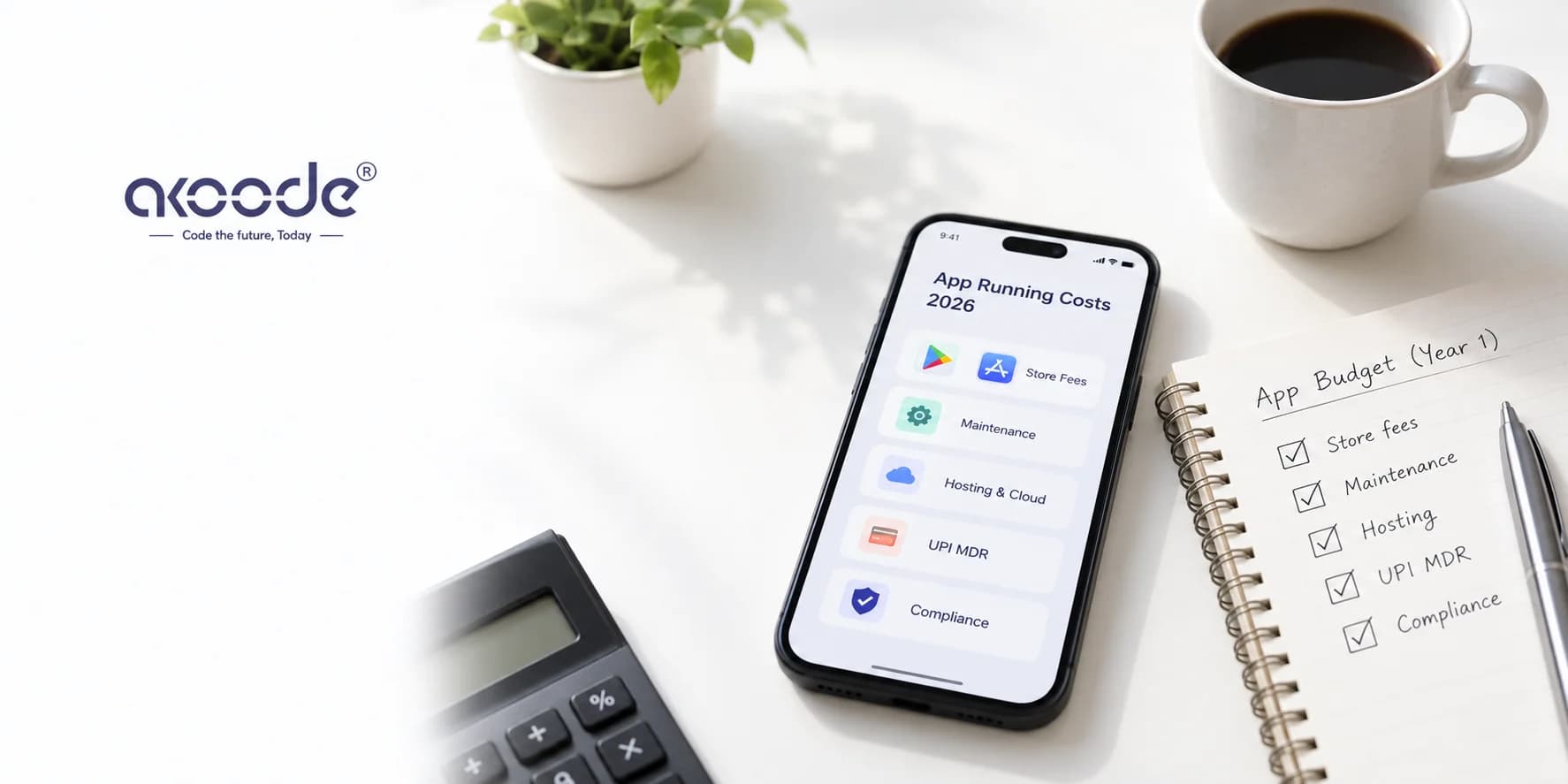
A build quote is the first bill an app sends you, not the last. Once the app is live, money keeps leaving: store fees, hosting, a maintenance retainer, third-party services, and in 2026 three new items that most budgets written a year ago don't include. UPI starts charging merchants on larger payments on 15 October. India's data protection rules start to bite in 2027. And Google Play expects an Android target bump every year, with this year's already in force.
This guide is about that second bill. For the build side, our guide to mobile app development cost in India breaks down price by app type, platform and feature. Here we cover what it costs to own the app once it ships, with a worked first-year budget near the end. Every figure is a planning range, not a quote, and every figure that comes from an outside source is linked.
The two bills: build cost and run cost
Founders tend to treat these as one number. They behave differently. Build cost is a project: scoped, quoted, finished. Run cost is a subscription you never cancel.
Build bill | Run bill | |
|---|---|---|
When you pay | Before launch | Every month and year after |
What drives it | Features, platforms, design depth, team seniority | Traffic, payment volume, OS and law changes, how fast you ship |
Who controls it | You, through scope | Partly you, partly Apple, Google, NPCI and the regulator |
Typical surprise | Scope creep | Items nobody listed |
The rest of this guide goes through the run bill line by line.
Store fees: small, fixed and easy to forget
Store fees are the smallest part of the run bill, but they're the only part with a published price.
Fee | Amount | Notes |
|---|---|---|
Apple Developer Program | US$99 a year, about ₹9,500 | Apple's own page says prices may vary by region and are shown in local currency at enrolment |
Google Play developer account | US$25, once, about ₹2,400 | One-time, not annual |
Apple commission on in-app sales | 15% under US$1M a year in revenue | Applies if you sell through the app and qualify for Apple's small business rate |
Both fees are priced in dollars, so their rupee cost moves with the exchange rate. The Apple fee in particular has crept up as the rupee has weakened. One practical point: Apple's fee is per account, not per app, so a company with three apps pays it once.
Maintenance: size it as a percentage, then check it against a retainer
The common rule of thumb across Indian cost guides is 15% to 20% of the build cost per year. It's a reasonable starting point, because maintenance work scales with how much app there is to maintain. Here's what that looks like by build size, using the tiers from our build-cost guide:
Build cost | Maintenance at 15% to 20% a year | Per month |
|---|---|---|
₹4,00,000 | ₹60,000 to ₹80,000 | ₹5,000 to ₹6,700 |
₹8,00,000 | ₹1,20,000 to ₹1,60,000 | ₹10,000 to ₹13,300 |
₹12,00,000 | ₹1,80,000 to ₹2,40,000 | ₹15,000 to ₹20,000 |
₹30,00,000 | ₹4,50,000 to ₹6,00,000 | ₹37,500 to ₹50,000 |
The retainers we publish run from ₹15,000 to ₹80,000 a month, which sits in the middle of that table. Very small apps are often better served by paying per fix than by a retainer, since a ₹5,000 monthly charge for an app that rarely changes buys little.
A maintenance retainer normally covers:
Bug fixes and crash investigation
Compatibility with new Android and iOS versions
Dependency and SDK updates
Security patches
Monitoring and uptime checks
A fixed number of support hours
It normally does not cover new features, redesigns, or large platform jumps. That last point matters this year, and we'll come back to it.
Cloud, SSL and third-party services
These are the lines that grow with your user base, which makes them the hardest to forecast.
Cloud hosting: ₹3,000 to ₹20,000 a month, depending on traffic and architecture.
SSL certificate: ₹2,500 to ₹10,000 a year.
Third-party services: maps, SMS and OTP, email, analytics, AI APIs. These are usage-priced, so we won't print a number that will be wrong by the time you read it. Ask each provider for its current price sheet.
A method that works better than guessing: calculate a monthly cost per 1,000 active users. Add your hosting bill and your usage-priced services, divide by active users, and track it each month. If that number climbs faster than revenue per user, you have a unit-economics problem long before you have a funding problem. Set budget alerts on your cloud account on day one, because a runaway query or a retry loop can burn a month of budget in a weekend.
2026 cost one: UPI MDR on larger payments
Until now, accepting a UPI payment cost the merchant nothing. From 15 October 2026, the Government of India's MDR FAQ sets a 0.4% merchant fee on person-to-merchant UPI payments above ₹2,000, capped at ₹300 for payments of ₹75,000 and above. Some categories pay a flat ₹5 instead, including railways, telecom, insurance, fuel and utilities. The merchant pays it, customers pay nothing, and merchants can't pass it on as a surcharge.
The same document says payments of ₹2,000 or less make up more than 95% of person-to-merchant volume by count. So for a typical consumer app with small tickets, the effect is small. For a business selling electronics, travel, courses or B2B supplies, it's a real line:
Monthly MDR ≈ 0.4% × value of UPI payments above ₹2,000 (₹300 cap per payment)

Example: 1,000 orders a month at an average of ₹4,000
Each order: 0.4% × ₹4,000 = ₹16
Monthly cost: ₹16,000, or about ₹1,92,000 a year
Unlike every other item in this guide, this cost scales with sales, not with the size of the app. It belongs in your margin model, not your maintenance budget. It also has an engineering side, because settlement amounts will stop matching gross payments and your reconciliation has to change. We cover that in our guide to the UPI MDR change for app teams. Your payment gateway's own fee is separate and varies by provider.
2026 cost two: DPDP readiness
India's Digital Personal Data Protection Rules were notified on 13 November 2025. According to a compliance tracker built from the Gazette text, the rules apply in phases: the Data Protection Board provisions first, consent manager registration around November 2026, and the main duties on data fiduciaries, meaning your app, around 13 May 2027. Some trackers count from the 14 November gazette date, so you'll see both. Those duties cover notice and consent, security safeguards, breach reporting, retention, and user rights. Penalties can reach ₹250 crore, and the Rules require breach reports to the Board within 72 hours. Apps that process data of users under 18 also need verifiable parental consent.
One caution on dates. MeitY floated a proposal in January 2026 to shorten the 18-month window to 12 months, which would pull the deadline to November 2026. As of early September that tracker said it had not been notified. Recheck before you rely on May 2027.
What this means in engineering terms:
A consent screen that names each purpose separately, and a stored record of who agreed to what and when
A way for users to withdraw consent as easily as they gave it
Analytics and advertising SDKs that stay silent until consent is recorded
Data deletion and retention jobs
Breach logging that can support a 72-hour report
A grievance contact inside the app
A parental consent flow, if minors can sign up
For a light-data app, meaning login, a basic profile and analytics, we'd plan on 40 to 80 developer hours. At the mid-level rate of ₹1,500 to ₹3,000 an hour from our build-cost guide, that's ₹60,000 to ₹2,40,000. Treat those hours as a planning assumption, not a quote. Apps handling health, financial or children's data should budget more and get a scoped estimate, since the consent and security work is deeper. Legal review of your privacy notice is a separate cost that we won't price here.
2026 cost three: the yearly Android target bump
Google Play raises its minimum target API level every August. Since 31 August 2026, new apps and updates must target Android 16 (API 36). Developers could request an extension to 1 November 2026. Existing apps on API 35 stay available, but apps on API 34 or lower are hidden from new users on newer Android versions.
This is a recurring cost, not a one-off, and a small yearly bump is cheaper than a catch-up after three skipped years. This year's step is bigger than most. At API 36, apps can't opt out of edge-to-edge drawing, the old back-button callbacks stop firing, and tablet orientation locks are ignored. Our API 36 migration guide covers the changes and the fixes.
For an app on a modern stack, we'd plan on 40 to 80 developer hours, and more for older codebases. Ask your vendor whether this is inside your maintenance retainer or billed as a separate project. Many retainers cover routine OS compatibility but not a jump with forced layout changes, and that gap is where budget disputes start.
The rupee line item for global buyers
If you're a US, UK, Canadian or UAE company paying an Indian team, the exchange rate is a line in your budget. The rupee is trading around ₹96 to the dollar, against about ₹88.7 a year ago, according to a daily rate tracker. On a contract priced in rupees, that's roughly 8% fewer dollars for the same work. On a contract priced in dollars, nothing changes for you.
Here are the build tiers from our build-cost guide at today's rate, rounded:
Build tier | Cost in rupees | About, in US dollars |
|---|---|---|
Medium app, lower end | ₹4,00,000 | $4,200 |
Medium app, upper end | ₹12,00,000 | $12,500 |
Complex app, upper end | ₹30,00,000 | $31,200 |
Enterprise platform | ₹1,00,00,000 | $104,000 |
A retainer of ₹15,000 a month is about $155 today, and ₹80,000 is about $830. Whichever currency your contract uses, ask which one the invoice will be in, and whether the rate can be revised mid-contract.
A worked budget: an ₹8 lakh app, first year
Here's a first-year budget for a medium-complexity cross-platform app with a build cost of ₹8,00,000. The assumptions are moderate traffic, hosting at ₹6,000 a month, and a maintenance retainer at 15% of build cost.
Line | Amount |
|---|---|
Maintenance retainer, 15% | ₹1,20,000 |
Hosting, ₹6,000 a month | ₹72,000 |
Apple Developer Program | ₹9,500 |
SSL certificate | ₹5,000 |
Recurring subtotal | ₹2,06,500, about 26% of build |
Google Play registration, year one only | ₹2,400 |
App store optimisation, year one only | ₹20,000 |
Year-one base | ₹2,28,900, about 29% of build |
DPDP readiness, light-data app, 40 to 80 hours | ₹60,000 to ₹2,40,000 |
Year one with DPDP readiness | ₹2,88,900 to ₹4,68,900, about 36% to 59% of build |
What the table leaves out: third-party service usage, which depends on your traffic, UPI MDR, which depends on your sales, and the API 36 bump if your retainer doesn't cover it. The recurring subtotal lands inside the 20% to 30% first-year overhead we cite in our build-cost guide. The new item is DPDP readiness, which for most apps is a one-time sprint in the first year or two, so the recurring percentage should settle back after that.
Questions to ask your vendor before you sign
What does the maintenance retainer cover, and what is billed separately?
Is the yearly Android and iOS compatibility update inside the retainer?
How many support hours are included each month, and what happens when they run out?
Who pays for third-party services, and will they be billed to us directly?
What is the response time for a production bug, and is it written into the contract?
Will you plan DPDP consent and deletion into the build, or quote it later?
What currency is the invoice in, and can the rate change during the contract?
Who owns the cloud accounts and the store accounts? They should be in your name.
Ways to lower your running cost without cutting corners
Take the small yearly bump. Skipping target updates for two years turns a 40-hour job into a rebuild.
Set cloud budget alerts and review the bill monthly. Most overspend is a forgotten service or an inefficient query.
Cache what doesn't change. Fewer database calls and fewer third-party API calls both cost less.
Audit your SDKs once a year. Each one adds update work and often a data-collection duty under DPDP.
Track cost per 1,000 active users. It tells you early whether growth is making the app cheaper or dearer to run.
Keep the accounts yours. Owning your store, cloud and domain accounts avoids migration fees if you change vendors.
Getting help with the run bill
If you'd like a second pair of eyes on a quote or an existing app's running costs, our mobile app development team can walk through it with you, and teams looking for a mobile app development company in India can talk to us directly. If you're still deciding what to build first, our guides to building an MVP and native versus cross-platform apps are a good place to start.
If you'd rather work with a team in your own city, we have pages for Gurgaon, Delhi NCR, Noida, Mumbai, Pune, Bangalore, Hyderabad, Chennai, Kolkata, Ahmedabad, Jaipur and Lucknow. If you're a company in the US, UK, Canada or UAE budgeting for an app with Indian users, see our mobile pages for the USA, UK, Canada and UAE. Security work is part of the run bill too, so our mobile app security checklist is worth a read, and our piece on mobile app development trends covers the wider picture.
Frequently Asked Questions
How much does it cost to maintain an app in India each year?
A common rule of thumb is 15% to 20% of the build cost per year. Our published maintenance retainers run from ₹15,000 to ₹80,000 a month, depending on the size and complexity of the app.
What fixed fees do app stores charge?
Apple's Developer Program is US$99 a year, about ₹9,500. Google Play charges a one-time US$25 registration, about ₹2,400.
Does UPI MDR affect an app's running costs?
Yes, if you accept UPI payments above ₹2,000. From 15 October 2026, merchants pay 0.4% on those payments, capped at ₹300 each, with a flat ₹5 in some categories. Customers pay nothing, and merchants can't pass the fee on.
What does DPDP compliance mean for my app budget?
You'll need consent capture with records, withdrawal, deletion and retention handling, breach logging and, if minors use the app, parental consent. For a light-data app we plan 40 to 80 developer hours. The main duties apply from around 13 May 2027, though that date could move.
Do I need to update my app every year for Google Play?
Google raises the minimum target API level each August. Since 31 August 2026, new apps and updates must target Android 16 (API 36). Existing apps on API 35 stay available, but apps on API 34 or lower are hidden from new users on newer Android versions.
Is an app built in India cheaper to run for a US or UK company in 2026?
The rupee trades around ₹96 to the dollar, about 8% weaker than a year ago. A contract priced in rupees therefore costs roughly 8% fewer dollars than it did a year ago. A contract priced in dollars is unchanged.
Should I pay a retainer or pay per fix?
A retainer suits apps that change often or carry payments and personal data. Very small, stable apps can do better paying per fix, since a monthly retainer buys little when little changes.
What does a maintenance retainer include?
Usually bug fixes, OS compatibility updates, dependency and SDK updates, security patches, monitoring and a set number of support hours. New features, redesigns and large platform jumps are normally billed separately.
Want an honest read on your quote or your running costs? Book a call with Akhil.
About Akoode
Akoode Technologies builds mobile apps, AI products and custom software from Gurugram, India, with a US presence in Jenks, Oklahoma. Clients rate us 4.9 on Google from 126 reviews and 5.0 out of 5 on GoodFirms.
Get In Touch Now
View More Our Blog