 September 21, 2026
Quick answer: A mobile app development company in India designs, builds, tests, launches, and maintains Android, iOS, and cross-platform apps, usually with the backend, cloud, and AI components behind them. This guide covers how these companies work, how to compare them, which technology fits which product, and what to check before hiring.
Akoode Technologies is a software development company based in Gurugram, India, providing custom mobile application development for businesses in India and international markets.
What does a mobile app development company in India do?
A mobile app development company in India plans, designs, builds, tests, launches, and maintains apps for Android, iOS, or both. Most also build the backend systems apps depend on: APIs, databases, cloud infrastructure, authentication, and payment or third-party integrations. Many now add AI features, analytics, and long-term support after launch.
The work splits into two halves. The visible half is the app on the phone: screens, navigation, offline behavior, notifications. The invisible half is everything the app talks to: servers, data storage, user accounts, payment providers, maps, and AI services. A company that only builds the visible half leaves you to find someone for the rest.
What services does a mobile app development company provide?
A full-service mobile app development company provides product discovery, UI/UX design, iOS and Android development, cross-platform development with Flutter or React Native, backend and API development, third-party integrations, QA and device testing, app store deployment, and ongoing maintenance. AI features, cloud setup, and analytics are increasingly part of the same engagement.
The services most buyers need, and why each matters:
Discovery and scoping. Turns an idea into a feature list, user flows, and technical decisions. Skipping it is the most common cause of budget overruns.
UI/UX design. Determines whether users finish onboarding. Design must follow Apple and Google platform conventions or the app feels wrong on the device.
iOS and Android development. Native (Swift, Kotlin) or cross-platform (Flutter, React Native), chosen against your requirements.
Backend and API development. The server logic, database, and endpoints the app depends on.
Third-party integration. Payments, maps, SMS/OTP, CRM, ERP, analytics, and messaging.
QA and device testing. Android alone runs on thousands of device and OS combinations. Testing on real devices catches what emulators miss.
Deployment. App Store and Google Play submission, including review requirements and privacy disclosures.
Maintenance. OS updates, security patches, and dependency upgrades that keep an app working after launch.
Akoode Technologies delivers these as part of its mobile app development services, alongside backend engineering and AI integration. For the wider market picture, see Akoode's guide to mobile app development trends.
Mobile App Technology at a Glance
Requirement | Typical approach |
|---|---|
iOS application | Swift / native iOS |
Android application | Kotlin / native Android |
Cross-platform application | Flutter / React Native |
Backend | Node.js / Laravel / other suitable technology |
Database | PostgreSQL / MongoDB / suitable database |
APIs | REST / GraphQL where appropriate |
Authentication | OAuth / OTP / secure authentication |
Cloud | AWS / Azure / GCP depending on requirements |
AI functionality | LLM APIs / ML / computer vision depending on use case |
No row in this table is universally correct. Each choice depends on the product, the team, and the constraints around it.
How do I choose a mobile app development company in India?
Choose an Indian app development company by checking five things: relevant shipped apps in your category, technical fit with your platform needs, a defined delivery process, clear IP and security terms, and post-launch support. Speak to the engineers who will do the work, ask for live app links, and run a paid discovery phase before committing to a full build.
A practical evaluation checklist:
Live apps, not screenshots. Download them. Check ratings, update history, and how they behave on an older phone.
Relevant experience. A team that has built a marketplace app knows where marketplaces break. Ask for examples close to your use case.
Who does the work. Ask for the names and seniority of the engineers assigned, not just the sales lead.
Process clarity. Sprint length, demo cadence, how change requests are priced, and how you see progress.
Ownership terms. Source code, design files, and app store accounts should belong to you.
Reviews from more than one place. Google, Clutch, and GoodFirms each have different verification standards. Read the critical reviews too.
What should I check before hiring an Indian app development company?
Before hiring, verify live apps the company has shipped, the seniority of the engineers assigned, written IP assignment, code repository ownership, security practices, testing process, post-launch support terms, and references you can call. Ask who owns the app store accounts and source code from day one, and whether you get full documentation at handover.
Three checks that often get missed:
Repository access from week one. If you can see commits weekly, you can verify progress without relying on status reports.
Developer accounts in your name. Register the Apple Developer and Google Play accounts under your company, not the vendor's.
Handover documentation. Architecture notes, environment setup, and API documentation decide whether another team could take over the app later.
If you are building or extending your own team instead, Akoode's guide on how to hire developers in India covers vetting, engagement models, and onboarding.
How much does mobile app development cost in India?
Mobile app development cost in India depends on scope, not a fixed rate. The main drivers are the number of platforms, feature complexity, design depth, backend requirements, third-party integrations, compliance needs, and team size. Indian engineering rates are generally lower than US or UK rates, but a reliable quote requires a defined feature list and a discovery phase.
Why each driver moves the price:
Cost driver | Why it matters |
|---|---|
Platforms | Native iOS plus Android means two codebases; cross-platform shares most of the work |
Feature complexity | Real-time chat, video, maps, and payments each add design, build, and test effort |
Design depth | Custom animation and brand-specific interfaces take longer than standard components |
Backend scope | A custom backend with admin panel, roles, and reporting often costs as much as the app itself |
Integrations | Every third-party API adds authentication, error handling, and testing |
Compliance | Payments, health, or financial data adds security review and documentation |
Team model | Fixed scope, dedicated team, and hourly billing distribute risk differently |
Post-launch support | Maintenance is a recurring cost, not a one-time item |
Watch for quotes that are far lower than the others. Usually the scope is thinner, the team is junior, or testing and backend work have been left out.
For a scoped estimate on your specific product, book a call with Akoode.
How long does it take to build a mobile app in India?
A focused MVP typically takes 8 to 12 weeks. A more complete app with a custom backend, payments, or real-time features usually takes 16 to 24 weeks, and enterprise applications with deep system integration often take six months or longer. Timelines depend on scope clarity, design approvals, integration readiness, and store review.
These are planning ranges, not guarantees. A typical build moves through these phases:
Phase | What happens | What delays it |
|---|---|---|
Discovery | Requirements, user flows, technical decisions | Unclear scope, stakeholder disagreement |
Design | Wireframes, UI design, clickable prototype | Slow feedback and approvals |
Development | Sprint-based build of app and backend | Scope changes mid-sprint |
Integration | Payments, maps, third-party APIs | Vendor sandbox delays, API changes |
QA | Functional, device, performance, and security testing | Late bug discovery, device coverage gaps |
Release | Store submission and review | Missing privacy disclosures, rejected builds |
The fastest way to shorten a timeline is to cut the first release down to the smallest version that proves the idea.
What is the difference between Flutter and native app development?
Flutter builds iOS and Android apps from one Dart codebase with its own rendering engine, which speeds delivery and keeps the UI consistent. Native development uses Swift for iOS and Kotlin for Android, giving same-day access to new platform features and fine-grained performance control, at the cost of maintaining two codebases.
Here is how the three main approaches compare:
Flutter | React Native | Native (Swift / Kotlin) | |
|---|---|---|---|
Language | Dart | JavaScript / TypeScript | Swift (iOS), Kotlin (Android) |
Codebase | One shared | One shared | Two separate |
UI approach | Own rendering engine, consistent across devices | Native platform components | Fully native components |
Platform feature access | Via plugins and platform channels | Via native modules | Direct and immediate |
Fits teams with | New or mixed skills | Existing web/React skills | Platform specialists |
Watch out for | Larger app size, plugin gaps for niche hardware | Bridge and third-party library maintenance | Higher cost from parallel builds |
The differences are real but narrower than online debates suggest. Flutter and React Native both ship production apps at scale. The decision usually comes down to team skills, UI requirements, and how much platform-specific functionality the product needs.
Which technology should a startup choose for mobile app development?
Many startups building an MVP choose Flutter or React Native, because one codebase reaches both platforms faster and with a smaller budget. Native makes sense when the product depends on advanced device features such as heavy AR, custom camera pipelines, or low-level Bluetooth. The right choice depends on the team's skills, product scope, and where the app needs to run.
Business requirement | Potential approach |
|---|---|
Fast MVP | Flutter / React Native |
Maximum platform-specific functionality | Native |
Existing React ecosystem | React Native |
Shared cross-platform UI | Flutter |
Complex device integration | Native or hybrid architecture |
AI-enabled application | Mobile + backend + AI services |
Two questions settle most decisions. Does the app need something the cross-platform frameworks handle poorly? And does your team, or your future hires, already know one of these stacks? If the answers are "no" and "either," cross-platform is usually a practical starting point. A good vendor will tell you when your case is the exception.
What should a mobile app development architecture include?
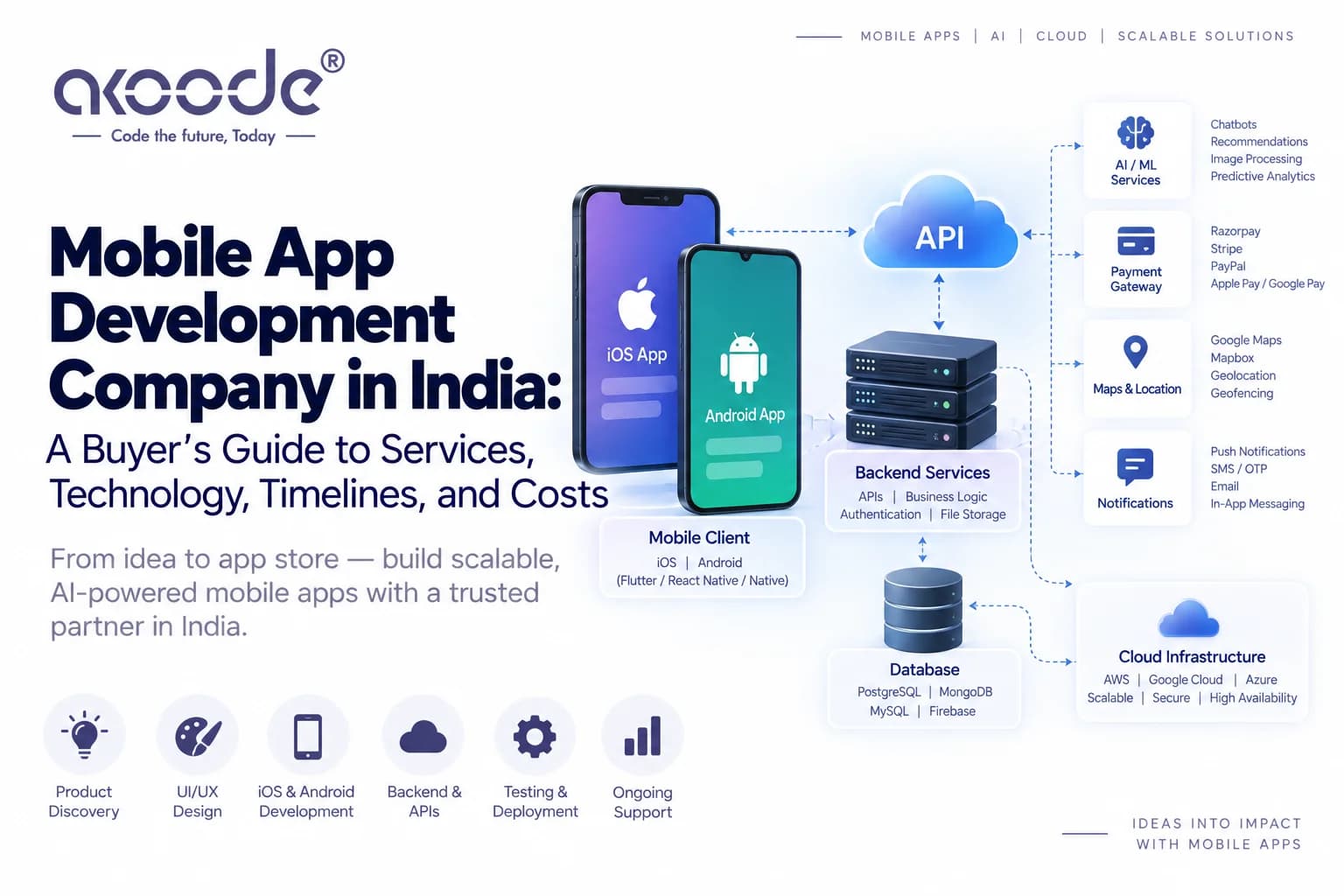
A mobile app architecture should include the client app, an API layer, backend services, a database, authentication, and file or cloud storage. Production apps also need push notifications, payment and third-party integrations, analytics, crash reporting, logging, a CI/CD pipeline, and security controls such as encrypted transport, token-based sessions, and secure on-device storage.
A conceptual architecture:
Mobile Application (iOS / Android / cross-platform)
        ↓
API Layer (REST / GraphQL, authentication, rate limiting)
        ↓
Backend Services (business logic, jobs, notifications)
        ↓
Database (PostgreSQL / MongoDB) + Cloud Storage

Connected services as needed:
AI Services · Payment Gateway · Maps · Push Notifications · Analytics
What each layer does, and why it matters:
Mobile application. Handles screens, local state, offline behavior, and device features like camera, GPS, and biometrics. Keep business rules out of it, because users run old app versions for months.
API layer. The single door between app and backend. It validates requests, enforces authentication, and versions endpoints so old app builds keep working after backend changes.
Backend services. Holds business logic, background jobs, and integrations. Building it as separate services or modules makes it easier to scale one part without rebuilding the rest.
Database. Stores users, transactions, and content. PostgreSQL suits structured, relational data; MongoDB suits flexible document data. The choice follows the data shape.
Authentication. OTP, OAuth, or social login, with short-lived tokens and refresh handling. Weak session handling is a common source of mobile security failures.
Push notifications. Delivered through Firebase Cloud Messaging and Apple's APNs. They need user consent handling and delivery tracking, not just a send button.
Payment gateway. Card and UPI data should pass through the provider's SDK and never touch your servers. That keeps compliance scope small.
Maps and location. Cost and battery use rise quickly with poll frequency. Design location updates deliberately.
Analytics and crash reporting. Show where users drop off and which devices crash. Without them, you fix the wrong problems.
Cloud infrastructure. AWS, Azure, or GCP, chosen by existing contracts, data-residency needs, and team familiarity.
Security and testing basics
Security belongs in the design phase. At minimum: TLS everywhere, no secrets stored in the app binary, secure storage for tokens (Keychain on iOS, Keystore on Android), server-side validation of every request, and dependency scanning.
Testing should combine automated unit and API tests with manual testing on a real device matrix that reflects your users' phones. Test on the low-end Android devices your audience actually carries, not just flagship models.
How These Patterns Look in Production
Three Akoode builds show the architecture decisions above in practice.
Parking platform (US client). A Flutter driver app, Next.js owner portal, and admin console run on one Node.js and MongoDB API. Access and refresh tokens sit in iOS Keychain and Android Keystore. Concurrent expired requests share a single token refresh, so users are not signed out when several calls fail at once. Stripe payments (cards, Apple Pay, Google Pay) are trusted only after the backend verifies the payment intent. The session countdown recalculates from absolute timestamps, so it stays correct after the phone sleeps.
Referral and commission platform (tourist attraction, Canada). A mobile app for referral partners connects to the client's ticketing system through OAuth, a 5-minute sync, and signed webhooks. The ticketing order ID is a unique database constraint, so the two sync paths cannot create duplicate commissions. Commission math uses decimal types instead of floats, and bank details are encrypted with AES-256 before they reach the database. Push notifications run outside the booking and commission write path, so a notification failure cannot block a transaction.
Peer support platform (in-house, web). This real-time chat platform resolves the user from a JWT when the WebSocket connects, tracks presence by heartbeat, and stores read receipts per message. It is a web build, but the same pattern applies to chat features in a mobile app.
What is involved in building an enterprise mobile application?
An enterprise mobile application adds requirements a consumer app usually skips: single sign-on, role-based access, integration with ERP, CRM, or HR systems, offline sync, audit logs, mobile device management support, and compliance controls. Development also involves security review, staged rollout, and internal distribution through managed app stores or MDM tools.
Enterprise apps differ from consumer apps in four ways:
Identity. Employees sign in through the company's identity provider (Azure AD, Okta), not a fresh account.
Integration depth. The app is often a front end to systems that already exist. Integration work can outweigh app work.
Offline behavior. Field teams, warehouses, and sites lose connectivity. Sync and conflict handling need design, not patches.
Governance. IT will ask about data residency, audit trails, and update control before approving rollout.
Akoode's custom software development practice handles the backend and integration side of enterprise mobile work, and its staff augmentation service is an option for teams that want to add mobile engineers to an existing product group.
AI-Powered Mobile App Development
Can a mobile app development company integrate AI? Yes. A mobile app development company can integrate AI in two main ways: calling cloud AI services such as LLM APIs, vision, or speech models from a backend, or running compact models directly on the device. The right approach depends on latency, privacy, connectivity, model size, and running cost.
Practical AI use cases in mobile apps
Use case | What it does | Typical implementation |
|---|---|---|
AI assistants | Answers questions, guides users through tasks | LLM API via backend |
LLM-powered features | Summaries, drafting, classification, extraction | LLM API with prompt and guardrail layer |
Computer vision | Detects objects, defects, or documents from camera | On-device model or cloud vision API |
OCR | Reads IDs, invoices, forms | On-device OCR or cloud OCR |
Recommendation engines | Suggests products, content, or matches | Backend ML model over user data |
Predictive analytics | Forecasts demand, churn, or risk | Backend models feeding app dashboards |
Voice interfaces | Speech-to-text commands and responses | Cloud speech APIs or on-device speech |
Intelligent search | Finds results by meaning, not exact keywords | Embeddings and vector search in the backend |
Workflow automation | Routes approvals, triggers actions | Backend agents with app as the interface |
Document processing | Classifies and extracts fields from uploaded files | OCR plus LLM extraction pipeline |
Cloud AI vs on-device AI
Cloud pattern: Mobile UI → Backend → AI API → Data layer.
The app sends a request to your backend. The backend calls the AI service, applies business rules and access control, and returns a result. This is the usual pattern for LLM features, because API keys stay on the server, you can swap models without an app update, and you control logging and cost.
On-device pattern: the model runs on the phone.
This suits camera-based detection, real-time features, offline use, and privacy-sensitive data that should not leave the device. The trade-offs are model size limits, battery and heat, and harder model updates.
Factor | Cloud AI | On-device AI |
|---|---|---|
Latency | Network-dependent | Immediate |
Offline use | No | Yes |
Model capability | Large, frequently updated models | Compact models |
Privacy | Data leaves the device | Data stays local |
Cost profile | Per-request API cost | No per-request cost, higher build effort |
Updates | Backend change | App or model release |
Many production apps combine both: a small on-device model for fast, private tasks and a cloud model for heavier reasoning.
The on-device pattern is easiest to see in a production app. Akoode built an AI pelvic floor fitness app for M2 Method in the USA that runs pose detection on the phone. Pre-trained MediaPipe models map 33 body landmarks per frame, and a JSON rule engine triggers audio and visual corrections within 300 milliseconds of a form deviation. Running the model on the device removes the network round trip that would otherwise make real-time feedback too slow. The app runs on iOS and Android from one Flutter codebase, with a Node.js backend on AWS handling Apple and Google subscription billing and a web admin panel for the client's team.
For document-heavy AI work, Akoode also built an AI quantity takeoff platform for Qualis Construction Ltd.. Its AI development services cover the model and backend layers that mobile AI features depend on.
Mobile App Development Companies in India
India is a major source of outsourced software engineering. Companies in the US, UK, and Europe hire Indian teams for mobile projects because of engineering talent depth, cost structure, and the ability to scale a team up or down as a product evolves.
Why companies outsource mobile development to India
Talent pool. India has large numbers of engineers experienced in Android, iOS, Flutter, and React Native.
Cost structure. Engineering rates are generally lower than in the US or UK, which stretches a product budget further.
Full-stack availability. Many Indian firms cover design, mobile, backend, QA, and DevOps under one roof.
Scalability. Teams can grow from two engineers to twelve as scope changes.
Types of teams and engagement models
Model | How it works | Suits |
|---|---|---|
Fixed-scope project | Agreed scope, timeline, and price | Well-defined MVPs |
Dedicated team | A team works only on your product, billed monthly | Evolving products, longer roadmaps |
Staff augmentation | Individual engineers join your existing team | Companies with their own product management |
Time and materials | Billed by effort against a sprint plan | Projects where scope will shift |
Communication and time zones
India Standard Time is UTC+5:30. The UK is 4.5 to 5.5 hours behind. US East Coast is 9.5 to 10.5 hours behind, and US Central is 10.5 to 11.5 hours behind. Most teams working with Western clients keep a defined overlap window, often India's late afternoon and evening, for stand-ups, demos, and reviews.
Set the communication rules at the start: one shared project tool, written specifications, weekly demos of working software, and a named project manager.
IP ownership, security, and maintenance
IP. The contract should assign all source code, designs, and documentation to you on payment. Keep repositories and cloud accounts in your organization.
Security. Ask about access controls, NDA practices, code review, and how the team handles production credentials. Data-protection obligations under GDPR, CCPA, and India's DPDP Act depend on where your users live.
Maintenance. Apps need updates whenever iOS or Android release new versions. Agree on a support model before launch.
Can Indian development companies build apps for US and European businesses?
Yes. Indian development companies routinely build apps for US and European clients, working through overlapping-hours schedules, written specifications, shared project tools, and weekly demos. Buyers should confirm contract terms under their own jurisdiction, IP assignment, data-protection compliance such as GDPR or CCPA, and how the team handles time-zone overlap.
Akoode Technologies runs dedicated pages for mobile app development for clients in the USA, the UK, Canada, and the UAE. US projects are supported from Gurugram and from its office in Jenks, Oklahoma.
The compliance framework depends on what the app handles:
HIPAA applies to protected health information.
PCI-DSS applies to payment card data.
CCPA applies to California residents' data.
GDPR applies to users in the European Union and, through the UK GDPR, the United Kingdom.
Identify which apply during discovery. Retrofitting compliance after the architecture is set costs far more.
About Akoode Technologies
Akoode Technologies is a software development company based in Gurugram, India, at Spaze iTech Park, Sector 49, with a US office in Jenks, Oklahoma. It serves clients across India, the UK, and the USA. Mobile application development is one of several capabilities, alongside AI development, custom software, web development, eCommerce, cloud solutions, and digital transformation.
The company has delivered 180+ software projects across 15+ industries. It holds a 4.9 rating on Google from 110 reviews and 5.0 on Clutch.
Mobile technologies
Akoode's mobile app development team works in Swift and SwiftUI for iOS, Kotlin and Jetpack Compose for Android, and Flutter and React Native for cross-platform builds. Backend and API work runs mainly on Node.js, Python, or Java, deployed on AWS, Azure, or Google Cloud. AI features use cloud LLM services or on-device models such as MediaPipe and TensorFlow Lite. The platform is chosen per project during discovery, not set by default.
Development process
Akoode works in six stages, each ending with a checkable deliverable:
Discovery and requirement analysis. Typically one to two weeks. Covers user journeys, platform choice, and any HIPAA, PCI-DSS, or CCPA obligations.
System architecture. Backend, integration, and technology decisions are documented.
UI/UX design. Wireframes and a clickable prototype.
Agile development. Two-week sprints with working builds shown to the client.
QA and security review. Functional, real-device, and security testing.
Deployment and post-launch support. App Store and Google Play submission, followed by at least 90 days of support covering bug fixes, OS compatibility updates, and performance monitoring.
Engagement options
Businesses can work with Akoode through a fixed-cost project, a dedicated team, or staff augmentation. The client owns the source code, designs, and data models. NDAs are signed before technical discussions.
Selected mobile work
Parking platform, US. Flutter app, web portal, and admin console with Stripe payments and QR check-in.
Referral and commission platform, Canada. A mobile app with ticketing-system sync and tiered commissions.
AI fitness app for M2 Method, USA. On-device pose correction on iOS and Android.
Travel dating app, Switzerland. Mifever, built around travel-based matching.
To discuss a mobile project, book a call or see the case studies page.
Frequently Asked Questions
What is a mobile app development company?
A mobile app development company designs, builds, tests, and maintains applications for smartphones and tablets. Services usually span iOS, Android, and cross-platform development, backend and API work, UI/UX design, QA, deployment, and ongoing support. Some also add cloud infrastructure, analytics, and AI features.
How much does an app cost in India?
App cost in India depends on scope: platforms, features, design depth, backend, integrations, and compliance needs. A defined feature list and a discovery phase produce a reliable estimate. Ranges quoted without scope are usually unreliable. Akoode provides scoped estimates through a short call.
How long does it take to build an app?
A focused MVP usually takes 8 to 12 weeks. Apps with a custom backend, payments, or real-time features usually take 16 to 24 weeks, and enterprise apps with deep integrations often take six months or longer. Scope clarity, design approvals, and third-party integration readiness affect the timeline most.
Is Flutter good for startups?
Flutter is a practical option for many startups because one Dart codebase produces iOS and Android apps, which shortens development and reduces budget. It is less suited to products that depend heavily on niche platform-specific hardware features. Team skills and hiring plans should factor into the decision.
What is the difference between Flutter and React Native?
Flutter uses Dart and draws its own interface, giving consistent UI across devices. React Native uses JavaScript or TypeScript and renders native platform components, which suits teams with existing React skills. Both are used in production apps. Neither is universally better.
Native vs cross-platform development: which should I choose?
Choose cross-platform (Flutter or React Native) when speed, shared code, and budget matter most. Choose native when the app needs deep platform integration, advanced hardware access, or maximum performance control. Complex products sometimes use a hybrid: shared code with native modules where needed.
How do I hire app developers in India?
Shortlist companies with live apps in your category, speak to the engineers assigned, check references, and start with a paid discovery phase. Then choose an engagement model: fixed scope, dedicated team, or staff augmentation. Confirm IP assignment and repository access in the contract before development starts.
Can an Indian company build an app for a US business?
Yes. Indian firms regularly build apps for US clients using overlapping working hours, written specs, and regular demos. The contract, IP terms, and data-protection compliance follow your jurisdiction. Akoode has a US presence in Jenks, Oklahoma and works with clients across the USA.
What does custom mobile app development include?
Custom mobile app development includes discovery, UI/UX design, app development, backend and API development, integrations, testing, store deployment, and post-launch support. Unlike template or no-code tools, the app is built to your specific workflows, data, and scale requirements, and you own the source code.
Can AI be integrated into mobile apps?
Yes. AI enters mobile apps through cloud services (LLM, vision, speech APIs called from the backend) or on-device models. Common uses include assistants, OCR, recommendations, intelligent search, and document processing. The right method depends on latency, privacy, connectivity, and cost.
What should an app development contract include?
A contract should cover scope and deliverables, timeline and milestones, payment terms, IP assignment to you, source code and repository ownership, confidentiality, security obligations, change-request handling, acceptance criteria, warranty or bug-fix period, support terms, and termination and handover conditions.
What happens after an app is launched?
After launch, the work shifts to monitoring, bug fixes, OS compatibility updates, security patches, analytics review, and feature iteration. iOS and Android release updates every year, so apps need regular maintenance to keep working. Agree on a support model and response times before launch.
What mobile technologies does Akoode Technologies use?
Akoode Technologies builds mobile apps with Flutter, React Native, and native iOS and Android development. It also builds the backend and API layers and integrates AI features such as LLM services, computer vision, and document processing. Technology is chosen per project requirement.
Get In Touch Now
View More Our Blog