


 July 29, 2026
eCommerce Development Cost in India: What You Actually Pay in 2026
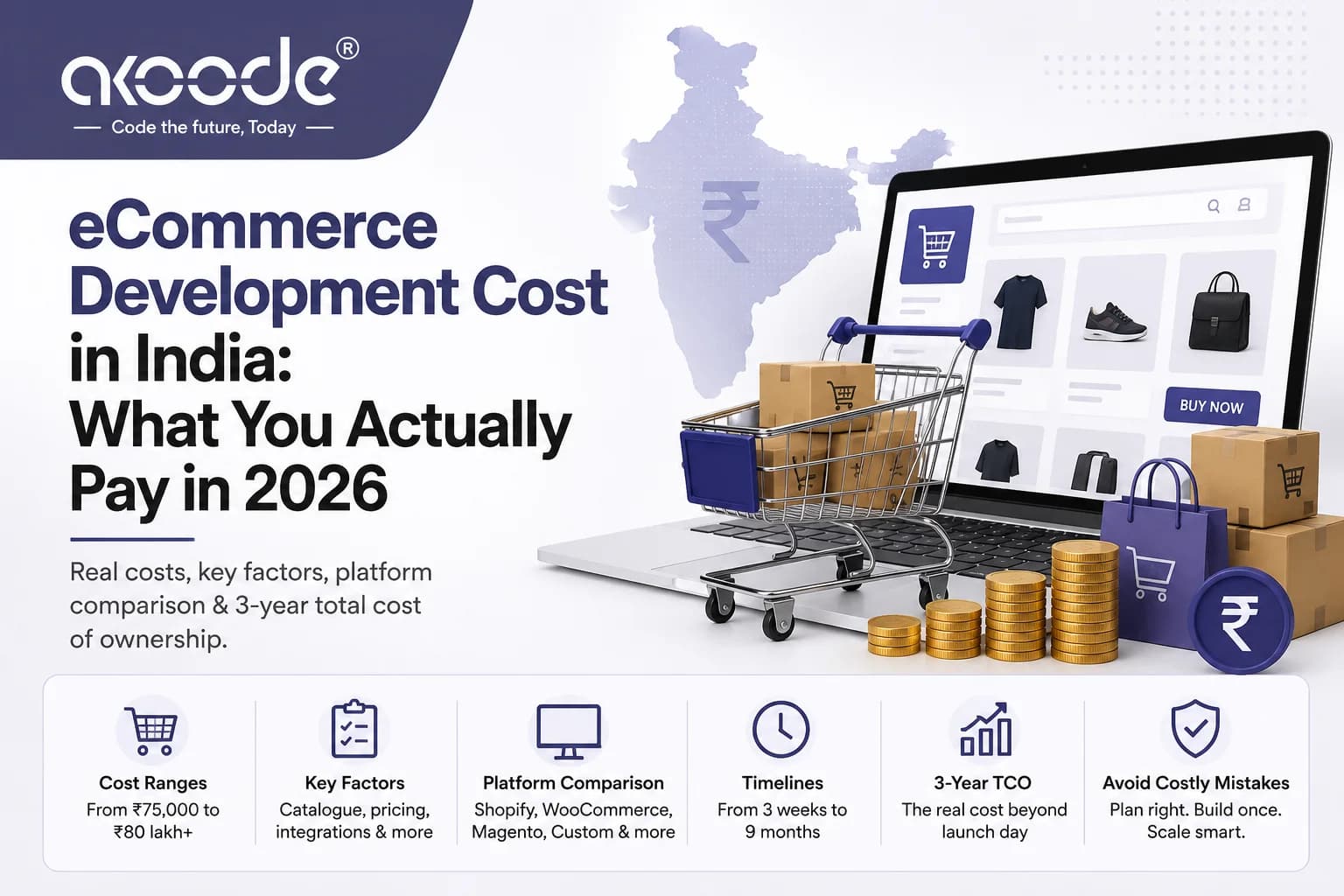
Quick answer: eCommerce development in India costs between ₹75,000 and ₹80 lakh in 2026, depending on what you are actually building. A theme-based D2C store runs ₹75,000 to ₹3 lakh. A customised storefront with real integrations lands between ₹4 lakh and ₹12 lakh. Custom builds, B2B dealer portals and multi-vendor marketplaces start around ₹15 lakh and climb past ₹60 lakh. The number is driven by catalogue complexity, pricing logic and integrations — not by page count.
Three quotes arrive for the same brief.
A freelancer says ₹90,000. A digital agency says ₹6 lakh. A product engineering company says ₹28 lakh and wants a discovery workshop before committing to that.
All three read the same requirements document. None of them is lying.
This is the part of eCommerce budgeting that nobody explains properly, and it is why so many Indian businesses end up building twice. The three quotes are not competing bids for one thing. They are bids for three different things that happen to share a name. One is a storefront. One is a storefront with some plumbing. One is commerce infrastructure with an order lifecycle, a pricing engine and integrations that survive a sale weekend.
The freelancer's number is real. So is the ₹28 lakh. What separates them is scope that was never written down.
This guide fixes that. It covers what eCommerce development actually costs in India in 2026, broken down by store type and platform, and it includes something the rest of the internet leaves out entirely: what the store costs you over three years, not on launch day. That second number is the one that decides whether the project was a good decision.
The Short Answer: eCommerce Development Cost Ranges in India (2026)
Here is the pricing landscape as it stands this year, based on prevailing market rates for established Indian development companies.
Cost by store type
Store type | Typical cost (INR) | Timeline | Best suited to |
|---|---|---|---|
Theme-based store (Shopify / WooCommerce) | ₹75,000 – ₹3,00,000 | 3–6 weeks | First store, <200 SKUs, standard pricing |
Customised storefront | ₹4,00,000 – ₹12,00,000 | 8–14 weeks | Growing D2C, 500–2,000 SKUs, 2–4 integrations |
Custom / headless build | ₹15,00,000 – ₹45,00,000 | 4–6 months | Scale, custom checkout, multi-channel |
B2B / dealer portal | ₹18,00,000 – ₹60,00,000 | 4–7 months | Manufacturers, distributors, wholesalers |
Multi-vendor marketplace | ₹20,00,000 – ₹80,00,000+ | 5–9 months | Platform businesses, aggregators |
eCommerce mobile app | ₹8,00,000 – ₹30,00,000 | 3–5 months | Repeat-purchase categories |
Cost by platform
Platform | Build cost (INR) | Licence / platform fee | Where the money goes later |
|---|---|---|---|
Shopify / Shopify Plus | ₹1,50,000 – ₹15,00,000 | ₹2,000/mo to ₹2,00,000+/mo | Apps, transaction fees, workarounds |
WooCommerce | ₹1,00,000 – ₹10,00,000 | ₹0 core | Plugins, hosting, security, performance work |
Magento / Adobe Commerce | ₹12,00,000 – ₹75,00,000 | ₹0 (Open Source) or licence tied to GMV | Specialist developer rates, upgrades |
OpenCart | ₹1,50,000 – ₹8,00,000 | ₹0 core | Extensions, custom module work |
Custom (Next.js + Node) | ₹15,00,000 – ₹60,00,000 | ₹0 | Infrastructure, your own roadmap |
Hourly rates in India, 2026
Vendor type | Rate (INR/hr) | Rate (USD/hr) |
|---|---|---|
Freelancer | ₹500 – ₹1,500 | $6 – $18 |
Small agency | ₹1,200 – ₹2,500 | $14 – $30 |
Established development company | ₹2,000 – ₹4,000 | $24 – $48 |
Specialist / enterprise commerce team | ₹3,500 – ₹6,000 | $42 – $72 |
Rates alone tell you very little. A ₹1,000/hr developer who needs 600 hours to build what a ₹3,000/hr team builds in 180 costs you more, ships later, and leaves you with code nobody wants to inherit. Compare total scoped cost against a defined outcome, never day rates against each other.
Why the same brief gets a ₹1.5 lakh quote and a ₹35 lakh quote
Because "eCommerce website" describes an outcome, not a system. Ask three vendors to price a "warehouse" and you will get a shed, a distribution centre and an automated fulfilment facility. Same word. Same accuracy. Wildly different buildings.
The gap closes the moment you specify three things: how your catalogue is structured, how your prices are decided, and which systems the store must talk to. We will come back to those, because they account for most of the variance in every quote you will ever receive.
What Actually Drives eCommerce Development Cost
Six variables move the number. Everything else is noise.
1. Catalogue complexity and product data model
A store selling 80 T-shirts in four sizes is a simple data model. A store selling industrial fasteners across 4,000 SKUs with compatibility rules, technical specifications, unit-of-measure conversions and packaging tiers is not. The second one needs a product information architecture designed before anyone opens a design tool, and it needs bulk data tooling for the merchandising team.
Rough impact: a complex catalogue adds 25–40% to build cost, and it is the single most common reason a store gets rebuilt within two years. Under-specified product models do not fail loudly. They fail slowly, as the merchandising team quietly stops using the admin and starts keeping the real data in a spreadsheet.
2. Pricing logic
This is where B2B budgets triple, and where most Indian buyers underestimate hardest.
Simple pricing means one price per product, occasionally discounted. That is nearly free to implement. Account-level pricing means a customer belongs to a group, which has a contract, which contains a price book, which has volume breaks, which can be overridden by a promotion — and something has to decide precedence when three of those apply at once.
Plugin-based pricing on hosted platforms handles roughly the first two layers well. It becomes unreliable at the third and unmaintainable at the fourth. Budget ₹4 lakh to ₹15 lakh for a real pricing engine, and treat any quote that includes contract pricing without a dedicated line item as a quote from someone who has not built one.
3. Integrations
Payment gateways, ERP, CRM, logistics, tax, accounting, warehouse systems. Each integration is not one job but three: the connection, the failure handling, and the reconciliation.
Most quotes price the first. Silent integration failures — a webhook that stopped firing a fortnight ago, orders sitting in a queue nobody monitors, stock counts drifting out of sync — are the most expensive class of eCommerce bug in India, precisely because nobody notices them until a customer does.
Integration | Typical cost (INR) | Complexity driver |
|---|---|---|
Payment gateway (Razorpay, PayU, Cashfree, Stripe) | ₹40,000 – ₹1,50,000 | Refunds, partial capture, UPI flows |
Logistics (Shiprocket, Delhivery, carrier APIs) | ₹60,000 – ₹2,50,000 | Multi-warehouse, rate shopping, RTO |
ERP (Tally, Zoho, SAP, Dynamics) | ₹2,50,000 – ₹12,00,000 | Real-time vs batch, master data ownership |
CRM | ₹80,000 – ₹3,00,000 | Event mapping, identity resolution |
GST / e-invoicing / e-way bill | ₹1,50,000 – ₹5,00,000 | IRN generation, credit notes, dispatch triggers |
WMS / OMS | ₹3,00,000 – ₹15,00,000 | Allocation logic, partial fulfilment |
4. Performance and scale requirements
Speed is not a finishing touch. If Core Web Vitals targets are written into the acceptance criteria — LCP under 2.5 seconds on a mid-range Android on 4G, checkout load-tested at four times expected peak — that is engineering work with a cost attached. Expect ₹2 lakh to ₹8 lakh for a properly executed performance workstream on a mid-sized build.
Skipping it is a decision, not a saving. It shows up later as a conversion rate you cannot explain.
5. Compliance
GST-compliant invoicing inside checkout, e-invoicing and IRN generation above the turnover threshold, e-way bill triggers on dispatch, TCS handling, DPDP Act obligations on customer data, PCI scope if you touch card data at all. For regulated categories — pharmacy, insurance, financial products — add prescription validation, consent capture and audit trails.
Compliance work rarely appears in a competitive quote because it is invisible in a demo. It is not optional.
6. Custom logic your business actually runs on
Subscriptions and dunning. Configure-to-order builders. Booking and availability. Loyalty. Marketplace commission and settlement. Entitlements. Each of these is a system in its own right, and each one belongs on its own line in a quote.
Cost Breakdown by Store Type
D2C storefront
₹4,00,000 – ₹12,00,000 | 8–14 weeks
What is included: custom design implementation, catalogue setup for up to ~2,000 SKUs, payment and logistics integration, basic CRM connection, analytics, SEO foundations, performance tuning, one round of conversion iteration post-launch.
Team shape: one frontend engineer, one backend engineer, a designer, part-time QA, a project lead.
When this is the right call: you have product-market fit, you are spending on acquisition, and your current store's conversion rate is the constraint. Choose this over a theme setup when your brand experience is a competitive asset rather than a nice-to-have.
Pros: fast to market, predictable cost, easy to hire for later. Cons: you inherit the platform's ceiling on checkout and pricing logic.
B2B / dealer portal
₹18,00,000 – ₹60,00,000 | 4–7 months
What is included: account hierarchy and user roles, price book architecture with volume breaks and contract rates, credit limits and payment terms, quote-to-order workflows, approval chains, bulk and repeat ordering, MOQ and pack handling, ERP synchronisation, GST-compliant invoicing.
Team shape: two to three backend engineers, one frontend, an integration specialist, a solution architect, QA, a project lead.
When this is the right call: your sales team spends more time keying in orders that arrived by WhatsApp than selling. That is the tell, and it is remarkably consistent across manufacturing, agriculture, pharma distribution and auto parts.
Pros: the highest-ROI eCommerce project most Indian mid-market businesses can run, because it removes cost rather than adding acquisition spend. Cons: dealer adoption is a genuine change-management project, and almost nobody budgets for it. Set aside 8–12% of the build cost for rollout, training and vernacular support material.
Multi-vendor marketplace
₹20,00,000 – ₹80,00,000+ | 5–9 months
What is included: seller onboarding and KYC, vendor dashboards, catalogue governance, commission engine, split payments and settlement, dispute and returns handling, payout reconciliation, ratings, search and ranking.
The buyer-facing catalogue is the straightforward half. The operational tooling that keeps two hundred sellers behaving — content moderation, SLA enforcement, settlement disputes, fraud signals — is where the budget goes and where most marketplace projects underestimate by a factor of two.
Pros: platform economics, inventory-light growth. Cons: you are building two products (buyer app and seller app) and running a supply-side sales operation from day one.
Headless commerce build
₹15,00,000 – ₹45,00,000 | 4–6 months
What is included: decoupled frontend on Next.js, commerce APIs, CMS integration, edge caching and CDN strategy, search service, one or more storefront channels off a single backend.
When this is the right call: you run multiple storefronts, regions or brands off one product catalogue, or your content team and your engineering team keep blocking each other. Not before that. Headless taken on for fashion rather than need is the most reliably regretted architecture decision in commerce.
Pros: independent release cycles, best-in-class performance, channel flexibility. Cons: you own the engineering. There is no support ticket for your own frontend.
eCommerce mobile app
₹8,00,000 – ₹30,00,000 | 3–5 months
What is included: React Native or Flutter app on the same backend as the web store, unified inventory and customer records, saved-payment checkout, push re-engagement, deep linking, store listings and release management.
When this is the right call: repeat-purchase categories — grocery, beauty, pharma, pet, B2B reordering. If your average customer buys once a year, an app is a cost centre with an icon.
The 3-Year Total Cost of Ownership Model
Every vendor in India will quote you a build cost. Almost none will tell you what the platform costs to own, and that is the number that determines whether you made a good decision.
Below is a worked model for a single business, priced four ways.
The business: ₹8 crore annual GMV. 4,000 SKUs. Sells B2C direct and B2B to roughly 120 dealers on account-level pricing. Syncs with Tally. Two warehouses. Runs three heavy campaign peaks a year.
Assumptions: rates as listed earlier in this guide; INR/USD at ₹86; GMV flat across three years; gateway charges excluded from all four paths because they are identical regardless of platform.
Cost line (3 years) | Shopify Plus | WooCommerce | Adobe Commerce | Custom build |
|---|---|---|---|---|
Year 0 build | ₹12,00,000 | ₹8,00,000 | ₹35,00,000 | ₹40,00,000 |
Platform licence | ₹72,00,000 | ₹0 | ₹63,00,000 | ₹0 |
Incremental platform fees | ₹6,00,000 | ₹0 | ₹0 | ₹0 |
Apps / extensions / services | ₹16,20,000 | ₹5,40,000 | ₹6,00,000 | ₹6,00,000 |
Hosting + infrastructure | Included | ₹14,40,000 | Included | ₹30,60,000 |
Workaround engineering | ₹8,00,000 | ₹15,00,000 | ₹4,00,000 | ₹0 |
Maintenance + roadmap | ₹12,60,000 | ₹16,20,000 | ₹27,00,000 | ₹30,00,000 |
3-year total | ₹1,26,80,000 | ₹59,00,000 | ₹1,35,00,000 | ₹1,06,60,000 |
Three observations, and the second one is uncomfortable for anyone selling custom development.
WooCommerce is genuinely the cheapest path on paper, and the number is not misleading — the risk profile is.That ₹59 lakh assumes the plugin stack holds together under three annual traffic peaks and that nothing in the ERP sync silently drifts. When it does not hold, the cost arrives as lost orders during your biggest weekend, which does not appear in any of these columns. Woo at ₹8 crore GMV with B2B pricing is a decision to accept operational risk in exchange for capital saved. That can be entirely rational. It should just be a decision rather than an accident.
Custom is cheaper than Shopify Plus over three years at this GMV — by roughly ₹20 lakh — and the gap widens with revenue. The Plus licence and the app stack scale with your success. Your own infrastructure grows far more slowly than your revenue does. This is the reverse of the intuition most founders start with.
Adobe Commerce is the most expensive path here and earns it only above a certain complexity. At 4,000 SKUs and one country, the licence buys capability this business will not use. At 40,000 SKUs across three countries with multi-store operations, the calculation inverts completely.
The crossover point
This is the question underneath every "should we go custom?" conversation, and it deserves an actual number rather than a shrug.
Based on the model above, run at varying GMV and complexity levels:
Your situation | Hosted stays cheaper until roughly | Notes |
|---|---|---|
Simple pricing, <1,000 SKUs, 1–2 integrations | ₹25–30 crore GMV | Hosted is the correct answer for most Indian D2C brands, for a long time |
Simple pricing, 1,000–5,000 SKUs, 3+ integrations | ₹12–15 crore GMV | App stack cost begins to bite |
Account-level pricing, ERP sync, multi-channel | ₹6–8 crore GMV | The workaround line grows faster than everything else |
Marketplace or subscription economics | Custom is usually cheaper from day one | Platform fees compound against the business model |
The pattern is consistent: it is pricing complexity, not catalogue size or revenue, that pulls the crossover point forward. A business doing ₹6 crore with contract pricing and an ERP will pay more to stay hosted than a business doing ₹25 crore selling one price to everyone.
If you take one thing from this guide, take that.
The Hidden Cost Ledger: Six Line Items Missing From Your Quote
These are the costs that turn a ₹12 lakh project into a ₹17 lakh project. None of them is exotic. All of them are omitted from competitive quotes because including them makes the quote look expensive next to vendors who omit them.
# | Hidden cost | Typical range (INR) | Why it appears |
|---|---|---|---|
1 | Data migration and cleanup | ₹80,000 – ₹6,00,000 | Legacy product data is never clean. Duplicate SKUs, inconsistent attributes, missing images, orders with no customer record. Someone has to reconcile it, and it is not a script — it is judgement calls, thousands of them |
2 | Integration failure handling | ₹1,50,000 – ₹5,00,000 | Retries, idempotency, dead-letter queues, alerting, reconciliation reports. Quoted integrations usually cover the happy path only |
3 | SEO preservation during cutover | ₹1,00,000 – ₹4,00,000 | URL mapping, 301 strategy, structured data carry-over, pre-launch crawl comparison, Search Console monitoring through the cutover window. Skipping this is how stores lose 40% of organic traffic in a fortnight |
4 | Performance budget work | ₹2,00,000 – ₹8,00,000 | Image pipelines, edge caching, bundle discipline, load testing checkout at peak multiples |
5 | Staging, UAT and environment setup | ₹50,000 – ₹2,50,000 | Everyone assumes it exists. On fixed-cost projects it is frequently the first thing cut |
6 | Post-launch optimisation | ₹40,000 – ₹1,50,000/month | Conversion iteration against real data. eCommerce platforms earn their return over years, and treating go-live as the finish line is how solid builds quietly decay |
A seventh, for B2B specifically: dealer adoption and rollout. Training material, vernacular interfaces, onboarding support, a transition period where phone orders and portal orders run in parallel. Budget 8–12% of build cost. Portals that skip this get built and then not used, which is the most expensive outcome available.
India vs US, UK and UAE: Development Cost Comparison
Market | Established company rate (USD/hr) | Same D2C storefront build | Same B2B portal build |
|---|---|---|---|
India | $24 – $48 | $12,000 – $28,000 | $40,000 – $90,000 |
UAE | $45 – $80 | $25,000 – $50,000 | $80,000 – $160,000 |
UK | $80 – $150 | $45,000 – $95,000 | $150,000 – $320,000 |
USA | $100 – $200 | $60,000 – $130,000 | $200,000 – $450,000 |
The gap is real and it is structural — cost of living, salary bands, office costs — not a quality discount. Indian engineering talent is priced against Indian salaries, and a senior commerce architect in Gurugram earns a fraction of what the identical skill set earns in London while doing identical work.
What the cost difference does not buy you, and where buyers get burned:
The saving is on rate, not on scope. A ₹15 lakh build in India is a ₹15 lakh build. Vendors who quote a fifth of the market rate are not more efficient; they are scoping a different, smaller thing, and the difference surfaces at integration testing.
The saving also disappears entirely if you have to build twice. Rebuilding an under-engineered store costs more than the original build, because you pay for the second build plus the migration plus the trading disruption.
Choose India for the economics. Choose the vendor on engineering evidence. Those are two separate decisions and conflating them is where the horror stories come from.
How to Scope a Build So the Quote Is Real
The pre-quote checklist
Answer these eleven questions before you approach anyone. Vendors who receive this document will quote within 15% of each other. Vendors who do not will quote within 400% of each other, and you will have no way to tell who is right.
How many SKUs today, and how many in three years?
How is a product's price decided? Write out every rule, including the ones the sales team apply informally.
Which systems must the store read from or write to? Name the software and the version.
Who owns master data for products, customers and stock — the store or another system?
Do you sell B2B, B2C, or both from one catalogue?
What are your three heaviest traffic events in a year, and what happens at peak?
What must migrate: products, customers, orders, content, URLs, reviews?
Which markets, currencies, languages and tax regimes?
What is your acceptable page-load target, in seconds, on mobile?
Who maintains this after launch — your team, the vendor, or nobody yet?
What commercial number defines success: conversion rate, average order value, cost to serve, or a channel that does not exist yet?
Question 11 is the one that separates a good build from an expensive one. A project scoped against a commercial target gets different architecture than a project scoped against a feature list.
Engagement model and its cost implications
Model | Cost behaviour | Fits when |
|---|---|---|
Fixed cost | Highest certainty, 10–20% risk premium priced in, change requests billed separately | Scope is genuinely settled and unlikely to move |
Dedicated team | Monthly rate, cost scales with team size, no change-request friction | The product will keep evolving after v1 — which is most eCommerce |
Staff augmentation | Per-person monthly, lowest overhead, you carry delivery management | You have an engineering lead and a specific skill gap |
Fixed cost is not cheaper. It is more predictable, and you pay a premium for that predictability. When requirements move — and on eCommerce projects with ERP integration, they always move — every improvement to the product arrives as an invoice. Choose it when your scope is truly locked, not because it feels safer.
Red flags in a quote
A single line item reading "eCommerce website development"
No discovery phase, or discovery offered free (nobody does careful work for free)
Integrations priced as a lump sum without naming the systems
No line for data migration
No performance or acceptance criteria expressed as numbers
A timeline that does not include UAT
Payment terms front-loaded above 40%
No mention of who owns the source code
A Real Scenario: Multi-Brand Beauty Retailer
A useful illustration of how cost tracks structure rather than page count.
A beauty retailer adds brands to stay competitive. More brands force more categories. More categories force deeper subcategories. Nothing looks broken — every individual product page is fine — but the store has quietly stopped being browsable, and the conversion rate reflects it.
The instinct is to redesign. The actual requirement is a catalogue structure sized for the brand range the retailer already has, with merchandising and retention mechanics designed in rather than bolted on afterwards. That is what we built for Stunner Selfcare: seven core categories, more than sixty subcategories, and the navigation and merchandising logic to make that depth usable.
The cost driver in that project was not visual design. It was information architecture and merchandising logic — the least visible line item on the quote and the one that determined whether the store worked.
Frequently Asked Questions
How much does it cost to build an eCommerce website in India?
Between ₹75,000 and ₹80 lakh in 2026. A theme-based store costs ₹75,000 to ₹3 lakh, a customised D2C storefront ₹4 lakh to ₹12 lakh, and custom builds, B2B portals or marketplaces range from ₹15 lakh to over ₹60 lakh. The determining factors are catalogue complexity, pricing logic and the number of systems the store must integrate with.
Is custom eCommerce development cheaper than Shopify in the long run?
It depends almost entirely on your pricing complexity rather than your revenue. For a business with simple pricing and under 1,000 SKUs, hosted platforms stay cheaper until roughly ₹25–30 crore GMV. For a business running account-level pricing with ERP sync, custom typically becomes cheaper somewhere between ₹6 and ₹8 crore GMV, because platform workarounds grow faster than every other cost line.
How long does eCommerce development take in India?
A theme-based store takes three to six weeks. A customised D2C storefront takes eight to fourteen weeks. Custom builds, B2B portals and marketplaces run four to nine months depending on integration depth. Timelines are set sprint by sprint at kickoff, and you should see working software every fortnight rather than a single reveal at the end.
What does a B2B eCommerce portal cost in India?
₹18 lakh to ₹60 lakh, driven mainly by pricing complexity and ERP integration depth. A portal with account-level price books, credit limits, approval workflows and live SAP or Tally synchronisation sits at the upper end. Budget an additional 8–12% for dealer rollout and training, which is the most commonly omitted cost in B2B commerce projects.
Why do eCommerce quotes vary so widely for the same requirement?
Because "eCommerce website" describes an outcome rather than a system. Without a specified catalogue structure, pricing model and integration list, each vendor scopes a different product. Supply those three specifications and competing quotes typically land within 15% of each other.
What ongoing costs should I budget after launch?
Platform or licence fees, hosting, third-party apps and services, maintenance and security patching, and post-launch conversion work. For a mid-sized Indian store, ongoing cost typically runs ₹40,000 to ₹2,00,000 per month depending on platform. Over three years, ongoing cost usually exceeds the original build cost — often by a wide margin.
Does migrating platforms hurt my SEO rankings?
It does when migration is treated as a technical task instead of an SEO discipline. A properly executed migration includes full URL mapping, a 301 redirect strategy, structured data carry-over, and pre-launch crawl comparison against the live site, with traffic continuity written into the acceptance criteria. Budget ₹1 lakh to ₹4 lakh for this work and treat any vendor who omits it as a risk.
Can I build an eCommerce store in phases to spread the cost?
Yes, and it is usually the right approach above ₹15 lakh. The sequence that works: catalogue and checkout first, then integrations, then advanced pricing or personalisation. The sequence that fails is deferring the data model, because the wrong product architecture costs more to correct later than the entire original build.
What is the cheapest way to start selling online in India?
A hosted platform on a standard theme, roughly ₹75,000 to ₹1,50,000 including setup and basic integrations. This is the correct choice for validating demand. Move to custom development only when platform fees scale against your revenue, checkout logic requires workarounds, or plugins begin conflicting with each other.
Do Indian eCommerce development companies work with international clients?
Widely, yes. A significant share of Indian commerce engineering work comes from the US, UK and UAE, typically delivered with overlapping working hours, international invoicing arrangements and compliance with the client's market standards. The cost advantage holds; the operational risk depends entirely on the vendor you select.
Where This Leaves You
The build cost is the least interesting number in this guide.
What decides whether an eCommerce project was worth it is the three-year figure — licence fees, app stack, workaround engineering and maintenance — and the point at which your pricing complexity outgrows the platform you chose when the business was simpler. Most Indian businesses discover that crossover eighteen months after passing it, usually while paying a developer to work around something the platform will never support.
You can find it in advance. Write down your catalogue structure, your pricing rules and your integration list, run the three-year arithmetic on each path, and the decision becomes a calculation rather than a judgement call.
If you want that calculation done against your actual numbers, we run a scoped discovery that produces an itemised quote and a three-year cost model — not a day rate. As an eCommerce development company in India that builds custom platforms, B2B portals and marketplaces, we would rather tell you to stay on your current platform than sell you a build you do not need yet.
Related reading
Get In Touch Now
View More Our Blog