




 May 7, 2026
A Shopify store can cost you twenty thousand rupees. It can also cost you twenty lakh. Both quotes can be right, for very different businesses.
This is the confusion most founders run into when they start asking for prices. They get wildly different numbers and no clear explanation for the gap.
This guide fixes that. It breaks down Shopify website development cost in India clearly, tier by tier, so you know exactly what you are paying for and why.
What Is Shopify Website Development?
Shopify website development is the process of building and configuring an online store on Shopify's platform. It covers everything from design and product setup to payment gateway integration, shipping configuration, and mobile performance.
A professional Shopify store is not just a theme installation. It involves UI design, brand customization, catalogue management, third-party app integrations, SEO setup, and performance optimization. Each of these adds to the overall development cost.
Shopify's monthly subscription fees are separate from development costs. Always account for both in your total budget.
What Is the Shopify Price in India for Monthly Plans?
Before looking at development costs, understand what Shopify charges as a platform fee. These are recurring monthly costs paid directly to Shopify, billed annually.
Shopify Plan | Monthly Cost (INR, billed annually) |
|---|---|
Basic | approx. ₹1,994/month |
Shopify | approx. ₹5,411/month |
Advanced | approx. ₹21,651/month |
Shopify Plus | approx. ₹1,65,000/month |
For most Indian D2C brands launching their first store, the Basic or standard Shopify plan is sufficient. Shopify Plus is built for high-volume brands crossing ten crore rupees in annual revenue.
These fees are ongoing and separate from what you pay a developer or agency to build your store.
How Much Does Shopify Website Development Cost in India in 2026?
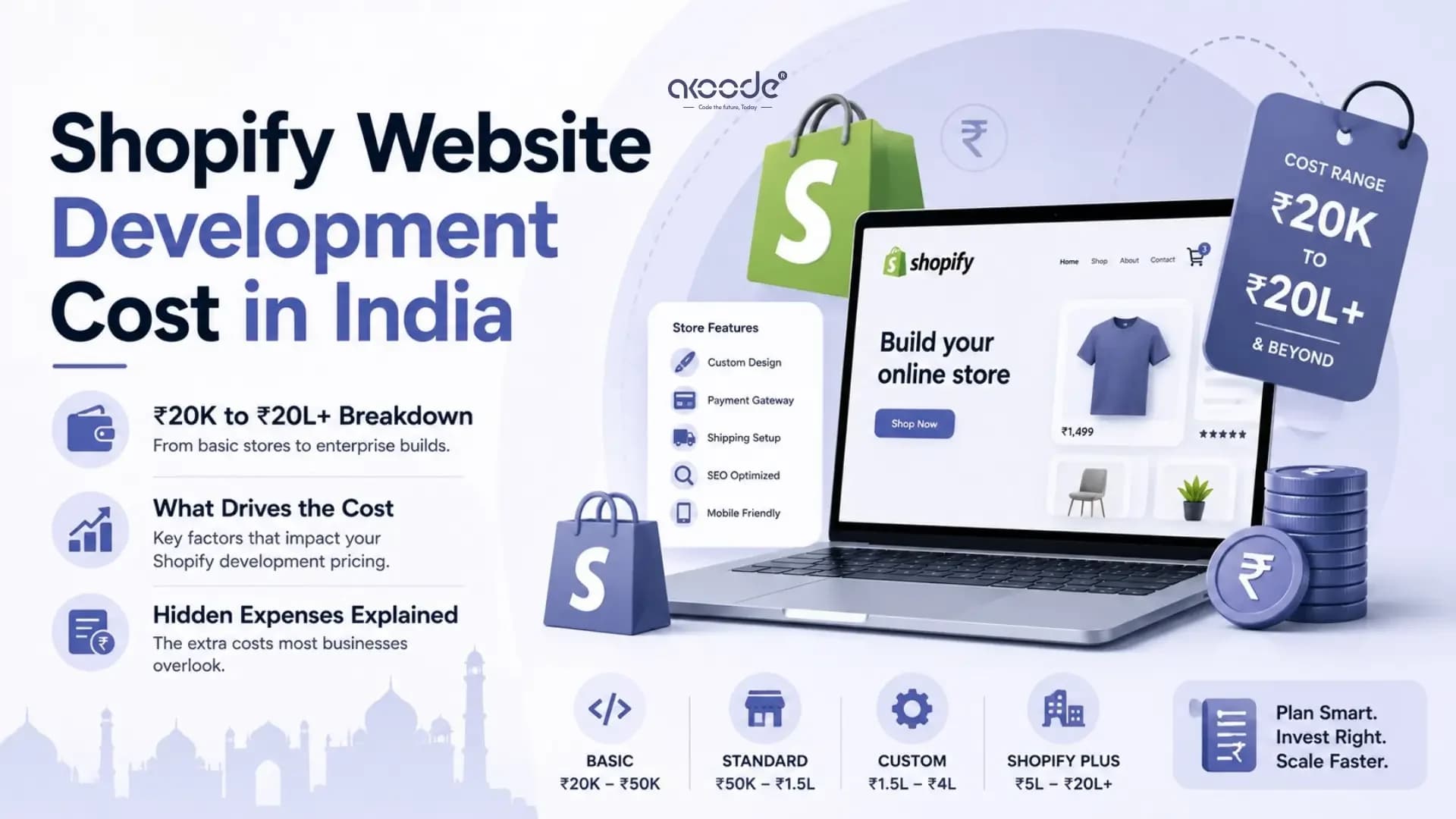
Shopify development costs in India fall into four clear tiers based on store complexity.
Basic Store: ₹20,000 to ₹50,000
A basic store uses a free or low-cost Shopify theme with minimal customisation. It suits businesses launching their first online store with fewer than 50 products.
What you get: a pre-built theme, standard pages, basic payment gateway integration like Razorpay or UPI, and standard shipping setup.
What you do not get: a unique brand identity, custom UI sections, or advanced integrations. This tier works well for testing a product idea but has limited scalability.
Standard Business Store: ₹50,000 to ₹1,50,000
This is the most common tier for serious D2C brands in India. It involves better UI customisation, brand-specific layouts, product filtering, marketing integrations, mobile performance optimization, and basic SEO setup.
Most businesses competing in crowded categories need this level of investment. A generic-looking store in a competitive market is a conversion problem from day one.
Custom Store: ₹1,50,000 to ₹4,00,000
Custom Shopify development suits brands that need a unique user experience or complex business logic. This includes custom checkout flows, ERP or CRM integrations, subscription models, multilingual or multi-currency setup, WhatsApp automation, and custom-built Shopify apps.
Developers build components from scratch at this level rather than relying on pre-made themes or standard apps. The cost is higher because the output is genuinely different from other stores in the market.
Shopify Plus Enterprise: ₹5,00,000 to ₹15,00,000 and above
Shopify Plus development is for large brands with high traffic and complex operations. This tier includes advanced checkout customisation, multi-store configuration, API-level integrations, B2B functionality, and automation at scale. The platform fee alone runs approximately ₹1,65,000 per month.
Also Read: eCcommerce Website Development Cost in India: Full Pricing Guide
What Factors Actually Drive Shopify Development Cost?
Two stores can look similar on a brief and differ by two lakh rupees in cost. Here is what actually causes that gap.
Design complexity
A free theme with basic colour and font changes costs very little. A fully custom design built from Figma wireframes, with unique section structures and brand-specific interactions, can add ₹60,000 to ₹2,00,000 to the cost on its own.
Catalogue size
Managing fifty products is straightforward. Managing five hundred products with multiple variants, custom filters, size guides, and collection logic requires significantly more setup time.
Third-party integrations
Every integration adds development effort. Common ones for Indian stores include Razorpay, Shiprocket, WhatsApp marketing tools, email automation platforms, review apps, and loyalty programs. Each one needs to be configured, tested, and maintained.
Custom functionality
Standard Shopify handles most common scenarios. But if your business needs a custom subscription model, a bundle builder, a B2B pricing structure, or an unusual checkout flow, that logic needs to be built. Custom functionality is the single biggest cost multiplier in Shopify projects.
SEO and performance setup
A store that is not optimised for Core Web Vitals and on-page SEO from day one will struggle to rank and convert. Proper SEO setup adds ₹15,000 to ₹50,000 but pays for itself quickly in organic traffic.
What Are the Hidden Costs of Building a Shopify Store in India?
Most developers quote only for the build. These costs are real but often missed in early budget planning.
Premium themes
Free Shopify themes are functional but generic. Premium themes cost ₹12,000 to ₹40,000 as a one-time purchase. Custom theme development starts at ₹60,000.
Paid apps
Many essential store features require paid Shopify apps. Review tools, upsell apps, email marketing integrations, subscription billing, and advanced analytics all carry monthly fees. Budget ₹2,000 to ₹10,000 per month depending on which apps your store needs.
Domain registration
A custom domain costs ₹800 to ₹2,000 per year. This is separate from Shopify's platform fee.
Post-launch maintenance
Shopify updates regularly. Apps need version compatibility checks. Products need updates. Performance issues surface under real traffic. Budget ₹5,000 to ₹25,000 per month for ongoing maintenance depending on store size.
Transaction fees
If you use a payment gateway other than Shopify Payments, Shopify charges an additional transaction fee of 0.5 to 2 percent per order depending on your plan. Shopify Payments is not currently available in India, so Indian stores pay this fee on every transaction. Factor this into your margin calculations before launch.
Should You Hire a Shopify Developer or a Shopify Agency in India?
This depends on store complexity and your long-term support needs.
A freelance Shopify developer typically costs 30 to 40 percent less than an agency for small jobs. They are a good fit for basic store setups, theme customisations, and specific feature additions. The risk is post-launch support. A freelancer's availability after delivery is not guaranteed.
A Shopify website development company costs more upfront. But they bring a structured team covering design, development, QA, and ongoing support under one roof. For businesses building a store they plan to grow, an agency relationship means consistent support, faster fixes, and a team that already understands your setup.
For stores in the standard or custom tier, a reliable Shopify website development company in India is almost always the more cost-effective choice over a two to three year horizon. The cost of fixing problems created by underqualified developers consistently exceeds the agency premium paid upfront.
How Long Does Shopify Website Development Take in India?
Timeline depends on the store tier.
A basic store takes two to three weeks. A standard business store takes three to five weeks. A custom store with complex integrations and unique functionality takes six to twelve weeks. Shopify Plus builds with enterprise integrations can run three to six months.
The most common cause of timeline overruns is unclear requirements at the start. Founders who finalise their product catalogue, brand assets, and payment requirements before development begins consistently see faster delivery.
Also Check: Shopify vs WooCommerce vs Magento: Which Platform Is Right for You?
Conclusion
Shopify website development cost in India varies widely because Shopify stores vary widely. A first-time founder testing a product idea needs a different store than a D2C brand scaling to multiple markets. The right budget is the one that fits what your business actually needs, not the cheapest quote available.
Plan for both the build cost and the ongoing platform costs from the start. A store built cheaply that cannot rank, does not convert, or breaks under traffic will cost more to fix than it saved in the first place.
Akoode Technologies is a leading AI and software development company headquartered in Gurugram, India, with a US office in Oklahoma. From Shopify website development services and custom web development to full stack development and AI-powered web applications, Akoode builds digital commerce products for startups, SMEs, and enterprises across 15+ industries globally. If you are planning a Shopify store and want it built to perform from day one, that conversation starts here.
Frequently Asked Questions
1. What is the Shopify website development cost in India in 2026?
Shopify development costs in India range from ₹20,000 for a basic store to ₹4,00,000 or more for a fully custom build. Shopify Plus enterprise builds can go significantly higher. The final cost depends on design complexity, catalogue size, integrations, and custom functionality requirements.
2. What is the Shopify price in India for monthly plans?
Shopify's Basic plan costs approximately ₹1,994 per month billed annually. The standard Shopify plan costs approximately ₹5,411 per month. Advanced costs approximately ₹21,651 per month. These fees are paid directly to Shopify and are separate from development costs.
3. Does Shopify website development cost include the monthly subscription?
No. The monthly Shopify subscription is charged separately by Shopify. Development cost covers the one-time work of building and configuring your store. Always budget for both.
4. What drives Shopify website development cost up?
The main cost drivers are custom design complexity, catalogue size, third-party integrations, custom functionality requirements, and SEO and performance optimization. A store with a free theme and fifty products costs a fraction of one with a fully custom UI and ERP integration.
5. How long does it take to build a Shopify store in India?
A basic store takes two to three weeks. A standard business store takes three to five weeks. A custom store takes six to twelve weeks. Clear requirements, finalised brand assets, and an approved product catalogue before development starts are the biggest factors in keeping timelines on track.
6. Is it better to hire a freelancer or a Shopify development company in India?
For small or one-off customisations, a freelancer is cost-effective. For a full store build with ongoing support needs, a Shopify website development company is the stronger choice. Agencies bring structured delivery, team coverage, and consistent post-launch support that reduces the risk of problems after your store goes live.