


 July 24, 2026
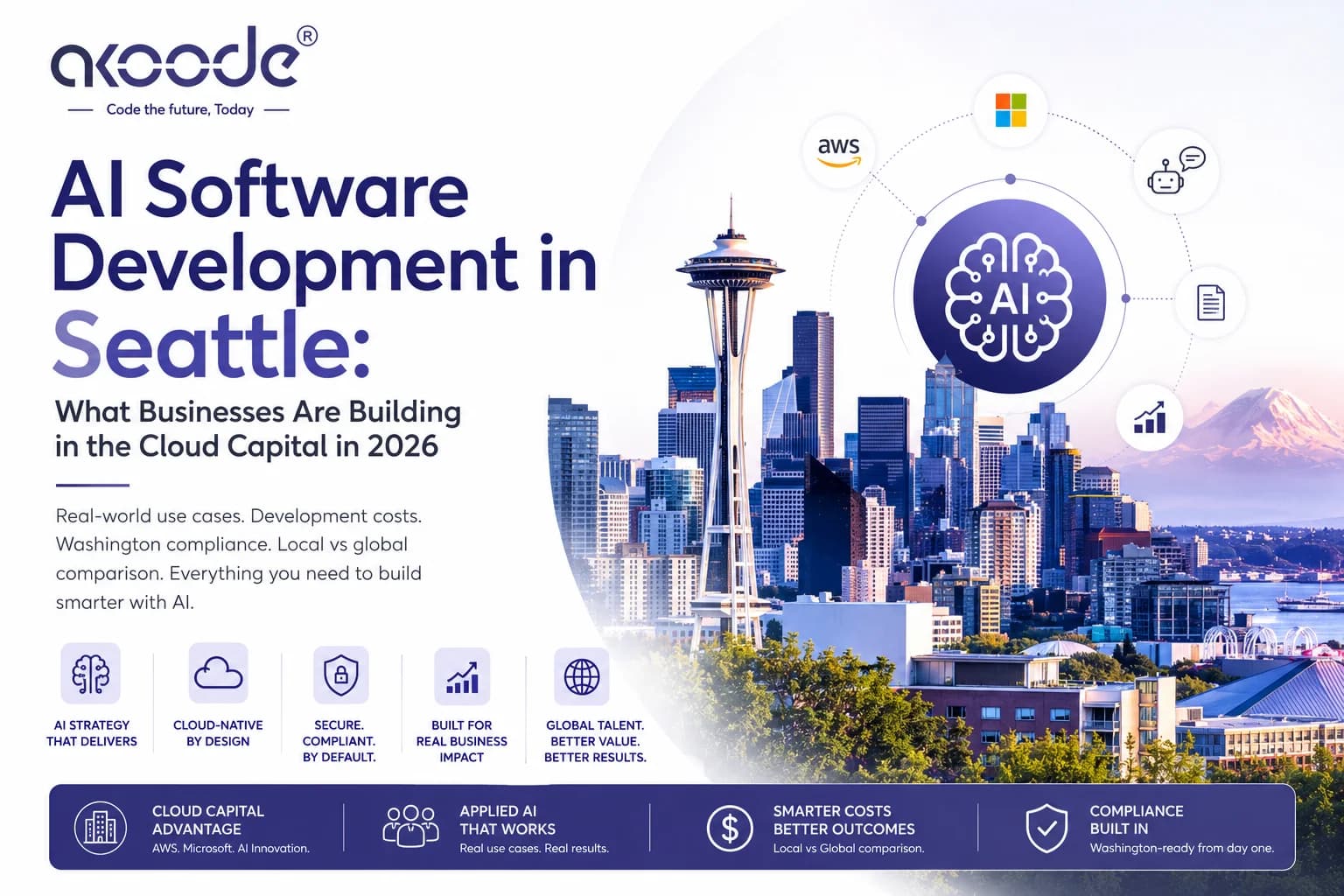
AI Software Development in Seattle: What Businesses Are Building in the Cloud Capital in 2026
Here's a strange fact about Seattle: the world's AI runs on infrastructure headquartered here, and yet most local businesses still don't know what to build with it.
Think about what sits within twenty miles of downtown. AWS — the servers behind more AI workloads than any platform on earth. Microsoft — OpenAI's biggest backer, with Copilot wired into half the world's office software. The Allen Institute for AI, quietly producing some of the most respected open research anywhere. Seattle isn't watching the AI wave. Seattle is the hardware the wave runs on.
And still, the SaaS founder in Fremont, the clinic operator on First Hill, the freight broker near the port — they're all asking the same question every business everywhere is asking: what does this actually mean for us, and what would it cost?
That's what this guide answers. Not the infrastructure story — the applied one. What Seattle businesses are genuinely deploying in 2026, what AI development costs here versus globally, the Washington compliance layer that catches almost everyone off guard, and how to choose an AI development partner without paying cloud-capital prices for skills that exist worldwide.
Seattle's Two AI Economies (And Which One You're Actually In)
Every major tech city has two AI economies. Seattle's split is unusually sharp.
The infrastructure economy is the famous one. AWS and Azure hosting the world's models. Microsoft's multi-billion-dollar OpenAI partnership. Amazon's own AI investments. The Allen Institute's research output. This economy employs armies of engineers at compensation packages that anchor the entire regional salary market — and it has almost nothing to do with your business.
The applied economy is the useful one. It's where proven models — GPT-4o, Claude, Gemini — get wired into actual business workflows: support agents, document intelligence, scheduling automation, forecasting. This is engineering, not research. Its raw materials are APIs, retrieval architectures, and vector databases. And its skills exist globally, at global prices.
Why does the distinction matter so much in Seattle specifically? Because the infrastructure economy's salary gravity inflates local applied-AI rates dramatically. Senior AI engineers at Seattle agencies bill $200–$270/hour — pulled upward by what Amazon and Microsoft pay — to do integration work whose global rate is $45–$75/hour with an identical stack.
Being the cloud capital gives Seattle businesses exactly one genuine AI advantage: unmatched cloud architecture talent for infrastructure-heavy builds. What it doesn't give you is cheaper AI development. AWS charges you the same rates it charges a company in Ohio, and local AI engineers cost more than almost anywhere except San Francisco.
Know which economy your project belongs to before you take a single sales call. It's the most expensive classification decision you'll make this year.
What Seattle Businesses Are Actually Deploying
Strip away the keynote-stage noise, and the AI in production across Puget Sound looks refreshingly practical.
SaaS and Technology Companies
Seattle's startup scene — dense across Fremont, South Lake Union, and increasingly Bellevue — faces a specific pressure: their buyers are trained on Big Tech product polish, and AI features have become table stakes.
What's shipping: in-product AI copilots (buyers now ask about them in every evaluation), AI support agents resolving 65–85% of tier-1 tickets, onboarding automation, and churn prediction from usage signals. The mechanics of the support-agent category are covered in our guide to AI customer support agents.
For Seattle SaaS companies, AI is both a cost lever and a product requirement — and the product pressure is the sharper one. Competing two blocks from Amazon's product bar raises everyone's floor.
Healthcare
The health systems and digital-health companies around Providence, UW Medicine, and the First Hill medical corridor are deploying AI against the administrative crush: prior authorization automation (the single most-requested use case we hear from providers), clinical documentation that returns hours per day to physicians, patient scheduling agents, and claims denial management.
Every one of these lives under HIPAA — and in Washington, under something stricter still, which gets its own section below. Our healthcare software development practice designs that compliance in from Phase 1, because a health AI system that can't survive legal review never ships.
Retail and E-commerce
Living in Amazon's shadow does something interesting to Seattle retail: it forces sophistication. Local and regional retailers deploy personalization engines, demand forecasting, AI-generated creative, returns automation, and conversational shopping — not because it's trendy, but because their customers' expectations were set by the most operationally advanced retailer in history.
Aerospace and Manufacturing
The supplier network around Boeing and the broader Puget Sound manufacturing base generates real demand for industrial AI: predictive maintenance on production equipment, computer vision quality inspection, technical documentation intelligence, and supply chain forecasting. Manufacturing's quiet advantage: processes are already instrumented and measured, so the data foundation usually exists — which is more than most sectors can say.
Maritime, Ports, and Logistics
The Port of Seattle and the freight ecosystem around it run on documents and schedules — exactly what current AI compresses best. In production: demand forecasting, route and yard optimization, and freight document processing (bills of lading, customs paperwork, carrier reconciliation — the paper bloodstream of the industry).
The pattern across every sector is identical: repetitive, document-heavy, or headcount-scaling work. And in a labor market where Big Tech compensation inflates every salary — where a fully loaded support hire runs $75,000+ — avoided headcount is worth more in Seattle than almost anywhere in the country. The AI ROI math that's merely compelling in Dallas is overwhelming here.
What AI Development Costs in Seattle vs. Globally
Concrete numbers, because vague AI pricing is how buyers overpay in exactly this market.
Senior AI/ML engineers at Seattle agencies bill $200–$270/hour. Here's what complete projects run:
AI Project Type | Seattle Agency | Global Partner (Akoode) | Timeline |
|---|---|---|---|
AI chatbot / support agent | $60,000–$170,000 | $20,000–$60,000 | 6–14 weeks |
Document processing / extraction | $80,000–$210,000 | $28,000–$75,000 | 8–16 weeks |
LLM-powered internal tool (RAG) | $90,000–$240,000 | $32,000–$85,000 | 10–20 weeks |
In-product AI copilot feature | $100,000–$260,000 | $35,000–$95,000 | 10–20 weeks |
AI agent (action-taking) | $110,000–$290,000 | $40,000–$110,000 | 10–22 weeks |
Custom ML model (train + deploy) | $160,000–$400,000 | $50,000–$140,000 | 14–24 weeks |
Enterprise AI platform | $320,000–$800,000+ | $110,000–$280,000 | 6–18 months |
Two things to sit with.
The gap isn't a quality gap. A senior engineer wiring Claude into your knowledge base with LangChain and Pinecone — deploying, ironically, to the same AWS regions — produces identical architecture in Gurugram and Bellevue. What differs is the salary gravity of having Amazon as the employer across the lake.
Ongoing costs never stop, anywhere. LLM API fees run $200–$20,000+/month scaling with usage. Vector database and infrastructure hosting adds $100–$5,000/month. Model monitoring and retraining costs 15–20% of build cost annually — and if a Seattle agency built the system, that percentage compounds at $200+/hour for the product's entire life. Any vendor who doesn't raise these in the first conversation is deferring the discussion, not the cost.
For the full picture on general development pricing in the region, our Seattle software development cost guide breaks down rates by role, complete project budgets, and the hidden costs that never appear in proposals.
The Washington Compliance Layer Nobody Warns You About
Here's where Seattle AI projects genuinely differ from every other state's — and where we see the most expensive surprises.
The My Health My Data Act (MHMDA) is Washington's health privacy law, and its reach startles almost everyone who encounters it. Unlike HIPAA — which binds healthcare providers and their partners — MHMDA covers "consumer health data" collected by any business: fitness tracking features, wellness content, biometric readings, even inferences about health drawn from purchases or searches. An e-commerce recommendation engine that infers a customer might be pregnant? Potentially in scope. A productivity app with a mood-tracking feature? In scope.
And it carries a private right of action — consumers can sue directly, which has made it one of the most consequential state privacy laws in the country.
For AI specifically, MHMDA bites hard: AI systems are inference machines, and inferring health-related conclusions from non-health data is precisely what the law regulates. If your AI touches anything health-adjacent for Washington users, consent flows, data handling, and deletion rights must be architected in from Phase 1.
Here's the practical vendor test: ask any prospective AI partner what MHMDA is. Most out-of-state firms — and frankly, plenty of local ones — have never heard of it. The ones who can explain how it shapes AI architecture are signaling exactly the compliance maturity you're paying for.
The rest of the stack: HIPAA for actual healthcare AI (15–25% added build cost, BAAs covering every vendor touching PHI — including your LLM provider), SOC 2 effectively mandatory for B2B SaaS selling into Seattle's enterprise-dense buyer market, and explainability expectations for anything in financial services.
Compliance architecture adds 15–25% to AI project costs in regulated work. Designed in, that's a line item. Retrofitted after a failed legal review, it's a crisis.
How to Choose an AI Partner in Seattle
The general vendor process — contracts, references, red flags — is covered in our guide to hiring a software development company in Seattle. AI adds six questions that general software hiring misses entirely, and in this market — thick with ex-Big-Tech credentials and infrastructure-adjacent marketing — they matter more than anywhere.
1. "Show me an AI system you built that's been in production for 12+ months."
Demos are trivially easy with modern LLMs. Production is hard. Ask what broke, how they monitored it, what they fixed. Production scars are the only credential that survives scrutiny.
2. "Walk me through your RAG architecture decisions on a recent project."
Chunking strategy, embedding model selection, retrieval tuning, how they measured retrieval quality separately from answer quality. "We use RAG" without a level deeper is vocabulary, not engineering.
3. "How do you prevent hallucination in front of my customers?"
Good answer: retrieval grounding, confidence thresholds, response filtering, source citation, mandatory human escalation. Bad answer: "the latest models are very accurate." That's false in exactly the situations that matter.
4. "What's your model evaluation process before deployment?"
Golden datasets, accuracy benchmarks, adversarial testing. No framework means shipping on hope — at $230/hour.
5. "How do you handle model drift after launch?"
AI degrades silently as data shifts and providers update models. An engagement designed to end at deployment guarantees quiet decay until a customer notices first.
6. "What is MHMDA, and have you shipped under HIPAA or SOC 2?"
The Washington-specific filter plus the universal one. Not can you comply. Have you.
And one Seattle-specific caution: "our team is ex-Amazon/ex-Microsoft" is this market's favorite credential — and it's not a delivery guarantee. Building internal tools at planet scale inside a trillion-dollar company is a genuinely different skill from shipping a mid-market product on a fixed budget with a four-person team. Sometimes the experience translates brilliantly. Ask the production question and find out, rather than paying the badge premium on faith.
Seattle AI Agency vs. Global Partner: The Honest Comparison
Factor | Seattle AI Agency | Global Partner (Akoode) |
|---|---|---|
Senior AI engineer rate | $200–$270/hr | $45–$75/hr |
AI project cost | Baseline | 55–70% lower |
Cloud architecture depth | World's best — genuine advantage | Strong — verify per vendor |
Applied AI delivery (LLM, RAG, agents) | Excellent | Excellent — identical stack |
MHMDA / WA compliance fluency | Strong at good local firms | Strong at US-focused firms — verify |
Engineer retention | Poor — Big Tech re-poaches constantly | Materially lower risk |
Time zone | Local | 3–4 hr Pacific overlap, async otherwise |
Best fit | Infrastructure-heavy builds, on-site needs | Production AI applications |
The honest read: Seattle's one genuine local AI advantage is cloud infrastructure depth. If your project is a complex AWS/Azure architecture challenge wearing an AI hat, local talent fluency is real and worth considering. For everything else — the support agents, the document intelligence, the RAG systems, the copilots that constitute most business AI — the premium buys proximity to a talent pool your project doesn't draw from, plus the industry's worst retention risk.
Akoode Technologies serves Seattle businesses on the applied side: production AI depth — GPT-4o, Claude, Gemini, LangChain, Pinecone, deployed to the same AWS and Azure regions any local team uses — through our AI development services, at global economics with US presence, Pacific-hours overlap, and full transparency about where every engineer sits.
How to Start Without Wasting a Quarter
Name the specific, expensive problem first. Not "we need an AI strategy." Something like: "Our billing team spends 90 hours a week on prior authorization paperwork, and 70% of it follows predictable patterns." That sentence transforms every vendor conversation you'll have.
Check your data before anything else. Accessible? Digitized? Structured enough to retrieve against? Most AI failures in Seattle — like everywhere — are data failures wearing an AI costume.
Check your MHMDA exposure early. If anything in your product touches health-adjacent data for Washington users, get that assessment before architecture, not after.
Start with one workflow, not a platform. A focused $50,000 system that automates one painful process beats a $400,000 "AI transformation" — and teaches you what your second project should be.
Demand a paid discovery phase. Data assessment, success metrics, realistic scope. Vendors who skip it to quote fast are guessing with your money — at cloud-capital rates.
Frequently Asked Questions
How much does AI software development cost in Seattle?
Seattle AI agencies bill $200–$270/hour for senior AI engineers. Complete projects run $60,000–$170,000 for an AI support agent, $90,000–$240,000 for an LLM-powered tool with RAG, and $320,000–$800,000+ for enterprise AI platforms. Global partners deliver identical applied scope 55–70% lower. Ongoing costs run $300–$25,000/month plus 15–20% of build cost annually for monitoring and retraining.
Does being the cloud capital make AI development cheaper in Seattle?
No — the opposite. AWS and Azure charge Seattle businesses the same published rates as everyone else, while Big Tech salary gravity makes local AI engineers among the most expensive in the country. Seattle's genuine advantage is cloud architecture talent fluency for infrastructure-heavy projects — not cheaper AI development.
What are Seattle businesses actually building with AI in 2026?
In production: SaaS copilots and support agents (now table stakes in competitive evaluations), healthcare prior authorization and clinical documentation automation, retail personalization and forecasting, aerospace predictive maintenance and computer vision inspection, and freight document processing across the port ecosystem. The common thread is repetitive, document-heavy, headcount-scaling work.
What is the My Health My Data Act and how does it affect AI projects?
Washington's MHMDA covers "consumer health data" collected by any business — including health inferences AI draws from non-health data like purchases or searches — with a private right of action letting consumers sue directly. Because AI systems are inference machines, MHMDA reaches far beyond healthcare companies. If your AI touches anything health-adjacent for Washington users, consent, data handling, and deletion rights must be architected in from Phase 1.
Is "ex-Amazon" or "ex-Microsoft" a reliable signal for an AI vendor?
It's a talent signal, not a delivery guarantee. Building internal tools at planet scale is a different skill from shipping mid-market products on fixed budgets. Some ex-Big-Tech teams translate brilliantly; others don't. Test with the production question — a system live for 12+ months and the story of what broke — rather than paying the badge premium on faith.
Should my SaaS company build AI features into our product?
In Seattle's market, this has moved past "should" — buyers trained on Big Tech product polish now ask about AI capabilities in every evaluation, and products without them lose deals silently. Builds run $100,000–$260,000 locally or $35,000–$95,000 with a global partner. Start with the capability your users request most, not the one that demos best.
How long does it take to build an AI system in Seattle?
Geography changes cost, not physics: a focused AI agent takes 6–14 weeks, an LLM-powered tool with RAG 10–20 weeks, custom ML models 14–24 weeks, enterprise platforms 6–18 months. Data preparation is the most common timeline extender — assess data readiness before committing to dates.
What ongoing costs come with an AI system?
LLM API fees scale with usage — $200/month for small deployments to $20,000+/month at enterprise volume. Vector database and infrastructure hosting adds $100–$5,000/month. Monitoring and retraining runs 15–20% of build cost annually — and compounds at whatever hourly rate structure built the system. The build-rate decision echoes for the product's entire life.
Can a small Seattle business afford AI?
Yes — and the ROI math is stronger here than most places because labor costs are Big-Tech-inflated. A focused AI agent handling support or document processing starts around $20,000–$60,000 with a global partner — a fraction of one fully loaded Seattle hire. Start with one workflow, win, expand.
Should I hire a Seattle AI company or a global partner?
For infrastructure-heavy cloud architecture projects, Seattle's talent depth is genuinely the world's best — consider local. For applied AI — the support agents, RAG systems, and copilots that constitute most business projects — a transparent global partner delivers equivalent outcomes at 55–70% less, with materially lower retention risk. Vet either identically: production proof, RAG fluency, MHMDA awareness, compliance experience.
The Bottom Line
Seattle's relationship with AI is unique: the world's AI infrastructure lives here, the salary gravity is enormous, and the local advantage is real — but narrow. Cloud architecture depth, yes. Cheaper or better applied AI, no.
Which makes the essential skill for a Seattle buyer the same classification discipline that applies in San Francisco, just with a different flavor: is your project an infrastructure challenge that draws on what only this region has, or an applied build whose skills exist globally at a third of the price? Most projects are the second kind — including most projects that arrive convinced they're the first.
The businesses getting this right share one habit: they named a specific expensive problem, checked their data (and their MHMDA exposure), and built one focused system before buying a platform. The ones getting it wrong paid cloud-capital rates for globally available engineering.
If you're weighing where your project falls, that's a conversation worth having before you commit to anything.
Book a free 45-minute AI consultation → calendly.com/akhil-akoode/ak
We'll review your workflow, assess your data, flag your MHMDA and compliance exposure, and give you a straight answer on scope, cost, and whether AI is even the right tool. Sometimes the answer is a $40,000 focused system. Sometimes it's a SaaS tool. Sometimes it's "organize your data first." We'll tell you which.
Explore: Software Development Company in Seattle | AI development services | Seattle software costs | akoode.com | contact us
Get In Touch Now
View More Our Blog