



 July 24, 2026
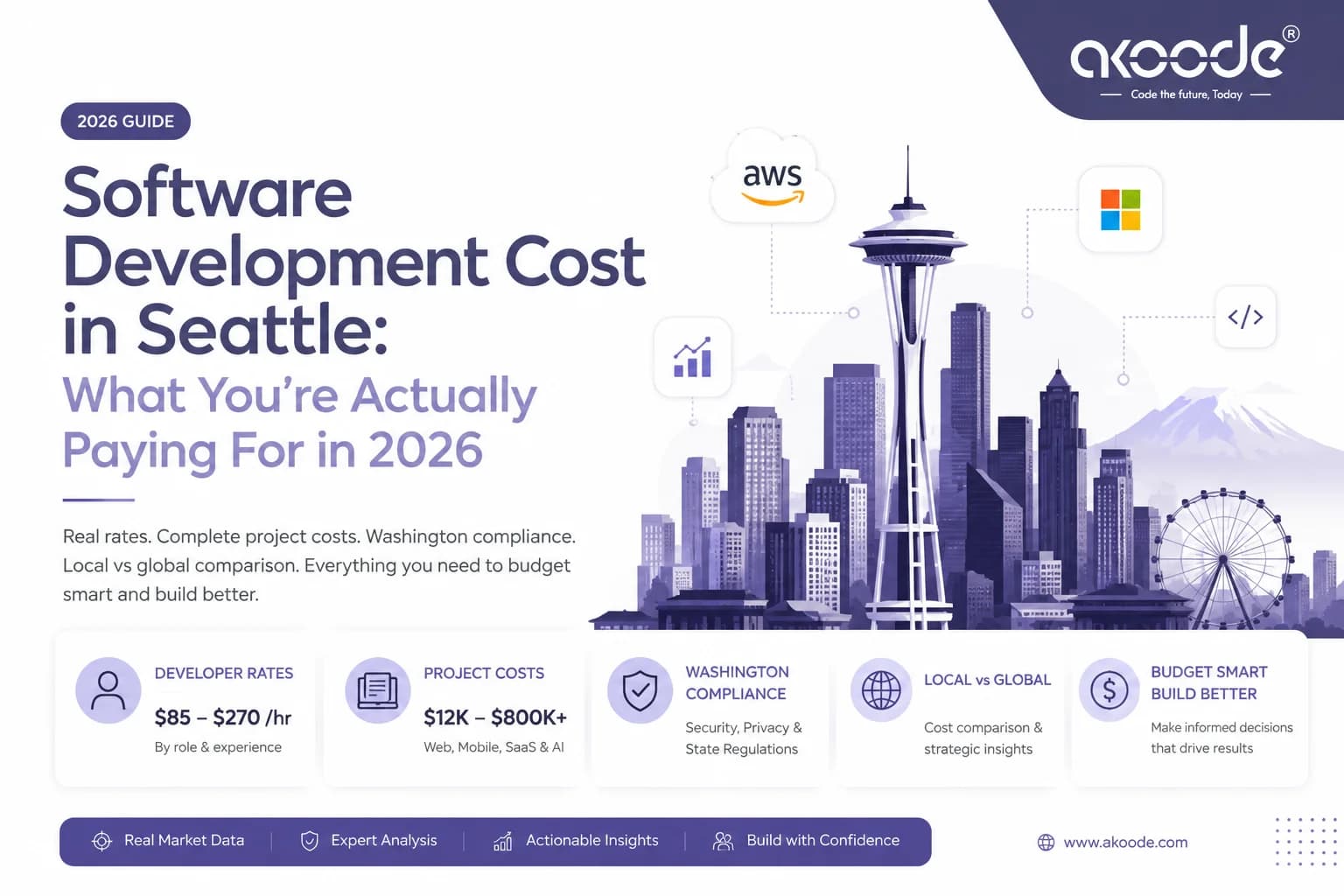
Software Development Cost in Seattle: What You're Actually Paying For in 2026
Every software quote in Seattle is shaped by two companies that will never bid on your project.
Amazon and Microsoft employ tens of thousands of engineers across the Puget Sound region, and their compensation packages set the gravitational floor for every developer salary in the market. Glassdoor puts the average Seattle software developer at $166,108 — 35% above the national average — and software engineers at $202,473, based on more than 74,000 submitted salaries. Top earners report $244,000–$248,000, and senior Big Tech trajectories reach past $368,000.
Every Seattle agency hires from that market, retains against that market, and prices against that market. The result: local agencies bill $120–$200 per hour — the second-highest rates in the country after San Francisco.
A mid-complexity SaaS platform that costs $130,000 in Dallas runs $250,000–$400,000 with a Seattle agency. The same scope with a senior-led global team runs $90,000–$130,000.
Whether Seattle's premium is worth paying depends entirely on what you're building — and that's what this guide helps you decide. If you're planning a software project in or for the Seattle market, here are the real numbers: rates by role, complete project budgets, the Washington-specific compliance layer almost nobody covers, and an honest framework for local versus global.
Why Seattle Costs What It Costs: The Gravity Well
Most city cost guides start with cost of living. Seattle's story is more specific than that.
The salary data, source by source:
Glassdoor (Software Developer): $166,108/year average — 35% above national — top decile at $244,934
Glassdoor (Software Engineer): $202,473/year average from 74,418 submissions, ranging $168,343–$248,685
ZipRecruiter: $127,283/year ($61/hour), majority between $102,400–$147,900
Talent.com: $125,000 median from 10,000 salaries, seniors up to $169,969 — noting Washington state's $150,304 average trails only California nationally
Salary.com (by level): Developer I at $90,290 rising to Developer V at $189,210
The spread between sources tells you something real: the aggregate boards capture the whole market including non-tech employers, while Glassdoor's tech-weighted submissions capture what competitive employers actually pay. When you hire an agency, you're paying for engineers retained against the competitive number — not the average one.
Two Seattle-specific forces sharpen this:
The Big Tech retention tax. Every agency engineer in Seattle is one recruiter call away from an Amazon or Microsoft offer with equity attached. Agencies either pay near-Big-Tech compensation to hold senior talent or accept constant churn. Both outcomes flow into your rate.
No state income tax — but no discount either. Washington has no personal income tax, which means Seattle engineers keep more of the same nominal salary than Californians do. You might expect that to soften salaries. It doesn't — Big Tech anchors the market at coastal levels anyway. The tax advantage accrues to the engineer, not to your project budget.
Run the agency math: a $170,000 engineer costs a firm $220,000+ fully loaded after benefits and employer costs, before South Lake Union or Bellevue office space, project management, sales overhead, and margin. Spread across billable hours, $120–$200/hour is what the economics produce — not a markup.
Seattle Developer Hourly Rates: The Full Breakdown
Role | Junior (0–2 yrs) | Mid-Level (3–5 yrs) | Senior (6+ yrs) |
|---|---|---|---|
Frontend Developer | $85–$115/hr | $115–$155/hr | $155–$200/hr |
Backend Developer | $90–$125/hr | $125–$165/hr | $165–$210/hr |
Full-Stack Developer | $90–$120/hr | $120–$160/hr | $160–$205/hr |
Mobile Developer (iOS/Android) | $95–$130/hr | $130–$170/hr | $170–$215/hr |
UI/UX Designer | $75–$105/hr | $105–$140/hr | $140–$180/hr |
DevOps / Cloud Engineer | $95–$135/hr | $135–$175/hr | $175–$220/hr |
AI / ML Engineer | $115–$155/hr | $155–$200/hr | $200–$270/hr |
QA Engineer | $65–$90/hr | $90–$120/hr | $120–$155/hr |
Technical Project Manager | $95–$125/hr | $125–$160/hr | $160–$200/hr |
Three observations.
Cloud engineering carries a distinctive Seattle premium. With AWS and Azure both headquartered here, the region has the deepest cloud-infrastructure talent pool on earth — and DevOps/cloud rates reflect it, running above general development at every seniority level. If your project is infrastructure-heavy, Seattle talent is genuinely elite. It's also genuinely expensive.
AI talent tops the chart. Senior AI/ML engineers bill $200–$270/hour locally, pulled upward by Microsoft's OpenAI partnership, Amazon's AI investments, and the Allen Institute's research orbit. Worth knowing before you pay it: most business AI work is applied engineering — LLM integration, RAG systems — whose skills are globally available at a fraction of that rate.
Glassdoor's top-paying industries surprise people. Telecommunications ($165,306 median total pay) and Retail & Wholesale ($161,869) lead for Seattle developers — the second being Amazon's shadow across the entire "retail" category. If your project competes for talent in these verticals, budget accordingly.
What Complete Projects Cost in Seattle
Web Application Development
Project Type | Complexity | Seattle Cost | Timeline |
|---|---|---|---|
Marketing website / landing pages | Simple | $12,000–$35,000 | 3–6 weeks |
MVP / proof of concept web app | Simple-Medium | $45,000–$100,000 | 2–4 months |
Business web application | Medium | $100,000–$230,000 | 4–7 months |
SaaS platform | Medium-High | $170,000–$400,000 | 5–10 months |
Enterprise web platform | Complex | $350,000–$800,000+ | 9–18 months |
Mobile App Development
App Type | Seattle Cost | Notes |
|---|---|---|
Simple MVP (cross-platform) | $50,000–$100,000 | Flutter/React Native, iOS + Android |
Mid-complexity app | $100,000–$220,000 | Integrations, custom UI, backend |
Complex / enterprise app | $220,000–$500,000+ | Real-time, multi-role, advanced security |
AI & Custom Enterprise Systems
Project Type | Seattle Cost |
|---|---|
AI chatbot / support agent | $60,000–$170,000 |
LLM-powered tool (RAG) | $90,000–$240,000 |
Healthcare platform (HIPAA + WA law) | $130,000–$450,000 |
Fintech application | $150,000–$480,000 |
Enterprise AI platform | $300,000–$800,000+ |
One myth worth retiring while we're here: being the cloud capital doesn't make cloud hosting cheaper. AWS and Azure charge Seattle businesses the same published rates as everyone else. The local advantage is talent fluency — architects who genuinely know these platforms — not infrastructure discounts. Budget hosting at standard market rates: $500–$15,000/month scaling with usage.
Where Your Budget Actually Goes
A $250,000 Seattle project distributes roughly like this:
Phase | Share | Amount |
|---|---|---|
Discovery & strategy | 8–12% | $20K–$30K |
UI/UX design | 18–25% | $45K–$62K |
Frontend development | 25–35% | $62K–$87K |
Backend & APIs | 20–30% | $50K–$75K |
QA & testing | 8–12% | $20K–$30K |
Deployment & PM | 10–15% | $25K–$37K |
Design and backend infrastructure together consume $95,000–$137,000 before a single user-facing screen ships. In a market where users are trained on Amazon-grade product polish, these aren't paddable line items — cut them and you've built expensive software nobody adopts.
The Hidden Costs Seattle Proposals Rarely Include
Post-launch maintenance, priced at Seattle rates, forever. Annual maintenance runs 15–25% of build cost — $37,500–$62,500/year on a $250,000 project — billed at the same $120–$200/hour that built it. The rate structure you choose today compounds for the product's entire life.
Engineer churn. The Seattle-specific version of a universal problem: agency teams get re-poached by Amazon and Microsoft constantly. Every mid-project departure costs 2–4 weeks of knowledge transfer at your billing rate. Check any prospective firm's engineer tenure on LinkedIn before signing, and negotiate key personnel clauses on engagements over three months.
Washington's compliance layer — the part almost nobody covers. Beyond the federal standards, Washington has its own aggressive privacy regime:
The My Health My Data Act (MHMDA) — Washington's health privacy law with a scope far broader than HIPAA. It covers "consumer health data" collected by any business, not just healthcare providers: fitness tracking, wellness features, biometric readings, even inferences about health drawn from purchases or searches. It carries a private right of action, meaning consumers can sue directly. If your app touches anything health-adjacent for Washington users, MHMDA shapes your architecture — consent flows, data handling, deletion rights — from Phase 1. Retrofitting it after launch is dramatically more expensive than designing it in.
HIPAA for actual healthcare platforms — adding 15–25% to build costs, with BAAs required for every vendor touching PHI.
PCI-DSS for payments; SOC 2 effectively mandatory for B2B SaaS selling into enterprise — and with Seattle's enterprise buyer density, you'll hit security review earlier here than most markets.
Third-party services start at launch and scale with users: $500–$15,000/month.
Discovery skipped in competitive bids. A proper discovery phase costs $12,000–$25,000 in Seattle and prevents rework costing ten times more at $170/hour.
The rule: add 20–25% to any Seattle quote for your internal budget.
Seattle vs. Everywhere Else: The Honest Math
Market | Hourly Rate |
|---|---|
San Francisco / Silicon Valley | $150–$250/hr |
Seattle | $120–$200/hr |
New York City | $130–$220/hr |
Austin | $90–$160/hr |
Dallas / Houston | $85–$155/hr |
Nearshore (Latin America) | $40–$80/hr |
Offshore (India, senior teams) | $25–$55/hr |
The project math on a 2,500-hour SaaS build:
Team | Avg Rate | Total Cost |
|---|---|---|
Seattle premium agency | $185/hr | $462,500 |
Seattle standard agency | $150/hr | $375,000 |
Austin agency | $125/hr | $312,500 |
Nearshore (LatAm) | $65/hr | $162,500 |
Global (India, senior team) | $45/hr | $112,500 |
The $260,000–$350,000 gap between a Seattle build and a senior global build buys the same architecture, the same stack — often literally the same AWS deployment targets — and the same timelines. A senior engineer produces identical output in Gurugram and South Lake Union. What differs is the salary structure underneath, and Seattle's is anchored by two of the five largest tech employers on earth.
The honest caveat, as always: global delivery done carelessly — chosen on price alone, managed set-and-forget — erodes its own savings through rework. The advantage holds only with a senior team, disciplined process, and real US-hours overlap. That's a vendor-quality question, not a geography question.
Akoode Technologies serves Seattle businesses on exactly this model: senior global engineering, full transparency about where every engineer sits, US presence, and Pacific-hours communication overlap — at 55–70% below local agency rates, with a bench deep enough that Big Tech poaching never becomes your problem.
When Seattle Rates Are Worth Paying
Pay local rates when:
Your project is deep cloud infrastructure. Complex AWS/Azure architecture, migration of serious estates, platform engineering at scale — Seattle's cloud talent fluency is genuinely the world's best, and for this specific work the premium buys real depth.
You're selling into the Boeing, Microsoft, or Amazon supply chains and vendor requirements demand US-based teams or specific certifications.
You need regular in-person collaboration — hardware integration, sensitive enterprise stakeholder work.
The project is short and tightly scoped — under 10 weeks — where coordination overhead could offset savings.
Look globally when:
The engineering is standard — web apps, mobile, SaaS platforms, LLM integration, standard cloud deployment. This describes most projects.
The build runs 3+ months, where the differential compounds into six figures.
Your team can manage a structured vendor relationship.
Budget matters — the $300,000 difference funds a year of runway, a marketing launch, or three additional product iterations.
Many experienced Seattle buyers land on a hybrid: local discovery and cloud architecture direction where the regional expertise genuinely shines, global delivery for the build.
A Practical Budget Framework
1. Define your project tier honestly. MVP, production replacement, or enterprise platform — each has a different cost floor.
2. Separate must-have from nice-to-have. At $150/hour, every descoped feature saves five figures. Descoping is free and it's your biggest lever.
3. Add 20–25% for hidden costs. MHMDA/compliance architecture, third-party services, churn friction, integration surprises.
4. Budget maintenance from day one. 15–25% of build cost annually, at whatever rate structure built the product — the strongest argument for getting build economics right.
5. Get three quotes across tiers — including one global. Compare scope line-by-line, never headline price. Without a global quote, you're only comparing Seattle premiums against each other.
Frequently Asked Questions
How much does software development cost in Seattle in 2026?
Seattle agencies bill $120–$200/hour — the second-highest rates in the country. Complete projects run $45,000–$100,000 for an MVP web app, $170,000–$400,000 for a SaaS platform, and $350,000–$800,000+ for enterprise systems. Mobile apps run $50,000–$500,000+ by complexity. Equivalent scope with a senior global team runs 55–70% less.
What do software developers earn in Seattle?
Glassdoor reports $166,108 average for developers — 35% above national — and $202,473 for software engineers from 74,000+ submissions, with top earners at $244,000–$248,000. Broader aggregates (ZipRecruiter, Talent.com) put the whole-market average at $125,000–$127,000. Washington's $150,304 state average trails only California nationally.
Why are Seattle development rates so high?
Amazon and Microsoft anchor the salary market. Every agency hires from and retains against Big Tech compensation, pushing engineer costs to coastal levels — and Washington's lack of state income tax benefits the engineer's take-home, not your project budget. Add premium office markets and standard agency overhead, and $120–$200/hour is what the economics produce.
Does being the cloud capital make hosting cheaper in Seattle?
No — this is a persistent myth. AWS and Azure charge Seattle businesses the same published rates as everyone else. The genuine local advantage is talent fluency: the world's deepest pool of engineers who know these platforms natively. Budget hosting at standard rates, $500–$15,000/month scaling with usage.
What is the My Health My Data Act and does it affect my project?
Washington's MHMDA is a health privacy law far broader than HIPAA — covering "consumer health data" collected by any business, including fitness features, biometrics, and health inferences from behavior, with a private right of action letting consumers sue directly. If your software touches anything health-adjacent for Washington users, it shapes consent flows, data handling, and deletion architecture from Phase 1. Most out-of-state vendors have never heard of it — which is itself a useful screening question.
How much does an app cost to build in Seattle?
A cross-platform mobile MVP runs $50,000–$100,000 with a Seattle agency. Mid-complexity apps run $100,000–$220,000; enterprise apps $220,000–$500,000+. The same builds with a senior global team run roughly half to a third of those figures.
What's the biggest hidden cost in Seattle software development?
Maintenance at Seattle rates: 15–25% of build cost annually — $37,500–$62,500/year on a $250,000 project — forever, at the same rate structure that built it. Second is engineer churn: Amazon and Microsoft re-poach agency talent constantly, and each mid-project departure costs weeks of knowledge transfer at your billing rate.
How long does software development take in Seattle?
The same as everywhere — geography changes cost, not physics. MVPs take 2–4 months, business applications 4–7 months, SaaS platforms 5–10 months, enterprise systems 9–18 months. A well-managed global team delivers identical timelines with proper Pacific-hours overlap.
Should I hire a Seattle agency or a global team?
For deep cloud infrastructure work, Big Tech supply-chain contracts, or in-person collaboration needs — local, with churn protections. For standard web, mobile, SaaS, and applied AI engineering, a transparent global partner delivers equivalent outcomes at 55–70% less. Many experienced buyers hybrid: local cloud architecture direction, global build.
How can I reduce software development costs in Seattle?
Three levers in order of impact: go global for standard engineering (55–70% savings), descope ruthlessly to a focused MVP (every cut feature saves five figures at Seattle rates), and structure a hybrid with local discovery and global delivery. Akoode Technologies runs exactly these engagements for Puget Sound clients.
Read related articles - How to Hire a Software Development Company in Seattle: The 2026 Buyer's Guide
and AI Software Development in Seattle: What Businesses Are Building in the Cloud Capital
The Bottom Line
Seattle's rates are the honest output of a market anchored by two of the largest tech employers on earth. The talent is genuinely elite — especially in cloud infrastructure, where this region has no equal. Nobody's gouging you. The gravity well is just real.
Which makes the buyer's job clear: figure out whether your project draws from what only Seattle has. Deep cloud architecture and Big Tech supply-chain work sometimes genuinely do. Standard product engineering — most projects — doesn't, and for those the $300,000 premium buys a zip code and inherits a churn risk.
The best move before committing to any number: a clear, itemized picture of what you're buying — discovery, MHMDA and compliance architecture, maintenance at compounding Seattle rates, and the retention risk no proposal mentions.
That's the conversation we offer.
Book a free consultation → calendly.com/akhil-akoode/ak
No pitch. No pressure. A straight conversation about what your project needs and what it should realistically cost.
Explore: Software Development Company in Seattle | akoode.com | AI development | custom software | mobile apps
Get In Touch Now
View More Our Blog