


 July 24, 2026
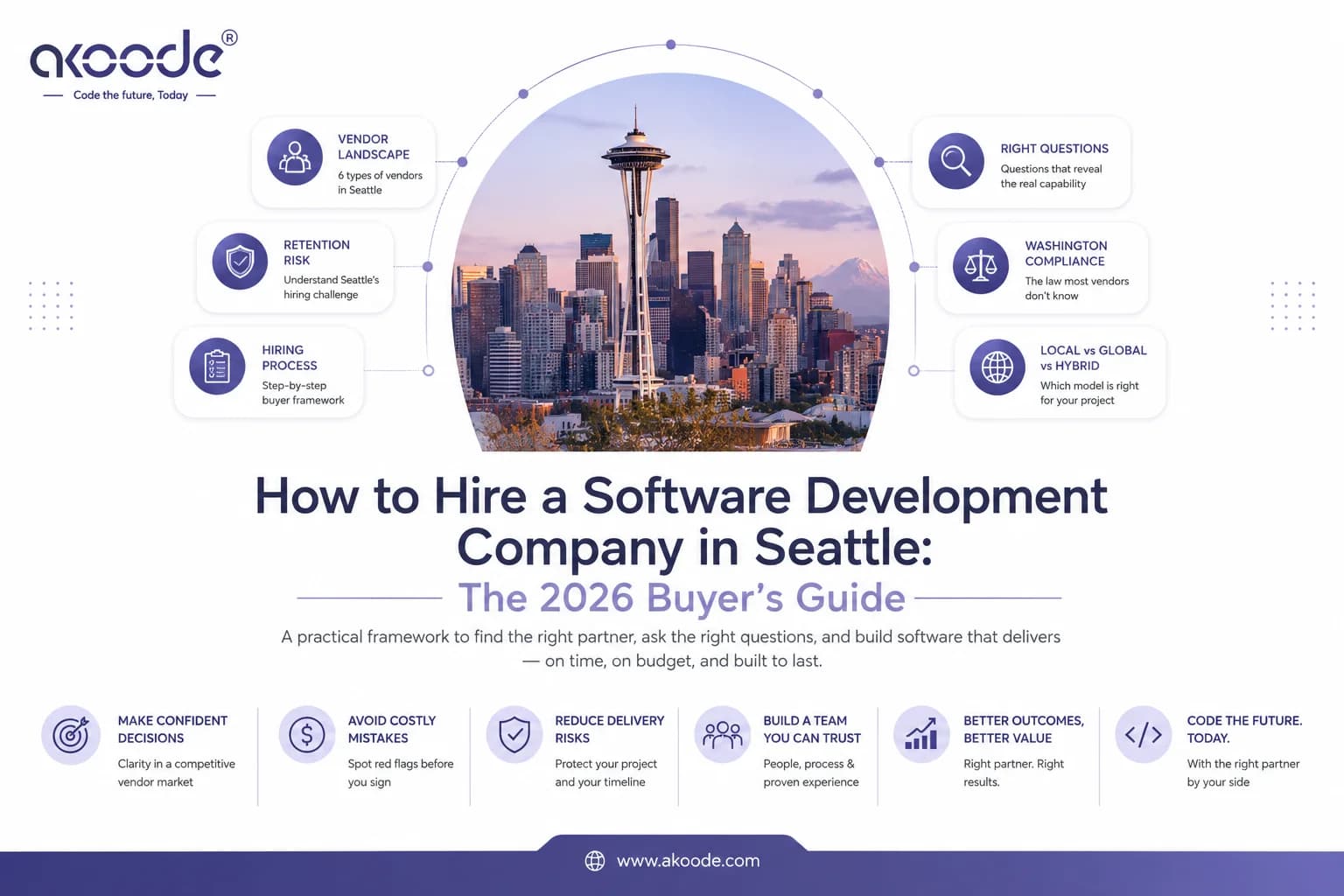
How to Hire a Software Development Company in Seattle: The 2026 Buyer's Guide
There's a two-word phrase that appears on almost every Seattle agency website, and it's quietly costing buyers a fortune.
"Ex-Amazon."
Sometimes it's "ex-Microsoft." Either way, the pitch is the same: our engineers came from Big Tech, therefore your project is in elite hands, therefore our rates — $120–$200/hour, second only to San Francisco — are justified.
Here's what two decades of watching these engagements teaches: the badge is a talent signal, not a delivery guarantee. Building internal tooling at planet scale inside a trillion-dollar company — with unlimited infrastructure, dedicated platform teams, and quarters-long timelines — is a genuinely different skill from shipping a mid-market product on a fixed budget with a four-person team and a hard deadline. Some ex-Big-Tech teams translate brilliantly. Others have never once worked under the constraints your project lives in.
The buyers who get burned in Seattle aren't careless. They're pattern-matching on credentials in a market engineered to reward exactly that. This guide gives you a better pattern: how the Seattle vendor landscape actually segments, the retention problem no proposal mentions, the questions that expose weak vendors in one call — including one about a Washington law most vendors have never heard of — and an honest framework for local versus global versus hybrid.
A founder in Fremont told us she'd shortlisted five agencies, all marketing former Big Tech talent. Only one could show her a system that had been in production for more than a year. She hired that one. This guide is how you find yours faster.
The Seattle Vendor Landscape: Six Types, Not Interchangeable
Ex-Big-Tech boutiques ($150–$200+/hour). Small firms founded by Amazon and Microsoft alumni, marketing the pedigree hard. The genuine article exists — teams whose platform-scale experience translates into exceptional architecture. But the category also includes teams who've never shipped under mid-market constraints. The badge tells you where they worked, not what they've delivered since. Test with production proof, not resumes.
Enterprise services firms. Larger consultancies serving the Boeing, Microsoft, and Amazon supply chains — process-heavy, compliance-fluent, built for procurement departments. Right for: enterprises buying multi-year programs with vendor-certification requirements. Wrong for: almost everyone else. You'll pay for structure your project doesn't need and move at enterprise pace.
Standard local agencies ($120–$170/hour). The broad middle across Seattle and Bellevue. Quality varies enormously inside this band — the best are solid value by local standards; the worst are learning on your budget at the country's second-highest prices. This is where disciplined evaluation pays for itself many times over.
Contractor collectives. A growing pattern: an "agency" that's actually a rotating bench of independent contractors under one brand. The individuals are often excellent — but nobody on your project is an employee, and the bench reshuffles as contractors take Big Tech contracts. Ask directly: "How many people on my proposed team are W-2 employees?"
Offshore-disguised firms. A Seattle address, a local-sounding name, an undisclosed delivery team abroad. You pay $150/hour for work performed at $35/hour, and the spread goes to the middleman. The issue isn't offshore work — it's the concealment and the markup you absorb without benefit.
Global firms with transparent delivery. Akoode's model: global engineering disclosed openly, at 55–70% below Seattle rates, with US presence, Pacific-hours communication overlap, and full clarity about where every engineer sits. Right for: applied builds where outcomes matter more than office geography. Wrong for: projects genuinely requiring in-person collaboration or supply-chain vendor certifications.
One question sorts the disguised from the transparent in thirty seconds:
"Where, specifically, will the engineers on my project be located — and can I meet them before we sign?"
Transparent firms answer in one sentence. Everyone else starts explaining their "global delivery model."
The Retention Problem: Seattle's Structural Hiring Risk
Before the process steps, one risk deserves its own section — because Seattle's version is distinctive, and no proposal will ever mention it.
Seattle agency engineers live twenty minutes from two of the five largest tech employers on earth. Amazon and Microsoft recruit continuously, pay compensation packages no agency can match, and — this is the Seattle-specific twist — many agency engineers came from Big Tech and maintain the relationships that make boomeranging back frictionless. The revolving door spins both directions, constantly.
Practical consequences for your project:
The team you're sold is provisional. The architect in the sales deck may have an Amazon offer before your kickoff.
Mid-project departures are normal here, not exceptional. Each one costs 2–4 weeks of knowledge transfer — billed at your rate.
Tenure is checkable in ten minutes. Before signing anything over three months, pull up the delivery team on LinkedIn. If engineers average under 18 months at the firm, your project will outlive several of its own developers.
Three contract protections, non-negotiable on larger Seattle engagements: a key personnel clause naming your technical lead, documentation requirements so knowledge lives in the repo rather than in heads, and repo access from day one so a departure never holds your code hostage.
This risk — more than rates — is the strongest argument for either the enterprise tier (deeper benches) or a global partner (materially lower poaching pressure). The vulnerable middle is exactly where most buyers shop.
Step-by-Step: How to Run the Hiring Process
Step 1: Write Your One-Page Project Definition First
Before any vendor call:
The business problem — not the feature list. "Our dispatch team loses 30 hours a week reconciling freight documents across three systems" is a problem. "We want a portal" is a solution someone sold you.
Success in numbers. Cycle time. Error rate. Hours returned.
Your real budget range — including the 20–25% reserve experienced buyers hold, and the 15–25% annual maintenance that starts at launch. Sanity-check everything against our Seattle cost guide.
AI classification, if relevant. Infrastructure-heavy cloud work (where Seattle talent genuinely shines) or applied AI (where skills are global)? Our Seattle AI guide covers the distinction — it roughly triples or thirds your budget.
Compliance exposure. HIPAA? SOC 2? And the one that surprises everyone: Washington's My Health My Data Act, which covers health-adjacent data far beyond healthcare companies.
Vague briefs get vague proposals. Vague proposals are where the $100K-vs-$400K quote spread is born.
Step 2: Build a Candidate List From Real Sources
Founder and operator referrals — the best signal in a credential-saturated market. Ask specifically: "Would you hire them again, and what went wrong?" Everyone has a "what went wrong." Honest ones tell you.
Clutch and GoodFirms verified reviews — read the 3- and 4-star reviews, where the real texture lives.
LinkedIn — the engineers, not the company page. This is your tenure check and your W-2-versus-contractor preview. Ten minutes per firm.
Live portfolio products. Ten minutes inside something they shipped beats an hour of case study PDFs.
Aim for 5–7 candidates, including at least one global partner — otherwise you're only comparing Seattle premiums against each other and calling the cheapest one "reasonable."
Step 3: Evaluate Portfolios Like an Investigator
Is the product still live?
What was the firm's actual role? In Seattle especially, "our team built systems at Amazon" often means individual engineers once worked on internal tools there — which is not the same as this firm shipping this kind of product for a client like you.
Is anything at your scale, in your vertical? A vendor with real healthcare or logistics delivery knows what HIPAA and MHMDA actually require. That knowledge is avoided rework.
Ask for one reference from a project that had problems. How a firm handles a rocky engagement tells you more than any success story. Firms claiming zero difficult projects are telling you something — just not what they think.
Step 4: Run Discovery Calls and Listen for Patterns
Who talks? If it's 100% salesperson and zero engineers, ask to meet the technical lead before a second call.
Do they push back? A firm that loves every idea you float is closing a deal, not evaluating a project. The vendor worth hiring is the one who tells you which assumptions look shaky — or which feature shouldn't be built at all.
Badge-forward or problem-forward? If the first ten minutes are about where the founders used to work rather than what you're trying to solve, you've learned the firm's actual product: pedigree.
Step 5: Read Proposals Where the Truth Hides
Compare scope line-by-line, never headline price. Spreadsheet it: discovery, design, frontend, backend, QA, DevOps, PM, post-launch support. The cheap quote almost always excludes three of these; the expensive one sometimes double-counts process ceremony.
Look for named assumptions. Proposals without an assumptions section haven't thought hard enough to have any — which means they exist unspoken and will resurface as change orders at $170/hour.
Check what happens after launch. A proposal ending at deployment describes a relationship designed to end at deployment — and Seattle maintenance rates compound forever.
Check the compliance line items. SOC 2 readiness, HIPAA architecture, MHMDA consent and deletion flows where relevant. Missing line items become expensive surprises.
Step 6: Negotiate the Contract Terms That Actually Matter
IP assignment on payment, not project completion
Source code access from day one — non-negotiable, and your churn insurance
Key personnel clause — more important in Seattle than almost any market
A defined change-order process with rates in writing
A clean exit clause — 30 days' notice, orderly handover, payment for work completed
Payment structure: 25–30% against a defined first milestone. A firm demanding 50%+ before discovery has cash flow or churn problems — about to become yours.
Red Flags Worth Walking Away From
A price in the first call. Real estimates require discovery.
The pitch is the pedigree. Badge-forward firms sell where they worked; engineering firms sell what they've shipped.
No engineers anywhere in the sales process.
"Yes" to everything. Real engineering involves trade-offs.
No assumptions section in the proposal.
50%+ deposit before discovery.
Won't share a reference from an imperfect project.
Evasive about team location. "Global presence" is not an answer.
Engineer tenure under 18 months on LinkedIn. Your project will outlive its own team.
The delivery team is mostly contractors — ask the W-2 question directly.
They've never heard of MHMDA and your product touches anything health-adjacent. A Washington vendor unaware of Washington's most consequential privacy law is telling you how they handle compliance generally.
Slow, sloppy communication during sales. This is their best behavior. It degrades from here.
The 15 Questions to Ask Before Signing
Who exactly will work on my project, and can I meet them before signing?
Where are those people located? — The disguise filter.
How many of them are W-2 employees versus contractors? — The collective filter.
What's your team's average tenure, and what happens when my technical lead gets an Amazon offer? — Not if. When. They should have a real answer.
Show me a live product you built that's been in production 12+ months. — The single most clarifying question in this market.
What was your firm's specific role on it? — Filters badge-inflation.
What's your average variance from original estimates, and why? — "We always deliver on time" is a lie.
Tell me about a project that went badly. What changed afterward?
What does your discovery phase produce and cost? — Expect $12,000–$25,000 in Seattle. Skipping it defers cost into change orders.
How do you price change requests? — Rates and turnaround in writing.
Who owns the IP and when does it transfer? — You, on payment.
Do I get repo access from day one? — Non-negotiable.
What's your QA process, and who does it? — "Developers test their own code" is not a QA process.
Have you shipped under HIPAA / SOC 2 — and what is MHMDA? — The universal filter plus the Washington-specific one that separates genuinely compliance-fluent firms from the rest.
Why would you be the wrong choice for some clients? — Honest self-awareness predicts honest communication.
Seattle Agency vs. Global Partner: The Honest Comparison
Factor | Seattle Agency | Global Partner (Akoode) |
|---|---|---|
Standard rate | $120–$170/hr | $45–$75/hr |
Ex-Big-Tech boutique tier | $150–$200+/hr | — |
Total project cost | Baseline | 55–70% lower |
Time zone | Local | 3–4 hr Pacific overlap, async otherwise |
In-person meetings | Easy | Video-first |
Cloud infrastructure depth | World's best — genuine advantage | Strong — verify per vendor |
Standard product engineering | Excellent at good firms | Excellent — identical stack |
WA compliance (MHMDA) fluency | Strong at good local firms | Strong at US-focused firms — verify |
Engineer retention | Poor — the revolving door spins both ways | Materially lower risk |
Team scaling | Brutal local hiring market | Faster — deeper bench |
The honest read: Seattle's genuine local advantage is narrow and real — cloud infrastructure depth without equal, plus supply-chain certifications for Boeing/Microsoft/Amazon vendor work. For standard product engineering — web, mobile, SaaS, applied AI — the $250,000+ gap between a Seattle build and a well-managed global build buys a badge and inherits a revolving door.
Many experienced Seattle buyers land on a hybrid: local discovery and cloud architecture direction where regional expertise genuinely shines, global delivery for the build. It captures both advantages and sidesteps the retention problem almost entirely.
The Decision Framework
Five questions:
Is your project deep cloud infrastructure — complex AWS/Azure architecture, platform engineering at scale — rather than standard product work?
Do your contracts require US-based vendors, supply-chain certifications, or onshore data handling?
Does your project require regular in-person collaboration?
Is your project under 10 weeks with fully locked scope?
Is budget genuinely comfortable at $120–$200/hour — including maintenance at those rates, forever?
Three or more yes → Seattle agency. The premium buys something real — protect yourself with key personnel clauses and the tenure check.
Zero or one yes → global partner. You'd be paying $250,000+ for a zip code and inheriting the industry's most active revolving door.
Two yes → hybrid. Local discovery and architecture direction, global build. Increasingly the default for experienced Seattle buyers.
Frequently Asked Questions
How do I hire a software development company in Seattle?
Start with a one-page project definition — business problem, success metrics, budget range, and compliance exposure including Washington's MHMDA where relevant. Build a list of 5–7 candidates from referrals and verified reviews, including at least one global partner as a price baseline. Run discovery calls with the 15 questions in this guide, check engineer tenure on LinkedIn, compare proposals line-by-line on scope, and verify references with the "what went wrong" question.
How much does it cost to hire a software development company in Seattle?
Standard Seattle agencies bill $120–$170/hour; ex-Big-Tech boutiques bill $150–$200+. Complete projects run $45,000–$100,000 for an MVP, $100,000–$230,000 for a business application, and $170,000–$400,000 for a SaaS platform. Global partners deliver equivalent scope 55–70% lower. Full benchmarks in our Seattle cost guide.
Is "ex-Amazon" or "ex-Microsoft" a reliable quality signal?
It's a talent signal, not a delivery guarantee. Building internal tools at planet scale — with unlimited infrastructure and platform teams — is a different skill from shipping mid-market products on fixed budgets. Some ex-Big-Tech teams translate brilliantly; others have never worked under your project's constraints. Test with production proof: a system live for 12+ months and the honest story of what broke.
Why is engineer turnover such a risk with Seattle agencies?
Agency engineers live twenty minutes from Amazon and Microsoft, who recruit continuously at packages no agency matches — and many agency engineers came from Big Tech, making the return frictionless. The revolving door spins both directions. Mid-project departures cost 2–4 weeks of knowledge transfer at your billing rate. Protect yourself with key personnel clauses, documentation requirements, day-one repo access — or a global partner with materially lower poaching pressure.
How do I verify a Seattle software company is legitimate?
Five checks: verified Clutch/GoodFirms reviews (read the middle-star ones), a live production product you can personally test, engineer LinkedIn profiles showing real tenure, the W-2-versus-contractor question, and a reference call about a project that went wrong. In Seattle, the tenure check is the highest-value ten minutes in the entire process.
What is MHMDA and why does it matter when hiring a vendor?
Washington's My Health My Data Act covers "consumer health data" collected by any business — including health inferences drawn from purchases, searches, or app behavior — with a private right of action letting consumers sue directly. Its reach extends far beyond healthcare companies. Asking a prospective vendor "what is MHMDA?" is a genuinely useful screening question: firms fluent in it are demonstrating the compliance maturity you're paying for.
How much should I pay upfront to a software development company?
25–30% against a defined first milestone is market standard. Dedicated teams bill monthly with no large deposit. A firm demanding 50%+ before discovery has cash flow or churn problems that shouldn't become yours.
Do Seattle software companies outsource their work?
Some do — and disclosed global delivery is legitimate. The problem is the disguised version: a Seattle address and local branding over an undisclosed offshore team, with you paying $150/hour for $35/hour work. Ask directly where your engineers will sit and whether you can meet them. Transparent firms answer in one sentence.
Should I hire an enterprise services firm or a smaller agency?
Enterprise firms suit multi-year programs with procurement departments and vendor-certification requirements — common in the Boeing and Microsoft supply chains. For most mid-market builds, they're structure you don't need at a pace you can't afford. A focused agency or global partner delivers faster with direct access to the people building your product.
Is it better to hire local in Seattle or go global?
For deep cloud infrastructure work, supply-chain certified engagements, or genuine in-person needs — local, with churn protections. For standard product engineering, a transparent global partner like Akoode Technologies delivers equivalent outcomes at 55–70% less with materially lower retention risk. Many experienced buyers hybrid: local architecture direction, global build.
What to Do in the Next 48 Hours
If you're serious about hiring, don't start by Googling agencies and calling whoever ranks first.
Write the one-page project definition — including your compliance exposure and, if AI is in scope, the infrastructure-versus-applied classification. Ninety minutes that improves every conversation for a month.
Run the tenure check. Pull up the LinkedIn profiles of any firm already on your radar. Ten minutes per firm. In Seattle, this eliminates candidates faster than any sales call.
Build your list of 5–7 — referrals and verified reviews, with at least one global partner included so your comparison has a real baseline.
Then start conversations with the 15 questions in hand — including at least one vendor who will tell you what not to build. That's the one worth trusting with what you do build.
Talk to Akoode About Your Seattle Project
Akoode Technologies builds custom software, mobile apps, and AI systems for Seattle businesses — 100+ projects delivered across 15+ industries, 4.9/5 on Google, 5.0/5 on Clutch. Global engineering economics, US presence, Pacific-hours communication, full transparency about where every engineer sits — and a bench deep enough that the revolving door never becomes your problem.
Review our case studies, our custom software, AI development, and mobile app services — or skip straight to a conversation.
Book a free 45-minute consultation → calendly.com/akhil-akoode/ak
Get In Touch Now
View More Our Blog