



 August 20, 2026
There's a phrase that shows up in most New Jersey vendor pitches, and it sounds like exactly what you want to hear.
"We understand compliance."
It's vague on purpose, and it's vague because "compliance" in New Jersey isn't one thing. A pharma manufacturer on the Route 1 corridor needs a system that survives an FDA inspector checking electronic-records validation under 21 CFR Part 11. A Jersey City finance office needs failover architecture that has actually been drilled, not just documented — a standard the office exists specifically to meet, a legacy of the industry's post-9/11 decision to stop keeping all its trading infrastructure in one borough. A consumer platform anywhere in the state needs consent and opt-out architecture that satisfies the New Jersey Data Protection Act, whose eighteen-month grace period ended July 1, 2026 — enforcement is now immediate, with no advance warning.
A vendor who says "we understand compliance" without specifying which of these they mean is telling you they haven't been asked to be specific before.
The question that actually separates a vendor who can deliver from one who'll cost you a failed inspection or a failed cutover isn't "do you understand compliance." It's "which review, specifically, has your work survived — and what did it find the first time?"
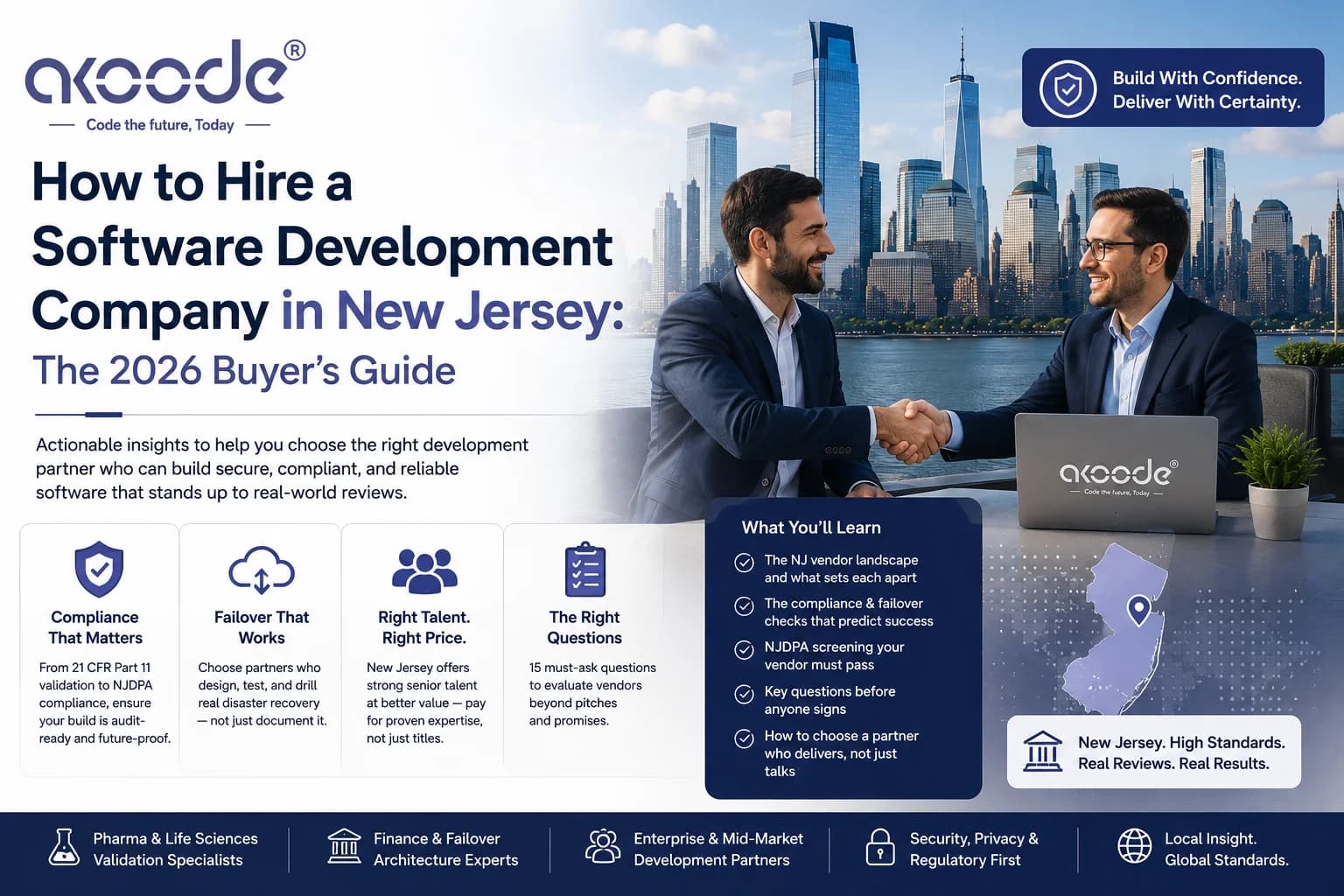
This guide covers the New Jersey vendor landscape, the validation and failover tests that predict whether a build survives its actual review, the NJDPA screening this state now specifically requires, and fifteen questions worth asking before anyone signs.
Why This Market Is Different
The reviewer is often a specific, named regime, not a general concept of "quality." An FDA inspector checking Part 11 validation evidence. A bank's disaster-recovery auditor timing an actual cutover. The New Jersey Attorney General's Division of Consumer Affairs, which as of July 1, 2026 can act without warning. Generic "best practices" satisfy none of these; each wants a specific, demonstrable artifact.
Two different things get called "failover," and only one of them works. A documented disaster recovery plan describes a hypothesis. A tested one has actually been drilled — real multi-region replication, a genuine cutover, a measured recovery time against a stated objective. Jersey City's finance sector, shaped by its post-9/11 backup-hub role, treats this distinction as existential rather than academic.
The senior talent pricing here is genuinely favorable, as we found analysing compensation data in our New Jersey cost guide — senior engineers run notably below national average, because the state's demand is driven by steady, high-volume regulated work rather than a scarce-talent bidding war. That means the premium worth paying for isn't generic seniority; it's demonstrated Part 11 validation or drilled-failover experience specifically.
The compliance clock just moved. The NJDPA cure period expired on July 1, 2026, which our companion engineering guide covers in depth. Any vendor scoping a consumer-facing New Jersey platform who isn't already asking about consent architecture and universal opt-out signal handling is behind the current regulatory reality, not ahead of it.
The New Jersey Vendor Landscape: Six Types
Pharma and life sciences validation specialists ($130–$195/hour). Firms built around 21 CFR Part 11 — audit trail architecture, electronic signature workflows, validation documentation that survives an FDA inspection. Where the experience is genuine, the premium is earned: knowing exactly what an inspector checks prevents mistakes that cost far more than the rate difference. The trap is the imitation — firms that built one dashboard for a pharma client and now market themselves as validation specialists. The evidence question below separates them.
Finance and failover specialists ($125–$190/hour). Teams built around Jersey City's disaster-recovery culture — tested multi-region architecture, genuine cutover drills, recovery-time measurement against stated objectives. Verify with the drill question, not the documentation claim.
Enterprise consultancies. Larger organizations serving pharma manufacturers, insurance carriers, and multi-site enterprises — procurement-friendly, governance-rich, comfortable with multi-stakeholder sign-off. Right for multi-year institutional programs where documentation is contractually part of the deliverable. Expensive overhead for a mid-market build.
Standard local agencies ($90–$150/hour). The broad middle across the state — Route 1 corridor, Jersey City, the Turnpike-corridor logistics belt. Quality varies widely — the best offer real value given New Jersey's compressed senior-tier pricing; the weakest are learning your compliance domain on your budget. Disciplined evaluation returns the most here.
Contractor collectives. An "agency" that is functionally a rotating bench of independents under one brand. Individuals are often strong, but nobody on your project is an employee. In validation-heavy work this is a specific risk: the person who wrote your Part 11 audit trail logic needs to be reachable when an inspector asks a question about it eighteen months later.
Global firms with transparent delivery. Offshore or nearshore engineering, disclosed openly, at materially lower rates. Akoode's model sits here: senior engineers owning architecture through every sprint review, Eastern Time standups during your working day, no subcontracting, and documentation written as decisions get made — not reconstructed before an inspection. Right for builds where engineering quality matters more than physical presence. Wrong for work requiring on-site validated manufacturing floor access or a bank's in-person DR exercise.
And the category to identify quickly: firms with a New Jersey address and an undisclosed delivery team elsewhere. Disclosed global delivery is legitimate and often the right call. Concealed global delivery means paying a local rate for offshore work and absorbing the spread without benefit.
One question sorts them in thirty seconds:
"Where, specifically, will the engineers on my project be located — and is any part of delivery subcontracted?"
Transparent firms answer plainly, in either direction. Everyone else starts describing a "global delivery model."
The Validation and Failover Tests
This is the section that matters most in New Jersey, because "compliance experience" as a general claim is nearly meaningless — the tests below are specific to which regime actually governs your build.
Test 1: The evidence question (for anything Part 11-adjacent)
"Show me validation documentation you produced for a system that went through an FDA inspection. What did the inspector ask about, and what came back the first time?"
Real answers involve specifics — a question about audit trail completeness, a gap in electronic signature workflow documentation, a request to demonstrate that access controls tied to individual accountability actually worked as designed. Firms that have never been through it can't manufacture those details convincingly.
The follow-up that reveals whether validation was designed in or bolted on: "Was the validation documentation written alongside the system, or produced afterward to describe it?" A team that designed for validation from sprint one has an entirely different answer than one that tried to reconstruct evidence before an inspection date.
Test 2: The drill question (for anything failover-dependent)
"Walk me through the last actual disaster recovery drill you ran — not documented, drilled. What broke?"
Everyone who has genuinely run one has a story, because drills reveal problems by design: the certificate that only existed in one region, the credential nobody rotated, the dependency on a service that wasn't actually replicated. A vendor with no story here has documented failover, not tested it — and those are different products at different price points.
Test 3: The consent architecture question (for anything consumer-facing)
"How would you verify that Global Privacy Control recognition on this build actually changes server-side data-sharing behavior, rather than just toggling a cookie banner category?"
Given the NJDPA cure period ended July 1, 2026, this is no longer an optional question for any consumer-facing New Jersey platform. A vendor who treats it as a frontend styling concern rather than a server-side data-flow question hasn't built this correctly before.
Test 4: The threshold question
"Do you think our platform is actually in scope of the NJDPA, and how would you confirm it?"
A vendor with real experience will ask about your consumer count and whether you derive any revenue from data sale — because the NJDPA's 25,000-consumer trigger with no revenue-percentage floor catches smaller platforms than the "big tech privacy law" mental model suggests. A vendor who assumes you're either obviously in or obviously out without asking hasn't scoped this correctly.
Step-by-Step: Running the Process
Step 1: Write the one-page definition
Before any vendor call:
The business problem, not the feature list. "Our batch-record system loses the audit trail during a shift handoff" is a problem. "We want a dashboard" is a solution someone sold you.
Which specific review this build has to survive. FDA Part 11 inspection, a bank's failover drill, NJDPA compliance, or standard commercial. The single most consequential line on the page — it determines your vendor pool before scope does.
Your real consumer count and any data-sale revenue, to establish NJDPA applicability honestly.
Your integration surface. Existing ERP, manufacturing-execution systems, core banking, or logistics platforms.
Success in numbers. Audit findings avoided. Recovery time against objective. Consumer rights request turnaround.
Budget posture, including the 20–25% reserve experienced buyers hold and the 15–25% annual maintenance beginning at launch. Benchmark against our New Jersey cost guide.
Step 2: Build a list from sources that reflect this market
Operator referrals from your own sector. A pharma quality director's or a Jersey City DR manager's assessment outweighs any review platform. Ask: "Would you hire them again, and what went wrong?" Everyone has a "what went wrong." Honest people tell you.
Verified review platforms — read the three- and four-star reviews, where the texture lives.
LinkedIn, filtered to delivery engineers rather than founders. Tenure, and whether backgrounds genuinely include Part 11-validated systems or drilled failover architecture.
Live products you can test.
Aim for five to seven candidates matched to your regime, including at least one out-of-market or global option so your comparison has a real baseline rather than local quotes measured only against each other.
Step 3: Interrogate portfolios properly
Is the system still running, and has it been inspected or drilled since?
What was the firm's actual role? "We worked with [major pharma manufacturer]" often means one engineer touched one module. Ask what specifically they built and who owned the validation architecture.
Did the failover claim survive an actual event, or only a tabletop exercise? Ask directly.
Is anything in your specific regime? A vendor with genuine Part 11 experience can describe how they structured electronic signature workflows. One without will show you a nice interface.
Ask for a reference from a project that went badly.
Step 4: Read proposals where the truth hides
Compare scope line by line, never headline price. Spreadsheet it: discovery and compliance scoping, architecture, design, frontend, backend, QA, failover testing or validation documentation, security testing, documentation, DevOps, project management, post-launch support.
In this market the cheap quote almost always omits the same two items — real failover testing (versus a documented plan) and validation documentation written alongside the build rather than after it. Those are precisely the two that determine whether the system survives its first real review.
Require an explicit line item for whichever regime applies — "failover drill" or "Part 11 validation" — rather than a vague "compliance" allocation. Its absence, or its vagueness, tells you the vendor hasn't scoped what your build actually needs to survive.
Look for a named assumptions section. A proposal without one hasn't been thought about hard enough to have assumptions — which means they exist unspoken and resurface as change orders.
Check what happens after launch. The FDA inspection, the DR drill, or the NJDPA enforcement question all typically arrive after your launch date, not before it.
Step 5: Negotiate the terms that matter
IP assignment on payment, not project completion
Source code and repository access from day one — non-negotiable
Documentation and validation evidence as a contractual milestone deliverable, not a promise — this matters more here than most markets, because two entirely different kinds of reviewer will eventually ask for it
A defined failover drill as an acceptance criterion, if failover applies — not "architecture designed to support failover," but an actually executed and measured drill before sign-off
Key personnel clause naming your technical lead
A change-order process with rates in writing
A clean exit clause — 30 days' notice, orderly handover, payment for work completed
Payment at 25–30% against a defined first milestone. A firm demanding 50%+ before discovery has cash flow or delivery problems that shouldn't become yours.
An NDA before any access to clinical data, trading logic, or proprietary financial models. Any competent New Jersey firm offers this unprompted.
Red Flags Worth Walking Away From
"We understand compliance" without specifying which regime, or asked to specify and staying vague.
"Failover" in the proposal with no drill mentioned — documented-only, priced as if tested.
A price in the first call. Real estimates require knowing which specific review applies.
No question about your NJDPA applicability for a consumer-facing platform, post-July 2026.
Global Privacy Control treated as a frontend styling task.
Validation documentation proposed as a deliverable near the end, rather than designed alongside the build.
No integration discovery proposed for a project touching legacy ERP, MES, or core banking systems.
No assumptions section in the proposal.
50%+ deposit before discovery.
Evasiveness about team location or subcontracting.
Delivery team is mostly contractors — ask plainly how many are employees.
Won't share a reference from an imperfect project.
Treats the New Jersey Consumer Fraud Act's treble-damages exposure as irrelevant to a consumer-facing build's data handling.
Slow, sloppy communication during sales. This is their best behavior. It degrades from here.
The 15 Questions to Ask Before Signing
Which specific review does this build have to survive? (Note whether they asked you first.)
Show me validation documentation from a system that went through an FDA inspection. What came back the first time?
Was that documentation written alongside the build or reconstructed afterward?
Walk me through the last actual disaster recovery drill you ran. What broke?
How would you verify Global Privacy Control recognition actually changes server-side behavior?
Do you think we're in scope of the NJDPA, and how would you confirm it?
Who exactly will work on this, where are they located, and is any part subcontracted?
How many of the proposed team are employees versus contractors?
What's your average variance from original estimates, and why? ("We always deliver on time" is a lie.)
Tell me about a project that went badly. What changed in your process afterward?
What does your discovery phase produce and cost?
Who owns the IP, when does it transfer, and do I get repository access from day one?
What's your QA process, who performs it, and does it include a real failover drill or validation walkthrough?
What documentation exists at handover, and when during the project is it written?
Why would you be the wrong choice for some clients?
New Jersey Agency vs. Global Partner: The Honest Comparison
Factor | New Jersey Agency | Global Partner (Akoode) |
|---|---|---|
Standard rate | $90–$150/hr | $45–$75/hr |
Validation / failover specialist tier | $125–$195/hr | — |
Total project cost | Baseline | 50–65% lower |
Time zone | Local | Eastern-hours overlap during your working day |
On-site pharma / DR exercise access | Available | Not a fit |
21 CFR Part 11 validation depth | Genuine at real specialists — verify | Verify identically |
Tested failover experience | Strong at real specialists — verify | Verify identically |
NJDPA / consent architecture fluency | Strong at current firms — verify | Strong at compliance-focused firms — verify |
Team scaling | Moderate | Faster — deeper bench |
The honest read: New Jersey's genuine local advantages are physical — validated manufacturing floor access, a bank's in-person disaster-recovery exercise — plus real depth in Part 11 validation and tested failover built up around Route 1 and Jersey City's specific economies.
For the engineering itself, demonstrated evidence in the specific regime that applies matters more than proximity, and Eastern time makes distributed delivery straightforward. The compressed senior-tier pricing locally, as our cost guidecovers, also means the domestic-versus-global gap here is somewhat narrower than in markets with hotter senior pricing — worth factoring into the decision either way.
The vetting standard shouldn't change with the answer. Whether the team sits on Route 1 or on another continent, the questions are identical: what specific evidence exists, what did the last real drill or inspection find, and is the consent architecture actually verified server-side.
The Decision Framework
Five questions:
Does the build require in-person presence — a validated manufacturing floor, a bank's physical DR exercise, regulator-facing stakeholder sessions?
Does it involve export-controlled data or contractual US-person requirements?
Is genuine on-site pharma quality-system integration required, rather than a remote-accessible data pipeline?
Do your contracts require US-based vendors?
Is the scope fully locked and the timeline under ten weeks?
Three or more yes → a local domain specialist, verified with the evidence and drill tests above.
Zero or one yes → a strong generalist or transparent global partner, vetted with exactly the same questions.
Two yes → hybrid. Local validation strategy and stakeholder sessions, distributed delivery for the build.
Note what isn't on this list: whether the NJDPA applies. That's an architecture capability, not a geography one, and should be tested identically regardless of where the team sits.
Frequently Asked Questions
How do I hire a software development company in New Jersey?
Start with a one-page definition covering the business problem, which specific review the build must survive, your NJDPA applicability, your integration surface, success metrics, and budget posture. Build a list of five to seven regime-matched candidates including one out-of-market option, run the evidence and drill tests, then compare proposals line by line on scope rather than headline price.
What should I look for in a New Jersey software vendor that's different from other markets?
Specificity about which compliance regime applies, and demonstrated evidence rather than a general claim. "We understand compliance" means nothing in a state where Part 11 validation, tested failover, and NJDPA consent architecture are three entirely different disciplines. Ask which one governs your build, and ask for the specific evidence — an inspection finding, a drill outcome, a verified server-side opt-out test.
How do I verify a vendor's 21 CFR Part 11 experience is genuine?
Ask for validation documentation from a system that went through an actual FDA inspection, and what the inspector asked about. Then ask whether that documentation was written alongside the build or reconstructed afterward — a team that designed for validation from sprint one answers this very differently than one that scrambled to produce evidence before an inspection date.
What's the difference between documented and tested failover, and why does it matter when hiring?
A documented plan describes theoretical disaster recovery and has never been executed. Tested failover means an actual drill — real multi-region replication, a genuine cutover, measured recovery time against a stated objective. Ask for the story of the last real drill and what broke; everyone who has genuinely run one has an answer, and a vendor without one is selling documentation as if it were the tested product.
Do I need to ask about the New Jersey Data Protection Act when hiring?
Yes, for any consumer-facing build, especially now that the 18-month cure period ended July 1, 2026 and enforcement can proceed with no advance warning. Ask whether the vendor would verify Global Privacy Control recognition actually changes server-side data-sharing behavior, and whether they'd assess your genuine NJDPA applicability against the 25,000-consumer threshold rather than assuming you're too small to be in scope.
What's the most useful question to ask a New Jersey software vendor?
"Which specific review does this build have to survive?" — and note whether they ask you this before you have to ask them. A vendor who opens with features rather than the applicable regime hasn't scoped the project; they've scoped a demo.
How much should I pay upfront to a software development company?
25–30% against a defined first milestone is standard. Dedicated team arrangements typically bill monthly without a large deposit. A firm demanding 50% or more before discovery has cash flow or delivery problems that shouldn't become yours.
Do New Jersey software companies subcontract their work?
Some do, and disclosed global or nearshore delivery is legitimate — often the right call. The problem is the undisclosed version: a New Jersey address over a delivery team elsewhere, with you paying a local rate for offshore work. Ask directly where engineers will sit and whether any part of delivery is subcontracted.
What contract terms matter most for a New Jersey build?
IP assignment on payment, repository access from day one, documentation and validation evidence as a contractual milestone deliverable, a defined failover drill as an acceptance criterion where applicable, a key personnel clause, a written change-order process, and a clean exit clause. The drill-as-acceptance-criterion term matters more here than in most markets, because "architecture designed to support failover" and "failover that was actually tested" are different products at different prices.
Is it better to hire locally in New Jersey or use a distributed team?
For validated manufacturing floor access, a bank's in-person DR exercise, or genuine on-site pharma quality-system integration — local. For the engineering itself, demonstrated regime-specific evidence matters more than proximity, and Eastern time gives straightforward overlap. New Jersey's compressed senior-tier pricing also narrows the domestic-versus-global cost gap somewhat compared to hotter markets, worth weighing alongside the physical-presence question.
What to Do in the Next 48 Hours
Don't start by searching for agencies and calling whoever ranks first.
Identify which specific review this build has to survive. FDA Part 11, a failover drill, NJDPA compliance, or standard commercial. Fifteen minutes that determines your entire vendor pool.
Check your NJDPA applicability honestly if the build is consumer-facing — your consumer count, and whether any revenue derives from data sale.
Write the one-page definition. Ninety minutes that improves every conversation for a month.
Run the LinkedIn check on any firm already on your radar — tenure, and whether backgrounds genuinely include validated systems or drilled failover, not just proximity to pharma or finance clients.
Then open conversations with the evidence question and the drill question. Those two answers will sort your shortlist before you've discussed a single feature.
Talk to Akoode About Your New Jersey Project
Akoode Technologies builds custom software, SaaS platforms, and applied AI for New Jersey's pharma, finance, and logistics companies. 180+ projects delivered across 15+ industries, 97% client retention, 4.9/5 on Google and 5.0/5 on Clutch.
No subcontracting — the engineer who designed your batch-record audit trail or your trading platform's failover path is the person your team reaches a year later. Senior engineers own architecture through every sprint review. Failover tested, not just documented. 21 CFR Part 11-aware patterns built in from sprint one. Documentation written as decisions get made, for a team that wasn't in the room. Eastern Time standups during your working day.
Review our case studies, our finance and banking, manufacturing, and logistics practices, or our AI development and cloud and DevOps services.
Book a free consultation → calendly.com/akhil-akoode/ak
A senior engineer reviews every inbound project — not an account manager — and replies within thirty working minutes.
Get In Touch Now
View More Our Blog