


 October 5, 2026
Short Answer
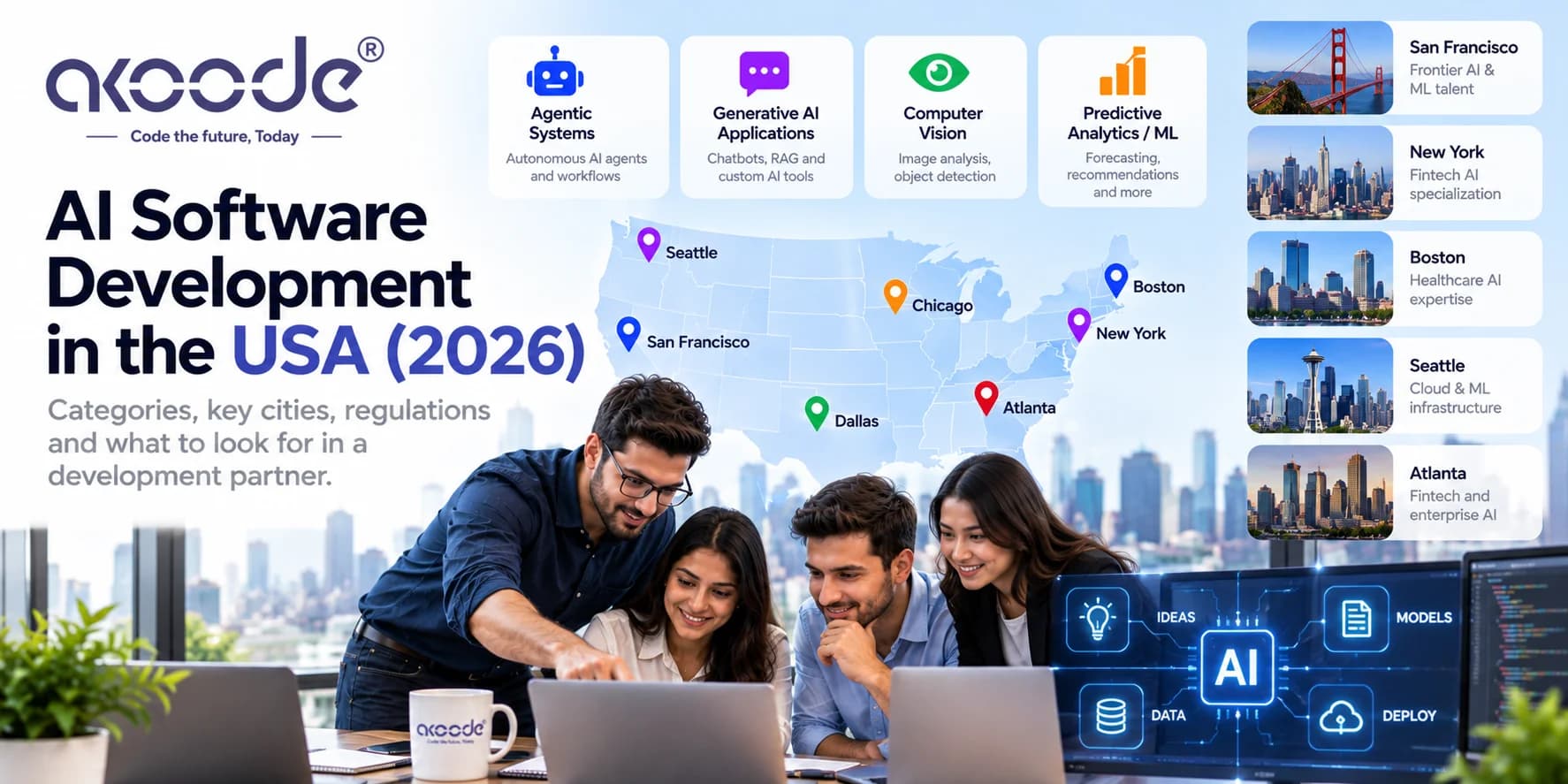
AI software development in 2026 covers four distinct categories — agentic systems, generative AI applications (chatbots, RAG-based tools), computer vision, and predictive analytics/ML — and no single US city is "best" for all of them. The right location and vendor depend on your project's domain: the Bay Area and Seattle lead on frontier-model access and cloud-native ML infrastructure, Boston and Philadelphia carry deep healthcare-AI experience, New York and Atlanta specialize in fintech-adjacent AI, and several states now have active AI governance rules — California's automated decision-making regulations, Illinois' biometric law, Texas's AI governance act — that should shape your architecture from day one, not get bolted on after launch. What matters more than geography is whether a vendor can show real engineering discipline around AI-generated code, since independent testing has found nearly half of AI-generated code introduces exploitable security flaws.
AI software development content right now tends to split into two unhelpful camps: breathless hype pieces claiming AI builds everything 10x faster, and skeptical pieces dismissing it entirely. Neither matches what's actually happening. This guide covers what AI software development means in practice in 2026, how the city-by-city US landscape actually differs for AI work specifically (not general software development, which we cover separately), the state AI laws that increasingly affect how these systems get built, and what to ask a vendor before you commit.
What Counts as "AI Software Development" in 2026
The term covers genuinely different categories of work, and conflating them is one of the most common sources of scope confusion in early vendor conversations:
Agentic systems — software that autonomously executes multi-step tasks, orchestrates tools and APIs, and makes sequential decisions with limited human intervention. This is the fastest-moving category right now, and worth understanding on its own terms before you scope a project around it.
Generative AI applications — chatbots, content generation tools, and retrieval-augmented generation (RAG) systems that ground LLM outputs in your own data rather than relying on the model's training alone.
Computer vision systems — object detection, quality inspection, facial or biometric recognition, and image classification, which carry their own distinct compliance considerations (more on this below).
Predictive analytics and traditional ML — forecasting, recommendation engines, and fraud detection, which predate the current generative-AI wave but remain a large share of what gets built under the "AI" label.
Each category has different cost drivers, different talent requirements, and — increasingly — different regulatory exposure. A vendor who treats all four as interchangeable "AI development" hasn't scoped your project accurately.
What the Productivity Research Actually Shows
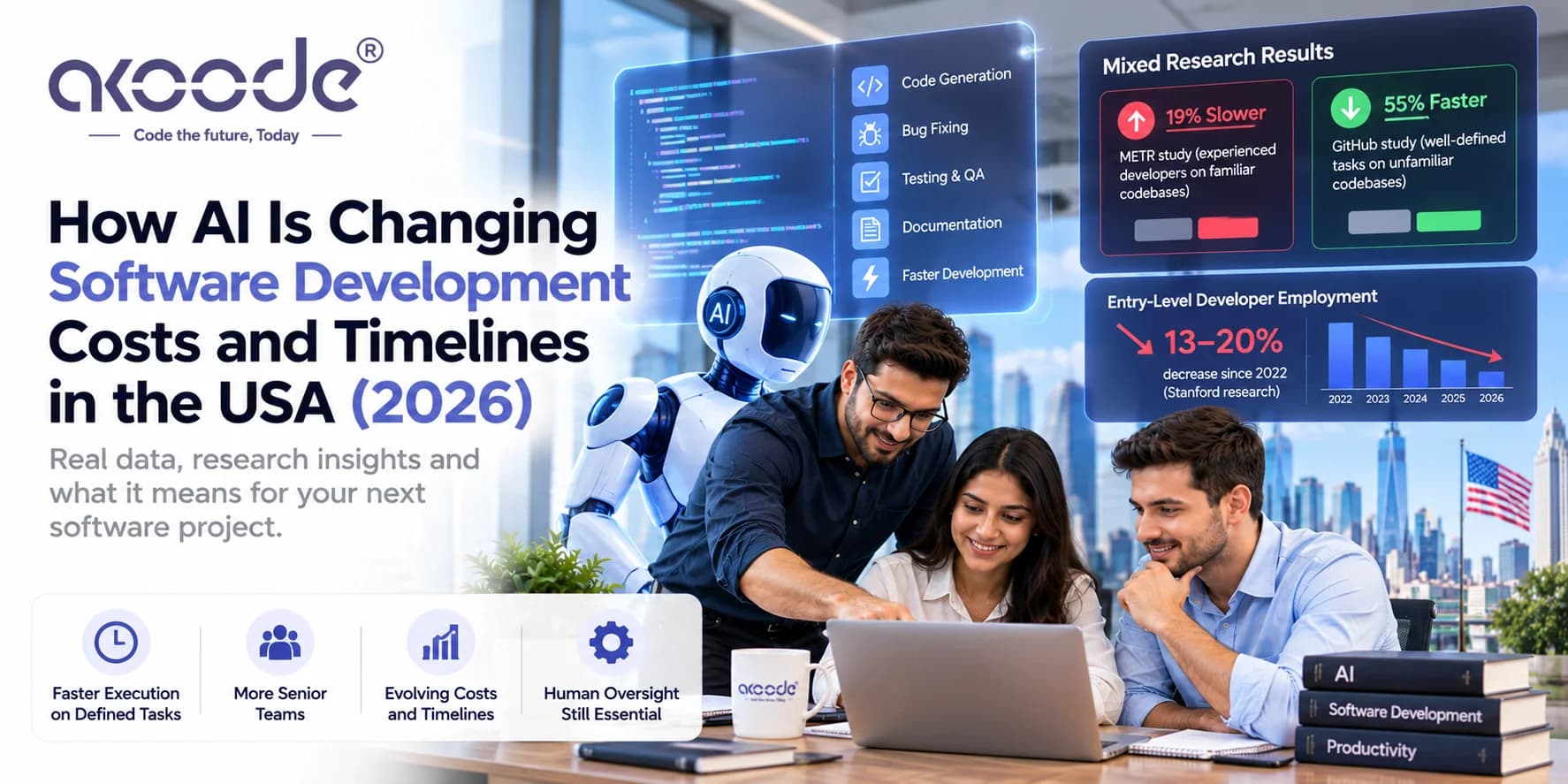
Before choosing a vendor or a timeline, it's worth knowing that the evidence on AI coding productivity is genuinely contested, not a settled "AI makes everything faster" story. A rigorous randomized controlled trial found experienced developers 19% slower using AI tools on codebases they already knew well, while other controlled studies show real speedups on well-defined, unfamiliar-codebase tasks. We cover this in detail, including why the studies disagree, in our piece on how AI is changing software development costs and timelines — worth reading before you accept a vendor's claimed AI-driven timeline discount at face value.
One data point from that research is worth repeating here specifically: independent testing by application security firm Veracode found that 45% of AI-generated code introduced at least one OWASP Top 10 vulnerability across more than 100 language models tested. If a vendor is using AI tools to accelerate your build, ask directly how their review process accounts for this — "we use AI" is not itself a quality signal.
AI Software Development Across the United States: City by City
AI talent and specialization aren't evenly distributed across the US, and the differences matter more for AI-specific work than for general software development, because AI engineering talent is scarcer and more concentrated around a handful of ecosystems.
New York City carries deep fintech-AI specialization — fraud detection, algorithmic trading infrastructure, and AI-driven risk modeling are common project types here, reflecting the city's financial-services density. A software development company in New York working on AI for financial products should expect compliance review (SOX, state financial regulation) to be a real part of the AI system's design, not an afterthought.
San Francisco and the broader Bay Area remain the center of frontier-model development and AI-native startup activity, with the deepest access to specialized ML engineering talent in the country — and correspondingly the highest rates. A software development company in San Francisco is the natural choice if your product is itself an AI-first company racing to ship against well-funded competitors.
Seattle has an unusually strong cloud-native ML infrastructure talent pool, driven by Amazon and Microsoft's proximity — this shows up in deep AWS/Azure ML-ops expertise that benefits data-pipeline-heavy AI projects specifically. Washington's My Health My Data Act also adds a real compliance layer for any AI system touching health-adjacent behavioral data, even outside traditional healthcare products.
Los Angeles is increasingly a hub for generative AI applied to media and entertainment — content generation, personalization engines, and creator-economy tooling. California's likeness and publicity-rights considerations add a legal-review layer here that's specific to generative content work and easy to underestimate if you're not local to the industry.
Boston brings genuine depth in healthcare and biotech AI, backed by a strong university research pipeline. Massachusetts' 201 CMR 17.00 data security regulation applies directly to any AI system processing personal information about Massachusetts residents, and healthcare-AI projects here typically need HIPAA-aware architecture from the start.
Austin has grown a strong enterprise-AI and SaaS-integration specialization, pulling relocated talent from the coastal hubs — a solid option for businesses wanting senior AI engineering talent without Bay Area pricing.
Dallas and Houston lean toward AI applied to large, established industries — enterprise automation and insurance-sector AI in Dallas, energy-sector predictive maintenance and grid-optimization AI in Houston, reflecting each city's dominant local industries.
Chicago requires specific caution for any AI project involving computer vision or biometric features — facial recognition, fingerprint-based authentication — because Illinois' Biometric Information Privacy Act (BIPA) carries a private right of action and has produced some of the largest privacy verdicts in US history, including a $228 million jury verdict. A software development company in Chicago should flag this during AI project scoping, not after a feature ships.
Denver offers a growing AI startup scene with a strong remote-work culture, pricing closer to national averages than the coastal AI hubs.
Atlanta has unusual depth in payments-fraud AI specifically, tied to the city's concentration of major payment processors — a natural fit for fintech AI products needing that domain expertise.
Miami has grown a real-estate AI and Latin America-facing AI product specialization, reflecting the city's international client base and property-tech concentration.
Philadelphia carries strong healthcare-AI experience tied to its dense hospital-system and university presence, with HIPAA and business-associate-agreement considerations shaping most AI healthtech projects built there.
Washington, DC is the center of government and public-sector AI work, where FedRAMP-adjacent compliance and fairness/transparency/audit-trail requirements are a defining engineering consideration, not an optional add-on.
Las Vegas has a growing hospitality and gaming AI specialization — personalization engines, dynamic pricing, and guest-experience AI — alongside Nevada Gaming Control Board compliance requirements for anything gambling-adjacent.
At the state level: California now has active automated decision-making technology (ADMT) regulations affecting AI-driven consumer decisions. Illinois carries statewide BIPA exposure for biometric AI features, not just in Chicago. New Jersey draws heavily on the broader NYC metro AI talent pool. Oklahoma, where Akoode maintains a US coordination office in Jenks, offers meaningfully lower AI engineering costs while keeping same-time-zone collaboration for Central US and distributed teams.
AI Governance Is a Moving Target — Here's What's Actually in Force
State-level AI regulation has moved faster than most development teams have adjusted to, and the landscape is genuinely volatile — worth knowing both what's settled and what's still shifting before you assume a given state's rules.
Confirmed and currently in force: California's ADMT regulations took effect January 1, 2026, adding obligations around AI-driven decisions affecting consumers. Texas's Responsible AI Governance Act (TRAIGA) took effect the same day, establishing a framework for AI development and government transparency. Illinois amended its Human Rights Act (HB 3773), also effective January 1, 2026, prohibiting AI use with discriminatory effect in employment decisions. New York City's Local Law 144, requiring annual bias audits for automated employment decision tools, has been in force since 2023 — the longest-standing AI-specific rule in the country.
Still genuinely in flux: Colorado's AI Act (SB 24-205) — originally positioned as the most comprehensive state AI law, modeled loosely on the EU AI Act — has been delayed and amended multiple times through 2026, with reporting suggesting it was significantly scaled back via a replacement bill (SB 26-189) that removed bias-audit and risk-assessment requirements before the original provisions ever took effect. Given how much this has moved in a single year, treat any specific claim about Colorado's current AI law as something to verify directly against the state legislature's site rather than take at face value from any single source, including this one.
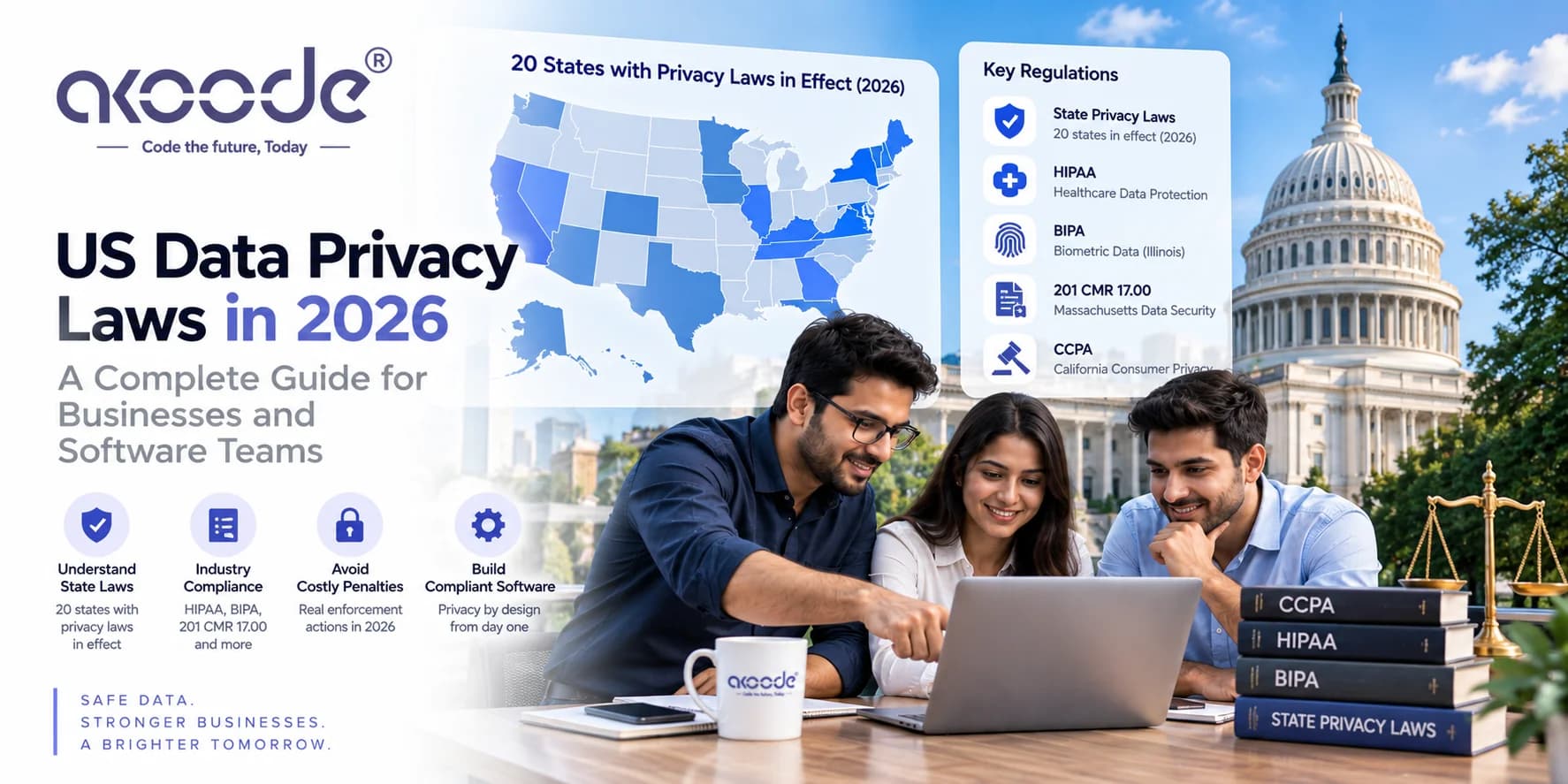
This governance picture builds directly on the broader privacy landscape we cover in our US data privacy and compliance guide — AI-specific rules are increasingly layered on top of, not separate from, the state privacy law patchwork already in effect.
The Six-Question Framework for Vetting an AI Development Vendor
Given how unevenly distributed real AI engineering discipline is right now, these six questions do more to separate genuine capability from surface-level AI marketing than a portfolio review:
What's your code review process specifically for AI-generated code? Given the documented vulnerability rate in AI-generated output, a vague "we review everything" answer is weaker than a specific, described process.
Where does your training or reference data come from, and do you have the rights to use it? This matters directly for any AI feature trained or fine-tuned on data beyond standard API usage.
Which state AI regulations apply to our specific use case, and how does that shape the architecture? A vendor who hasn't considered this hasn't scoped an AI project seriously in 2026.
How senior is the team actually building this, versus reviewing AI tool output? Given the productivity research showing mixed results and the labor-market shift toward senior-heavy AI teams, this is a legitimate staffing question, not an unusual one.
What happens if the AI model or API you're building on changes or gets deprecated? AI-dependent architecture carries a vendor-lock-in risk that traditional software doesn't, and a serious vendor should have a real answer.
Can you show a real example of an AI system you've built in production, not a demo? Demos are easy; production AI systems handling real data at real scale are a meaningfully different bar.
This extends the vendor-evaluation framework from our guide to hiring a software development company in the USA— these six questions are AI-specific additions to that broader checklist, not a replacement for it.
Watch for "AI Development" That's Really Just Prompting
A pattern worth naming directly: some vendors marketing "AI development" services are, in practice, a small team prompting a general-purpose chatbot API with minimal engineering discipline around data handling, security review, or system architecture — essentially outsourcing the hard parts to the model provider and billing for the integration work as if it were deep AI engineering. This isn't always dishonest, but it's a meaningfully different (and lower-value) service than real agentic system design, RAG architecture grounded in your own data, or custom model fine-tuning — and it should be priced and scoped differently. Ask a vendor directly what parts of the system are custom-engineered versus a thin wrapper around an off-the-shelf API; a vendor confident in their actual architecture will have a specific, technical answer.
Why a Hybrid US-Plus-Offshore AI Team Often Works Best
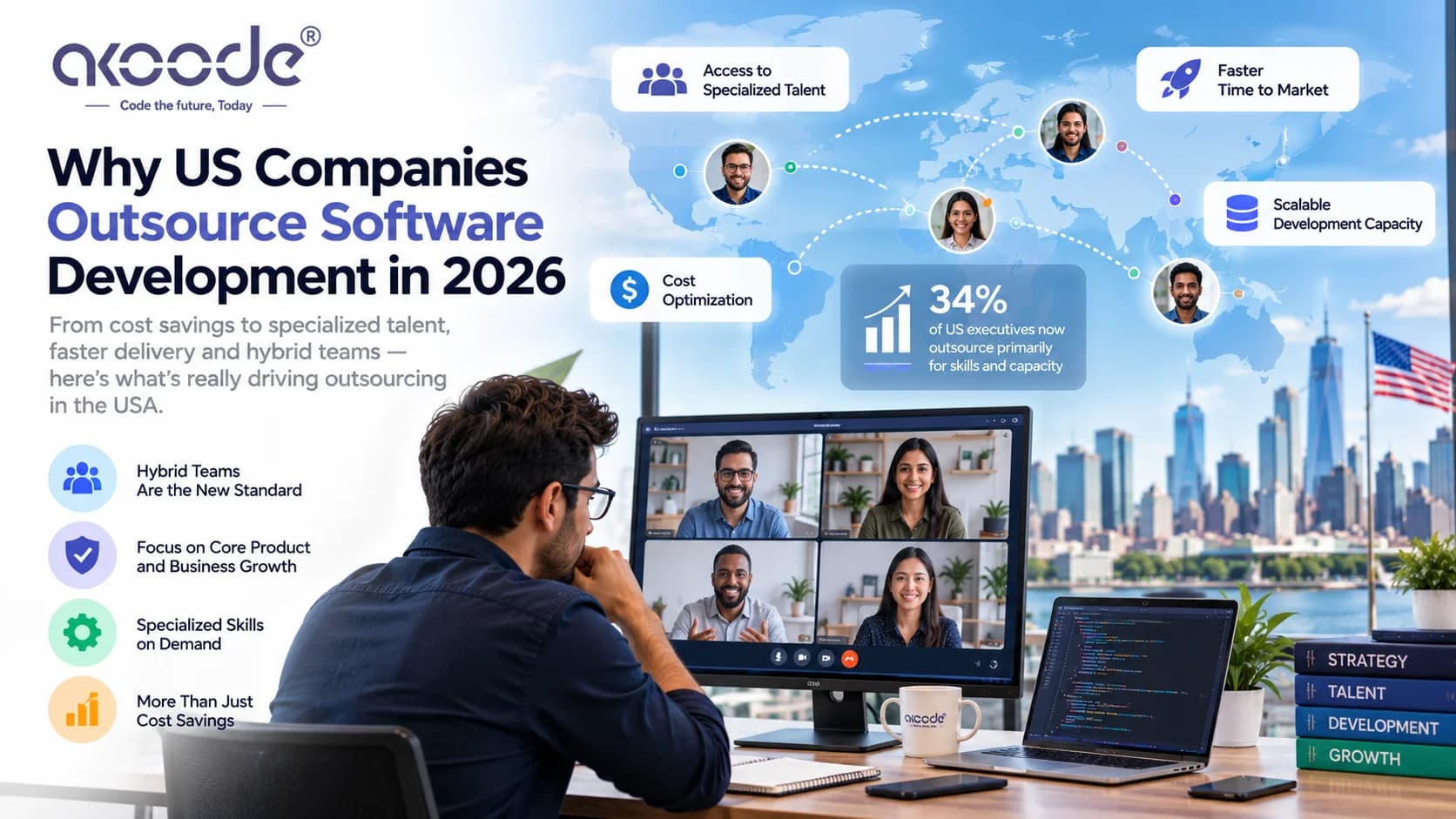
AI engineering talent is expensive and concentrated in a handful of US metros, which has pushed many mid-market buyers toward a hybrid structure: US-based coordination and architecture oversight, paired with distributed engineering execution. This captures real cost efficiency without losing the communication quality that pure offshore engagements are most often criticized for — our outsourcing trends guide covers why this hybrid pattern has become the dominant structure for US technology buyers generally, and it applies with particular force to AI projects, where senior engineering judgment matters more than raw headcount. Akoode's own structure reflects this directly — AI engineering delivered from Gurugram, India, coordinated through a US office in Jenks, Oklahoma for real-time collaboration with US clients.
Frequently Asked Questions
What's the difference between agentic AI and generative AI?
Generative AI produces content or responses from a prompt; agentic AI goes further, autonomously executing multi-step tasks and making sequential decisions across tools and systems with limited human intervention.
Which US city is best for AI software development?
It depends on your project's domain — the Bay Area and Seattle lead on frontier-model and ML-infrastructure talent, Boston and Philadelphia on healthcare AI, New York and Atlanta on fintech AI, with no single city best for every AI use case.
Is AI-generated code safe to use in production?
Not without review — independent testing found 45% of AI-generated code introduced at least one OWASP Top 10 security vulnerability, meaning it requires the same or greater review rigor as human-written code.
Does California regulate AI-driven business decisions?
Yes — California's automated decision-making technology (ADMT) regulations took effect January 1, 2026, adding obligations for AI systems that affect consumer decisions.
What is Illinois' BIPA and why does it matter for AI projects?
BIPA is Illinois' biometric privacy law, carrying a private right of action and some of the largest privacy verdicts in US history — it applies to any AI feature using facial recognition, fingerprint authentication, or similar biometric data from Illinois residents.
Is Colorado's AI Act in effect?
Its status has changed multiple times through 2026 and should be verified directly against current state legislative records before being relied on for compliance planning — this guide reflects the most recent available reporting but the law has moved fast enough to warrant independent verification.
Does AI actually make software development faster?
The evidence is mixed and task-dependent — rigorous studies show both slowdowns on familiar, complex work and speedups on well-defined tasks, so a flat "AI makes this faster" claim from a vendor is worth questioning.
Should I hire a US-based or offshore team for an AI project?
Many mid-market buyers use a hybrid model — US-based coordination and architecture oversight paired with distributed engineering — to balance cost efficiency with communication quality, particularly given how much senior judgment AI projects require.
What should I ask a vendor before starting an AI project?
Ask about their AI-generated code review process, data rights and provenance, which state regulations apply to your use case, team seniority, model dependency risk, and whether they can show a real production AI system, not just a demo.
How is AI changing software development team composition?
Entry-level developer hiring has declined meaningfully since AI tools began absorbing routine coding tasks, while senior developer demand has held steady — a pattern that shows up clearly in AI-specific projects, where architecture and judgment matter most.
Akoode Technologies builds AI software — agentic systems, generative AI applications, and computer vision — for clients across the US, UK, and India, with AI engineering delivered from Gurugram and coordinated through a US office in Jenks, Oklahoma. The team holds a 4.9 rating from 126 reviews on Google and a 5.0 rating on GoodFirms. If you're scoping an AI project and want an honest read on what it actually takes to build, book a time on our calendar.
Get In Touch Now
View More Our Blog