


 September 26, 2026
Short Answer
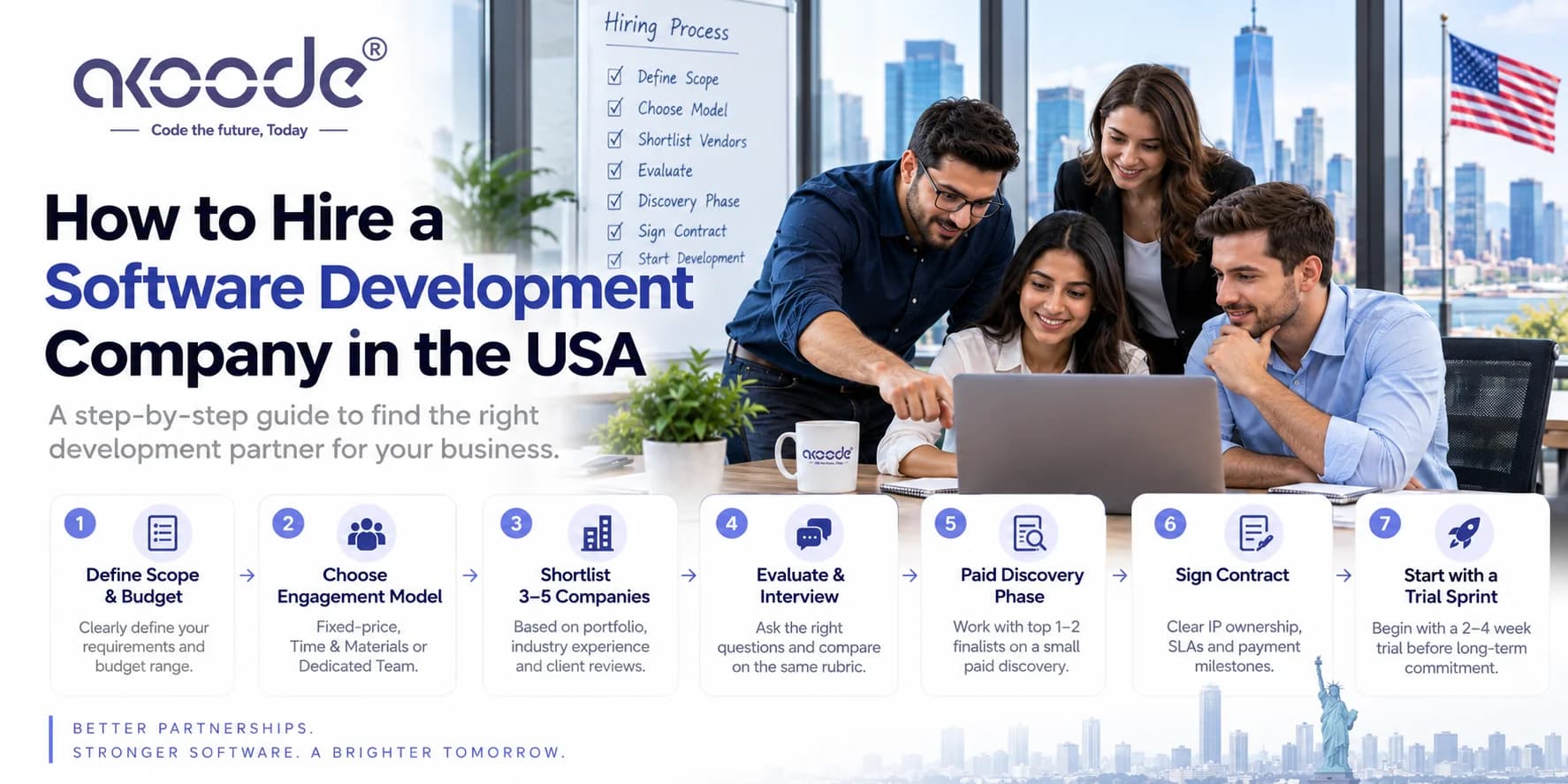
Hiring a software development company in the USA involves five core steps: define your project scope and budget range, choose an engagement model (fixed-price, time-and-materials, or dedicated team), shortlist 3–5 vendors based on relevant portfolio and industry experience, vet them through structured interview questions and a small paid discovery phase, then lock in a contract with clear IP ownership, SLAs, and payment milestones before full development begins. The process typically takes 2–6 weeks from first outreach to signed contract, depending on how quickly you can define requirements.
Hiring the wrong software development company doesn't usually show up as a bad first meeting — it shows up eight weeks in, as a codebase you don't fully own, a timeline that's quietly slipped twice, and a point of contact who's stopped answering directly. This guide walks through the actual hiring process the way experienced buyers run it: what to ask, what to sign, what to watch for, and how the US market specifically changes the decision versus hiring offshore or hiring in-house.
If you're still building the internal business case and want realistic dollar figures for your project type, our software development cost in the USA guide covers pricing by project category, hourly rate, and city — this article assumes you've got a rough budget in mind and focuses entirely on the hiring decision itself.
The Software Development Company Hiring Process, Step by Step
Hiring a development partner is a procurement decision, not a one-call sales conversation, and treating it that way is what separates smooth engagements from expensive ones.
Step 1: Define scope before you talk to anyone. Write down the problem you're solving, not the features you think you want. A one-page brief covering your core user, the primary workflow, and your non-negotiables (compliance, integrations, launch date) will get you dramatically better proposals than "we need an app like Uber but for X."
Step 2: Decide your engagement model. Fixed-price, time-and-materials, or dedicated team — each fits a different scope-certainty level. This decision shapes everything that follows, so make it before shortlisting vendors, not after.
Step 3: Build a shortlist of 3–5 companies. Cast a wide enough net to compare, but not so wide that evaluation becomes unmanageable. Mix at least one boutique agency, one larger firm, and — if cost matters — one offshore or nearshore option to see the real spread.
Step 4: Run a structured evaluation. Same questions, same rubric, across every vendor. This is where most buyers get sloppy — comparing a polished sales deck from one company against an engineering-led conversation from another isn't a fair comparison.
Step 5: Commission a small paid discovery phase with your top 1–2 finalists before committing to the full build. A one-to-two-week paid discovery (requirements documentation, technical architecture proposal, and a real estimate) costs a fraction of the total project and tells you more about how a team actually works than any sales call will.
Step 6: Negotiate and sign the contract, with IP ownership, payment milestones, and termination terms explicit — never assumed. We cover exactly what this contract needs further down.
Step 7: Start with a trial sprint if you're not fully confident. Many companies, including Akoode's software development team, will structure the first 2–4 weeks as a lower-commitment trial period before locking into a longer contract — a reasonable ask if you're choosing between finalists.
Engagement Models: Fixed-Price, Time & Materials, and Dedicated Teams
Which model you choose determines how risk is split between you and the vendor — get this wrong and you'll either overpay for flexibility you didn't need or get boxed into a fixed scope that can't absorb the changes every real project needs.
Model | Best For | How Risk Is Split | Watch Out For |
|---|---|---|---|
Fixed-Price | Well-defined, smaller-scope projects (MVPs, single-feature builds) | Vendor absorbs scope-estimation risk | Change requests get expensive fast; vendors may pad the quote to cover uncertainty |
Time & Materials (T&M) | Projects with evolving requirements or unclear final scope | Client absorbs the risk of the project running longer than expected | Requires active client oversight to control scope drift; budget can balloon without discipline |
Dedicated Team / Staff Augmentation | Ongoing product development, teams needing to scale quickly | Client manages the team directly; vendor provides talent and infrastructure | You need internal product/technical leadership to direct the team effectively |
Hybrid (Fixed discovery + T&M build) | Most mid-to-large projects | Balanced — fixed cost for planning, flexible cost for execution | Requires a genuinely thorough discovery phase to be worth it |
Most experienced buyers land on the hybrid model: a fixed-price discovery and design phase to nail down scope and get a real estimate, followed by time-and-materials or milestone-based billing for the build itself. This avoids the two most common failure modes — a fixed-price quote built on guesswork, or an open-ended T&M engagement with no cost ceiling.
What to Look for in a Software Development Company
Beyond the general checklist most guides repeat (portfolio, communication, reviews), here's what actually predicts whether a company will deliver:
Do they ask you hard questions before quoting a number? A vendor who quotes fast without probing your requirements is estimating from a template, not your project.
Can they name a project of comparable complexity, not just comparable industry? A healthtech company that's only built marketing websites for healthcare clients hasn't solved your actual problem before.
Do they have a defined QA process they can describe specifically (automated test coverage targets, manual QA checkpoints), or do they say "we test everything thoroughly" without detail?
Will they show you their development methodology in practice — sprint cadence, how you'll see progress, how blockers get escalated — rather than just naming "Agile" as a buzzword?
Do they have senior technical oversight on your account, not just junior developers reporting to a project manager with no engineering background?
What's their team continuity track record? Ask directly how often developers rotate off active projects — high turnover mid-project is one of the most common causes of quality drops and timeline slips.
Are they transparent about their own limits? A company willing to say "we'd bring in a specialist partner for that piece" is more trustworthy than one that claims universal expertise.
Freelancer vs. Boutique Agency vs. Enterprise Consultancy vs. Offshore — Who Should You Hire?
The right hiring category depends on your project's risk tolerance, timeline, and internal technical capacity — not just your budget ceiling.
Choose a freelancer if you have strong technical judgment in-house to manage them directly, the scope is small and well-defined, and you can tolerate the risk of a single point of failure.
Choose a boutique US agency (typically 10–150 people) if you want a full team — design, engineering, QA, project management — without enterprise-consultancy pricing, and you value direct access to senior staff rather than layers of account management. This is where most mid-market software projects land, and it's the model Akoode operates on for US clients.
Choose an enterprise consultancy (Accenture, Deloitte Digital, Capgemini) if you need deep regulatory compliance expertise for a large-scale, high-stakes system, or your procurement process requires a vendor with a specific enterprise track record and insurance/liability profile that smaller firms can't match.
Choose an offshore or nearshore team if budget efficiency is a primary driver and you (or your chosen partner) have strong project management discipline to bridge time-zone and communication gaps. This works best paired with a US-based point of contact — which is why hybrid models, where engineering happens offshore but coordination runs through a US-hours office, have become increasingly common. Akoode's own structure reflects this directly: engineering out of Gurugram, India, with a coordination office in Jenks, Oklahoma for US-hours alignment.
If you're weighing US-based against offshore/international options in more depth — total cost of ownership, communication overhead, IP protection across jurisdictions — our global buyer's guide covers that comparison at length; this article stays focused on the US hiring process specifically.
Questions to Ask Before Signing a Contract
Ask every shortlisted vendor the same list, and pay attention not just to the answers but to how directly they're given:
Who specifically will be working on our project, and what are their roles?
What happens if a key team member leaves mid-project?
How do you handle scope changes once development has started?
What does your QA process look like in practice — automated coverage, manual testing, staging environment?
Who owns the code, designs, and data once the project is complete?
What's your average response time for critical bugs post-launch?
Can you walk us through a project that failed or ran into serious trouble, and what you did about it?
What does your development environment and deployment pipeline look like?
How do you handle security — code review practices, dependency scanning, access controls?
What's included in your post-launch support, and what's billed separately?
Can we speak directly with a past client in a similar industry?
How do you document the codebase and system architecture for future developers?
What's your policy on subcontracting work to third parties?
How are payment milestones structured, and what triggers each payment?
What happens if we want to bring development in-house later — do you support that transition?
Do you carry professional liability insurance?
How do you handle time-zone coordination if any part of the team isn't US-based?
What's your typical sprint or check-in cadence, and how will we see progress?
Red Flags When Hiring a Software Development Company
A fixed final price with no discovery phase. Real estimates require real scoping; a number given in the first call is a guess dressed up as a quote.
Vague answers about who owns the code. If IP ownership isn't addressed proactively, it needs to be resolved in writing before you sign anything.
No named technical lead on your account. If every conversation goes through a salesperson or generalist account manager, you don't have visibility into who's actually building your product.
Reluctance to provide client references. A company confident in its work will connect you with a past client; hesitation here is worth taking seriously.
Pressure to sign quickly. Legitimate vendors expect you to compare options and do diligence; urgency tactics are a sales pattern, not a technical one.
A portfolio that's all logos and no specifics. Ask what each portfolio project actually involved — many portfolio pages list clients the company had a minor role with.
No clear escalation path. Ask directly, "if something goes wrong, who do I call and what happens next?" A company without a ready answer hasn't thought this through.
Contract Essentials: What Needs to Be in Writing
A statement of work alone isn't enough. Before development starts, your contract should explicitly address:
IP and ownership: All code, designs, and data transfer to you upon payment — not upon "project completion," which can be disputed. This should be unambiguous, not implied by a generic "work product" clause.
Payment milestones: Tied to specific, verifiable deliverables (not calendar dates alone), with a final payment held until acceptance testing passes.
Service-level agreements (SLAs): Response times for bugs by severity level, uptime commitments if the vendor is also hosting, and what counts as a critical issue.
Confidentiality and data handling: An NDA covering both directions, and explicit data-handling terms if you're sharing customer or business data during development.
Termination terms: What happens if either party wants to exit early — notice period, handover requirements, and what you're entitled to receive (source code, documentation, credentials) on exit.
Warranty period: A defined window (commonly 30–90 days) post-launch during which bug fixes related to the original scope are covered without additional billing.
Change-order process: A defined procedure for how scope changes get priced and approved, so "quick additions" don't quietly become unbilled scope creep on either side.
How Location Affects Your Hiring Decision
Where a US development company is based shapes more than just its rate card — it shapes talent availability, industry specialization, and sometimes compliance exposure. If you're hiring in a specific metro area, it's worth understanding the local market context: New York and San Francisco skew toward fintech and venture-backed SaaS talent, Bostonand Philadelphia carry deep healthtech and biotech experience, Atlanta has unusual payments-industry depth, and Dallas, Houston, and Chicago offer strong enterprise-software talent at more moderate rates than the coastal hubs. State-level rules matter too — California's CCPA, Illinois' BIPA, and Massachusetts' 201 CMR 17.00 all shape how a California or Illinois vendor should be scoping compliance work, even before you get into project specifics. For the actual rate and cost comparison across these markets, our city-by-city cost breakdown goes deeper than this guide does — this section is about hiring fit, not pricing.
You don't have to hire locally. Remote-first development is now the norm across the US software market, and a company based in Oklahoma or Denver can serve a New York client just as effectively as a local firm, often at a more favorable rate given lower regional overhead.
How to Evaluate a Company's Portfolio and Case Studies
A portfolio page tells you what a company is willing to show you — it doesn't tell you what actually happened on the project. When reviewing case studies:
Ask what the company's specific role was, especially on larger projects with multiple vendors involved.
Look for outcomes, not just deliverables. "We built a CRM" is a deliverable; "the client's sales team cut manual data entry by automating lead routing" is an outcome.
Check whether the case study names the client or is anonymized, and ask why. Some clients require confidentiality (common in healthcare and finance), which is a legitimate reason — but you should still be able to verify it if you ask directly.
Look for depth in your specific domain. Akoode's case studies include named, verifiable projects like the ai-instructor platform built for M2 Method in the US market, alongside AI-driven builds like the Qualis Construction quantity-takeoff system — useful reference points if your project involves AI features or US-market SaaS specifically.
Common Mistakes to Avoid When Hiring
Choosing the lowest quote without adjusting for what's actually included. Compare scope line-by-line, not just the bottom-line number.
Skipping the discovery phase to save time. This almost always costs more time later in rework and misaligned expectations.
Not involving a technical advisor in vendor evaluation if you don't have technical expertise in-house — even a paid one-off consultation to review proposals is worth it.
Treating the kickoff call as the finish line. The real test of a vendor relationship happens in weeks 3–8, when the first real challenges surface.
Failing to define what "done" means upfront. Acceptance criteria prevent the most common source of end-of-project disputes.
How Long Does the Hiring Process Take?
A disciplined hiring process — from first vendor outreach to signed contract — typically takes 2–4 weeks for small-to-mid-sized projects, and 4–6 weeks for enterprise engagements requiring formal procurement, security review, or legal negotiation. Rushing this timeline is one of the more common reasons buyers end up locked into a mismatched vendor; the weeks spent evaluating properly are consistently cheaper than the months spent recovering from a bad hire.
Frequently Asked Questions
How do I hire a software development company in the USA?
Define your project scope and budget, choose an engagement model, shortlist 3–5 vendors, evaluate them with structured questions, run a small paid discovery phase with finalists, then sign a contract with explicit IP ownership and payment terms.
What questions should I ask before hiring a software developer?
Ask about team composition and continuity, QA process, code and IP ownership, post-launch support terms, and request a past client reference in a similar industry — see the full 18-question list above.
How much does it cost to hire a software development company in the USA?
Costs vary widely by project type, complexity, and vendor location — see our software development cost in the USA guide for detailed pricing by project category and city.
Should I hire a freelancer or an agency?
Freelancers work well for small, well-defined projects when you can manage them directly; agencies offer a full team, structured QA, and project management, which better suits most mid-to-large projects.
What's the difference between fixed-price and time-and-materials contracts?
Fixed-price sets a set cost for a defined scope, shifting estimation risk to the vendor; time-and-materials bills for actual hours worked, offering flexibility but requiring active client oversight of scope and budget.
How do I know if a software development company is legitimate?
Check for verifiable client references, a specific and detailed portfolio (not just client logos), transparent pricing discussions, and willingness to sign a proper contract covering IP ownership and SLAs.
Should I hire a US-based or offshore development company?
It depends on your priorities — US-based teams offer time-zone alignment and often deeper regulatory familiarity, while offshore teams typically offer lower hourly rates; many businesses use a hybrid model combining both.
What should be included in a software development contract?
IP ownership terms, payment milestones tied to deliverables, service-level agreements, confidentiality terms, termination conditions, and a defined warranty period for post-launch bug fixes.
How long does it take to hire a software development company?
A disciplined process typically takes 2–4 weeks for small-to-mid projects and 4–6 weeks for enterprise engagements requiring formal procurement or security review.
What's a discovery phase, and do I need one?
A discovery phase is a short, usually paid engagement where a vendor documents requirements and produces a real technical estimate before full development starts — strongly recommended for any project beyond a very small, well-defined scope.
How do I compare quotes from different development companies?
Compare scope line-by-line rather than just the total price, confirm what's included in each quote (QA, PM, post-launch support), and weight vendor questions and reference checks as heavily as the number itself.
What are the biggest red flags when hiring a development company?
A fixed quote with no discovery phase, vague answers about code ownership, no named technical lead on your account, and reluctance to provide client references.
Do I need a lawyer to review a software development contract?
For projects above a modest budget or involving sensitive data, yes — a lawyer reviewing IP ownership, liability, and termination terms is inexpensive relative to the cost of a poorly structured contract later.
Can I switch development companies mid-project?
Yes, if your contract includes clear IP ownership and handover terms — this is why confirming code and documentation ownership upfront matters even if you don't expect to switch.
What's the difference between a software development company and a staffing agency?
A development company delivers a finished product with its own project management and QA process; a staffing agency places individual developers into your team for you to manage directly.
Akoode Technologies is a software development company serving clients across the US, UK, and India, with a coordination office in Jenks, Oklahoma for US-hours collaboration. The team holds a 4.9 rating from 110 reviews on Google and a 5.0 rating on GoodFirms. If you're currently evaluating vendors and want a second technical opinion on a proposal you've received, book a time on our calendar — no obligation, just a real conversation about your scope.
Get In Touch Now
View More Our Blog