


 September 27, 2026
Short Answer:
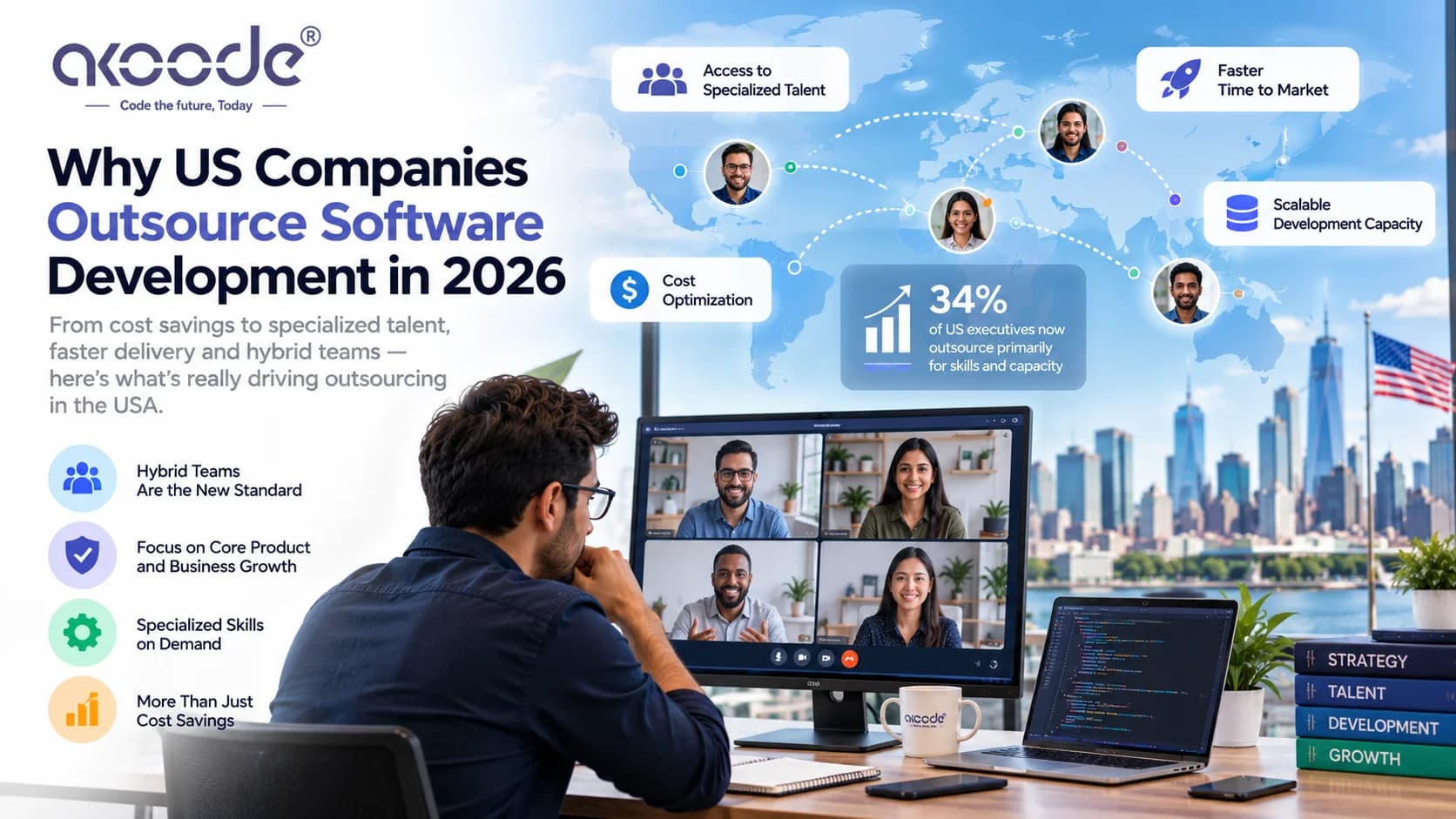
Outsourcing software development is now a mainstream, mature decision for US businesses, not a cost-cutting fallback — Deloitte's Global Outsourcing Survey found that cost reduction has fallen to just 34% of executives' primary reason for outsourcing in 2024, down sharply from 70% in 2020, while access to specialized talent and capacity has taken over as the leading driver. Most US companies now treat outsourced and contracted developers as part of their core workforce planning rather than a separate category, and the fastest-growing pattern isn't pure offshore or pure in-house — it's hybrid teams that mix US-based coordination with distributed engineering. If you're weighing whether to outsource in 2026, the honest answer depends less on saving money and more on whether you can access skills, capacity, or speed you can't build in-house fast enough on your own.
Most outsourcing content either oversells offshore savings or wildly inflates market-size statistics without a real source behind them. This piece skips the inflated numbers and sticks to what's actually well-documented: why US companies are outsourcing differently than they did five years ago, what's changed the calculation, and what that means if you're making this decision right now.
Why US Companies Outsource Software Development in 2026
The single most important shift in the outsourcing data over the past several years is why companies do it. According to Deloitte's Global Outsourcing Survey, cost reduction was cited as the primary driver by 70% of executives in 2020. By the 2024 survey, that figure had fallen to just 34% — cost savings didn't disappear as a factor, but it stopped being the main reason companies outsource. What replaced it: access to specialized skills, faster capacity scaling, and increasing customer demands that internal teams can't keep pace with alone.
This tracks with what's happening in the broader engineering labor market. The tech talent shortage is real and measurable — cybersecurity alone has a documented global shortage exceeding 4 million specialists, and a majority of US employers report ongoing difficulty filling skilled technical roles. When a US business can't hire a specific specialization fast enough internally — AI/ML engineering, specific compliance expertise, a particular legacy-system integration skill — outsourcing to a team that already has that expertise built up is often faster than hiring and training for it from scratch.
Deloitte's survey also found that 80% of executives plan to maintain or increase their investment in third-party outsourcing relationships — this isn't a market in decline or in a temporary pandemic-era bump; it's a durable, growing part of how US companies staff technical work.
Outsourced Talent Is Now Part of Core Workforce Planning
Perhaps the clearest sign that outsourcing has matured past "vendor relationship" status: Deloitte found that 87% of organizations now include contractors, outsourced teams, and other third-party workers in their overall workforce count — treating them as part of headcount planning rather than a separate, off-the-books category. This reflects a genuine shift in how US companies think about team structure: the question isn't "should we build a team or hire a vendor," it's "what's the right mix of direct hires and outsourced capacity for this specific need."
This connects directly to something we cover in our software development team structure guide — the roles a project needs don't disappear when you outsource; they just get filled by a vendor's team instead of your own payroll. The planning question is the same either way: what roles does this project actually need, and who fills them.
What's Actually Being Outsourced
Outsourcing isn't evenly distributed across technical functions. Deloitte's data shows cybersecurity and IT infrastructure tied as the most commonly outsourced functions, at 72% each — both areas where specialized expertise is expensive to build in-house and mistakes are costly, making external expertise an easier case to justify than for, say, core product feature development.
For US software buyers specifically, this pattern shows up as a common structure: core product development handled by a dedicated team (in-house, outsourced, or hybrid), with security, infrastructure monitoring, and compliance-heavy work often carved out to specialists — sometimes a different vendor than the one building the core product. If you're planning a project with real compliance exposure, this is worth structuring deliberately rather than assuming one vendor covers everything equally well; our US data privacy and compliance guide covers what to look for specifically when compliance is a major factor in your build.
The Hybrid Model Is Replacing Pure Offshore or Pure In-House
The clearest structural trend in how US companies actually outsource in 2026 is a move away from the binary choice — either build a fully in-house US team, or send the whole project offshore — toward hybrid structures that combine both.
This shows up in a few common patterns: a US-based project manager or account lead coordinating a distributed engineering team, a "follow-the-sun" structure where work continues across time zones, or a US office serving as the client-facing coordination point for offshore engineering delivery. This last pattern is common enough that it's become a standard structure for mid-market development companies serving US clients — engineering delivered from a lower-cost location, paired with US-hours coordination so clients aren't managing time-zone gaps directly. It's the same structure behind Akoode's own setup: engineering out of Gurugram, India, coordinated through a US office in Jenks, Oklahoma.
The reason this model has grown is straightforward: it captures a meaningful part of the cost efficiency of offshore development while reducing the communication friction that pure offshore engagements are most often criticized for. Our US vs. offshore cost comparison goes deeper into exactly where that friction shows up and what it costs when it's not managed well.
AI Is Changing the Outsourcing Calculation Too
Outsourcing decisions in 2026 increasingly factor in how a vendor uses AI tools, not just their hourly rate. Deloitte's survey data shows the vast majority of organizations now expect their outsourcing vendors to integrate AI capabilities into service delivery — a near-universal expectation that wasn't part of the conversation even a couple of years ago.
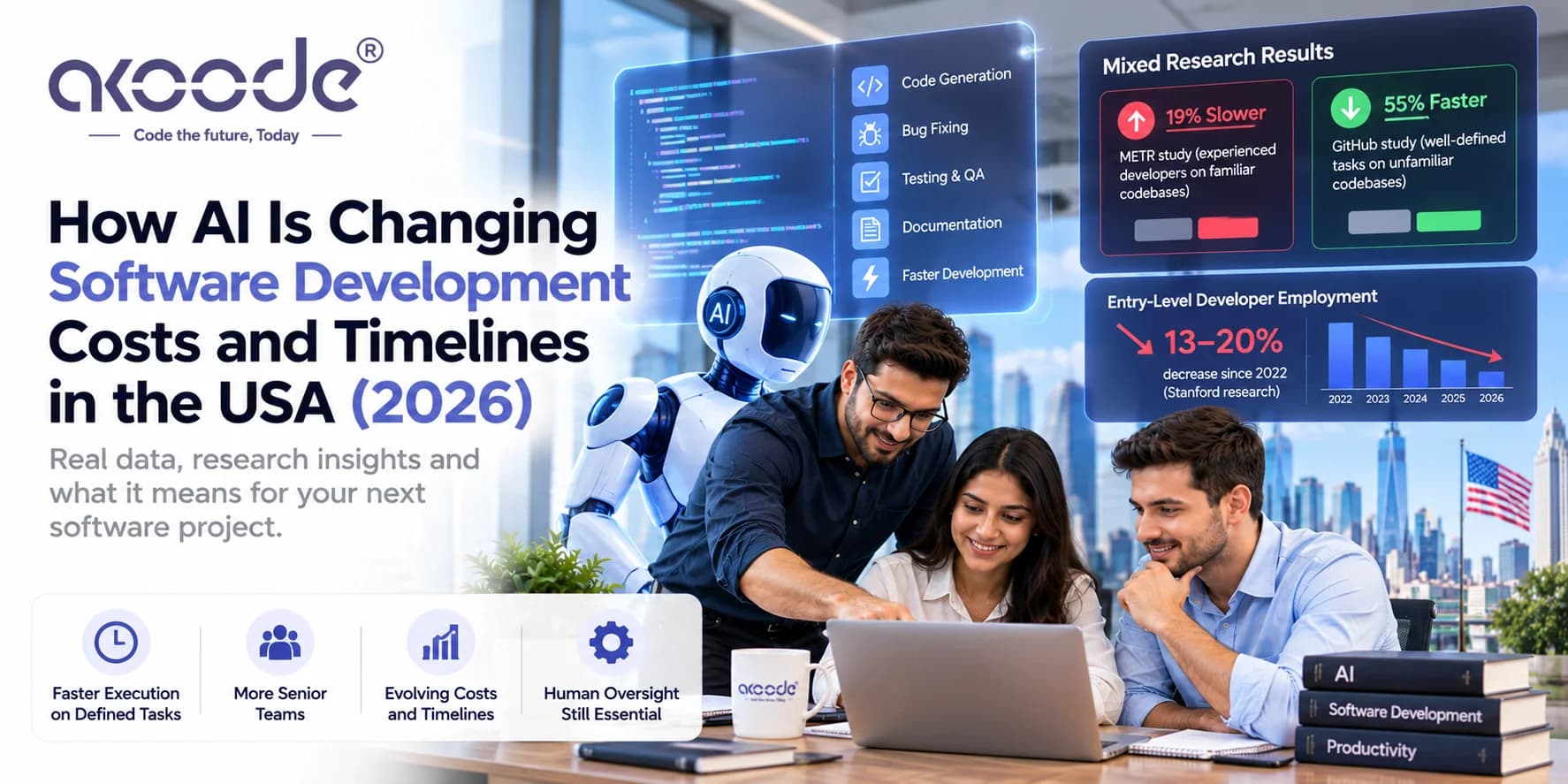
This intersects with something we covered in detail in our piece on how AI is changing software development costs and timelines: the productivity research on AI coding tools is genuinely mixed, and a vendor's AI usage should be a specific, honest conversation — not a checkbox. It also connects to the labor-market data from Stanford's Digital Economy Lab showing entry-level developer hiring has declined roughly 13-20% since late 2022 as AI absorbs more routine coding work. For outsourcing specifically, this means the calculation has shifted: you're less often outsourcing to access cheap junior labor, and more often outsourcing to access senior expertise and specialized skill that AI tools can't substitute for.
What This Means If You're Deciding Whether to Outsource
Given where the data actually points in 2026, here's how the decision should realistically be framed:
If your main goal is pure cost reduction, outsourcing can still deliver that, but it's no longer the strongest case for it — and cost-only decisions are exactly the ones most likely to produce a mismatched vendor relationship, since price becomes the only filter.
If your main goal is accessing specialized skills you can't hire fast enough, this is where outsourcing data shows the clearest current momentum — and it's a stronger basis for a vendor conversation, since it shifts the question from "who's cheapest" to "who actually has this expertise."
If compliance, security, or infrastructure reliability is central to your project, treating those as a deliberately scoped part of the engagement (potentially with specialized involvement) tracks with how outsourcing is actually being structured by mature buyers, rather than assuming one generalist team handles everything equally well.
If you're choosing between pure offshore and a hybrid model, the hybrid pattern has clear structural advantages for most mid-market US buyers — namely, someone in a compatible time zone who can catch miscommunication before it becomes a costly rework cycle.
None of this means outsourcing is automatically right for every project — plenty of US companies build strong in-house teams and never need it. The point is that the reason to outsource has shifted, and a decision still anchored to 2020-era logic ("outsourcing is mainly for saving money") is working from an outdated picture of how mature US buyers actually approach this in 2026.
Frequently Asked Questions
Why do US companies outsource software development in 2026?
Access to specialized skills and faster capacity scaling has become the primary driver, cited by a larger share of executives than cost reduction, which fell to 34% in 2024 from 70% in 2020, per Deloitte's Global Outsourcing Survey.
Is outsourcing software development still growing in the USA?
Yes — 80% of executives report plans to maintain or increase their investment in third-party outsourcing relationships, according to Deloitte's 2024 survey data.
What software development functions do US companies outsource most?
Cybersecurity and IT infrastructure are the most commonly outsourced technical functions, each cited by 72% of organizations in Deloitte's Global Outsourcing Survey.
What's the difference between offshore outsourcing and a hybrid model?
Pure offshore outsourcing sends all delivery to an overseas team; a hybrid model combines offshore or distributed engineering with a US-based (or US-hours) coordination point to reduce communication and time-zone friction.
Has AI changed how companies think about outsourcing?
Yes — most organizations now expect outsourcing vendors to have real AI capabilities as part of service delivery, and the labor-market shift away from junior-heavy teams has changed what kind of expertise companies are outsourcing to access.
Do outsourced developers count as part of a company's workforce?
Increasingly, yes — 87% of organizations now include contractors and outsourced teams in their overall workforce planning rather than treating them as a separate category.
Should I outsource my software development project?
It depends on your goal — outsourcing makes the strongest case when you need specialized skills or capacity you can't hire fast enough internally, less so if cost reduction is your only consideration.
Akoode Technologies operates on exactly this hybrid model engineering delivered from Gurugram, India, coordinated through a US office in Jenks, Oklahoma — for clients across the US, UK, Canada,UAE and India. If you're weighing whether outsourcing, in-house hiring, or a hybrid structure makes the most sense for your specific project, book a time on our calendar and we'll talk through it honestly.
Get In Touch Now
View More Our Blog