


 June 28, 2026
1. Introduction
Your support inbox never sleeps — but your team does.
In 2026, customers expect answers in under 60 seconds, at 2 a.m., in five languages, across WhatsApp, chat, voice, and email simultaneously. An AI customer support agent is the technology that bridges that gap — resolving queries instantly, escalating intelligently, and learning continuously without ever burning out.
This is not a guide about chatbots that give frustrated non-answers. This is a deep-dive into how modern AI agents — powered by large language models (LLMs), retrieval-augmented generation (RAG), and real-time CRM integrations — are replacing tier-1 support teams while simultaneously improving CSAT scores.
Whether you're a CEO evaluating AI investment, a support manager drowning in tickets, or an IT leader designing next-generation customer experience infrastructure, this guide gives you everything: definitions, architecture, real ROI, implementation steps, cost breakdowns, and the exact technology stack you need.
Akoode Technologies has built and deployed AI customer support agents across healthcare, SaaS, e-commerce, real estate, and finance for clients across India, the UK, and the USA. What follows is informed by real implementations, not theory.
2. What Is an AI Customer Support Agent?
An AI customer support agent is an intelligent software system that autonomously handles customer queries, resolves issues, and takes action on behalf of a business — without requiring constant human intervention.
Unlike a basic FAQ bot that pattern-matches keywords, an AI customer support agent understands context, remembers conversation history, accesses live business data, performs multi-step tasks (like processing a refund or rescheduling an appointment), and knows when to hand off to a human agent.
The Three Generations of Customer Support Automation
Generation 1 (2010–2018): Rule-based chatbots. Decision trees. If customer says X → reply Y. Zero understanding, high frustration.
Generation 2 (2018–2022): NLP-powered virtual assistants. Better intent detection. Still brittle on complex or out-of-scope queries.
Generation 3 (2022–present): LLM-powered AI agents. True language understanding. Connected to live data. Capable of multi-step reasoning and action.
We are firmly in Generation 3. The systems built today can read a customer's purchase history, understand why they're frustrated, apply your refund policy intelligently, issue the credit, update your CRM, and send a follow-up email — all in under 10 seconds.
Industry Stat: According to Gartner, AI-powered virtual customer assistants are projected to handle 70% of all customer interactions by 2025, up from under 15% in 2018. The global AI in customer service market is expected to reach $47.82 billion by 2030 (MarketsandMarkets, 2024).
- Key Takeaways
An AI customer support agent is not a chatbot — it is an autonomous reasoning system connected to your business data.
Modern agents use LLMs, RAG, and APIs to understand context and take real actions.
The market is growing at >25% CAGR and is no longer optional for competitive businesses.
3. How AI Customer Support Agents Work
To build or evaluate an AI customer support agent, you need to understand the eight core technology layers that make it function. Each layer contributes a distinct capability.
3.1 Large Language Models (LLMs)
The LLM is the brain. It understands natural language — the way actual customers write, not sanitised query strings. Leading LLMs used in enterprise support agents include GPT-4o (OpenAI), Claude 3.5 Sonnet (Anthropic), and Gemini 1.5 Pro (Google).
An LLM can read a message like "my package said it delivered but I haven't got it and I need it for a birthday tomorrow" and understand urgency, context, and the required action without any keyword triggers.
💡 Expert Tip: Don't build on a single LLM provider. Architect your agent with a model-agnostic orchestration layer (LangChain or LlamaIndex) so you can swap models as better options emerge — and they will.
3.2 Natural Language Processing (NLP)
NLP handles the linguistic preprocessing layer: intent detection, entity extraction, sentiment analysis, and language identification. While LLMs subsume many traditional NLP functions, dedicated NLP pipelines are still valuable for classification tasks at scale — particularly for routing and prioritisation before a query hits the LLM.
Example: NLP classifies inbound messages as 'billing', 'technical', 'cancellation', or 'general enquiry' and routes each to a specialised agent sub-workflow, reducing LLM compute costs significantly.
3.3 Knowledge Bases
A knowledge base is the agent's long-term memory — your product documentation, FAQ library, support articles, policy documents, and historical resolved tickets. The quality of your knowledge base directly determines the quality of your agent's responses.
Best-in-class implementations use structured knowledge bases (Confluence, Notion, SharePoint) with version-controlled documents, combined with unstructured content processed through vector embeddings.
3.4 Retrieval-Augmented Generation (RAG)
RAG is the architecture that prevents AI hallucination — the AI's tendency to confidently invent facts. Instead of relying on the LLM's training data, RAG retrieves relevant chunks from your knowledge base at query time and feeds them into the LLM prompt as grounding context.
The result: the agent answers with your actual policies, your actual product specs, your actual pricing — not something it guessed. This is non-negotiable for enterprise deployments.
- How RAG Works in 4 Steps:
Customer asks a question
Question is converted to a vector embedding
Semantic search retrieves the 3–5 most relevant knowledge base chunks
LLM synthesises a grounded, accurate answer using those chunks
3.5 CRM Integration
A support agent that cannot see the customer's history is flying blind. CRM integration (HubSpot, Salesforce, Zoho) gives the agent instant access to: purchase history, previous support tickets, subscription status, account tier, last interaction date, and open issues.
With this data, the agent personalises every response. It knows this customer bought the Premium plan six months ago, had a billing issue in March, and has a renewal coming up next week. That context changes the entire conversation.
3.6 APIs and Action Layer
Reading data is only half the job. A true AI agent needs to take action: process refunds, update addresses, schedule appointments, reset passwords, cancel subscriptions, create support tickets in your helpdesk. The API integration layer connects the agent to your backend systems and enables these actions.
Common integration patterns: REST APIs, GraphQL endpoints, webhook triggers, and automation middleware like Zapier or Make.com.
3.7 Voice AI
As of 2026, voice is no longer an experimental channel. Customers calling your support line increasingly encounter AI voice agents capable of natural, low-latency conversation. The technology stack for voice: Twilio (telephony), ElevenLabs or Azure Neural Voice (text-to-speech), Whisper or Deepgram (speech-to-text), and your LLM backbone.
Voice AI agents can handle IVR replacement, appointment booking, order status, account enquiries, and more — with latency under 500ms and voice quality indistinguishable from human agents on standard phone calls.
3.8 Omnichannel Support
Your customers don't choose a single channel. They start a conversation on your website, follow up on WhatsApp, and call if it's urgent. An omnichannel AI support agent maintains conversation context across all channels — so the customer never has to repeat themselves.
Channel coverage in 2026 should include: web chat widget, WhatsApp Business API, Facebook Messenger, Instagram DMs, SMS, email, voice/IVR, in-app support, and Slack (for B2B SaaS).
Key Takeaways
LLMs provide language understanding; RAG grounds them in your actual business data.
CRM integration is what separates a generic chatbot from a genuinely useful support agent.
Voice AI and omnichannel are now table stakes, not future features.
The API action layer is what enables an agent to resolve issues rather than just answer them.
4. Traditional Chatbots vs AI Customer Support Agents
The difference is not cosmetic. Traditional rule-based chatbots and modern AI agents operate on fundamentally different principles.
Feature | Traditional Chatbot | AI Customer Support Agent |
|---|---|---|
Language Understanding | Keyword/pattern matching | Natural language understanding (LLM) |
Context Memory | None – each message is isolated | Full conversation history + CRM context |
Knowledge Source | Static FAQ tree, manually updated | Dynamic knowledge base with RAG |
Action Capability | Information only, no backend access | Can process refunds, book appointments, update records |
Multilingual | Requires separate builds per language | Native multilingual (100+ languages) |
Escalation | Manual, often clumsy | Intelligent, context-aware handoff |
Learning | None (manual updates only) | Continuous improvement from feedback |
Channel Coverage | Typically web only | Web, WhatsApp, voice, email, SMS, in-app |
Setup Complexity | Low (decision tree) | Medium-high (but ROI is far superior) |
Resolution Rate | 15–30% of queries | 65–85% without human involvement |
Customer Satisfaction | Often negative (frustration) | Positive when implemented correctly |
The bottom line: if you deployed a chatbot before 2022 and found it frustrating, that experience is irrelevant to what AI agents can deliver in 2026. The technology has fundamentally changed.
- Key Takeaways
AI agents outperform chatbots on every meaningful metric.
Resolution rates of 65–85% are achievable with proper knowledge base and integration design.
If your chatbot experience was bad, your AI agent experience can be transformative — they are different technologies.
5. Key Benefits of AI Customer Support Agents
5.1 True 24/7 Support Without Overtime Costs
Human support teams cost more outside business hours: overtime, night-shift premiums, holiday pay. An AI agent has a flat cost structure regardless of when it operates. For global businesses serving customers across time zones, this is transformative — your Indian customers get instant responses at 3 a.m. IST without you needing an overnight shift.
Real example: A Delhi-based e-commerce company we worked with saw 34% of their support queries arriving between 11 p.m. and 7 a.m. Before AI, those customers waited an average of 9 hours for a response. After deployment, average response time dropped to 4 seconds.
5.2 Significant Cost Reduction
Industry benchmarks consistently show AI customer support agents reduce support costs by 30–60%. The savings come from: fewer headcount needed to handle tier-1 queries, reduced average handle time for complex tickets (agents enter with full context), lower training costs as the AI handles onboarding queries, and reduced error rates on routine tasks like refund processing.
A study by IBM found that businesses save an average of $1.3 million annually per 1,000 customer interactions handled by AI versus human agents.
5.3 Response Times Measured in Seconds, Not Hours
First response time (FRT) is one of the most heavily weighted factors in customer satisfaction surveys. AI agents respond in 1–5 seconds. No queue. No wait. This alone tends to lift CSAT scores by 15–25 percentage points in the first 90 days of deployment.
5.4 Improved CSAT and NPS
Counter-intuitively, many businesses report higher customer satisfaction after AI deployment than before — even compared to human agents. The reasons: instant responses, no hold music, no being transferred between departments, consistent accurate information, and 24/7 availability. Zendesk's 2024 CX Trends Report found that 64% of customers preferred chatting with an AI if it meant an immediate resolution over waiting for a human.
5.5 Multilingual Support at Scale
LLM-powered agents handle 100+ languages natively. No need to hire multilingual agents or build separate knowledge bases per language. For Indian businesses serving global markets — or global businesses with Indian customer bases — this eliminates a major operational constraint.
5.6 Better Lead Qualification and Revenue Generation
AI support agents don't just solve problems — they create opportunities. By identifying customers researching upgrade options, approaching renewal dates, or expressing buying intent in support conversations, AI agents can proactively route leads to sales, offer relevant upsells, and capture contact details from anonymous visitors.
Akoode's AI solutions include conversational lead qualification workflows that consistently increase sales-ready lead volume by 20–40% for our SaaS and e-commerce clients.
5.7 Agent Productivity and Morale
When AI handles routine queries (order status, password reset, FAQs, basic troubleshooting), your human agents are freed for complex, high-value interactions. This is better for agents too — they spend less time on repetitive tasks and more time on work that requires empathy, judgment, and expertise. Turnover in support teams drops when roles become more intellectually engaging.
- Key Takeaways
24/7 availability without cost spikes is the most immediate operational win.
Cost reductions of 30–60% are consistent across industries when AI is properly implemented.
CSAT improvements come from speed and consistency, not despite automation.
Multilingual capability at no extra cost is a major competitive differentiator for global businesses.
6. Common Use Cases by Industry
6.1 Healthcare
Healthcare AI support agents handle: appointment scheduling and rescheduling, prescription refill requests, pre-visit instructions, post-discharge follow-up, symptom triage (with appropriate disclaimers), insurance verification, and billing enquiries. HIPAA compliance is essential — see Section 13.
Akoode's healthcare software development practice has deployed compliant AI agents that reduced no-show rates by 28% through automated appointment reminders and rescheduling flows.
6.2 E-commerce and Retail
The highest-volume use case globally. E-commerce AI agents handle: order tracking, returns and refunds, product recommendations, inventory queries, coupon application, checkout abandonment recovery, and loyalty programme enquiries.
Our e-commerce development team integrates AI agents directly with Shopify, WooCommerce, and custom order management systems for real-time accuracy.
6.3 SaaS Companies
SaaS support is characterised by high query volume, technical complexity, and customers who expect fast, accurate answers. AI agents excel at: tier-1 technical troubleshooting, onboarding assistance, feature discovery, billing and subscription management, API documentation queries, and bug report collection. The key is training the agent on your product's full documentation and changelog.
6.4 Real Estate
Real estate AI agents qualify leads 24/7, answer property enquiries, schedule viewings, provide neighbourhood data, and follow up with buyers and tenants automatically. Given that most property enquiries arrive outside business hours, AI agents can increase lead capture rates by 50–70%.
Explore Akoode's real estate software solutions for integrated CRM and AI agent workflows.
6.5 Education and EdTech
Educational institutions use AI support agents for: admissions enquiries, course information, fee payment support, assignment deadline reminders, scholarship eligibility checks, and student wellbeing check-ins. Universities with 10,000+ students can offset the equivalent of 15–20 FTE support staff.
6.6 Insurance
Insurance AI agents handle policy enquiries, premium calculations, claims status updates, document collection guidance, and renewal reminders. Strict compliance requirements (IRDAI in India, FCA in the UK) must be integrated into the agent's response guardrails.
6.7 Travel and Hospitality
Travel sector AI agents manage booking modifications, cancellations, visa information, baggage policies, flight status, hotel check-in instructions, and loyalty point redemptions. High query volumes during disruptions (weather events, strikes) make AI agents essential rather than optional.
Our team has built AI agents for hospitality clients integrated with digital transformation programmes across the UK and India.
6.8 Banking and Finance
Banking AI agents — subject to RBI, FCA, or relevant regulatory frameworks — handle: account balance enquiries, transaction history, card blocking, loan eligibility checks, branch/ATM locators, and fraud alert responses.
Our finance and banking solutions team builds AI agents with mandatory human escalation for high-risk transactions.
6.9 Manufacturing
B2B manufacturers use AI agents to handle: dealer/distributor queries, spare parts availability, warranty claims, technical specification requests, and order status tracking. AI agents connected to ERP systems (SAP, Oracle) provide real-time inventory and production status without human involvement.
- Key Takeaways
Every industry has a high-ROI use case for AI customer support agents.
The specific queries each agent handles should be defined by your top 20 ticket categories.
Integration with industry-specific systems (EHR, ERP, PMS) is what separates generic from exceptional implementations.
7. Step-by-Step Implementation Guide
Deploying an AI customer support agent is a project, not a plug-and-play installation. Here is the implementation framework Akoode uses across all client engagements.
Phase 1: Discovery and Scoping (Weeks 1–2)
Ticket analysis: Export 3–6 months of support tickets. Categorise by query type. Identify your top 20 query categories by volume — these become your agent's initial scope.
Automation potential scoring: For each category, score automation feasibility (1–5) based on: information availability, action complexity, and compliance risk.
Success metrics definition: Agree on KPIs before building. Typical metrics: resolution rate, average handle time, CSAT, escalation rate, cost per ticket.
Stakeholder mapping: Identify who needs to approve the agent's responses (legal, compliance, product) and build review processes into the workflow.
Phase 2: Knowledge Base Development (Weeks 2–4)
Content audit: Inventory existing documentation — help articles, FAQs, policy documents, agent scripts, product guides.
Gap analysis: For the top 20 query categories, identify where documentation is missing, outdated, or ambiguous. Fix these first.
Content structuring: Rewrite documentation in clear, unambiguous language. The AI is only as accurate as your source material.
Vector database setup: Ingest all content into a vector database (Pinecone, Weaviate, or Supabase pgvector). Configure chunking and embedding strategies.
Phase 3: Agent Architecture and Integration (Weeks 3–6)
LLM selection: Choose your primary model based on performance, latency, cost, and data residency requirements.
RAG pipeline: Build and test the retrieval pipeline. Evaluate retrieval quality with sample queries before connecting to live systems.
System prompt engineering: Write comprehensive system prompts defining the agent's persona, scope, escalation triggers, tone, and compliance guardrails.
API integrations: Connect to CRM, helpdesk, order management, and any other backend systems required for action capabilities.
Channel deployment: Deploy on primary channel first (usually web chat). Add channels progressively.
Phase 4: Testing and Quality Assurance (Weeks 5–7)
Red team testing: Deliberately try to break the agent — ask out-of-scope questions, test edge cases, probe for hallucination, test escalation triggers.
Adversarial testing: Test prompt injection attempts, attempts to extract system prompts, and abuse scenarios.
UAT with real support agents: Have your experienced support staff interact with the agent and rate response quality. Their feedback is invaluable.
Load testing: Ensure the system performs under concurrent query loads relevant to your traffic peaks.
Phase 5: Staged Rollout (Weeks 7–10)
Shadow mode: Run the AI in parallel with human agents for 1–2 weeks. AI suggests responses; humans send them. Compare suggestion quality vs. actual responses.
Soft launch (10–20% traffic): Route a small percentage of live traffic to the AI. Monitor resolution rate, escalation rate, and CSAT closely.
Full rollout: Scale gradually to 100% of tier-1 traffic. Maintain human oversight dashboards throughout.
Phase 6: Optimisation and Continuous Improvement (Ongoing)
Weekly performance reviews: Review escalated tickets to identify knowledge gaps and system prompt improvements.
Monthly knowledge base updates: As products change, policies update, or new query types emerge, update the knowledge base.
Quarterly model reviews: Assess whether a newer or more cost-effective LLM should replace the current model.
💡 Expert Tip: Never deploy an AI agent without a clear escalation path to a human. The agent should know its limits and hand off gracefully. A frustrated customer who cannot reach a human is worse than no AI at all.
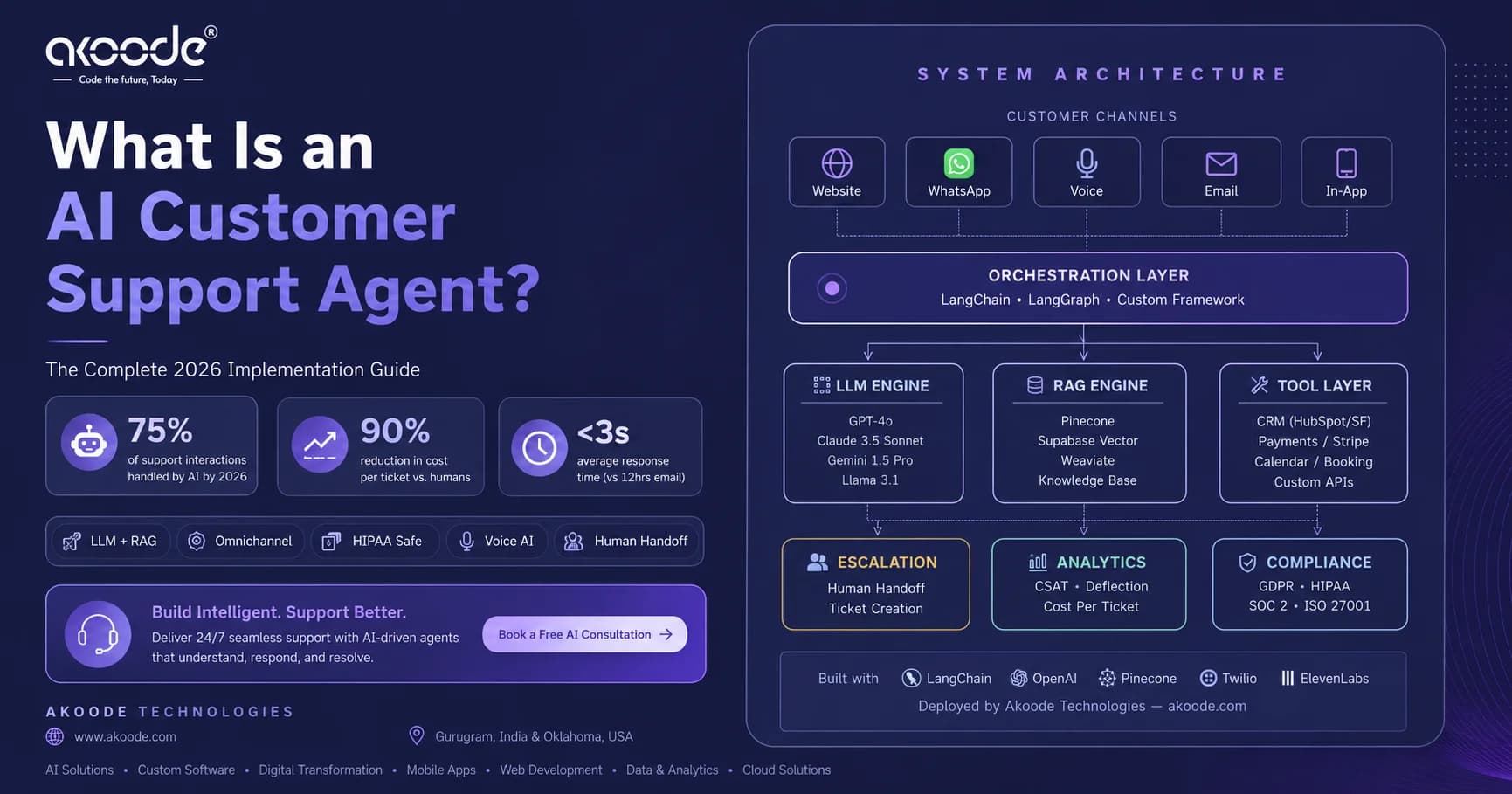
8. AI Customer Support Agent Architecture
Understanding the full system architecture helps you make informed build-vs-buy decisions, identify integration complexity, and plan for scale.
Full Architecture Flow
Customer (Web / WhatsApp / Voice / Email / SMS)
↓
Omnichannel Gateway (Twilio / WhatsApp Business API / SMTP)
↓
Orchestration Layer (LangChain / LlamaIndex)
↓
[RAG Pipeline ←→ Vector Database (Pinecone/Supabase)] + [LLM (GPT-4o / Claude / Gemini)]
↓
Action Router
↓
[CRM (HubSpot/Salesforce)] + [Helpdesk (Zendesk/Freshdesk)] + [Backend APIs] + [Database]
↓
Response → Customer | Escalation → Human Agent Queue
Component-by-Component Breakdown
Customer Entry Points
Web chat widget: Embedded JavaScript widget on your website. Handles text, file uploads, and rich media. Typical latency: 1–3 seconds.
WhatsApp Business API: Requires Meta Business verification. Supports text, images, voice notes, and structured messages. Critical for South Asian and MENA markets.
Voice: Twilio or AWS Connect handles telephony. Deepgram or Whisper converts speech-to-text. ElevenLabs or Azure Neural Voice handles text-to-speech. Roundtrip latency target: under 800ms.
Email: Parsed via IMAP/SMTP or API (SendGrid, Mailgun). AI agent drafts responses with human review option for high-stakes categories.
Orchestration Layer
LangChain or LlamaIndex acts as the conductor — managing conversation state, routing queries to the right tools (retrieval, action, or escalation), and formatting final responses. This layer also handles function calling: telling the LLM what tools are available and interpreting the LLM's decision to use them.
Our custom software development team builds orchestration layers that are modular, testable, and model-agnostic.
RAG Pipeline
Embedding model (text-embedding-3-large or equivalent) converts both the knowledge base and incoming queries into vector representations. Semantic search retrieves contextually relevant content. Retrieved chunks are injected into the LLM prompt as grounding context. Chunk size, overlap, and retrieval top-k are all tunable parameters that significantly affect response quality.
CRM and Backend Integration
REST API calls fetch customer data in real-time at the start of each conversation. Webhook triggers update CRM records when actions are taken. Authentication uses OAuth 2.0 or API keys stored in environment variables, never in code.
9. Technology Stack
Category | Technology | Purpose |
|---|---|---|
LLM | OpenAI GPT-4o | Primary reasoning and language generation |
LLM | Anthropic Claude 3.5 | High-accuracy, safety-focused responses; strong at long context |
LLM | Google Gemini 1.5 Pro | Multimodal tasks; Google Workspace integrations |
Orchestration | LangChain | Agent workflow management, tool calling, RAG pipelines |
Vector DB | Pinecone | Production-grade managed vector database; fast semantic search |
Vector DB | Supabase (pgvector) | Open-source alternative; good for cost-sensitive projects |
Automation | Zapier / Make.com | No-code workflow automation; CRM updates, notifications |
Telephony | Twilio | Voice calls, SMS, WhatsApp Business API |
Voice TTS | ElevenLabs | Ultra-realistic AI voice generation for phone support |
CRM | HubSpot | SMB CRM; excellent API; free tier available |
CRM | Salesforce | Enterprise CRM; Einstein AI features |
Helpdesk | Zendesk / Freshdesk | Ticket management, escalation, SLA tracking |
Backend | Node.js / Python FastAPI | Agent backend API layer |
Infrastructure | AWS / GCP / Azure | Hosting, compute, managed services |
💡 Expert Tip: For startups and SMBs, start with OpenAI + LangChain + Supabase + HubSpot. For enterprises, evaluate Anthropic Claude for compliance-sensitive verticals (healthcare, finance) due to its stronger safety guarantees and long context window.
10. Real ROI Calculations
ROI from AI customer support agents is measurable, concrete, and typically achieved within 6–12 months.
ROI Formula
ROI = [(Annual Cost Savings + Revenue Impact) – Annual AI Agent Cost] / Annual AI Agent Cost × 100
Example 1: E-commerce Startup (INR / India)
Scenario: 5,000 support queries/month. Currently handled by 3 support agents at ₹35,000/month each.
Metric | Value |
|---|---|
Monthly query volume | 5,000 queries |
Current team cost (3 agents) | ₹1,05,000/month |
AI agent resolution rate | 70% (3,500 queries auto-resolved) |
Agents required post-AI | 1 (for complex 30%) |
Reduced team cost | ₹35,000/month (saving ₹70,000/month) |
AI agent cost (API + infra + platform) | ₹18,000/month |
Net monthly saving | ₹52,000/month |
Annual saving | ₹6,24,000 |
ROI (Year 1) | ~289% |
Example 2: SaaS Company (USD / Global)
Scenario: 20,000 support tickets/month. Team of 12 agents at $4,500/month fully loaded.
Metric | Value |
|---|---|
Monthly ticket volume | 20,000 tickets |
Current team cost | $54,000/month |
AI resolution rate | 75% (15,000 auto-resolved) |
Agents required post-AI | 3 (for tier-2+ tickets) |
Reduced team cost | $13,500/month |
AI agent total cost | $8,000/month |
Net monthly saving | $32,500/month |
Annual cost saving | $390,000 |
Revenue impact (faster resolution → lower churn) | $60,000 (est.) |
Total annual value | $450,000 |
ROI (Year 1) | ~462% |
💡 Expert Tip: When calculating ROI, don't forget indirect revenue impact: reduced churn from faster resolution, increased upsell from AI-assisted conversations, and reduced cost of errors. These often equal or exceed direct cost savings.
11. AI Customer Support Cost Breakdown
Cost Component | Startup | SMB | Enterprise |
|---|---|---|---|
Monthly query volume | Up to 5,000 | 5,000–50,000 | 50,000+ |
LLM API costs | $200–$500 | $800–$3,000 | $5,000–$20,000 |
Vector DB (Pinecone) | $70 (Starter) | $350–$700 | $2,000+ |
Infrastructure (hosting) | $100–$200 | $500–$1,500 | $3,000–$10,000 |
Twilio (WhatsApp/Voice) | $100–$300 | $500–$2,000 | $5,000+ |
Platform/helpdesk | $0–$300 | $500–$2,000 | $5,000+ |
Build cost (one-time) | $5,000–$15,000 | $20,000–$60,000 | $100,000–$500,000 |
Ongoing maintenance/month | $500–$1,000 | $2,000–$5,000 | $10,000–$30,000 |
Total monthly OpEx | $1,000–$2,500 | $5,000–$15,000 | $30,000–$70,000 |
Note: Costs above are estimates for custom-built agents via a development partner like Akoode Technologies. Out-of-the-box SaaS platforms (Intercom, Freshdesk AI, Drift) have different pricing structures but offer less customisation and integration depth.
12. Common Mistakes to Avoid
Most failed AI customer support deployments share the same predictable failure modes.
Skipping the knowledge base phase. The AI is only as good as its source material. Companies that rush to build the agent without cleaning and structuring their knowledge base get inaccurate, unreliable responses. Dedicate at least 30% of project time to knowledge management.
No escalation path. An AI agent that cannot gracefully hand off to a human is a liability. Define clear escalation triggers (sentiment score below threshold, query category outside scope, customer explicitly requesting human) and test them rigorously.
Deploying on too many channels simultaneously. Start with your highest-volume channel. Master it. Then expand. Trying to launch web chat, WhatsApp, voice, and email simultaneously leads to inconsistent quality across all channels.
Ignoring conversation analytics. Every failed resolution is a data point. Set up dashboards from day one to track: escalation reasons, low-CSAT conversations, unanswered query types, and knowledge gaps. Review weekly.
Choosing a platform over a custom build for complex needs. Off-the-shelf AI support tools work well for simple use cases. If your support requires deep CRM integration, complex business logic, or industry-specific compliance, custom development delivers far superior results.
Under-investing in system prompt engineering. The system prompt is the agent's constitution. Poorly written prompts lead to inconsistent tone, scope creep, and compliance risks. Invest time in testing dozens of prompt variations before going live.
Not testing adversarial scenarios. Users will try to manipulate your AI agent — to get free products, to extract confidential information, or simply to see what it does. Red team testing before launch is non-negotiable.
Treating deployment as a finish line. AI agents require ongoing maintenance. Product changes, policy updates, new query patterns, and LLM version updates all require active management. Plan for ongoing investment from day one.
13. Security and Compliance
AI customer support agents handle sensitive customer data. For regulated industries, compliance is not optional — it is a legal requirement.
GDPR (EU/UK)
Under GDPR, AI agents processing EU or UK residents' personal data must: obtain explicit consent for AI interaction where applicable, implement right-to-erasure capabilities, maintain data processing agreements with all AI vendors (OpenAI, Anthropic, etc.), and document the legal basis for each type of processing.
Practical requirement: LLM API calls should be configured with 'zero data retention' options where available. Do not use customer conversation data to train shared models without explicit consent.
HIPAA (US Healthcare)
HIPAA-compliant AI agents must: operate on HIPAA-eligible infrastructure (AWS GovCloud, Azure Government, or equivalent), sign Business Associate Agreements (BAAs) with all vendors handling PHI, avoid logging PHI in plain text, implement role-based access controls, and conduct annual security risk assessments.
Akoode's healthcare software development team has built HIPAA-compliant AI agents with end-to-end PHI encryption and mandatory human oversight for clinical query categories.
SOC 2 Type II
For SaaS companies and enterprise vendors, SOC 2 Type II certification demonstrates that your AI agent infrastructure meets security, availability, processing integrity, confidentiality, and privacy standards. If you use a development partner, verify they can provide SOC 2-compliant deployment architecture.
ISO 27001
ISO 27001 certification demonstrates systematic information security management. For enterprises in finance, government, and healthcare, vendor ISO 27001 certification is often a procurement requirement.
Security Best Practices Checklist
Encrypt all data in transit (TLS 1.3) and at rest (AES-256)
Implement API rate limiting to prevent abuse
Use secrets management (AWS Secrets Manager, Vault) for API keys
Conduct quarterly penetration testing
Implement prompt injection defences
Audit log all agent actions, especially those affecting customer accounts
Set up real-time alerts for anomalous behaviour patterns
14. AI Trends in Customer Support: 2026–2028
The AI customer support landscape is evolving rapidly. Here are the five most significant trends shaping the next two years.
Trend 1: Agentic Workflows — AI That Acts, Not Just Answers
The most significant shift in 2026 is from reactive AI (answering questions) to proactive AI agents (identifying and resolving issues before customers contact support). AI agents are increasingly triggering actions autonomously — processing refunds without being asked, rescheduling deliveries when delays are detected, or reaching out to customers when usage data suggests they're struggling with a feature.
Trend 2: Multimodal Support Agents
Customers can now send images, videos, and audio in support conversations. Multimodal AI agents analyse a photo of a broken product, a screenshot of an error, or a voice note describing an issue — and respond appropriately. This dramatically improves resolution rates for visual and technical support queries.
Trend 3: Emotionally Intelligent AI
Sentiment analysis has been around for years. What's new in 2026 is real-time emotional adaptation — AI agents that detect frustration, anxiety, or confusion and adjust their communication style, pacing, and escalation behaviour accordingly. This reduces customer service rage and improves outcomes for sensitive interactions.
Trend 4: AI-Human Collaborative Support
The future is not AI replacing humans — it's AI making humans dramatically more effective. AI co-pilots are appearing in agent dashboards: real-time suggested responses, instant knowledge base lookups, sentiment alerts, and post-conversation summaries. Human agents handle fewer tickets but deliver higher quality outcomes.
Trend 5: Vertical-Specific AI Models
General-purpose LLMs are giving way to fine-tuned models for specific verticals — a healthcare AI that understands clinical terminology, a legal AI that knows jurisdiction-specific regulations, a financial AI trained on compliance frameworks. These vertical models significantly outperform generic LLMs on domain-specific accuracy and reduce hallucination rates.
15. Frequently Asked Questions
Q1. What is the difference between an AI chatbot and an AI customer support agent?
A chatbot follows pre-written scripts and keyword triggers. An AI customer support agent uses large language models to understand natural language, accesses live business data, and can take actions like processing refunds or booking appointments. The capability difference is substantial.
Q2. How accurate are AI customer support agents?
With a well-structured knowledge base and RAG architecture, accuracy rates of 85–95% on in-scope queries are achievable. Accuracy depends heavily on knowledge base quality and the precision of scope definition.
Q3. Can AI agents replace human customer support teams entirely?
For tier-1 queries (FAQs, status checks, standard processes), yes — AI agents can handle 65–85% of volume autonomously. Complex, emotional, or high-stakes interactions still benefit from human judgment. The optimal model is AI + human collaboration, not replacement.
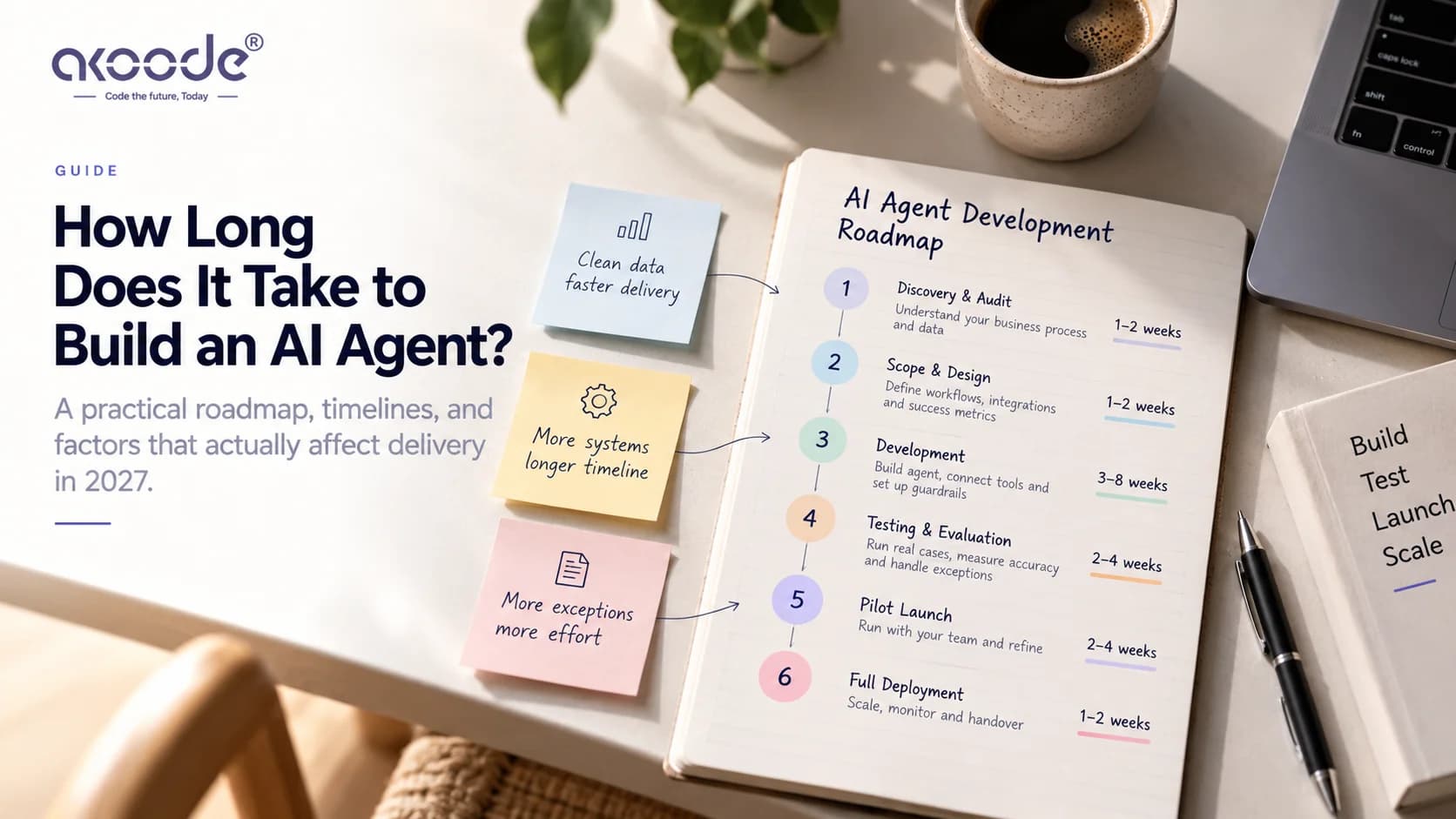
Q4. How long does it take to implement an AI customer support agent?
For a focused implementation on a single channel with defined scope: 6–10 weeks. Full omnichannel enterprise deployments typically take 3–6 months including knowledge base development, integration, testing, and staged rollout.
Q5. What is the average cost to build an AI customer support agent?
Build costs range from $5,000–$15,000 for startup-scale implementations to $100,000–$500,000 for enterprise-grade custom agents. Ongoing monthly costs vary from $1,000 for small deployments to $70,000+ for high-volume enterprise systems.
Q6. Which LLM is best for customer support agents?
GPT-4o is excellent for general customer support with good speed and accuracy. Claude 3.5 Sonnet is preferred for compliance-sensitive verticals (healthcare, finance) due to its safety focus and long context window. Gemini 1.5 Pro is strong for multimodal tasks and Google Workspace integrations.
Q7. How do AI agents handle languages other than English?
Modern LLMs handle 100+ languages natively without separate builds. The agent detects the customer's language automatically and responds in kind. Quality is highest for major languages (Spanish, French, German, Hindi, Arabic) and lower for less-represented languages.
Q8. Can an AI agent work on WhatsApp?
Yes. Via the WhatsApp Business API (Meta) and Twilio, AI agents can handle full conversations including text, images, documents, and structured message templates on WhatsApp. This is increasingly the primary support channel for markets in India, Latin America, and the Middle East.
Q9. How do AI agents handle escalation to human agents?
Well-designed agents detect escalation signals (negative sentiment, explicit human request, query complexity threshold, compliance trigger) and hand off seamlessly — transferring the full conversation context to the human agent so the customer doesn't have to repeat themselves.
Q10. Is it safe to use AI for customer support in healthcare?
Yes, with appropriate architecture. HIPAA-eligible infrastructure, BAAs with vendors, PHI encryption, audit logging, and mandatory human oversight for clinical queries make AI customer support viable and compliant in healthcare. Symptom triage must include appropriate medical disclaimers.
Q11. What data does an AI customer support agent need access to?
Minimum: your product/service knowledge base. Recommended: CRM (customer history, subscription status), order management system (order status, tracking), and helpdesk (existing ticket history). The more relevant data the agent can access, the more personalised and accurate its responses.
Q12. How do I measure the success of an AI customer support agent?
Key metrics: automated resolution rate, CSAT, first contact resolution rate, average handle time, cost per ticket, and escalation rate. Set baselines before launch and review weekly.
Q13. Can AI support agents generate leads?
Yes. AI agents identify buying intent signals in support conversations (asking about pricing, comparing features, enquiring about upgrades) and can proactively collect contact details, qualify prospects, and route hot leads to sales. This is particularly effective for SaaS and real estate.
Q14. What is RAG and why does it matter for AI customer support?
RAG (Retrieval-Augmented Generation) grounds AI responses in your actual business data instead of the LLM's training data. This prevents hallucination — the AI inventing facts — and ensures the agent answers with your real policies, real prices, and real product information.
Q15. Do AI agents improve over time?
Yes, in two ways: through knowledge base updates (adding new content as products and policies change) and through analysis of failed resolutions (identifying knowledge gaps and updating content to address them). Some implementations also use reinforcement learning from human feedback (RLHF) to improve response quality.
Q16. What channels can an AI customer support agent cover?
Web chat, WhatsApp, Facebook Messenger, Instagram DMs, SMS, email, voice/phone (IVR replacement), in-app chat, Slack (for B2B SaaS), and Teams. A well-architected agent maintains conversation continuity across all channels.
Q17. How does voice AI work in customer support?
Twilio or AWS Connect handles telephony. Deepgram or Whisper converts the customer's speech to text. The AI processes the text and generates a response. ElevenLabs or Azure Neural Voice converts the response back to speech. Total roundtrip latency in optimised setups is under 800ms — comparable to a human agent's response time.
Q18. What is the difference between a virtual agent and a conversational AI?
These terms are often used interchangeably. 'Conversational AI' typically refers to the underlying technology enabling natural dialogue. 'Virtual agent' or 'AI support agent' typically refers to a deployed system with specific business scope, integrations, and actions. The terms overlap significantly in current usage.
Q19. Can I build an AI customer support agent without coding?
For simple implementations, platforms like Intercom Fin, Freshdesk Freddy AI, or Tidio offer no-code AI agents. For complex integrations, custom logic, or regulated industries, you need development expertise. The no-code path is faster but the custom path delivers significantly better outcomes for most businesses.
Q20. How do I prevent my AI agent from giving wrong answers?
Four key measures: (1) Use RAG to ground responses in verified knowledge base content. (2) Configure confidence thresholds — the agent escalates when confidence is low rather than guessing. (3) Implement response filtering for prohibited topics. (4) Monitor and review low-CSAT conversations weekly to identify and fix knowledge gaps.
Q21. What is the best AI platform for customer support in India?
For Indian businesses, WhatsApp-first deployment is typically most effective given penetration rates. Technology stack: OpenAI or Anthropic as LLM backbone, Twilio for WhatsApp/voice, HubSpot or Zoho CRM, built on AWS (Mumbai region) for data residency. Akoode Technologies builds India-market AI agents with WhatsApp Business API integration as standard.
Q22. How does AI customer support affect my CSAT score?
When implemented correctly, AI agents typically improve CSAT by 15–25 percentage points within 90 days. The primary drivers: instant response times, 24/7 availability, and consistent accurate information. Poor implementations (wrong answers, clunky escalation) can reduce CSAT. Quality of implementation is everything.
Q23. Can AI agents handle complaints and unhappy customers?
Yes, with appropriate design. AI agents detect negative sentiment and respond with empathetic language, prioritised response paths, and proactive escalation to senior human agents for high-distress situations. The agent should never argue with an upset customer or deny a clear policy entitlement.
Q24. What is agentic AI in customer support?
Agentic AI refers to AI systems that take multi-step actions autonomously — not just answering questions but completing tasks. An agentic customer support system might: detect a delayed delivery, check if an expedited option is available, apply a goodwill voucher to the account, send a notification to the customer, and log the interaction in the CRM — all without human instruction.
Q25. How do AI agents integrate with Salesforce?
Via the Salesforce REST API or Salesforce Connected App. The agent authenticates using OAuth 2.0, retrieves account data at conversation start, creates/updates cases during the interaction, and logs conversation summaries post-resolution.
Q26. What industries benefit most from AI customer support agents?
E-commerce and retail (highest query volume), SaaS (technical complexity + scale), healthcare (appointment management + patient communication), banking and finance (routine enquiries at scale), and travel (booking modifications + disruption management) see the highest ROI.
Q27. How do I ensure my AI agent complies with GDPR?
Key steps: configure data minimisation (only collect what is necessary), implement consent mechanisms, establish data retention policies and automated deletion, sign DPAs with all AI vendors, maintain processing records, and implement right-of-access and right-of-erasure workflows for customers who request them.
Q28. What is the difference between AI customer service and AI customer support?
'Customer support' refers to reactive help — resolving issues after they occur. 'Customer service' is broader, including proactive communication, onboarding, account management, and relationship building. AI agents increasingly span both — resolving issues reactively while proactively reaching out to prevent problems.
Q29. How many queries can an AI agent handle simultaneously?
Unlike human agents who handle one conversation at a time, AI agents scale horizontally. A properly architected system can handle thousands of simultaneous conversations with consistent performance. The limiting factor is typically LLM API rate limits and infrastructure throughput, not the agent logic itself.
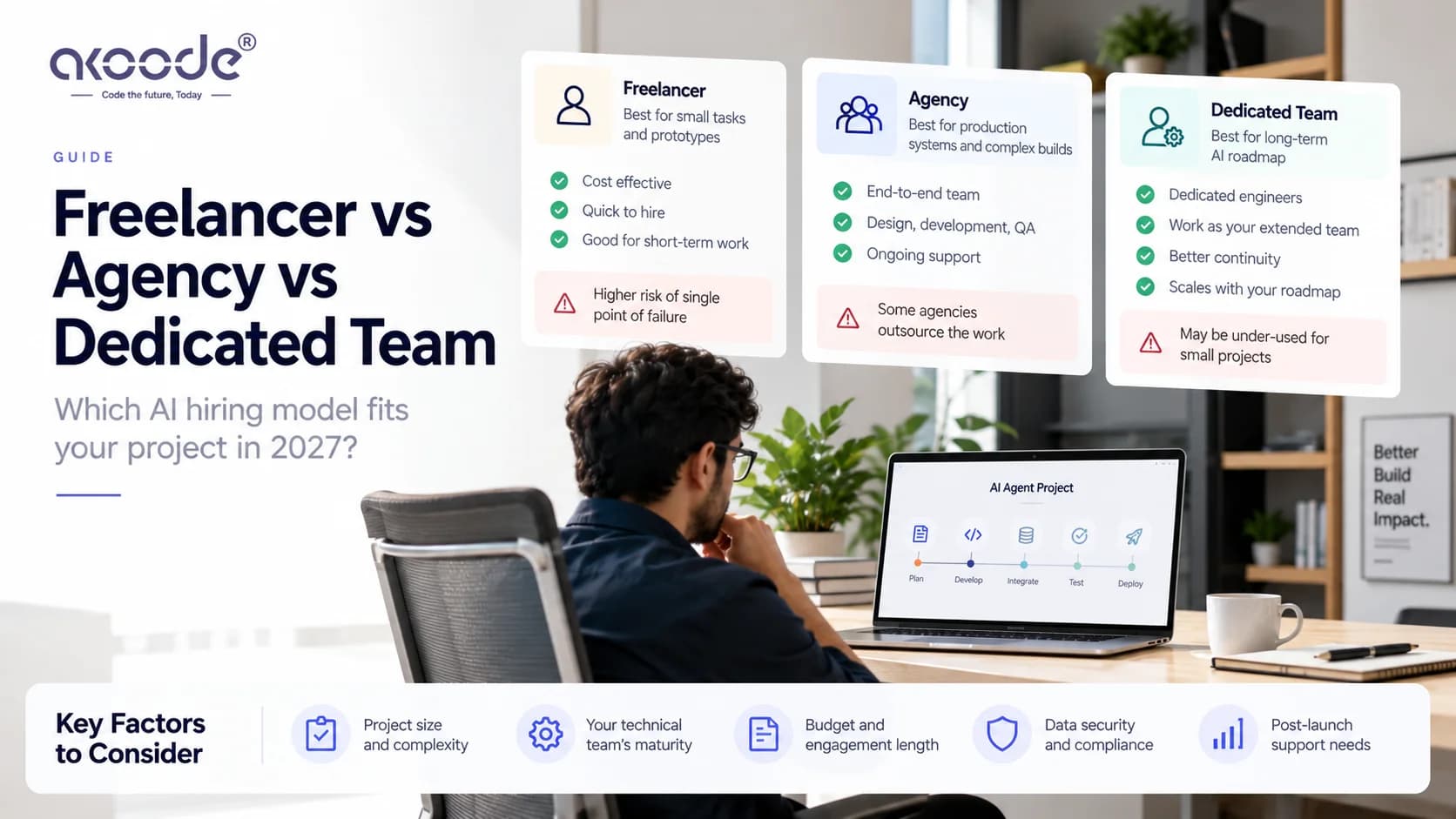
Q30. What should I look for when choosing an AI customer support development partner?
Evaluate: demonstrated experience with LLM integration and RAG architecture, understanding of your industry's compliance requirements, capability across your required channels, references from comparable deployments, transparent pricing with no hidden API markup, and post-launch support and optimisation services.
16. Conclusion
An AI customer support agent in 2026 is not a futuristic experiment — it is business-critical operational infrastructure. The technology is mature. The ROI is proven. The implementation path is clear.
Businesses that deploy well-architected AI support agents are resolving 65–85% of customer queries instantly, reducing support costs by 30–60%, improving CSAT scores by double digits, and freeing their human teams for high-value work that requires genuine empathy and judgment.
The question is no longer whether to implement AI customer support — it is how to implement it well. That means thoughtful knowledge base development, rigorous RAG architecture, genuine CRM integration, comprehensive testing, and ongoing optimisation.
Akoode Technologies has delivered AI customer support agents across healthcare, SaaS, e-commerce, real estate, travel, and finance — for clients in India, the UK, and the USA. Our implementations are grounded in real business outcomes, not technology demonstrations. Explore our AI solutions and case studies to see the work.
Ready to Build Your AI Customer Support Agent?
Book a free 45-minute AI consultation with Akoode Technologies. We will review your current support workflows, identify your highest-ROI automation opportunities, and give you a clear implementation roadmap — no commitment required.
👉 Book Your Free AI Consultation → calendly.com/akhil-akoode/ak
Or visit akoode.com | [email protected] | +91-9899300017
Get In Touch Now
View More Our Blog