


 May 18, 2026
Artificial intelligence is evolving beyond simple chatbots and text generation tools. Modern systems are now capable of reasoning, planning, and interacting with external tools to complete complex tasks independently. These systems are known as autonomous AI agents, and they are becoming one of the most important developments in the AI industry.
However, building scalable AI agents is still difficult. Developers often struggle with fragmented APIs, disconnected workflows, and custom integrations that make systems difficult to maintain. As AI applications grow more advanced, the need for standardized orchestration becomes critical.
This is where Gemini 3.1 and the Model Context Protocol (MCP) are changing the landscape. Gemini 3.1 provides advanced multimodal intelligence and reasoning capabilities, while MCP introduces a standardized way for AI systems to communicate with tools, services, and external environments.
In this article, we explore how autonomous AI agents work, how Gemini 3.1 and MCP improve AI orchestration, and why this architecture is becoming essential for the future of intelligent software systems.
What Are Autonomous AI Agents?
Autonomous AI agents are intelligent systems designed to perform tasks with minimal human intervention. Unlike traditional AI chatbots that simply respond to prompts, these agents can plan actions, remember information, use external tools, and adapt based on feedback.
An autonomous AI agent typically includes several important components:
A large language model that acts as the reasoning engine
Memory systems for storing context
Planning mechanisms for task execution
External tool access for interacting with APIs or software
Feedback loops for continuous improvement
For example, an AI research assistant can search the web, summarize findings, organize documents, and generate reports automatically. Similarly, enterprise AI agents can manage customer support workflows, automate software testing, or monitor infrastructure systems.
The biggest challenge with autonomous AI agents is orchestration. Most AI systems rely on custom API wrappers and manually connected services. This creates integration debt and makes scaling difficult. As organizations deploy more AI-powered systems, maintaining these integrations becomes increasingly complex.
This is why standardized communication frameworks such as MCP are becoming important in modern AI architecture.
Also check: Top Agentic AI Coding Tools to Know
How Gemini 3.1 and MCP Work Together
AI Agent Architecture Explained
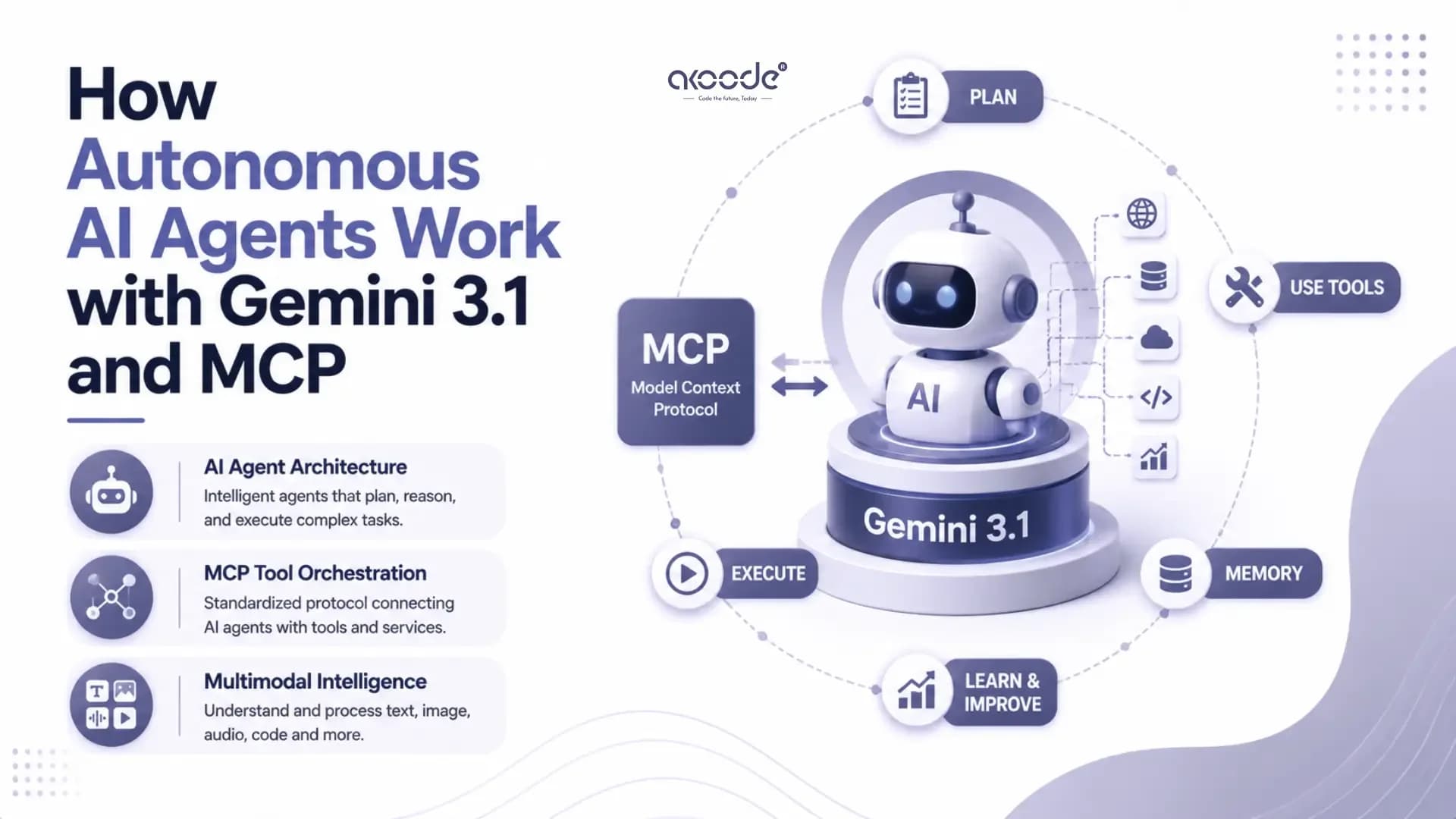
Modern AI agent architecture combines reasoning models, planning systems, memory layers, and external tool integration to create scalable autonomous systems.
Instead of functioning like traditional chatbots, autonomous AI agents operate through interconnected components that work together to complete complex tasks. These systems rely on intelligent orchestration to manage workflows, maintain context, and interact with external environments efficiently.
A typical AI agent architecture includes:
A reasoning engine powered by large language models
Planning systems for task execution
Memory layers for contextual awareness
Tool integration for APIs, databases, and enterprise systems
Feedback loops for continuous improvement
By using frameworks such as the MCP framework, developers can standardize communication between AI models and external tools while improving scalability and maintainability.
Gemini 3.1 as the AI Brain
Gemini 3.1 acts as the core intelligence layer of the autonomous AI agent. It provides advanced reasoning, multimodal understanding, and contextual decision-making capabilities.
Unlike earlier AI models that focused only on text generation, Gemini 3.1 can process:
Text
Images
Documents
Structured data
Code
Audio inputs
This allows AI agents to interact with real-world information more effectively.
For example, an enterprise AI assistant powered by Gemini 3.1 could analyze reports, interpret charts, generate summaries, and execute workflow tasks simultaneously.
Model Context Protocol (MCP)
The Model Context Protocol is a standardized framework that allows AI models to connect with tools, applications, APIs, and external systems using a unified interface.
Traditionally, developers needed custom integrations for every tool connected to an AI system. This resulted in duplicated code, inconsistent architectures, and maintenance problems.
MCP solves this problem by introducing a common communication layer between AI models and external tools.
Instead of building custom wrappers repeatedly, developers can connect systems using a shared protocol.
Core Components of MCP-Based Architecture
1. Planning Layer
The planning layer determines how the AI agent approaches a task. It breaks complex goals into smaller actions.
For example:
Search for data
Retrieve documents
Analyze information
Generate output
Validate results
This makes autonomous systems more structured and reliable.
2. Tool Usage
AI agents use external tools to interact with the real world.
Examples include:
Databases
Search engines
APIs
File systems
Enterprise software
Automation platforms
With MCP, these tools become standardized and easier to manage.
3. Memory Systems
Memory allows AI agents to retain context across multiple interactions.
There are two main types:
Short-term memory for active conversations
Long-term memory for persistent learning
This helps AI systems maintain continuity and improve decision-making.
4. Feedback and Learning
Modern AI systems improve through feedback loops.
The agent evaluates outcomes, identifies errors, and updates future behavior. Over time, this creates more reliable and adaptive autonomous systems.
Real-World Applications of Autonomous AI Agents
Autonomous AI agents powered by Gemini 3.1 and MCP can be applied across multiple industries.
Enterprise Automation
Companies use AI agents to automate repetitive workflows such as:
Customer support
Internal documentation
Data analysis
Report generation
IT operations
This reduces manual effort and improves operational efficiency.
AI Software Development Assistants
AI coding copilots are becoming more advanced with autonomous capabilities.
These systems can:
Write code
Debug applications
Analyze repositories
Generate documentation
Suggest optimizations
With MCP integration, these assistants can interact directly with development environments and deployment systems.
Research and Knowledge Systems
AI agents can gather information from multiple sources, summarize findings, and generate structured insights.
For example, research assistants can:
Read technical papers
Extract important points
Compare information
Generate presentations
Build reports automatically
Healthcare and Biotechnology
In biotechnology and healthcare, autonomous AI agents can support:
Medical research
Clinical data analysis
Drug discovery workflows
Genomic data processing
These systems improve productivity while helping researchers analyze complex datasets more efficiently.
Benefits and Challenges of MCP-Based AI Systems
Benefits of Autonomous AI Agents
Improved Scalability
Standardized orchestration allows organizations to scale AI systems without rebuilding integrations repeatedly.
Better Tool Integration
MCP simplifies communication between AI models and external services.
This reduces development complexity and improves maintainability.
Increased Automation
Autonomous systems can complete multi-step workflows with minimal human supervision.
This improves productivity and operational speed.
Enhanced Context Awareness
Memory systems and reasoning capabilities help AI agents make better decisions across long workflows.
Challenges and Limitations
Security Risks
AI agents interacting with tools and enterprise systems require strong access control and security policies.
Without proper safeguards, autonomous systems may create vulnerabilities.
Hallucinations and Reliability
Large language models can still generate incorrect or misleading outputs.
This remains a major challenge for enterprise deployment.
High Infrastructure Costs
Advanced AI systems require significant computing resources.
Running multimodal models and orchestration frameworks at scale can become expensive.
Data Privacy Concerns
AI systems often process sensitive enterprise or customer data.
Organizations must ensure compliance with privacy and governance standards.
Despite these challenges, the long-term potential of autonomous AI agents continues to drive rapid adoption across industries.
Conclusion
Autonomous AI agents are transforming how intelligent systems operate by moving beyond simple prompt-response interactions toward real decision-making and task execution. By combining advanced reasoning models such as Gemini 3.1 with standardized orchestration frameworks like the Model Context Protocol (MCP), developers can build scalable, adaptive, and tool-connected AI systems.
Instead of relying on fragmented integrations and custom API wrappers, MCP introduces a unified communication layer that simplifies AI orchestration, improves maintainability, and enables efficient AI tool integration across enterprise environments.
As AI systems continue to evolve, autonomous agents will play a critical role in enterprise automation, software development, research, healthcare, and intelligent workflow management. Organizations adopting unified AI architectures early will gain significant advantages in scalability, operational efficiency, and innovation.
For businesses exploring advanced AI solutions, partnering with an experienced enterprise AI development company becomes essential. Akoode Technologies – a software company in Gurugram, an AI-powered corporation and IT company delivering advanced software solutions – helps organizations build scalable autonomous AI systems powered by intelligent orchestration, AI agent architecture, and modern machine learning technologies.
Frequently Asked Questions
1. What are autonomous AI agents?
Autonomous AI agents are intelligent systems that can plan, make decisions, use tools, and complete tasks with minimal human intervention.
2. How do autonomous AI agents work?
They combine large language models, planning systems, memory, and external tools to execute multi-step workflows and improve through feedback.
3. What is Gemini 3.1?
Gemini 3.1 is an advanced multimodal AI model capable of processing text, images, code, documents, and structured data for intelligent decision-making.
4. What is the Model Context Protocol (MCP)?
The Model Context Protocol (MCP) is a standardized framework that allows AI systems to communicate with tools, APIs, and external environments through a unified interface.
5. What is AI orchestration in autonomous systems?
AI orchestration refers to coordinating models, tools, memory systems, and workflows to enable autonomous AI agents to complete complex tasks efficiently.
6. What are the benefits of MCP-based AI systems?
MCP-based systems improve scalability, simplify AI tool integration, reduce development complexity, and enhance automation capabilities.
7. Where are autonomous AI agents used?
They are used in enterprise automation, AI software development, healthcare, research systems, and intelligent workflow management.
Get In Touch Now
View More Our Blog