


 June 1, 2026
Most business leaders have heard of generative AI. Fewer have a clear answer to the question that actually matters: where does it create real value in my business, and where is it just hype?
That gap is not a knowledge problem. It is a framing problem. Most generative AI content is written to impress rather than to inform. It lists capabilities without explaining trade-offs. It shows demos that would never survive production. It treats adoption as self-evidently good without asking what the adoption is actually trying to achieve.
This guide is different. It explains what generative AI is, how it works, and where it genuinely delivers for businesses in 2026. It also covers where it fails, because understanding both sides is what makes an investment decision worth making.
What Is Generative AI in Simple Terms?
Generative AI is artificial intelligence that creates new content. Text. Code. Images. Audio. Video. Data.
It differs from earlier AI in a fundamental way. Traditional AI analysed existing data and made predictions. It classified an email as spam. It flagged a transaction as suspicious. It told you the predicted delivery date. The output was always a classification or a numerical value derived from inputs it had seen.
Generative AI produces outputs that did not exist before. It writes a product description. It generates a line of code. It drafts a customer email. It creates a synthetic dataset. The output is new content, created from patterns the model learned during training on large volumes of existing material.
The underlying mechanism is a large language model, or LLM. These models are trained on vast amounts of text and learn statistical patterns about how language, code, and reasoning work. When you give the model a prompt, it generates a response by predicting what output is most likely to be relevant and coherent based on those learned patterns.
That is both the power and the limitation. Generative AI is very good at producing plausible-sounding output. It is not inherently accurate. A model does not know what is true. The model has no concept of truth. It produces what is statistically likely to come next given the input it received. This distinction shapes every sensible deployment decision.
How Does Generative AI Work?
Understanding how generative AI works helps you understand what it is and is not appropriate for.
The training phase is where the model learns. It processes enormous volumes of data, books, websites, code repositories, scientific papers, and learns patterns across all of it. The resulting model has billions of parameters, essentially a compressed representation of the statistical relationships in that training data.
The inference phase is where the model produces outputs. You send a prompt. The model processes it and generates a response token by token, where each token is a word or word fragment. The model does not retrieve a stored answer. It constructs a new response based on the patterns it learned.
The quality of the output depends on three things. The quality and recency of the training data. The structure and specificity of the prompt. And the model's ability to apply learned patterns to the specific task you are giving it.
This is why generative AI performs well on tasks with clear patterns and fails on tasks that require genuine novel reasoning, real-time information, or precise factual accuracy. Knowing this boundary is the most practical thing a business leader can take from this explanation.
What Are Real Generative AI Examples That Actually Work in Business?
Here is where generic guides fail. They list fifty use cases without explaining which ones work in production, which ones work only in demos, and which ones are not worth attempting yet.
These are the generative AI examples that consistently deliver measurable business value.
Content production at scale.
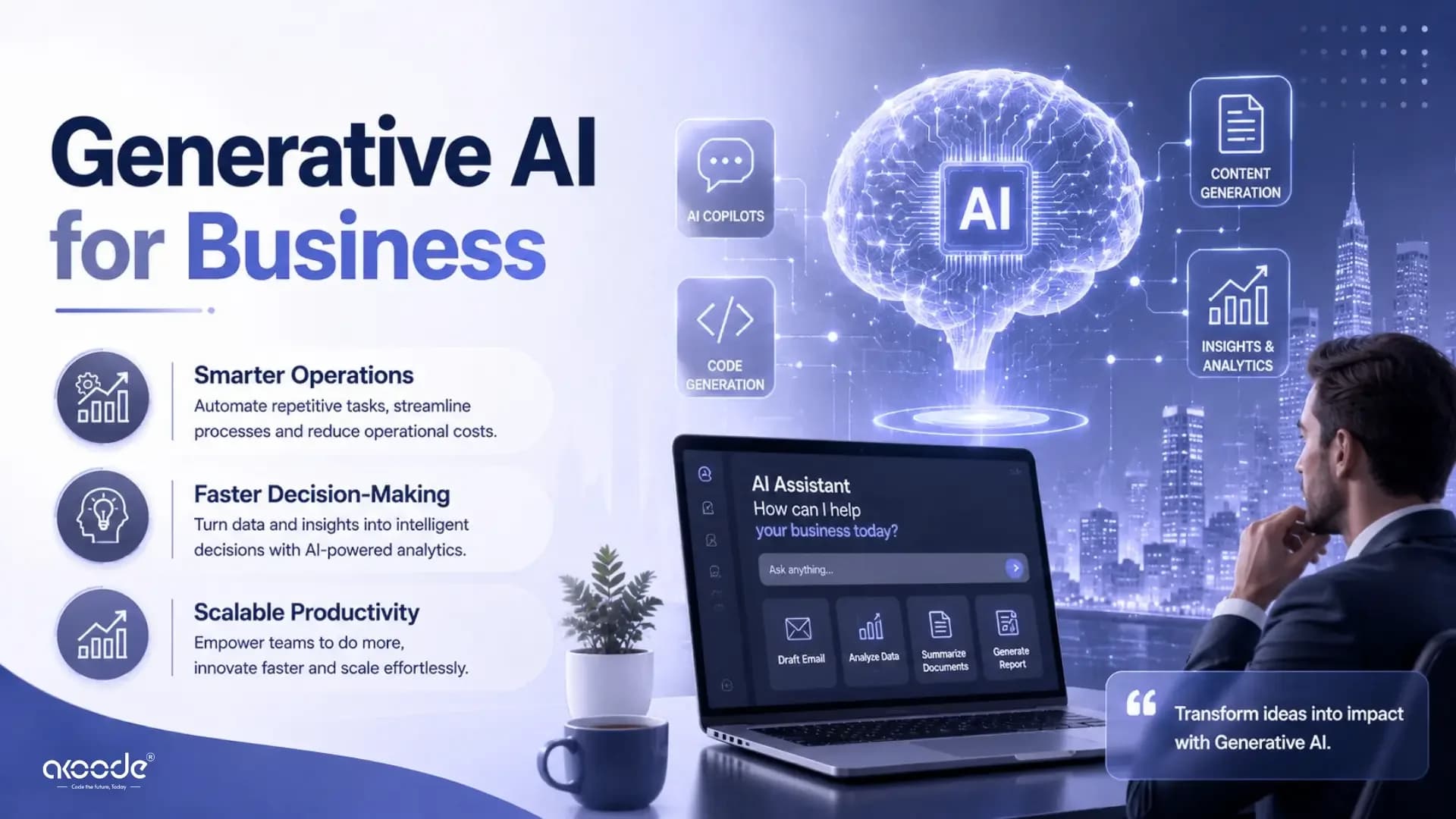
Marketing teams using generative AI to produce first drafts of blog posts, product descriptions, email campaigns, and social content are genuinely faster. Not because the AI writes better than a human, it does not, but because editing a draft is faster than writing from a blank page. Teams that have integrated generative AI into content workflows report 40 to 60 percent reductions in content production time. The human still reviews, edits, and approves everything. The AI removes the blank page problem.
Code generation and developer productivity.
Software developers using AI coding assistants generate boilerplate, write unit tests, refactor functions, and document code significantly faster. The quality of the output depends on the quality of the prompt and the developer's ability to review what the AI produces. Senior developers get the most value because they review efficiently. Junior developers using AI output without adequate review create the most problems.
Customer support automation.
Generative AI handles tier-one support queries with genuine competence when the scope is well-defined and the knowledge base is structured. A customer asking about delivery status, return policies, or account settings gets a coherent, accurate response. Queries that require judgment, empathy, or escalation still need a human. The businesses seeing the best results are the ones that defined the handoff boundary carefully before deployment.
Internal knowledge retrieval.
Large organisations have enormous amounts of knowledge trapped in documents, policies, past projects, and internal wikis that nobody can efficiently search. Generative AI with retrieval-augmented generation allows employees to ask natural language questions against that internal knowledge base. Internal knowledge retrieval consistently sits at the top of enterprise ROI rankings. The reason is straightforward. Your data is the source. The model is not reaching across the internet for answers. The scope stays narrow and the output quality stays high.
Document summarisation and extraction.
Legal teams reviewing contracts. Finance teams processing invoices. Compliance teams auditing policies. Document-heavy teams see some of the fastest returns from generative AI adoption. Hours spent reading, summarising, and extracting information compress dramatically when the AI handles the first pass. A contract review that takes two hours manually takes twenty minutes with AI assistance that surfaces key clauses and flags anomalies.
Software documentation and testing.
Development teams use generative AI to generate API documentation, write test cases, and produce technical specifications from code. This is one of the few use cases where AI output quality rivals human output because documentation follows defined patterns that AI models learn well.
What Are the Generative AI Use Cases That Sound Good but Rarely Deliver?
This is the section most guides skip. It is worth reading carefully.
Autonomous research and analysis.
Generative AI looks impressive when it summarises research. The risk is that it summarises confidently even when the underlying claim is wrong. For any business decision that carries financial or strategic weight, generative AI output must be verified against primary sources. Businesses that use AI summaries as the basis for decisions without verification are taking a risk that is difficult to quantify.
Creative work without human direction.
AI-generated marketing creative, brand assets, and product design typically needs significant human direction and editing to reach the quality standard that builds brand trust. The businesses seeing good creative results from generative AI are the ones using it as a starting point with skilled humans driving the direction, not as a replacement for creative judgment.
Customer-facing interactions without scope control.
An AI agent that has access to too much of a business's information and too few guardrails will eventually say something wrong, off-brand, or inappropriate in a customer interaction. Every generative AI customer-facing deployment needs clearly defined scope, escalation paths, and monitoring before it is trusted in production.
What Is Generative AI Primarily Focused on in 2026?
The framing has shifted. Early generative AI conversation was about content generation. The 2026 focus is on workflow transformation.
The most significant business applications are not standalone tools. They are generative AI capabilities embedded into existing workflows. An EHR system that drafts clinical notes from a doctor's dictation. A CRM that generates personalised follow-up emails from deal context. A development environment where the AI reviews code changes before they go to pull request.
This shift from tool to workflow layer is what separates businesses getting real returns from those stuck in pilot projects. When AI becomes part of how work happens rather than a separate thing someone does, adoption is not a change management problem. It is just part of the process.
The latest shifts in AI software development reflect this pattern across every category. The tools are maturing. The strategic question is no longer whether to use generative AI. It is how to embed it in a way that compounds value over time.
How Does Generative AI Drive Innovation for Businesses?
Generative AI's most underappreciated innovation contribution is speed of iteration.
A product team that previously took two weeks to produce three design concepts can produce thirty in a day. A developer who previously spent a week writing integration boilerplate can spend that time on the architecture decisions that actually matter. A marketing team that previously took a month to test three campaign angles can test fifteen.
Speed of iteration is not just an efficiency gain. It is a learning advantage. Businesses that can run more experiments in the same time window accumulate market knowledge faster. They find product-market fit faster. They discover what their customers actually respond to faster.
This is where the real competitive moat from generative AI is being built in 2026. Not in individual productivity improvements. In the cumulative learning advantage that comes from running more experiments, more quickly, across every function.
For a deeper view of how AI delivers value across business functions beyond content generation, the pattern is consistent. The highest-value applications are the ones that sit in the critical path of how decisions get made and work gets done.
What Is the Difference Between Generative AI and Traditional AI?
The question comes up often and is worth answering precisely.
Traditional AI analysed data and produced predictions or classifications. It answered, 'Is this email spam?' What is the customer's churn probability? Which product should we recommend? The output was always derived from a defined task with labelled training data.
Generative AI produces new content. It answers, 'Write me an email.' Generate a product description. Summarise this document. Produce a code function that does this. The output is a new piece of content that did not previously exist.
The distinction matters for deployment decisions. Traditional AI is more reliable for tasks with defined correct outputs. Generative AI is more capable for tasks involving language, reasoning, and content creation but requires more governance around output quality.
In 2026, most sophisticated AI products combine both. A customer service platform might use traditional AI to classify and route an inbound query, and generative AI to draft the response. An investment analytics system might use traditional machine learning to score assets and generative AI to summarise the analysis in natural language.
What Are the Risks of Generative AI That Businesses Should Plan For?
Hallucination: Generative AI produces confident-sounding output that is factually wrong. This is not a bug being fixed. It is a characteristic of how the models work. Any deployment where accuracy matters absolutely requires a human review step or a retrieval-augmented architecture that grounds outputs in verified sources.
Intellectual property risk: Training data for large models includes copyrighted material. The legal environment around AI-generated content and IP ownership is still developing. Businesses using generative AI for customer-facing content or product development should understand the IP landscape in their jurisdiction.
Data privacy: Sending sensitive business data to a third-party model API exposes that data to potential privacy risks. Enterprise deployments of generative AI should use private model deployments or vendors with appropriate data handling agreements rather than public APIs.
Over-reliance on output without review: Teams that trust AI output without verification gradually lose the judgment needed to catch errors. The same pattern shows up in AI coding tools, AI research assistants, and AI content generation. The review step is not optional. It is the mechanism that makes the deployment safe.
Autonomous AI agents operating on generative AI foundations add a further layer of consideration. How AI agents make decisions and take actions is worth understanding before deploying any system that acts rather than just responds.
How Should a Business Start With Generative AI?
Pick one workflow. Not the most ambitious one. The one with the clearest before-and-after measurement.
A content team measuring average time to publish a piece. A support team measuring first-response time. A development team measuring hours spent on documentation. These are measurable baselines. Run a generative AI deployment against one of them for 90 days. Measure the outcome honestly. Build from there.
The businesses that have scaled generative AI successfully are the ones that started narrow, proved the value, and then expanded. Broad deployments without clear measurement typically generate enthusiasm in the first month and abandonment by the third.
For businesses evaluating implementation options, generative AI integration services that include measurement frameworks and governance design are worth far more than implementations that deliver a tool and leave the team to figure out adoption.
Conclusion
Generative AI is a genuine business capability in 2026. It is not a silver bullet and it is not a threat to every human job. It is a set of tools that make specific types of knowledge work significantly faster and more scalable when deployed with clear scope, honest measurement, and consistent human oversight.
The businesses getting real returns are not the ones with the most AI projects. They are the ones with the fewest projects and the clearest measurement of what each one delivers.
Start with one workflow. Measure it. Expand what works. That sequence, repeated with discipline, is how generative AI builds a genuine competitive advantage rather than a collection of pilots that never reach production.
Akoode Technologies is a leading AI and software development company headquartered in Gurugram, India, with a US office in Oklahoma. From generative AI integration and integrated intelligence solutions to full stack development and custom AI-powered platforms, Akoode builds AI systems that go into production and stay there. If you are planning a generative AI deployment and want honest advice on where to start, that conversation starts here.
Frequently Asked Questions
1. What is generative AI in simple words?
Generative AI is artificial intelligence that creates new content. Text, code, images, audio, and data. It differs from traditional AI, which analysed data and made predictions. Generative AI produces outputs that did not previously exist, based on patterns learned from large amounts of training data.
2. What is a generative AI model and how does it work?
A generative AI model is a large neural network trained on vast amounts of data. During training it learns statistical patterns. During inference it constructs new outputs by predicting what content is most likely to be relevant given a prompt. It does not retrieve stored answers. It generates new responses each time.
3. What are real generative AI examples that work in business?
Content production, developer productivity through coding assistants, customer support automation for tier-one queries, internal knowledge retrieval through RAG systems, document summarisation, contract review, and software documentation generation. These consistently deliver measurable value in production environments.
4. What is generative AI primarily focused on in 2026?
The primary focus has shifted from standalone tools to workflow integration. Businesses embedding generative AI into existing workflows, CRM, EHR, development environments, support platforms, are seeing far better returns than those using generative AI as a separate tool their team needs to remember to use.
5. What are the main risks of generative AI for businesses?
Hallucination, where the model produces confident but incorrect output. Intellectual property risk from AI-generated content. Data privacy exposure when sending sensitive data to public model APIs. And over-reliance on AI output without review, which gradually erodes the human judgment needed to catch errors.
6. How does generative AI drive innovation?
Primarily through speed of iteration. Businesses that can run more experiments in the same time window accumulate market knowledge faster. More design concepts tested. More content angles tried. More code paths explored. The competitive advantage is not in any single output. It is in the cumulative learning from running more experiments more quickly across every function.
Get In Touch Now
View More Our Blog