


 June 1, 2026
Most businesses building AI products hit the same wall. The base model is impressive in demos. In production, it does not know your data. It gives generic answers where specific ones are needed. It gets facts wrong about your own product.
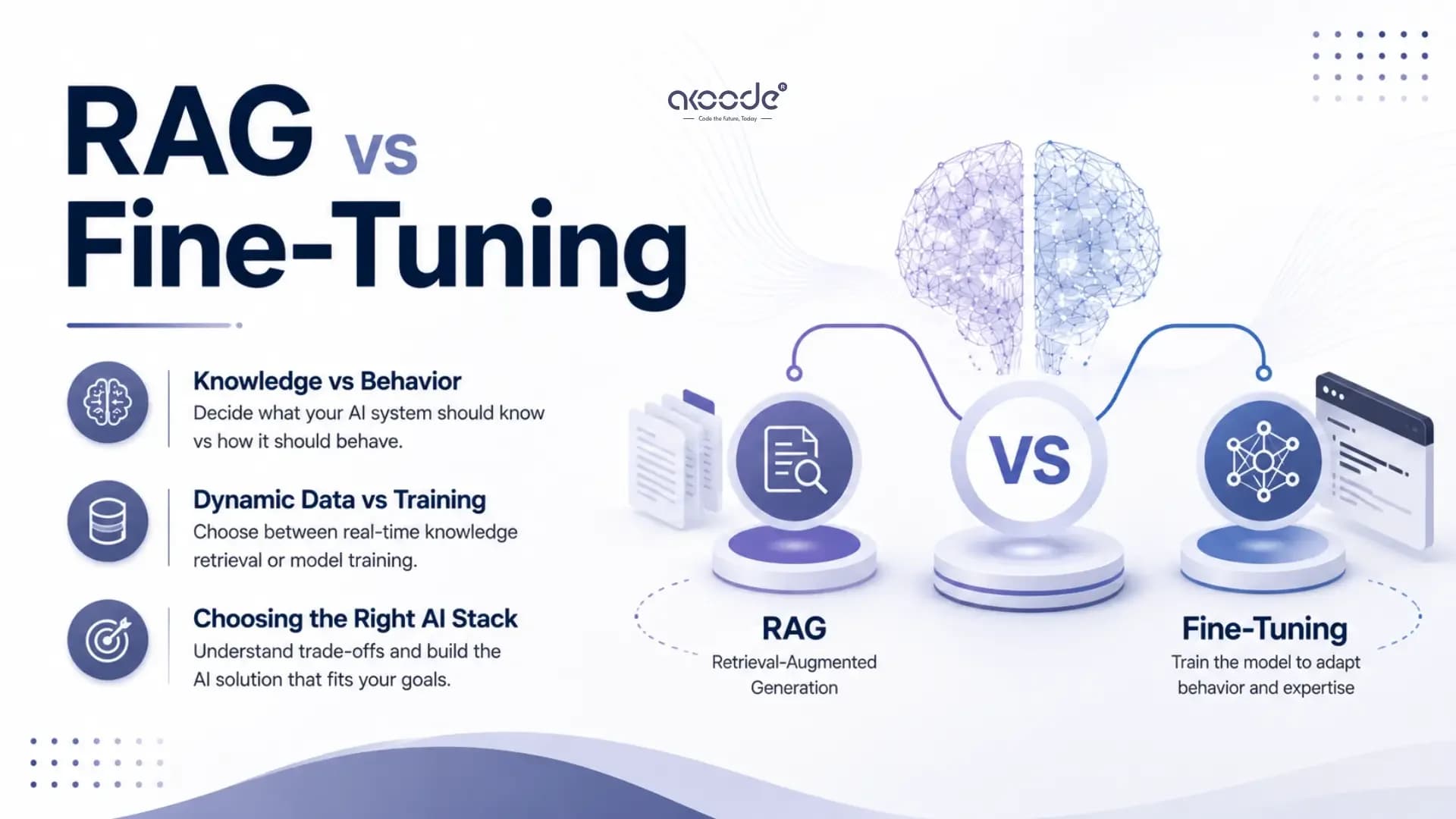
Two approaches exist to fix this. Retrieval-Augmented Generation, or RAG, and fine-tuning.
Most content on this topic treats them as competing choices. They are not. They solve different problems. Using RAG for a problem that needs fine-tuning wastes infrastructure budget. Using fine-tuning for a problem that needs RAG burns training compute on something a retrieval pipeline would have solved in a week.
This guide explains what each approach actually does, where each one belongs, what it costs, and how the two work together in production systems.
What Is RAG and How Does It Work?
RAG stands for Retrieval-Augmented Generation. It is a pattern for giving a language model access to external knowledge at the moment it generates a response.
Here is the sequence. A user sends a query. The system converts that query into a vector embedding and searches a knowledge base for the most relevant documents or chunks. The retrieved content is inserted into the model's context window alongside the original query. The model generates a response grounded in that retrieved material rather than relying solely on what it learned during training.
The knowledge lives outside the model. The model remains unchanged. When your data changes, you update the knowledge base. The model automatically reflects the new information the next time it retrieves from it.
This makes RAG excellent for anything where freshness matters. Your product documentation. Your customer support knowledge base. Your internal policies. Your pricing information. None of these need to be baked into a model. They need to be retrievable by one.
Understanding how vector databases store and retrieve the embeddings that power RAG is worth reading before designing a retrieval pipeline. The database choice and indexing strategy directly affect retrieval quality and latency at scale.
What Is Fine-Tuning and How Does It Differ?
Fine-tuning takes a pre-trained model and continues training it on a smaller, domain-specific dataset. The goal is to change how the model behaves, not what it knows.
This is an important distinction. Fine-tuning is not the right tool for injecting facts. Facts change. Model weights do not update automatically. A fine-tuned model trained on your product knowledge in January will give wrong answers about the pricing update you made in March.
What fine-tuning does well is modify behaviour. Tone. Format. Output structure. Classification consistency. Domain-specific reasoning patterns. Teaching a model to always respond in a specific JSON structure. Training it to understand your industry's terminology as a first-class concept. Adjusting it to match your brand voice consistently across thousands of interactions.
Fine-tuning happens before deployment. The knowledge gets embedded into the model weights during the training process. After fine-tuning, the model behaves differently from the base model on the tasks it was trained for. That behavioural change persists across every subsequent inference without retrieval overhead.
The most practical framing for 2026: put volatile knowledge in retrieval, put stable behaviour in fine-tuning. Stop trying to force one tool to do both jobs.
RAG vs Fine-Tuning: Side-by-Side Comparison
Factor | RAG | Fine-Tuning |
|---|---|---|
What it changes | What the model knows at runtime | How the model behaves permanently |
Knowledge freshness | Always current, update the knowledge base | Static at training time, requires retraining to update |
Training compute required | None | Significant, depends on model size |
Upfront cost | Lower | Higher |
Ongoing cost | Retrieval infrastructure, vector DB | Retraining, adapter versioning, evaluation |
Transparency | High, you can see what was retrieved | Low, knowledge is in weights |
Best for | Dynamic data, factual accuracy, internal knowledge | Tone, format, classification, domain behaviour |
Risk of hallucination | Lower when retrieval works | Higher on out-of-distribution queries |
Implementation time | Days to weeks | Weeks to months |
Maintenance burden | Update the knowledge base | Retrain when base model updates or data drifts |
Data requirements | Structured retrievable documents | Labelled training examples |
When Should You Use RAG?
RAG is the right first choice in most production AI deployments. It is faster to implement, easier to maintain, and more transparent than fine-tuning.
Use RAG when your data changes frequently. Product catalogues, pricing, policies, documentation, support knowledge bases, and internal wikis all change regularly. A retrieval pipeline reflects those changes immediately. A fine-tuned model requires a new training run every time the underlying knowledge shifts.
Use RAG when factual accuracy is critical. RAG systems are more auditable. When the model produces an answer, you can trace which retrieved documents informed it. When a fine-tuned model produces a wrong answer, tracing why is much harder because the knowledge is embedded in the weights.
Use RAG when you need to ground a general-purpose model in your specific business context. A customer service bot that knows your exact return policy, your specific product variants, and your current inventory is not a model problem. It is a retrieval problem. RAG solves it without the cost and complexity of training.
Use RAG when your team does not have ML engineering capacity for model training and lifecycle management. A well-designed RAG pipeline is primarily a data engineering and software engineering challenge. Fine-tuning requires ML expertise that many product teams do not have in-house.
When Does Fine-Tuning Make More Sense?
Fine-tuning earns its cost when the problem is genuinely a behaviour problem rather than a knowledge problem.
Use fine-tuning when your application requires consistent output format. A model that must always return structured JSON with specific fields. A classification system that must produce reliable category labels. A summariser that must follow a specific length and structure template. These are behaviour problems. Fine-tuning solves them in a way that prompt engineering alone cannot consistently maintain at scale.
Use fine-tuning when domain terminology is consistently misunderstood by the base model. Medical coding, legal contract language, financial instrument terminology, proprietary product naming. Teaching the model these concepts once at training time produces more reliable results than including examples in every prompt.
Use fine-tuning when you are optimising a small language model for a highly specific, narrow task. Deploying a lightweight model for a single classification task, with a fine-tuned adapter, can be more cost-effective at high inference volume than routing every query through a large general-purpose model.
Use fine-tuning when tone and brand voice must be consistent at scale. A model that has been trained on thousands of examples of your brand's communication style reliably produces on-brand output. Prompt instructions alone drift under the variety of real user interactions.
The honest caveat: fine-tuning comes with a maintenance tax that most teams underestimate. Adapter versioning, rollback plans, retraining cadence, and base model drift management are recurring costs. When a hosted provider updates their base model, a fine-tuned adapter may degrade without warning. Budget for quarterly revalidation as an operational baseline, not an edge case.
How Much Does RAG vs Fine-Tuning Cost?
Cost is one of the most practically important factors and one of the least honestly discussed.
RAG cost structure: The upfront cost is relatively low. You need a vector database, an embedding model, a retrieval pipeline, and integration with your LLM of choice. Setup costs range from $5,000 to $30,000 depending on complexity. Ongoing costs are primarily infrastructure. A mid-scale RAG system running on a managed vector database with moderate query volume costs $500 to $3,000 per month. The hidden cost is data preparation. Getting your documents chunked, embedded, and indexed in a way that produces high-quality retrieval takes more engineering time than most teams plan for.
Fine-tuning cost structure: The training compute cost varies enormously by model size and dataset. Fine-tuning a smaller open-source model like Llama with LoRA adapters on a focused dataset can cost $200 to $2,000 in GPU compute. Fine-tuning a mid-size model on a substantial dataset costs $5,000 to $50,000 in compute alone. Enterprise fine-tuning runs cost significantly more. The bigger cost is everything else. Data curation and labelling. Evaluation design. Adapter lifecycle management. Retraining when the base model updates. The real cost of fine-tuning is 3 to 5 times the training compute cost when you include the full operational lifecycle over 12 months.
The decision implication: For most business applications, RAG is cheaper in year one and often cheaper through year three. Fine-tuning becomes cost-effective when the specific behaviour improvement it produces generates measurable business value that outweighs the ongoing maintenance cost.
What Is the Hybrid Approach and When Does It Make Sense?
In 2026, the binary framing of RAG versus fine-tuning is largely obsolete in production. The practical default for high-quality AI products is a hybrid system.
Fine-tune the model to understand your domain's terminology and consistent behaviour requirements. Deploy RAG on top to provide current, factual grounding at inference time. The fine-tuned model knows how to reason in your domain. The retrieval layer keeps it factually accurate about your current data.
A specific example: a legal AI assistant for an Indian law firm. Fine-tune the model on Indian legal terminology, statute naming conventions, and citation format. Deploy RAG over the firm's case library, current regulations, and client matter history. The model behaves like a legal professional. The retrieval layer keeps it accurate about what is current.
The right sequencing question for any new AI project is: try prompt engineering first. If that does not produce the required quality, add RAG. If RAG is not enough because the behaviour problem is separate from the knowledge problem, add fine-tuning. Skipping directly to fine-tuning without testing RAG first is one of the most common and expensive AI deployment mistakes teams make.
The broader context for where these approaches sit within AI systems architecture is covered in how generative AI actually works, which gives the foundational context that makes the RAG and fine-tuning distinction meaningful.
How Does Fine-Tuning Work Technically?
For teams evaluating fine-tuning for the first time, understanding the technical process helps set realistic expectations.
The most common fine-tuning approach in 2026 is parameter-efficient fine-tuning, specifically LoRA, which stands for Low-Rank Adaptation. Instead of retraining all of a model's billions of parameters, LoRA inserts small trainable adapter layers into the model's architecture. Only the adapter weights are updated during training. The base model weights stay frozen.
This makes fine-tuning dramatically cheaper and faster than full retraining. A LoRA fine-tune that produces meaningful behaviour improvement can complete in hours rather than days on modern GPU hardware. The resulting adapter is a small file that can be loaded on top of the base model at serving time.
The training data format matters as much as the training process. Fine-tuning for instruction following requires prompt-completion pairs where each example shows the model the input it will receive and the ideal output it should produce. The quality of these examples directly determines the quality of the fine-tuned model. One thousand high-quality, well-structured examples consistently outperforms ten thousand inconsistent ones.
For businesses building on deep learning development capabilities, fine-tuning is a natural extension of the ML engineering skillset. The infrastructure for evaluation, experiment tracking, and model versioning that makes deep learning projects maintainable applies directly to fine-tuning workflows.
How Do RAG and Fine-Tuning Fit Into Agentic AI Systems?
Both RAG and fine-tuning are components within a larger AI system architecture. Neither is a complete solution by itself.
Agentic AI systems, where the model plans and executes multi-step tasks using tools, integrate both patterns. The agent's base behaviour, how it decides which tools to use, how it structures plans, how it handles errors, benefits from fine-tuning. The agent's factual grounding, knowing what is true about your systems and data, benefits from RAG.
How autonomous AI agents work and make decisions puts the role of both RAG and fine-tuning into the context of a complete system. Neither approach is useful in isolation when the application requires multi-step reasoning over complex, changing information environments.
Conclusion
RAG and fine-tuning are not rivals. They are tools with different jobs.
RAG handles what the model knows right now. Fine-tuning handles how the model behaves consistently. Most production AI systems that perform well in 2026 use both, deliberately, with clear thinking about which problem each one is solving.
The practical sequence for any new AI project: start with prompt engineering. Add RAG when you need factual grounding in your own data. Add fine-tuning when behaviour consistency is the problem that retrieval alone cannot solve. Build the hybrid when you need both.
The businesses that get this right ship AI products that work. The ones that skip straight to expensive fine-tuning runs for problems that needed a retrieval pipeline lose months and budget learning the distinction the hard way.
Akoode Technologies is a leading AI and software development company headquartered in Gurugram, India, with a US office in Oklahoma. From AI engineering and deployment to RAG pipeline development and fine-tuning infrastructure, Akoode builds AI systems for startups, SMEs, and enterprises across 15+ industries globally. If you are deciding between RAG and fine-tuning for your next AI project and want an engineering opinion grounded in production experience, that conversation starts here.
Frequently Asked Questions
1. What is the difference between RAG and fine-tuning?
RAG gives a model access to external knowledge at inference time through retrieval. Fine-tuning changes how a model behaves by training it further on a specific dataset. RAG is for dynamic, factual grounding. Fine-tuning is for consistent behaviour, tone, and domain-specific output patterns.
2. When should you use RAG vs fine-tuning?
Use RAG when your data changes frequently and factual accuracy is critical. Use fine-tuning when the problem is about consistent behaviour: output format, tone, domain reasoning, or classification accuracy. Use both when the application requires reliable behaviour over dynamic, changing information.
3. What is model fine-tuning in simple terms?
Fine-tuning takes a pre-trained AI model and continues training it on a smaller, focused dataset. The goal is to teach the model to behave differently for a specific task. The trained behaviour gets embedded into the model weights and persists across every inference without any retrieval step.
4. How much does RAG vs fine-tuning cost?
RAG setup costs $5,000 to $30,000 with ongoing infrastructure at $500 to $3,000 per month. Fine-tuning compute costs range from $200 for a small LoRA adapter to $50,000 for larger models. The real fine-tuning cost is 3 to 5 times the training compute when data curation, evaluation, and ongoing lifecycle management are included.
5. Which is better for an enterprise AI deployment: RAG or fine-tuning?
RAG is the right starting point for most enterprise deployments because it is faster to implement, easier to maintain, more transparent, and keeps AI responses grounded in current data. Fine-tuning adds value on top when behaviour consistency is a specific, measurable problem that RAG and prompt engineering cannot solve.
6. Can you use RAG and fine-tuning together?
Yes. The hybrid approach is the production default for high-quality AI systems in 2026. Fine-tune the model to understand your domain and behave consistently. Deploy RAG on top to keep responses factually grounded in current data. Each approach handles a different layer of the problem.
Get In Touch Now
View More Our Blog