


 July 22, 2026
Artificial Intelligence Development Services & Company in India: The 2026 Guide
Something changed in how the world builds AI — and India sits at the center of it.
In April 2026, Google announced a $15 billion AI data center hub in India, one of the largest foreign AI infrastructure investments in the country's history. The IndiaAI Mission has committed over ₹10,371 crore (roughly $1.25 billion) to sovereign AI infrastructure, with 34,000 GPUs already accessible at subsidized rates and a target of 100,000 GPUs by the end of 2026. And India now accounts for 16% of the global AI talent pool — second only to the United States.
None of this happened by accident. It happened because the economics of AI development shifted, and India's combination of engineering depth, cost structure, and delivery maturity became the obvious answer for businesses worldwide asking the same question: how do we build production AI without Silicon Valley budgets?
If you're evaluating artificial intelligence development services — whether you're a US startup, a UK enterprise, or an Indian business modernizing operations — this guide covers what the Indian AI market actually looks like in 2026, what AI development genuinely costs, what's being built, and how to choose a partner that ships production systems rather than impressive demos.
The Indian AI Market in 2026: What the Numbers Say
Let's establish the scale first, because it explains everything else.
India's AI market is growing at over 38% annually — one of the fastest rates anywhere in the world. Fortune Business Insights projects the market surging from approximately $13 billion in 2025 to over $130 billion by 2032. Grand View Research's estimates run even more aggressive, projecting Indian AI revenue reaching $325 billion by 2033 at a 38.1% CAGR from 2026 onward.
The composition of that growth matters as much as the size. Services was the largest revenue-generating segment in 2025, holding a 56.69% revenue share — and it's registering the fastest growth through the forecast period. In plain terms: the Indian AI boom isn't primarily about products or chips. It's about AI development services — the engineering work of building, integrating, and deploying AI systems for businesses worldwide.
The foundations underneath:
Talent depth. India's IT services industry employs nearly 6 million professionals and contributes close to 7% of national GDP. The AI specialization layer on top of that base is the second-largest in the world.
Infrastructure investment. Beyond Google's $15 billion commitment, the IndiaAI Mission's subsidized GPU access (roughly 42% below open market rates) is dramatically lowering the cost floor for AI development and training workloads.
Ecosystem maturity. Fractal's February 2026 public listing became one of the most visible signals that India's enterprise AI ecosystem has matured beyond experimentation into durable, scalable business models. Cities beyond Bangalore are producing serious AI clusters — Pune alone hosts 87+ AI companies with over $102 million in collective funding.
Global delivery legacy. Global leaders like Accenture and Capgemini, alongside Indian giants TCS, Infosys, and Wipro, use India as their strategic AI delivery and innovation hub. The processes, communication norms, and quality frameworks refined over three decades of global IT delivery now power AI engagements.
This is the context every "AI development company in India" operates within. The question for you as a buyer isn't whether India can build world-class AI. That's settled. The question is how to find the right partner within a market this large — which is what the rest of this guide addresses.
What AI Development Services Actually Include in 2026
"AI development" has become a catch-all term. Here's what a full-service artificial intelligence development company actually delivers in 2026, and what each service is for.
Generative AI & LLM Application Development
The largest demand category by far. This means building applications powered by large language models — GPT-4o, Claude, Gemini, and increasingly open-source models like Llama deployed on private infrastructure. Typical builds: AI customer support agents, internal knowledge assistants, content generation systems, code assistants, and document drafting tools.
The engineering that separates production systems from demos: retrieval-augmented generation (RAG) architecture that grounds responses in your actual business data, evaluation frameworks that measure accuracy before deployment, and guardrails that prevent hallucination in front of customers.
AI Agent Development
The 2026 frontier. AI agents don't just answer questions — they take actions: processing refunds, updating CRM records, scheduling appointments, triaging tickets, executing multi-step workflows across your systems. Agentic architectures require deeper integration engineering and more rigorous safety design than chatbots, which is why vendor experience matters more here than anywhere.
Machine Learning & Predictive Analytics
The classical discipline, still enormously valuable: demand forecasting, churn prediction, fraud detection, credit risk modeling, predictive maintenance, and recommendation engines. This work involves training custom models on your historical data — different engineering from LLM integration, and a capability worth verifying separately when evaluating vendors.
Computer Vision
Quality control on production lines, medical imaging analysis, document digitization and OCR, retail shelf monitoring, security and surveillance intelligence. India's computer vision talent runs deep, particularly in manufacturing and healthcare applications.
Natural Language Processing
Sentiment analysis, entity extraction, multilingual processing (a genuine Indian strength — platforms like Yellow.ai support 135+ languages), voice interfaces, and speech-to-text pipelines.
AI Integration & Modernization
Often the highest-ROI category: embedding AI into the systems you already run — your ERP, CRM, EHR, or custom platforms — rather than building standalone tools. This is where India's enterprise software depth pays off, because integration is fundamentally an engineering discipline, not a data science one.
MLOps & AI Infrastructure
Model deployment pipelines, monitoring, drift detection, retraining automation, and cost optimization. The unglamorous layer that determines whether your AI still works eight months after launch.
What AI Development Costs: India vs. the World
This is usually the question behind the question. Here's the honest comparison.
Hourly rates for senior AI engineers in 2026:
Market | Senior AI/ML Engineer Rate |
|---|---|
San Francisco / Silicon Valley | $225–$300+/hr |
New York | $210–$300/hr |
Austin | $180–$250/hr |
Western Europe | $120–$200/hr |
Eastern Europe | $60–$110/hr |
India (senior specialist firms) | $30–$75/hr |
Complete AI project costs with a senior Indian team:
Project Type | India Cost | US Equivalent | Timeline |
|---|---|---|---|
AI chatbot / support agent | $15,000–$60,000 | $50,000–$180,000 | 6–14 weeks |
Document processing / extraction system | $25,000–$75,000 | $70,000–$220,000 | 8–16 weeks |
LLM-powered business tool (RAG) | $30,000–$85,000 | $80,000–$250,000 | 10–20 weeks |
AI agent (action-taking) | $35,000–$100,000 | $90,000–$280,000 | 10–22 weeks |
Custom ML model (train + deploy) | $45,000–$140,000 | $130,000–$400,000 | 14–24 weeks |
Computer vision system | $45,000–$130,000 | $110,000–$350,000 | 12–24 weeks |
Enterprise AI platform | $95,000–$280,000 | $250,000–$800,000+ | 6–18 months |
The 55–70% cost difference isn't a quality discount. A senior engineer working with GPT-4o, LangChain, Pinecone, and AWS produces the same architecture in Gurugram as in San Francisco — the stack is identical, the deployment targets are identical, and the evaluation methods are identical. What differs is the salary structure underneath, and India's subsidized GPU infrastructure is widening that advantage further for training-heavy workloads.
The costs that continue after launch — anywhere in the world: LLM API fees ($200–$20,000+/month scaling with usage), vector database and infrastructure hosting ($100–$5,000/month), and model monitoring and retraining (15–20% of build cost annually). Any AI development company that doesn't surface these in the first conversation is deferring the discussion, not the cost.
What's Actually Being Built: AI Use Cases Driving Demand in 2026
The Indian AI services market serves two demand streams — global clients (primarily US, UK, and Europe) and India's own rapidly digitizing economy. The use cases overlap heavily:
E-commerce and retail. Personalized recommendations, dynamic pricing, and fraud detection — the playbook Flipkart runs at national scale is now being implemented for mid-market retailers worldwide. Add conversational shopping assistants and AI-generated creative at scale.
Healthcare. Clinical documentation, prior authorization automation, diagnostic support, and patient engagement agents — built under HIPAA for US clients and equivalent frameworks elsewhere. Our healthcare AI work designs compliance into the architecture from day one, because a system that can't pass an audit can't ship.
Financial services. Fraud detection, AML monitoring, credit risk modeling, automated underwriting, and compliance document review — with the explainability layers regulators demand. Covered in depth across our finance and banking practice.
Enterprise operations. The biggest volume category: AI customer support agents resolving 65–85% of tier-1 queries, internal knowledge assistants, document intelligence systems, and workflow automation. (Our complete guide to AI customer support agents covers the mechanics.)
Manufacturing and logistics. Predictive maintenance, computer vision quality control, route optimization, and demand forecasting.
Agriculture. Precision farming, crop health monitoring, and yield prediction — a distinctly strong Indian AI application area now being exported globally.
How to Choose an AI Development Company in India
The market's size is your challenge. India has hundreds of firms claiming AI capability — from the giants (TCS, Infosys, Wipro, HCL) through CMMI-certified mid-market specialists to two-person prompt-engineering shops. Here's how to filter.
Match the vendor tier to your project
The giants (TCS, Infosys, Accenture's India operations) suit Fortune 500 transformation programs with procurement departments. For a mid-market business, you'll pay for structure you don't need and move at enterprise pace.
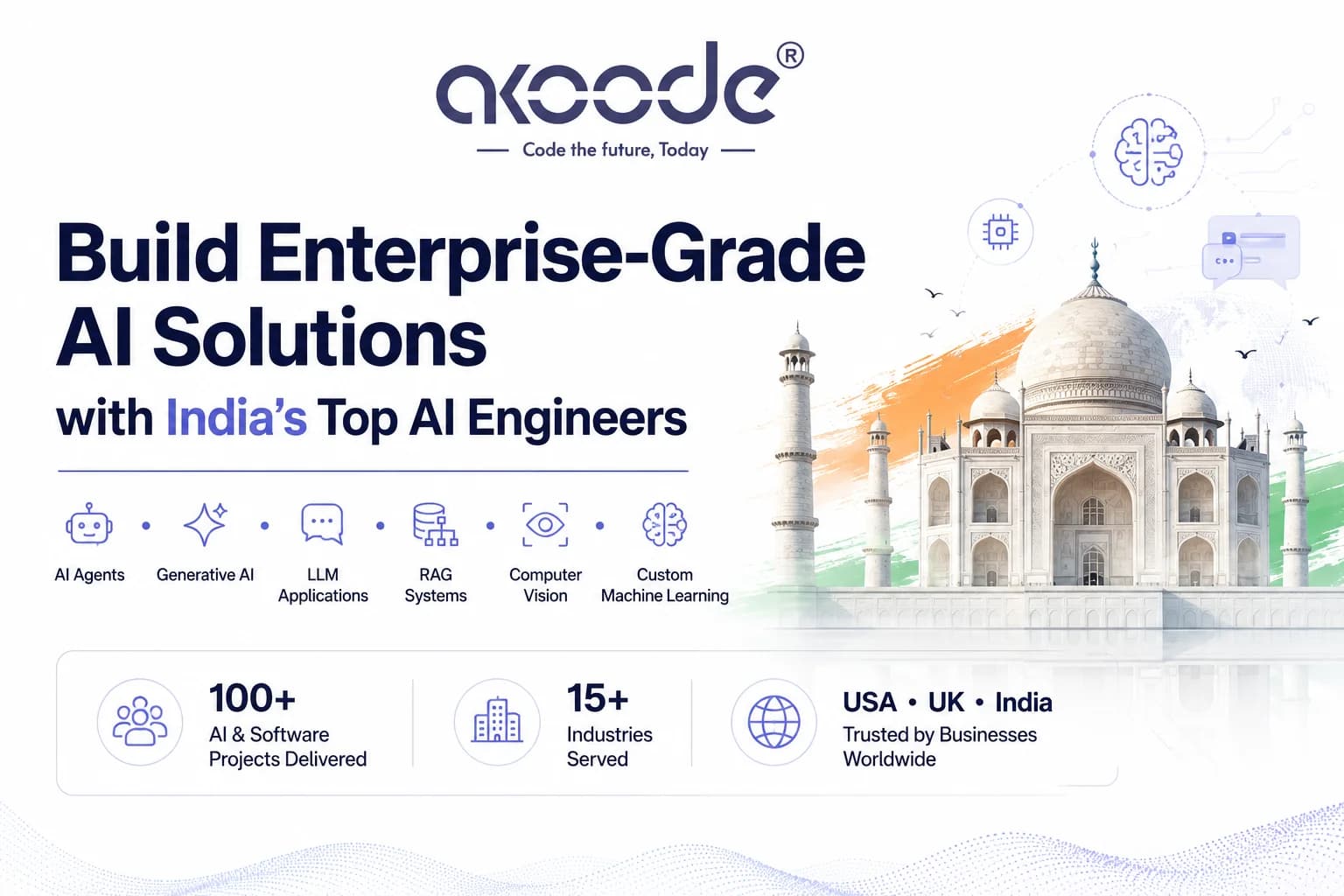
Mid-size specialist firms — the sweet spot for most businesses. Deep enough for real engineering rigor, small enough that your project matters. This is where Akoode Technologies sits: senior AI engineering teams, 100+ delivered projects across 15+ industries, and direct access to the people building your system.
Freelancers and micro-shops — viable for narrow experiments, structurally risky for production systems that need QA, monitoring, and continuity.
Ask the six questions that separate shippers from demo-makers
"Show me an AI system you built that's been in production for 12+ months." Modern LLMs make demos trivially easy. Production is hard. Ask what broke, how they monitored it, what they fixed.
"Walk me through your RAG architecture decisions." Chunking strategy, embedding model selection, retrieval tuning, evaluation methodology. Fluency here is the single fastest capability filter.
"How do you prevent hallucination in a regulated environment?" Right answer: grounding, confidence thresholds, response filtering, mandatory human escalation. Wrong answer: "We use GPT-4, it's very accurate."
"What's your model evaluation process before deployment?" Golden datasets, accuracy benchmarks, adversarial testing. No framework means shipping on hope.
"How do you handle model drift and retraining?" AI degrades as data shifts. If the engagement ends at deployment, performance decays quietly.
"Have you shipped under HIPAA / GDPR / SOC 2 / my compliance regime?" Not can you. Have you.
Watch for the red flags
They lead with the model, not your problem ("we use GPT-4o" is a component, not a solution)
They quote a price before assessing your data
They promise accuracy numbers before seeing your data — nobody can
The portfolio is all demos and POCs, no production deployments
Compliance is treated as a post-launch checkbox
Ongoing costs never come up
Verify communication before you commit
The historical concern about offshore engagements — communication gaps, timezone friction — is a vendor-quality question, not a geography question. The firms that serve US and UK clients well run disciplined async processes, maintain real working-hours overlap, and put engineers (not just account managers) in front of clients. Test this during the sales process: response speed, clarity, and who actually shows up on calls. Sales-stage behavior is the ceiling, not the floor.
Why Global Businesses Choose Akoode for AI Development
Akoode Technologies is an AI and software development company headquartered in Gurugram, India, with a US presence in Oklahoma — serving clients across the USA, UK, and India.
The track record: 100+ projects delivered across 15+ industries. 4.9/5 on Google. 5.0/5 on Clutch. 5.0/5 on GoodFirms.
The stack: GPT-4o, Claude, Gemini, and open-source models. LangChain, LlamaIndex, Pinecone, Supabase. Production deployment on AWS, GCP, and Azure. The same tools as any Silicon Valley team — at Indian engineering economics.
The services: Generative AI and LLM application development, AI agents, RAG systems, custom ML models, computer vision, NLP, AI integration into existing platforms, and the MLOps layer that keeps it all working after launch — alongside our custom software and mobile development practices for full-product builds.
What we do differently:
We run a paid discovery phase before quoting any build. We assess your data before promising anything about accuracy. We surface compliance requirements — HIPAA, GDPR, SOC 2, industry-specific regimes — in the first conversation, not the third invoice. And we'll tell you when a $200/month SaaS tool solves your problem better than a custom build, because occasionally that's the honest answer, even when it costs us the engagement.
US-hours communication overlap. Engineers on client calls, not just account managers. Full transparency about who's building your system and where they sit.
Review our case studies or read more about how we work.
Frequently Asked Questions
How big is the AI development market in India in 2026?
India's AI market is growing at over 38% annually, with projections ranging from $130 billion by 2032 (Fortune Business Insights) to $325 billion by 2033 (Grand View Research). Services is the largest segment at 56.69% revenue share. India holds 16% of the global AI talent pool — second only to the US — and recent infrastructure investments include Google's $15 billion AI data center hub and the IndiaAI Mission's $1.25 billion sovereign infrastructure program.
How much do AI development services cost in India?
Senior AI engineers at Indian specialist firms bill $30–$75/hour, compared to $180–$300/hour in US markets. Complete projects: $15,000–$60,000 for an AI chatbot, $30,000–$85,000 for an LLM-powered tool with RAG, $35,000–$100,000 for an action-taking AI agent, and $95,000–$280,000 for enterprise AI platforms — typically 55–70% below US equivalents. Ongoing costs (LLM APIs, infrastructure, model maintenance) run separately and permanently.
Is AI development quality in India comparable to the US?
For applied AI — LLM integration, RAG systems, AI agents, computer vision, ML models — yes. The stack is identical (GPT-4o, Claude, LangChain, AWS), the engineering discipline is identical, and India's three decades of global software delivery provide mature quality processes. The cost difference reflects salary structures, not capability. The exception is frontier research — novel model architectures — where US labs retain an edge irrelevant to most business projects.
What AI services do Indian development companies offer in 2026?
Full-service firms deliver generative AI and LLM application development, AI agent development, RAG system engineering, custom machine learning and predictive analytics, computer vision, NLP (with particular multilingual strength), AI integration into existing enterprise systems, and MLOps. The strongest demand categories in 2026 are LLM applications, AI agents, and AI integration into existing platforms.
How do I choose the best AI development company in India?
Match the vendor tier to your project size, then apply six filters: proof of AI in production for 12+ months, RAG architecture fluency, a hallucination-prevention approach, a pre-deployment evaluation framework, a model drift and retraining process, and demonstrated experience under your compliance regime. Test communication quality during the sales process — it's the ceiling, not the floor, of what delivery will look like.
How long does AI development take with an Indian team?
Identical to anywhere: a focused AI agent takes 6–14 weeks, an LLM-powered tool with RAG takes 10–20 weeks, custom ML models run 14–24 weeks, and enterprise AI platforms take 6–18 months. Geography changes cost, not engineering time. Data preparation is the most common timeline extender everywhere.
Can Indian AI companies handle HIPAA, GDPR, and SOC 2 compliance?
Experienced firms serving US and European clients build under these regimes routinely — HIPAA-eligible infrastructure with BAAs, GDPR data-handling architecture, SOC 2 controls. The verification question isn't "can you comply?" but "show me a system you shipped under this regime." Compliance architecture typically adds 15–25% to build costs and must be designed in from Phase 1.
What are the risks of offshore AI development, and how do I manage them?
The real risks are vendor-quality risks: thin AI experience dressed up in marketing, communication indiscipline, and engagement models that end at deployment. Manage them by demanding production proof, testing communication during sales, requiring a paid discovery phase, securing IP assignment and repo access from day one, and structuring payments against milestones (25–30% upfront maximum). Geography itself isn't the risk — opacity is.
Why is India becoming a global AI development hub?
Four converging forces: the world's second-largest AI talent pool (16% of global talent), massive infrastructure investment (Google's $15 billion hub, the IndiaAI Mission's subsidized GPUs at 42% below market rates), a mature global-delivery services industry employing 6 million professionals, and a cost structure that makes production AI accessible to mid-market businesses worldwide — not just enterprises with Silicon Valley budgets.
Should my business build custom AI or buy a SaaS platform?
Buy a platform when your use case is standard, speed matters more than fit, and you're validating whether AI helps at all. Build custom when the AI must integrate with proprietary systems, compliance requires specific architecture, your data is a competitive advantage, or per-seat SaaS pricing punishes your scale. The break-even typically lands at 12–18 months — and an honest development partner will tell you which side of it your project falls on.
What to Do Next
If you're evaluating AI development services, the most useful step this week isn't shortlisting vendors.
It's writing one sentence naming the specific, expensive problem: "Our team spends X hours a week on Y, and Z% of it follows predictable patterns." That sentence transforms every vendor conversation — it gives an AI team something concrete to scope against, and lets you evaluate proposals on substance rather than enthusiasm.
Then check your data. Accessible? Digitized? Structured enough to retrieve against? Most AI projects that fail, fail on data — not models.
Then talk to two or three teams — including at least one that will tell you honestly whether your project is worth doing at all.
Talk to Akoode About Your AI Project
We'll review your workflow, assess your data, surface the compliance requirements you'll hit, and give you a straight answer on scope, cost, and whether AI is even the right tool for the problem.
Sometimes the answer is a $25,000 focused system. Sometimes it's a SaaS tool. Sometimes it's "not yet — organize your data first." We'll tell you which.
Book a free 45-minute AI consultation → calendly.com/akhil-akoode/ak
Artificial Intelligence Development Services | akoode.com | case studies | contact us | info@akoode.com
Get In Touch Now
View More Our Blog