


 July 23, 2026
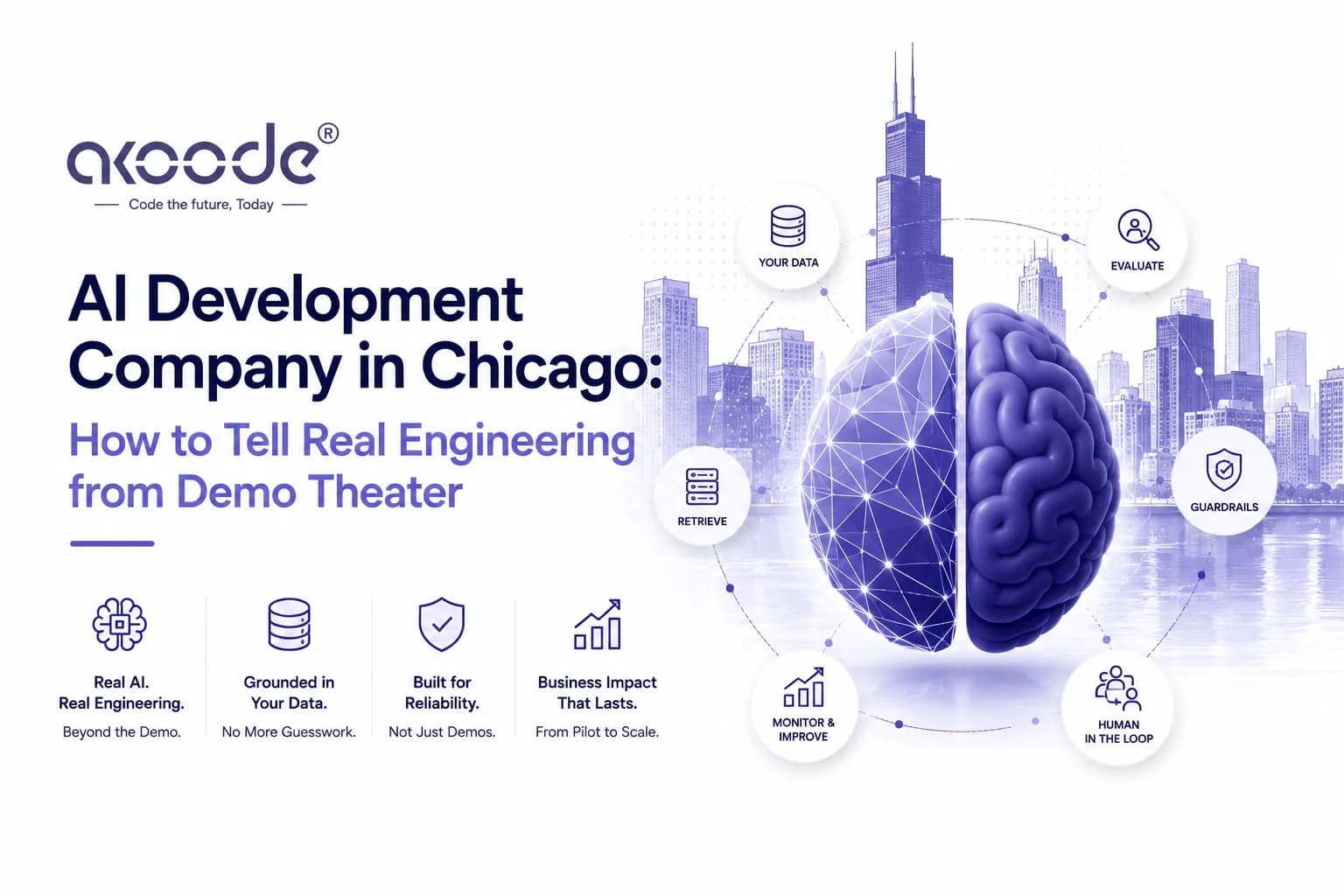
AI Development Company in Chicago: How to Tell Real Engineering from Demo Theater
There's a specific moment when most enterprise AI projects quietly die.
It's not the kickoff. Kickoffs are electric. It's not the demo either — the demo almost always works, because demos are built to work. The moment is usually four to six months in, when the system meets real users, real data, and real edge cases, and someone in the room finally asks: "Why does it keep making things up?"
That moment is the dividing line in the AI services market right now. Almost every software agency in Chicago — and everywhere else — now claims AI expertise. A much smaller number can engineer AI that survives contact with production. The gap between a working demo and a dependable system is where the real engineering lives, and it's precisely the gap most buyers can't see until they've already paid for it.
This guide exists to close that visibility gap. It's written for the CEOs, CTOs, and technology leaders across Chicago — from the trading firms in the Loop to the manufacturers along the I-88 corridor — who are evaluating an AI development company in Chicago and want the technical literacy to separate engineering from theater before signing anything.
No hype. Some uncomfortable honesty about what AI can't do yet. And frameworks you can use in your next vendor call.
Why Every Agency Suddenly Claims AI Expertise {#why-every-agency-suddenly-claims-ai-expertise}
Three years ago, building AI meant hiring machine learning specialists, assembling training datasets, and spending months on model development. The barrier to claiming AI capability was high because the barrier to having it was high.
Large language models collapsed the first barrier without collapsing the second.
Today, any competent web developer can wire an OpenAI or Anthropic API into an application in an afternoon. The result looks remarkably like AI capability: it converses, it summarizes, it drafts. Agencies across the country updated their websites accordingly — "AI development services" appeared on thousands of firms' service lists in a matter of quarters.
Here's what didn't change: the difficulty of making that system reliable. Grounding it in your actual business data so it stops inventing answers. Evaluating it rigorously before it talks to a customer. Monitoring it after launch as models drift and data shifts. Controlling costs when usage scales. Keeping a human in the loop where the stakes demand one.
That second layer is real engineering. It's invisible in a demo. And it's the entire difference between an AI system that compounds value for years and one that gets quietly turned off after the pilot.
The buyer's dilemma in one sentence: the skills required to demo AI and the skills required to ship AI have never been further apart — and both groups use identical marketing language.
The Wrapper Problem: What "AI Development" Often Actually Means {#the-wrapper-problem}
Let's define the term the industry avoids saying out loud.
An AI wrapper is a thin application layer over a foundation model API — a chat interface, a prompt template, and little else. Wrappers aren't inherently bad; for low-stakes internal experiments, they're a reasonable starting point. The problem is wrappers sold as enterprise AI systems, at enterprise prices, to buyers who can't tell the difference.
How to spot the difference in practice:
A wrapper agency's deliverable is a prompt and an interface. When the model hallucinates, their answer is "we'll adjust the prompt." When accuracy is questioned, their answer is "the model is very good." When you ask how they'll know if quality degrades next quarter, there's no answer, because nothing is measuring it.
An AI engineering team's deliverable is a system: retrieval architecture grounding responses in your data, an evaluation harness measuring accuracy against a test set before every release, guardrails filtering unsafe or off-policy outputs, logging and monitoring that detects drift, and escalation paths routing uncertain cases to humans.
The demo of both looks the same on day one. By month six, they are entirely different products.
This distinction matters more in Chicago than in most markets, because so much of the local economy — healthcare systems, trading and financial services, freight and logistics, regulated manufacturing — operates where hallucination isn't an embarrassment. It's a compliance incident.
What Production AI Actually Requires {#what-production-ai-actually-requires}
Here's the layer beneath the demo — the components a serious AI development engagement should include, explained in plain terms.
1. Data Pipelines
Before AI can use your knowledge, someone has to get it there: extracting content from your document stores, CRMs, ERPs, and wikis; cleaning it; chunking it into retrievable units; and keeping it synchronized as source systems change. Unglamorous, essential, and routinely 30–40% of the actual engineering effort. Vendors who don't ask about your data sources in the first conversation are planning to skip this.
2. Retrieval Architecture (RAG)
Retrieval-Augmented Generation grounds model responses in your actual content rather than the model's training memory. When a user asks a question, the system first retrieves relevant passages from your knowledge base, then instructs the model to answer from those passages. This is the primary defense against hallucination — and it involves real design decisions: how documents are chunked, which embedding model represents them, how retrieval is tuned and ranked. A vendor who can't discuss these choices fluently hasn't made them.
3. Evaluation Frameworks
How do you know the system is right? Serious teams build a "golden dataset" — a few hundred representative questions with verified correct answers — and measure the system against it before every change. They test adversarially: ambiguous phrasing, out-of-scope questions, attempts to manipulate the system. Without evaluation, "it seems good" is the quality bar, and "seems good" is how AI reaches customers wrong.
4. Guardrails and Hallucination Control
Layers that constrain what the system will say: confidence thresholds below which it declines to answer, topic boundaries it won't cross, output filters catching policy violations, and grounding checks verifying claims trace back to retrieved sources. The NIST AI Risk Management Framework provides a useful public vocabulary for this discipline — and a vendor familiar with it is signaling maturity.
5. Human-in-the-Loop Design
The most honest sentence in enterprise AI: some decisions should not be fully automated. Good systems are designed around this — routing low-confidence cases, high-stakes actions, and regulated decisions to humans, with interfaces that make review fast. In Chicago's healthcare and financial sectors, human-in-the-loop isn't a nice-to-have. It's frequently the difference between deployable and not.
6. Cost and Latency Management
LLM calls cost money and take time, and both scale with usage. Production systems manage this deliberately: caching common queries, routing simple requests to smaller cheaper models, streaming responses, and monitoring spend. Teams that haven't thought about this ship systems whose API bills triple quarter over quarter — a surprise nobody enjoys.
7. Monitoring and Drift Detection
AI systems degrade silently. Your business changes, your documents change, the underlying models get updated by their providers — and accuracy erodes without anyone noticing until a customer does. Production AI includes dashboards tracking answer quality, retrieval performance, and user feedback over time, with retraining and re-indexing processes when metrics slip.
Pull quote: "The model is maybe 20% of a production AI system. The other 80% — data, retrieval, evaluation, guardrails, monitoring — is what you're actually hiring an engineering team to build."
AI Readiness Is Mostly Data Readiness {#ai-readiness-is-mostly-data-readiness}
Here's the assessment we wish more buyers ran before contacting any vendor: forget the AI for a moment and look at your data.
The pattern across failed AI initiatives is remarkably consistent — and it's rarely the model's fault. The knowledge the AI needed lived in scanned PDFs nobody had digitized. Or in the heads of three senior employees. Or across four systems with conflicting versions of the truth. Or in a document repository where a third of the content was obsolete but nothing was labeled as such.
An AI system grounded in bad data doesn't fail loudly. It fails plausibly — confidently serving outdated policies and conflicting answers, which is worse.
The honest readiness questions:
Does the knowledge exist in digital, extractable form? If your critical know-how is tribal, the first project is knowledge capture, not AI.
Is there one source of truth, or several competing ones? AI amplifies whatever inconsistency it's fed.
Is the content current, and is currency maintained? A retrieval system serving last year's pricing sheet is a liability generator.
Can the data legally be used this way? Customer data, health information, and financial records carry obligations — HIPAA, GLBA, Illinois' own Biometric Information Privacy Act (BIPA), which has produced some of the most active privacy litigation in the country — that shape architecture from day one.
None of this means "not ready, come back later." It means the right vendor scopes a data phase honestly instead of discovering it as a change order in month three. A firm that quotes your project without assessing your data hasn't scoped your project. They've scoped a demo.
Why Most Enterprise AI Pilots Stall {#why-most-enterprise-ai-pilots-stall}
Industry research from Gartner and McKinsey has documented the same pattern for several years running: a large majority of enterprise AI pilots never make it to production deployment. The reasons are rarely mysterious, and almost never "the AI wasn't good enough."
The pilot was scoped to impress, not to survive. It handled the happy path beautifully and nobody tested the other paths until real users found them.
No one owned the accuracy question. Without an evaluation framework, the go/no-go decision came down to anecdotes — and one bad anecdote in front of the wrong executive ends a program.
The economics were never modeled. The pilot ran on subsidized enthusiasm; production required a real budget line for API costs, monitoring, and maintenance that nobody had prepared leadership for.
Compliance was consulted last. Legal and security review arrived after the build, found architecture that couldn't satisfy them, and the retrofit cost exceeded the appetite.
The workflow was automated, but the humans weren't redesigned around it. Staff didn't trust the system, or the escalation path was clumsy, so everyone quietly reverted to the old process.
The pilots that survive share the inverse traits: narrow scope aimed at one measurable, expensive problem; evaluation built in from week one; compliance at the table before architecture decisions; economics modeled to production scale; and the human workflow redesigned alongside the system, not after it.
This is also, not coincidentally, a checklist for evaluating vendors: ask how they'd prevent each failure mode. The answers are revealing.
The Chicago Context: Where AI Is Actually Working {#the-chicago-context}
Chicago's AI opportunity looks different from the coasts' — and in many ways, better suited to what current AI actually does well.
This isn't a foundation-model town. It's an applied AI town, because the regional economy runs on exactly the workflows that modern AI compresses best: documents, logistics, claims, transactions, and compliance.
Manufacturing. The industrial corridor stretching through the western suburbs — Naperville, Schaumburg, and beyond — is deploying computer vision for quality inspection, predictive maintenance on production equipment, and AI-assisted technical documentation. Manufacturing's advantage: processes are already measured, which means the data foundation often exists.
Healthcare. Chicago's hospital systems and the health tech companies around them are targeting the administrative burden — prior authorization, clinical documentation, claims and denial management, patient scheduling. Every deployment lives under HIPAA, which rewards vendors who design compliance in rather than bolting it on.
Financial services and trading. From the exchanges and prop trading firms in the Loop to the banks and fintechs across River North, the applications are document intelligence for research and compliance, transaction monitoring, and workflow automation — always with the explainability that regulators require. "The model said so" is not an acceptable audit response, and architecture has to reflect that.
Logistics and freight. Chicago remains North America's rail and freight crossroads. AI is being applied to demand forecasting, route and yard optimization, and — the sleeper category — freight document processing: bills of lading, customs paperwork, and carrier reconciliation, the paper bloodstream of the industry.
The talent and innovation base. Between the University of Chicago, Northwestern, UIUC's engineering pipeline down the interstate, and the startup ecosystem around Fulton Market and West Loop innovation hubs, Chicago produces genuine AI and data science talent — while sustaining a business culture that prizes ROI over novelty. It's a market where "show me the payback period" beats "show me the demo," which is precisely the right instinct for buying AI in 2026.
For a broader view of the local market beyond AI specifically, our software development in Chicago market guide and our breakdown of software development cost in Chicago cover the full landscape.
Which Problems Are Worth Solving with AI (and Which Aren't) {#use-case-selection}
The fastest way to waste an AI budget is choosing the wrong problem. Here's a selection framework we use in scoping conversations.
Strong AI candidates share four traits:
High volume, repetitive pattern. The task happens dozens-to-thousands of times weekly and most instances follow recognizable patterns.
Document- or language-heavy. Reading, extracting, summarizing, drafting, classifying — the native strengths of language models.
Tolerable error economics with an escalation path. Either occasional errors are low-cost, or uncertain cases can route to a human cheaply.
Measurable baseline. You know what the task costs today — hours, headcount, cycle time — so ROI is calculable rather than vibes-based.
Weak AI candidates — be honest about these:
Judgment calls with thin precedent. Novel strategic decisions, one-off negotiations. AI assists research here; it doesn't decide.
Tasks where a single error is catastrophic and unreviewable. If there's no viable human checkpoint, current AI doesn't belong in the loop.
Problems that are actually process problems. If two departments disagree about the correct answer, AI will automate the disagreement.
Anything where the data doesn't exist. See the readiness section. No retrieval corpus, no grounded system.
A useful sorting exercise: list your ten most expensive recurring workflows. Score each 1–5 on the four strong-candidate traits. The top scorer — not the most exciting one — is your first project.
Build vs. Buy vs. Fine-Tune: A Decision Matrix {#build-vs-buy-vs-fine-tune}
One of the most common scoping conversations, condensed:
Factor | Buy (SaaS AI tool) | Build (custom RAG/agent system) | Fine-Tune (custom model behavior) |
|---|---|---|---|
Best when | Use case is generic (meeting notes, generic support) | Workflow is specific to your business, data, and systems | You need consistent style/format at massive volume, or domain language a base model handles poorly |
Time to value | Days–weeks | 2–5 months | 3–6+ months (needs training data) |
Differentiation | None — competitors buy the same tool | High — built on your data and workflows | High for the specific behavior tuned |
Data required | Minimal | Organized knowledge base | Hundreds–thousands of labeled examples |
Compliance fit | Limited to vendor's posture | Architected to your regime (HIPAA, GLBA, BIPA) | Same as build, plus training-data governance |
Ongoing cost shape | Per-seat/usage fees that scale with headcount | API + infrastructure + maintenance | Build costs + retraining cycles |
Common mistake | Forcing a generic tool onto a specific workflow | Building custom for a problem a $99 tool solves | Fine-tuning to fix hallucination (RAG solves that better) |
The honest guidance: most Chicago mid-market businesses should buy for generic productivity, build for workflow-specific systems tied to proprietary data, and treat fine-tuning as a specialized instrument for style and domain-language problems — not a default. A vendor who recommends fine-tuning before discussing retrieval architecture is usually selling complexity.
An experienced partner will tell you which category your problem falls into even when the answer is "buy a tool" — and that willingness is itself a vendor signal. It's how we approach scoping across our AI development and custom software development practices.
Questions to Ask AI Vendors — With Good and Bad Answers {#questions-to-ask-ai-vendors}
This section alone will change your vendor calls. Ask these verbatim.
1. "Show me an AI system you built that's been in production for over a year. What broke, and what did you change?"
Good: A specific system, specific failure stories — "retrieval quality degraded when the client reorganized their doc repository; we added index-freshness monitoring" — and lessons that changed their process.
Bad: Demos, prototypes, "we're under NDA on all of it," or a story with no failures. Production systems all have failure stories.
2. "Walk me through your retrieval architecture decisions on a recent project."
Good: Fluent discussion of chunking strategy, embedding model choice, ranking and retrieval tuning, and how they measured retrieval quality separately from answer quality.
Bad: "We use RAG" with no ability to go one level deeper. That's a vocabulary word, not an architecture.
3. "How will we know the system is accurate before launch — and still accurate in six months?"
Good: A golden dataset, pre-release evaluation runs, adversarial testing, and post-launch dashboards tracking quality and drift with defined retraining triggers.
Bad: "We test thoroughly" or "the models are very accurate now." Ask what "thoroughly" means; watch what happens.
4. "How do you prevent hallucination in front of my customers or regulators?"
Good: Layered answer — retrieval grounding, confidence thresholds, response filtering, source citation, human escalation for uncertain cases.
Bad: "GPT-4 rarely hallucinates anymore." This is false in exactly the situations that matter.
5. "What will this cost to run at production volume — not pilot volume?"
Good: A model of API costs at your projected usage, caching and model-routing strategies to control it, and honest ranges.
Bad: Silence, or a build quote with no operating cost discussion at all.
6. "Have you shipped under [HIPAA / GLBA / BIPA / our regime]?"
Good: "Yes — here's what it required architecturally," with specifics like BAAs covering the model provider, audit logging, data residency decisions.
Bad: "We take compliance very seriously." Seriousness is not experience.
7. "What would make you tell us not to build this?"
Good: A real answer — data isn't ready, the error economics don't work, a SaaS tool solves it. Firms with standards have declined projects.
Bad: "We can make anything work." No, they can't, and this answer predicts how honestly they'll report problems later.
Red Flags and the Wrapper-vs-Engineering Comparison {#red-flags}
Walk-away signals, compiled from real engagements:
A price quoted before anyone has looked at your data
The pitch leads with model names ("we use GPT-4o and Claude") instead of your problem — those are components, not solutions
Accuracy promises made before seeing your data (nobody can)
A portfolio of demos and POCs with no systems in sustained production
Compliance treated as a post-launch checkbox
No mention of ongoing costs, monitoring, or maintenance — the engagement is designed to end at deployment
Fine-tuning recommended before retrieval is discussed
Agreement with every idea you float — real engineering involves trade-offs, and a vendor surfacing none is closing, not scoping
The side-by-side:
Dimension | AI Wrapper Agency | AI Engineering Team |
|---|---|---|
First questions | "What do you want it to do?" | "Where does the knowledge live? Who owns accuracy?" |
Deliverable | Prompt + interface | Data pipeline + retrieval + evals + guardrails + monitoring |
Accuracy approach | "The model is very good" | Golden dataset, measured before every release |
When it hallucinates | Adjust the prompt | Trace retrieval, fix grounding, add filters |
After launch | Engagement ends | Monitoring, drift detection, retraining cycles |
Compliance | "We take it seriously" | Architected in; can name what your regime required |
Cost talk | Build price only | Build + realistic operating costs at scale |
Willing to say "don't build this" | Never | Yes — and it's a trust signal |
For the broader (non-AI-specific) vendor process — contracts, references, deposit norms, IP terms — our guide to choosing a software development company in Chicago covers the full framework.
Pre-Engagement Readiness Checklist {#readiness-checklist}
Run this before your first vendor call. Twenty minutes here saves months later.
Problem definition
We can state the problem in one sentence with a number in it ("Team X spends Y hours weekly on Z")
We know what the task costs today (the ROI baseline)
We've scored it against the four use-case traits above
We know what "good enough" accuracy means for this task, and what happens on errors
Data readiness
The knowledge the AI needs exists in digital form
We know which system is the source of truth
Someone owns keeping that content current
We've flagged any regulated data involved (PHI, financial records, biometric data under BIPA)
Organizational readiness
A named owner is accountable for the system's accuracy post-launch
The team whose workflow changes knows and has input
Legal/compliance is in the conversation before architecture, not after
Budget includes operating costs (APIs, infrastructure, maintenance), not just the build
Vendor process
Our shortlist includes at least one firm that will assess data before quoting
We're prepared to fund a paid discovery phase rather than demand free fixed quotes
The seven questions above are printed and coming to every call
If you can't check most of the first two sections, the honest first project may be data organization — and a vendor who tells you that is demonstrating exactly the judgment you're hiring for.
Key Takeaways {#key-takeaways}
The AI vendor market has bifurcated. Demo-capable agencies and production-capable engineering teams use identical language. The difference is invisible in a sales call unless you know what to probe.
The model is a minority of the system. Data pipelines, retrieval architecture, evaluation, guardrails, human-in-the-loop design, cost management, and monitoring are where production reliability comes from — and where wrapper agencies have nothing.
AI readiness is mostly data readiness. Systems grounded in disorganized or outdated knowledge fail plausibly, which is worse than failing loudly.
Pilots stall for predictable, preventable reasons — scoped to impress, no accuracy owner, unmodeled economics, compliance consulted last. Vendor conversations should test for each.
Chicago's economy is unusually well-matched to applied AI — manufacturing, healthcare, financial services, and logistics run on exactly the document-heavy, high-volume workflows current AI compresses best.
Choose problems with the four-trait framework, decide build-vs-buy-vs-fine-tune with honest criteria, and treat a vendor's willingness to say "don't build this" as the strongest trust signal available.
Frequently Asked Questions {#faqs}
What does an AI development company in Chicago actually do?
A genuine AI development company designs and builds production AI systems: data pipelines that organize your knowledge, retrieval architectures (RAG) that ground model responses in your content, evaluation frameworks that measure accuracy, guardrails that control outputs, and monitoring that catches degradation after launch. Firms that only wire a chat interface to a model API are delivering a wrapper, not a system.
How do I know if an AI vendor is a "wrapper agency"?
Ask to see a system in production for over a year and ask what broke. Wrapper agencies have demos and prototypes; engineering teams have failure stories and the process changes those failures produced. Second test: ask them to walk through retrieval architecture decisions. "We use RAG" without the ability to go a level deeper is vocabulary, not engineering.
What is RAG and why does it matter?
Retrieval-Augmented Generation grounds an AI's answers in your actual business content: when a question comes in, the system first retrieves relevant passages from your knowledge base, then answers from those passages rather than the model's memory. It's the primary defense against hallucination, and for regulated Chicago industries — healthcare, financial services — it's effectively a requirement, not a feature.
Why do most enterprise AI pilots fail to reach production?
Because they're scoped to impress rather than survive: no evaluation framework owns the accuracy question, operating economics are never modeled, compliance reviews arrive after architecture is fixed, and the human workflow isn't redesigned around the system. The failures are organizational and architectural far more often than they are model failures.
What is "AI readiness" for a business?
Mostly data readiness. The knowledge the AI needs must exist in digital, extractable, current form with a clear source of truth — plus a named owner for accuracy, compliance at the table early, and a budget that includes operating costs. If critical knowledge lives in scanned PDFs or employees' heads, the honest first project is knowledge capture, not AI.
Which business problems are worth solving with AI?
Problems that are high-volume and pattern-heavy, document- or language-centric, tolerant of occasional error or cheaply escalatable to humans, and measurable against a known baseline cost. Weak candidates: novel judgment calls, tasks where single errors are catastrophic and unreviewable, and process disputes AI would merely automate.
Should we build custom AI, buy a SaaS tool, or fine-tune a model?
Buy for generic productivity needs where differentiation doesn't matter. Build custom when the workflow is specific to your business, data, and compliance regime. Fine-tune only for consistent style/format at high volume or domain language a base model genuinely mishandles — and be wary of vendors recommending fine-tuning before discussing retrieval, since RAG solves accuracy problems fine-tuning doesn't.
How much does AI development cost in Chicago?
It varies with scope, data readiness, and compliance requirements — focused single-workflow systems sit at the accessible end, enterprise platforms at the other, and ongoing costs (model APIs, infrastructure, monitoring, retraining) continue for the system's life. Beware any firm quoting a precise price before assessing your data; our software development cost in Chicago guide covers local pricing dynamics in depth.
How long does it take to build a production AI system?
A focused, single-workflow system typically takes a few months from discovery to production; enterprise platforms take substantially longer. The most common timeline extender isn't model work — it's data preparation, which is why honest vendors assess data before committing to dates.
What industries in Chicago benefit most from AI right now?
Manufacturing (visual inspection, predictive maintenance, technical documentation), healthcare (prior authorization, clinical documentation, claims workflows), financial services and trading (document intelligence, monitoring, compliance review), and logistics (forecasting, optimization, freight document processing). The common thread is high-volume, document-heavy work with measurable baseline costs.
What compliance issues affect AI projects in Illinois?
HIPAA for anything touching health information — including a business associate agreement covering your model provider. GLBA and regulator expectations around explainability in financial services. And Illinois' Biometric Information Privacy Act (BIPA), among the most actively litigated privacy statutes in the country, for anything involving biometric data. All three reward architecture-first compliance over retrofits.
What are guardrails in an AI system?
Layered controls constraining system behavior: confidence thresholds below which it declines to answer, topic boundaries, output filtering for policy violations, source-grounding checks, and escalation routes to humans. Public frameworks like NIST's AI Risk Management Framework give buyers and vendors a shared vocabulary for these controls.
What is human-in-the-loop design and when is it required?
Deliberately routing certain cases — low-confidence answers, high-stakes actions, regulated decisions — to human review, with interfaces that make that review fast. In Chicago's healthcare and financial sectors, it's frequently the difference between a deployable system and one that fails legal review.
What ongoing costs come with an AI system?
Model API fees that scale with usage, vector database and infrastructure hosting, and monitoring plus periodic retraining or re-indexing — typically a meaningful annual percentage of the original build. Any vendor who presents a build price with no operating-cost discussion is deferring the conversation, not the cost.
How should we run our first AI project to maximize the odds it survives?
Pick one measurable, expensive workflow (not the most exciting one — the highest scorer on the four-trait framework). Fund a paid discovery that assesses your data honestly. Require an evaluation framework from week one. Bring compliance in before architecture. Model production economics upfront. And redesign the human workflow alongside the system, not after it ships.
Talk to a Team That Builds for Production
If you're evaluating AI for your Chicago business, the most valuable first conversation isn't a sales pitch — it's an honest scoping session.
We'll look at your workflow, assess your data readiness, flag the compliance requirements you'll hit, and tell you plainly which category your problem falls into: build, buy, fine-tune — or not yet. Sometimes the right answer is a focused custom system. Sometimes it's an off-the-shelf tool. We'll tell you which, because that honesty is cheaper for both of us than a stalled pilot.
Akoode Technologies builds production AI and custom software for businesses across the US — 100+ projects across 15+ industries, top-rated on Google, Clutch, and GoodFirms — through our AI development services and our software development company in Chicago practice.
📅 Schedule a free consultation → calendly.com/akhil-akoode/ak
Get In Touch Now
View More Our Blog