


 July 22, 2026
Software Development Cost in Chicago: A Realistic 2026 Pricing Guide
Ask five vendors what your software will cost and you'll get five numbers that differ by 300%. That's not because four of them are lying — it's because "software development cost" hides a dozen variables that most pricing conversations never surface. This guide surfaces them.
Below is a complete breakdown of software development cost in Chicago in 2026: real ranges by project type, the rate structures behind them, the cost drivers you control, the hidden expenses that wreck budgets, and a practical framework for building a number your CFO can trust.
At Akoode Technologies, we scope and price custom software and AI projects for US businesses every week, so these figures come from live deal flow — not recycled blog averages.
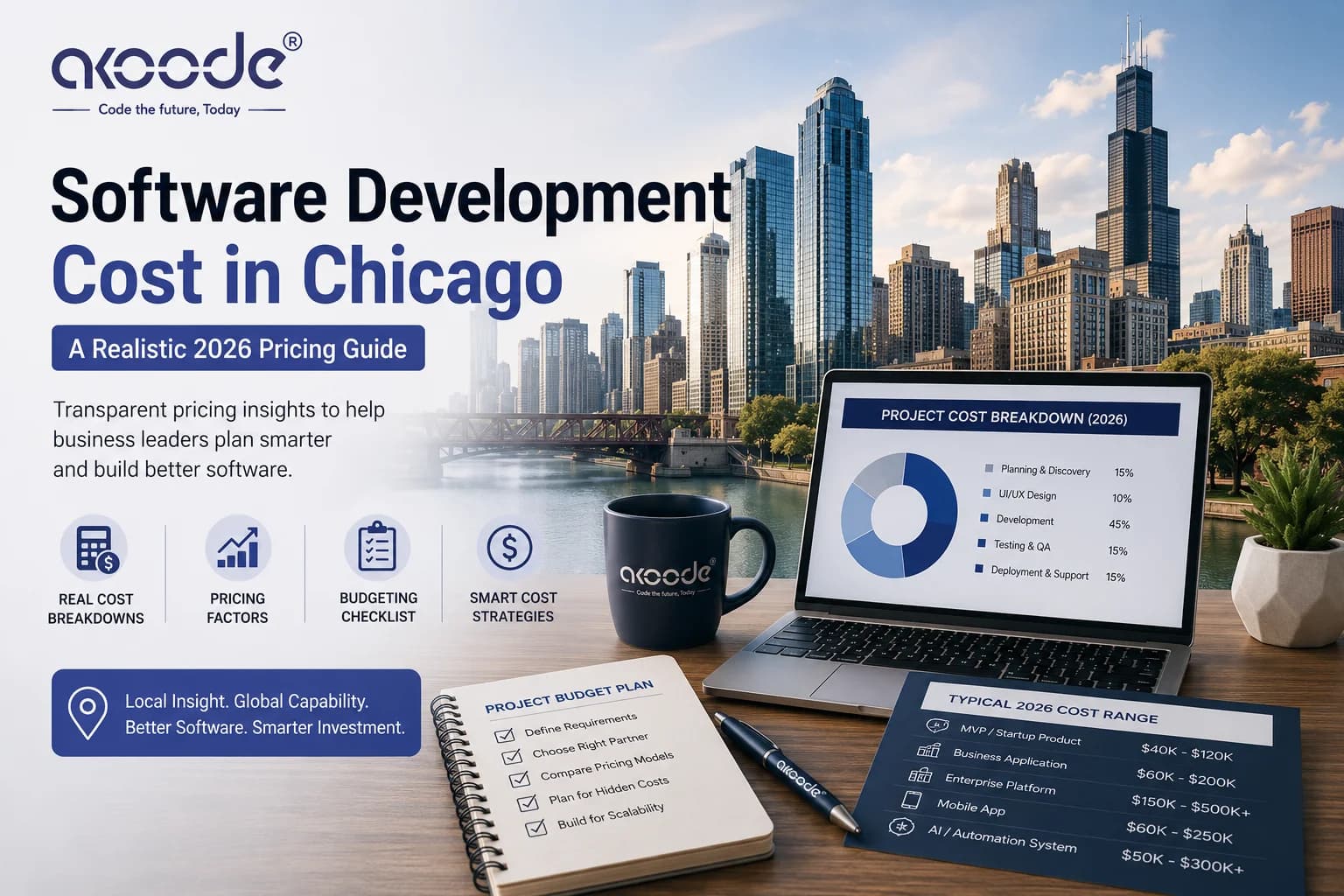
The short answer, if you only read one table:
Project type | Typical 2026 cost | Timeline |
|---|---|---|
Startup MVP / v1 product | $40,000 – $120,000 | 3–5 months |
Custom internal business application | $60,000 – $200,000 | 3–6 months |
Customer portal / enterprise web platform | $150,000 – $500,000 | 6–12 months |
Mobile app (iOS + Android) | $60,000 – $250,000 | 4–8 months |
Production-grade AI / automation system | $50,000 – $300,000+ | 3–9 months |
Legacy system modernization | $200,000 – $1M+ | 9–24 months |
Everything below explains where in those ranges your project will land — and why.
Why Chicago Pricing Works the Way It Does
Chicago is an expensive market for pure local engineering and an efficient one for hybrid delivery. Understanding that split explains almost every quote you'll receive.
Local rates are high because local demand is high. Chicago's economy concentrates industries that buy serious software — trading firms in the Loop, healthcare systems like Northwestern Medicine and Rush, the logistics companies clustered around the nation's busiest freight hub, and the manufacturing corridor running through Naperville and Schaumburg. These employers, plus the Google-anchored tech scene in Fulton Market and the West Loop, keep senior engineering salaries near coastal levels. A senior Chicago engineer typically costs an employer $180,000–$250,000+ fully loaded, and agency rates reflect that.
Three pricing tiers dominate the market:
Delivery model | Typical hourly rate | What you're paying for |
|---|---|---|
Local boutique agency | $150 – $275 | In-person collaboration, local accountability, design depth |
Large consultancy | $200 – $400+ | Brand assurance, compliance machinery, enterprise process |
Hybrid onshore-offshore firm | $40 – $120 blended | Senior US-accountable leadership + global engineering economics |
The hybrid model has become the default for Chicago's mid-market precisely because of this math: when architecture and project leadership stay accountable in US time zones while engineering execution is distributed globally, output quality holds while blended cost drops 40–60% versus pure local staffing. The catch — and it's a real one — is that quality varies enormously between hybrid firms, which is why the evaluation criteria in our companion hiring guide matter more than the rate card.
Software Development Costs by Project Type: The Detailed View
Ranges compress or expand based on the drivers covered later. Here's what moves the number inside each category.
Startup MVP: $40,000 – $120,000
A focused v1 product with one core workflow done well, basic user management, and a clean but unelaborate interface sits at the lower end. You climb toward $120,000 with: payment processing, multi-role permissions, third-party integrations, or real-time features. The most common budgeting mistake founders make is pricing the full product vision instead of the smallest version that can validate demand — a disciplined MVP scope routinely cuts the initial spend by half.
Custom internal business applications: $60,000 – $200,000
The workhorse category for Chicago's mid-market: replacing spreadsheet-driven operations, connecting systems that don't talk to each other, digitizing approval workflows. Cost tracks integration count more than feature count. An application that stands alone might be $60,000–$90,000; the same application talking to your ERP, accounting system, and a vendor API lands at $120,000–$200,000 because every integration adds discovery, edge cases, and testing.
Enterprise platforms and customer portals: $150,000 – $500,000
Multi-department platforms, B2B customer portals, and systems of record. What pushes projects toward the upper half: compliance requirements (SOC 2, HIPAA), single sign-on and enterprise identity, high-availability architecture, and data migration from legacy systems — which is almost always underestimated and deserves its own line item.
Mobile apps: $60,000 – $250,000
Cross-platform frameworks (React Native, Flutter) have made "iOS + Android" a single engineering effort for most business cases, which is why the floor is lower than many published guides suggest. Costs rise with offline functionality, device hardware features, complex animations, or a companion backend that's really its own product. If your app is a mobile front end on an existing system, budget the lower half; if the app is the business, budget the upper.
AI and automation systems: $50,000 – $300,000+
This category needs honest treatment because it's where 2026 quotes vary most wildly. A well-scoped AI system — document processing, an internal knowledge assistant, workflow automation with an LLM in the loop — is achievable at $50,000–$120,000. What pushes serious AI development toward $200,000+: custom data pipelines, evaluation frameworks that actually measure accuracy, guardrail engineering, and integration into production workflows with human review. Beware of the opposite failure too: a $25,000 "AI solution" is usually a thin wrapper on an API that will disappoint in production. The gap between a demo and a dependable system is where the real engineering — and cost — lives.
Legacy modernization: $200,000 – $1M+
The widest range because scope is genuinely unknowable until someone examines the existing system. Chicago has an unusually large modernization market — manufacturers, insurers, and distributors running 15–25 year-old core systems. The critical cost decision is strategy: incremental modernization (strangling the legacy system service by service) costs more per phase but dramatically less in risk than big-bang rewrites, which fail often enough that we counsel against them in most cases.
The 7 Factors That Actually Drive Your Cost
Two projects with identical feature lists can differ by 2x in price. These factors explain why — and most are within your control.
Scope clarity. The single biggest driver. Vague requirements get priced with risk padding (you overpay) or optimistically (you overpay later, with interest, via change orders). A 2–4 week paid discovery phase costing $8,000–$25,000 consistently pays for itself in tighter pricing on the build.
Integrations. Each external system — ERP, EHR, payment rails, carrier APIs, CRM — adds $8,000–$40,000 depending on the quality of its API and documentation. Count your integrations before you count your features.
Compliance and security posture. HIPAA adds architecture, audit, and process overhead of roughly 15–30% on healthcare projects. SOC 2 readiness, PCI scope, and data residency requirements each carry similar surcharges. In Chicago's healthcare and financial services sectors, these aren't optional.
Design depth. A clean, conventional interface is included in the ranges above. Custom design systems, extensive user research, and polished micro-interactions can add 15–25% — worth it for customer-facing products, rarely worth it for internal tools.
Team seniority mix. A cheap team of juniors bills fewer dollars per hour and burns more hours per outcome, then bills again for the rework. Senior-heavy teams cost more per hour and less per result. Ask every vendor for the actual seniority composition behind their blended rate.
Performance and scale requirements. Software for 50 internal users and software for 50,000 concurrent customers are different engineering problems. State your real numbers — overbuilding for imaginary scale is one of the quietest budget killers.
Data migration. If the new system replaces an old one, migrating and cleaning historical data is real work — commonly 10–20% of project cost, and commonly missing from lowball quotes. Ask about it explicitly.
The Hidden Costs Most Budgets Miss
The build price is not the total price. Plan for these from day one:
Ongoing maintenance: 15–20% of build cost annually. Security patches, dependency updates, bug fixes, and small improvements. Software without a maintenance budget degrades into a liability within two years.
Third-party services and licensing. Cloud hosting ($200–$5,000+/month depending on scale), LLM API usage for AI features, email/SMS services, monitoring tools. Ask your vendor for a projected monthly operating cost — a good one can estimate it during discovery.
Internal time. Your team will spend real hours in demos, reviews, and decisions — figure 3–6 hours weekly from a project owner. Projects that skip this "free" investment pay for it in rework.
Training and change management. For internal systems, adoption is the actual finish line. Budget for documentation, training sessions, and a feedback loop after launch.
The cost of waiting. The least visible number: what the current broken process costs monthly while you deliberate. For most operational software, this is the figure that makes the business case — calculate it first.
Custom Software vs. Off-the-Shelf: The Honest Math
Custom isn't always the answer, and a good development partner will tell you so. The comparison that matters is 3–5 year total cost of ownership:
Off-the-shelf SaaS | Custom software | |
|---|---|---|
Upfront cost | Low ($0–$20K setup) | High ($60K–$500K) |
Recurring cost | Per-seat fees that scale with headcount | Maintenance (15–20%/year) |
Fit to your workflow | You adapt to it | It's built around you |
Competitive differentiation | None — competitors use the same tool | Yours alone |
5-year cost, 100+ users | Often $250K–$750K+ in licensing | Often comparable or lower |
The crossover logic: buy off-the-shelf for commodity functions (email, accounting, standard CRM). Build custom software when the workflow is your competitive advantage, when you're paying people to work around tool limitations, or when per-seat licensing across a large team exceeds what a build would cost. For a 150-person Chicago distributor paying $85/user/month across three overlapping SaaS tools, custom consolidation frequently pays back inside 24–30 months.
How to Reduce Costs Without Reducing Quality
Cost-cutting done wrong produces cheap software that costs a fortune. Done right, it looks like this:
Cut scope, not corners. Ship the 40% of features that deliver 90% of the value first. The rest gets funded by the results of phase one — or turns out to be unnecessary, which happens more often than anyone predicts.
Use the hybrid delivery model — with US-accountable leadership. This is the largest single lever, worth 40–60% versus pure onshore rates, if architecture and project management remain senior and accountable in your time zone.
Pay for discovery before you pay for development. Precise requirements get precise pricing. Every dollar of discovery typically saves three in build.
Choose boring technology. Proven frameworks and standard cloud services cost less to build on and far less to maintain than whatever is fashionable this quarter.
Don't custom-build commodity features. Authentication, payments, notifications — mature services exist for all of these. Custom-building them is paying premium rates to reinvent solved problems.
Start with a smaller first engagement. A 4–8 week initial phase tests the partnership at limited risk before you commit the full budget — and gives you leverage on pricing for the remainder.
Red Flags in Software Development Quotes
A pricing conversation tells you as much about a vendor as their portfolio. Walk away, or at minimum dig deeper, when you see:
A same-day fixed quote on a complex project. Nobody can price what they haven't understood. Fast quotes are either padded or fictional.
One opaque number. Credible quotes itemize: phases, team composition, rates, assumptions, and what's excluded. A single figure with a paragraph of generic scope is a template.
No mention of maintenance, hosting, or third-party costs. The vendor either doesn't know your total cost of ownership or prefers you don't.
A price dramatically below every other bid. The missing 40% is testing, project management, and rework — you'll pay it either way, just later and with less control.
Reluctance to name the delivery team. If pricing can't be connected to actual people and their seniority, the blended rate is unverifiable.
"AI-powered" with no engineering specifics. Ask how they handle model evaluation, accuracy measurement, and inference costs. Vague answers at quote stage become expensive surprises in production.
A Simple Budgeting Framework for Your Project
Before you request quotes, build your own number in five steps:
Quantify the problem. What does the current process cost monthly in labor, errors, or lost revenue? This sets your value ceiling and makes every quote instantly comparable to something real.
Define the minimum valuable version. Not the vision — the smallest build that moves your number. Price requests should describe this, with the roadmap noted separately.
Count integrations and compliance requirements. These are your two biggest multipliers; naming them upfront gets you honest quotes instead of padded ones.
Set total cost of ownership, not build cost. Build price + 20% contingency + (15–20% × build) annually for maintenance + projected monthly operating costs, over three years.
Fund discovery separately. Commit $8,000–$25,000 to a discovery phase with your leading candidate before committing to the full build. It's the cheapest de-risking available in software.
Rule of thumb: if the three-year value of solving the problem isn't at least 3x the three-year total cost of ownership, either shrink the scope or don't build it. Good vendors will respect this math; the best ones will help you do it.
What Akoode Technologies Charges — and Why
Akoode Technologies delivers custom software and AI systems for US businesses, including the Chicago market, using the hybrid model described above: senior architects and accountable project leadership working directly with your stakeholders, backed by full engineering teams that keep blended rates 40–60% below pure onshore agencies.
How we price:
Fixed-price discovery first (2–4 weeks) — so the build quote is built on understood requirements, not guesses
Itemized proposals — team composition, rates, assumptions, and exclusions in writing
Your choice of model for the build — fixed price for stable scope, time & materials for evolving products, dedicated teams for long-term roadmaps
Total cost of ownership upfront — including projected hosting, third-party, and maintenance costs, before you sign
With 100+ delivered projects across 15+ industries and strong ratings on Clutch, GoodFirms, and Google, we're comfortable having our quotes compared line-by-line against anyone else's — that comparison usually works in our favor. Details on local engagement are on our software development company in Chicago page.
Frequently Asked Questions
How much does software development cost in Chicago?
Most custom projects fall between $40,000 and $500,000. Startup MVPs run $40,000–$120,000, internal business applications $60,000–$200,000, and enterprise platforms $150,000–$500,000. Legacy modernization can exceed $1M.
What are typical hourly rates for software developers in Chicago?
Local boutique agencies charge $150–$275/hour, large consultancies $200–$400+, and hybrid onshore-offshore firms $40–$120 blended. The rate matters less than the seniority behind it — always ask for team composition.
How much does an app cost to develop in Chicago?
A business mobile app for iOS and Android typically costs $60,000–$250,000. Cross-platform frameworks keep the floor low; offline features, hardware integration, and a complex backend push costs toward the top of the range.
How much does custom enterprise software cost?
Enterprise platforms typically run $150,000–$500,000 depending on integrations, compliance requirements, and scale. Compliance-heavy builds (HIPAA, SOC 2) add roughly 15–30% in architecture and process overhead.
How much does AI development cost?
Well-scoped AI systems — document processing, internal assistants, workflow automation — run $50,000–$120,000. Production-grade systems with custom data pipelines, evaluation frameworks, and guardrails run $150,000–$300,000+.
Why do quotes for the same project vary so much?
Different delivery models (local vs. hybrid vs. consultancy), different seniority mixes, and different assumptions about unstated scope. Itemized quotes with named assumptions are comparable; single opaque numbers are not.
Is offshore development cheaper than hiring in Chicago?
Pure offshore is cheapest on paper but carries the highest failure risk for business-critical systems. The hybrid model — US-accountable leadership with global engineering — captures most of the savings (40–60%) while keeping quality and communication intact.
What does software maintenance cost after launch?
Budget 15–20% of the original build cost annually for security patches, dependency updates, bug fixes, and small improvements, plus monthly operating costs for hosting and third-party services.
How can I reduce software development costs?
Cut scope to the minimum valuable version, pay for a discovery phase to get precise pricing, use proven technology, avoid custom-building commodity features, and choose a hybrid delivery firm with senior US-based leadership.
Is custom software cheaper than SaaS in the long run?
For large teams, often yes. Per-seat SaaS fees across 100+ users frequently total $250,000–$750,000 over five years — comparable to or more than a custom build with maintenance. Below ~50 users, off-the-shelf usually wins on cost.
How much should I budget for a discovery phase?
$8,000–$25,000 for 2–4 weeks, covering workshops, technical audit, and a prioritized, priced backlog. Discovery consistently pays for itself through tighter build pricing and fewer change orders.
What payment structure should I expect?
Milestone-based payments tied to delivered, working software — typically 10–20% to start, with the remainder spread across sprints or phases. Be cautious of vendors requiring more than 30–40% upfront.
Also read related article - software-development-chicago-2026
Get a Real Number for Your Project
Generic ranges get you oriented; they don't get you a budget. The only way to a number you can plan around is a scoped conversation about your specific workflows, integrations, and constraints.
Book a free 30-minute consultation with Akoode Technologies. We'll review your requirements, give you an honest feasibility read, and provide a realistic cost range with the assumptions spelled out — whether or not you build with us.
Schedule your free consultation →
Or explore our Chicago software development services to see how we deliver for businesses across Illinois.
Get In Touch Now
View More Our Blog