


 July 22, 2026
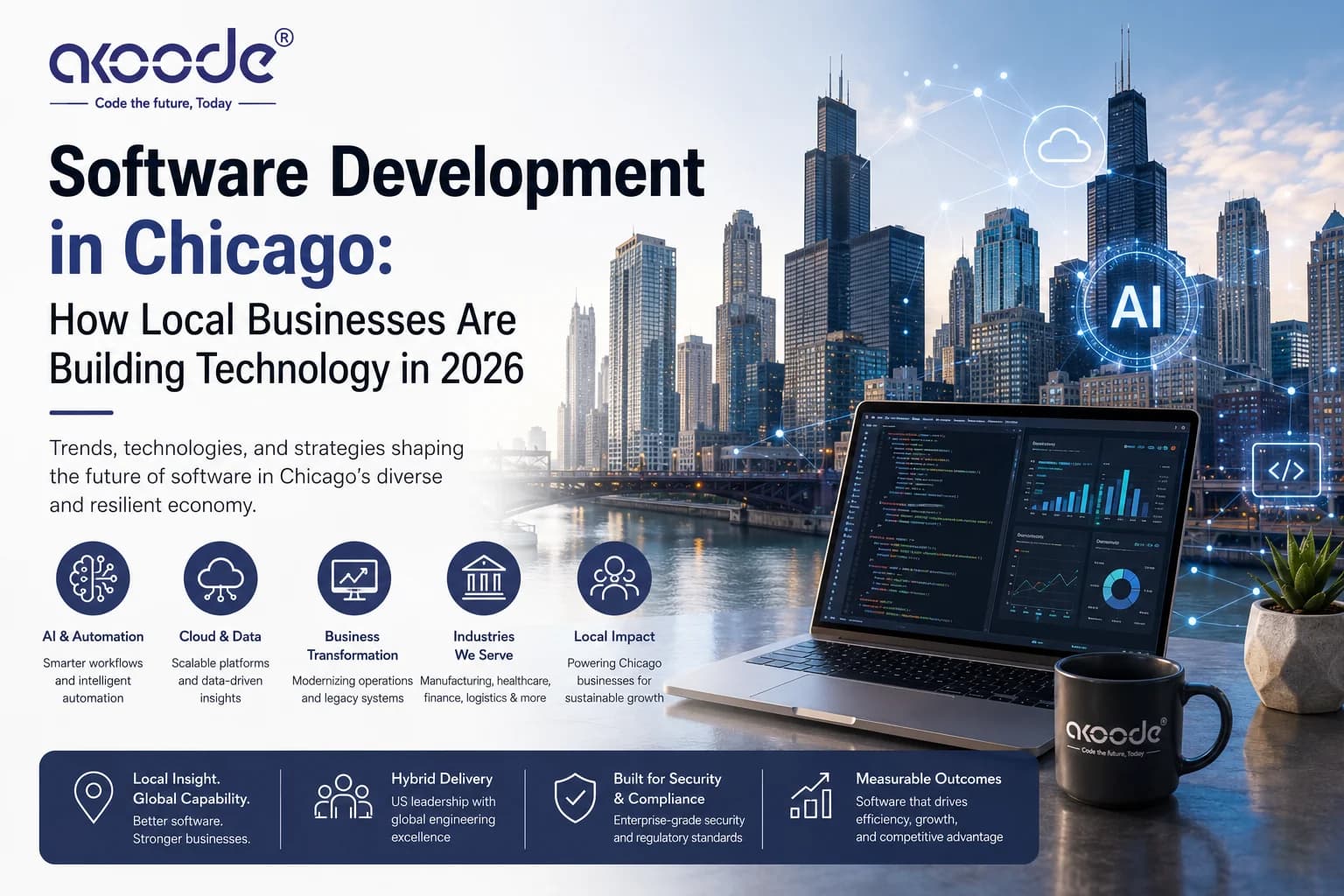
Software Development in Chicago: How Local Businesses Are Building Technology in 2026
Chicago builds software differently than the coasts. Here, technology decisions are made by manufacturers modernizing plant operations, healthcare systems untangling data silos, logistics firms squeezing margin out of freight, and financial companies where downtime is measured in dollars per second. Understanding software development in Chicago means understanding that context — because the trends, priorities, and buying patterns here follow the region's operational economy, not Silicon Valley's product cycles.
This article maps the current state of the market: what Chicago businesses are actually building in 2026, how AI has changed the development landscape, which delivery models dominate, and how to decide what your own organization should build next. It's written for the CEOs, CTOs, and operations leaders making those calls — educational first, with the commercial questions (who to hire, what it costs) linked where they belong rather than repeated here.
The Chicago Software Landscape in 2026
What defines the Chicago software market? In one sentence: a diversified operational economy that buys software to solve business problems, served by a mix of local talent, global delivery teams, and a maturing startup ecosystem.
Three structural facts shape everything else:
The economy is unusually balanced. No single industry dominates the way tech dominates the Bay Area or finance dominates New York. Manufacturing across the suburban corridor, healthcare anchored by systems like Northwestern Medicine and UChicago Medicine, financial services and trading around the Loop, and logistics built on the nation's busiest freight hub each generate their own software demand. This balance makes Chicago's technology market steadier than coastal hubs — less boom, less bust.
The talent base is deep and institutionally fed. The University of Chicago, Northwestern, UIC, Illinois Tech, and DePaul supply a continuous pipeline of engineering and data science graduates, while Google's Fulton Market office and the 1871 incubator anchor a visible startup scene in the West Loop. Chicago's most successful software companies — supply-chain platforms like project44 and FourKites among them — reflect the region's DNA: enterprise and operational software rather than consumer apps.
Delivery is hybrid by default. Senior local engineering talent is priced near coastal levels, so most mid-market development now combines US-based architecture and leadership with globally distributed engineering. That shift has made serious custom software financially accessible to companies that couldn't have justified pure local rates — a structural change in who gets to build.
What Chicago Businesses Are Building Right Now
Demand in 2026 concentrates in five categories, listed roughly by volume of activity we see across the mid-market:
Workflow and operations software. Replacing spreadsheet-driven processes, connecting systems that don't share data, and digitizing approvals. Unglamorous, high-ROI, and the most common first custom build for established businesses.
AI-augmented systems. Document processing, knowledge assistants, forecasting, and automation with a human in the loop — covered in depth in the next section.
Customer-facing portals. B2B businesses building self-service portals for ordering, tracking, and account management, driven by customer expectations set by consumer software.
Integration and data platforms. The connective tissue between ERPs, CRMs, e-commerce systems, and operational tools — often the prerequisite for everything else on this list.
Legacy modernization. Chicago's stock of 15–25 year-old core systems in insurance, manufacturing, and distribution is being incrementally replaced, usually service by service rather than in risky big-bang rewrites.
The pattern worth noticing: four of the five categories are about making existing operations work better, not launching new digital products. That's the Chicago market in miniature — and it's why evaluating a development partner on operational domain knowledge matters as much as technical skill, a theme covered fully in our guide to choosing a software development company in Chicago.
AI Software Development: From Experiments to Infrastructure
How has AI changed software development in Chicago? The short, direct answer: AI has moved from a pilot-project budget line to a standard component of ordinary business software, and the market now separates sharply between teams that can engineer production AI and teams that demo it.
Between 2023 and 2025, most Chicago enterprises ran generative AI experiments. The 2026 shift is that AI is now inside the operational software described above rather than beside it:
Document-heavy workflows — claims intake, invoice processing, contract review — now routinely include extraction and classification layers that eliminate manual data entry.
AI agents handle bounded, repeatable tasks: triaging support requests, matching freight loads, drafting responses for human review, monitoring data quality.
Decision support — demand forecasting, maintenance prediction, pricing analysis — embeds models into the screens where decisions already happen instead of separate analytics tools.
What separates production AI from demos is rarely the model — it's the engineering around it: data pipelines that keep inputs clean, evaluation frameworks that measure accuracy against real business criteria, guardrails that constrain failure modes, and human-review workflows for consequential decisions. Research from firms like McKinsey and Gartner has consistently found that most enterprise AI initiatives stall before production impact, and the missing ingredient is usually this engineering layer, not the AI itself. That's the substance behind serious AI development services, and it's the right lens for evaluating any vendor's AI claims: ask about evaluation and guardrails, not model names.
For buyers, one practical implication stands out: AI readiness is mostly data readiness. If your operational data is fragmented across disconnected systems, the integration work comes first — which is why categories 4 and 2 in the previous section are so often the same project.
Digital Transformation in Chicago's Core Industries
Digital transformation in Chicago looks different by sector because the operational problems differ. A brief map:
Manufacturing. The suburban corridor from Naperville through Schaumburg is mid-transformation: connecting plant-floor equipment to business systems, replacing planning spreadsheets with real scheduling software, and adding predictive maintenance. The hard part is rarely the new software — it's integrating with SAP, Oracle, or Epicor installations and the middleware between machines and ERPs.
Healthcare. Interoperability dominates. Providers, payers, and the health-tech companies around them are building on HL7/FHIR standards, integrating with Epic and Cerner ecosystems, and automating administrative workflows that consume clinical staff time. Compliance (HIPAA) shapes architecture from day one rather than being bolted on.
Financial services. Chicago's trading and lending heritage sets the bar: real-time processing, audit trails, and regulatory reporting. The 2026 emphasis is automation of middle- and back-office operations — reconciliation, compliance monitoring, document processing — where AI-augmented workflows deliver measurable headcount leverage.
Logistics. Visibility and optimization. Shippers and 3PLs are building integration layers across TMS/WMS platforms, carrier APIs, and telematics, then adding optimization and exception-management intelligence on top. Chicago's freight centrality makes this the region's deepest pool of domain-experienced engineers.
Retail and distribution. Unified commerce — one accurate view of inventory, orders, and customers across channels — remains the core project, with automation of fulfillment operations close behind.
The common thread: transformation succeeds when it's framed as a sequence of operational problems solved in priority order, and stalls when it's framed as a monolithic "digital strategy." The businesses making real progress pick one measurable workflow, fix it, and compound from there.
Build vs. Buy vs. Extend: A Decision Matrix
Should you build custom software, buy off-the-shelf, or extend what you have? Answer directly: buy for commodity functions, extend when your current platform covers 80% of the need, and build custom when the workflow is competitively distinctive or integration gaps are costing real money.
Use this matrix against any proposed project:
Your situation | Buy (SaaS) | Extend existing systems | Build custom |
|---|---|---|---|
The function is standard across all companies (email, accounting, basic CRM) | ✅ Best choice | — | ❌ Wasteful |
Current platform does most of it; gaps are configuration-sized | — | ✅ Best choice | ❌ Premature |
Off-the-shelf tools exist but you're working around their limits daily | Possible, reluctantly | Worth testing first | ✅ Strong case |
The workflow is your competitive advantage | ❌ You'd surrender the edge | Rarely sufficient | ✅ Best choice |
Per-seat licensing across a large team exceeds build cost over 3–5 years | ❌ The math has flipped | — | ✅ Strong case |
Multiple disconnected tools cause manual re-entry and errors | ❌ More tools worsen it | Sometimes (iPaaS) | ✅ Integration build |
Two honest cautions that vendors selling either direction won't volunteer: custom software carries an ongoing maintenance obligation (plan roughly 15–20% of build cost annually), and SaaS carries a compounding per-seat cost plus permanent dependence on someone else's roadmap. The full financial comparison, with Chicago-specific figures, is in our software development cost guide, and the case for building is examined in depth on our custom software development page.
How Software Gets Delivered: Comparing the Models
Four delivery models serve the Chicago market. The right one depends on project criticality, budget, and how much senior oversight the work demands:
Model | Strengths | Weaknesses | Fits best |
|---|---|---|---|
Freelancers | Cheap, fast to engage | No continuity or bench; single point of failure | Small defined tasks, maintenance |
Local boutique agency | In-person collaboration, design depth, local accountability | Highest rates; small bench limits specialization | Design-heavy or workshop-driven projects |
Large consultancy | Brand assurance, compliance machinery | Premium pricing; senior sellers, junior doers | Enterprise programs needing name-brand cover |
Hybrid onshore-offshore firm | 40–60% cost advantage with senior US-accountable leadership | Quality varies widely between firms | Most mid-market custom and AI builds |
The hybrid model's dominance in the mid-market is an economic fact, but it works only when leadership genuinely stays senior and accountable — the difference between a real engineering partner and a sales office forwarding requirements overseas. The evaluation criteria that expose that difference are detailed in our hiring guide linked above.
Technology Trends Shaping Chicago in 2026
Beyond AI, five trends are visibly changing what and how Chicago companies build:
Integration-first architecture. Businesses have stopped buying point solutions faster than they connect them. API-first design and integration platforms are now project prerequisites, not afterthoughts.
Automation of the back office. Finance, HR, and compliance workflows — approval chains, reconciliation, reporting — are the highest-density automation targets because the ROI is direct and measurable.
Cybersecurity as a design constraint. Insurance requirements, customer security questionnaires, and supply-chain attestations have pushed security from IT policy into software architecture. SOC 2 readiness increasingly appears in mid-market build requirements, not just enterprise ones.
Cloud cost discipline. After a decade of cloud-by-default, engineering teams are being asked to justify operating costs. Efficient architecture — right-sized services, managed platforms over custom infrastructure — is a selection criterion for development partners.
Composable, replaceable systems. Burned by monoliths, buyers now favor modular architectures where individual components can be swapped without rewriting everything — the same philosophy driving incremental legacy modernization.
The through-line is maturity: Chicago's market is past the phase of adopting technology for optics and firmly in the phase of engineering for measurable operational return.
A Readiness Checklist Before You Start Any Project
Run this before engaging any development partner. Every unchecked item is a known source of budget overrun or stalled adoption:
The problem is quantified. You can state what the current process costs monthly in labor, errors, or lost revenue.
Success has a number. You've defined the metric the software must move and by how much.
Scope has a floor. You've identified the minimum version that delivers value, separate from the full vision.
An internal owner is named. One person with authority to answer questions weekly and refuse scope creep.
Data sources are mapped. You know which systems hold the data the new software needs and who controls access.
Integrations are counted. Every system the software must talk to is listed — this drives cost more than features do.
Compliance requirements are stated. HIPAA, SOC 2, PCI, or data-residency needs are identified upfront, not discovered mid-build.
Maintenance is budgeted. Post-launch support (roughly 15–20% of build cost annually) is in the financial plan.
Stakeholders have seen the plan. The people whose workflows change have been consulted — adoption starts before development does.
Total cost of ownership is modeled. Build cost plus operating costs plus maintenance over three years, compared against the quantified problem.
Organizations that can check eight or more of these boxes consistently ship close to plan. Fewer than five, and the most valuable first engagement is a discovery phase, not a build.
Key Takeaways
Chicago's software market is operational, not speculative. Demand comes from manufacturing, healthcare, finance, and logistics solving measurable business problems — and the best partners are fluent in those domains, not just in code.
AI has become infrastructure. In 2026 it lives inside ordinary business software; the differentiator is production engineering (data pipelines, evaluation, guardrails), and AI readiness is mostly data readiness.
Hybrid delivery is the mid-market default, offering 40–60% savings over pure local rates when — and only when — architecture and accountability stay senior and US-based.
Build vs. buy has clear rules: buy commodity, extend when gaps are small, build when the workflow is your edge or licensing math has flipped.
Transformation compounds from small wins. One quantified workflow fixed and measured beats any monolithic digital strategy.
Readiness predicts outcomes. The checklist above — quantified problem, named owner, counted integrations, budgeted maintenance — separates projects that ship from projects that drift.
Frequently Asked Questions
What is the software development market like in Chicago?
Diversified and operationally driven. Demand comes primarily from manufacturing, healthcare, financial services, and logistics companies building workflow software, AI-augmented systems, customer portals, and integrations — served by local agencies, consultancies, and hybrid onshore-offshore firms.
What kind of software are Chicago companies building in 2026?
Five categories dominate: workflow and operations software, AI-augmented systems, B2B customer portals, integration and data platforms, and incremental legacy modernization. Most projects improve existing operations rather than launch new digital products.
Is Chicago a good city for software development talent?
Yes. Universities including UChicago, Northwestern, UIC, Illinois Tech, and DePaul feed a deep engineering pipeline, and anchors like Google's Fulton Market office and 1871 sustain a startup ecosystem oriented toward enterprise and operational software.
How is AI being used in Chicago businesses?
Primarily inside operational workflows: document extraction and classification, AI agents for bounded tasks like triage and drafting, and decision support such as forecasting and predictive maintenance — with human review for consequential decisions.
What is digital transformation for a mid-size company?
Practically, it's a prioritized sequence of operational fixes: connecting disconnected systems, automating manual workflows, and adding intelligence where decisions happen. It succeeds one measured workflow at a time, not as a monolithic program.
Should my company build custom software or buy SaaS?
Buy for standard functions like email and accounting. Build when the workflow is your competitive advantage, when you're constantly working around tool limitations, or when per-seat licensing across a large team exceeds build cost over 3–5 years.
What does custom software development cost in Chicago?
Most projects fall between $40,000 and $500,000 depending on type and complexity — startup MVPs at the lower end, enterprise platforms at the upper. Integrations and compliance requirements are the biggest multipliers.
What is hybrid software development delivery?
US-based senior architects and project leadership combined with globally distributed engineering teams. Done well, it delivers comparable quality to local agencies at 40–60% lower blended cost; quality between hybrid firms varies widely, so vetting is essential.
What should I prepare before starting a software project?
Quantify the problem's monthly cost, define the success metric, identify the minimum valuable scope, name an internal owner, list every integration, and state compliance requirements. Projects with this preparation consistently ship closer to plan.
How long does a typical software project take?
Focused MVPs take 3–5 months, internal business applications 3–6 months, and enterprise platforms or modernization programs 6–24 months, usually delivered in working increments rather than a single final release.
What are the biggest software trends in Chicago right now?
Production AI embedded in business workflows, integration-first architecture, back-office automation, security as a design requirement, cloud cost discipline, and composable systems that can be modernized piece by piece.
How do I choose a software development partner in Chicago?
Evaluate domain experience in your industry, discovery process quality, the actual delivery team's seniority, engineering process maturity, and contract terms on IP ownership — then verify everything through reference calls with past clients.
Turn the Landscape Into a Plan
Understanding the market is step one. Step two is deciding what your organization should build first — and that decision deserves a structured conversation, not guesswork.
Akoode Technologies helps Chicago businesses move from problem to production: custom software, AI development, and modernization delivered through the hybrid model described above, with 100+ projects shipped across 15+ industries. Book a free 30-minute consultation — we'll help you quantify the problem, pressure-test the build-vs-buy math, and map a realistic first phase.
Schedule your free consultation →
Or start with our software development services in Chicago to see how we work with businesses across Illinois.
Get In Touch Now
View More Our Blog