


 July 22, 2026
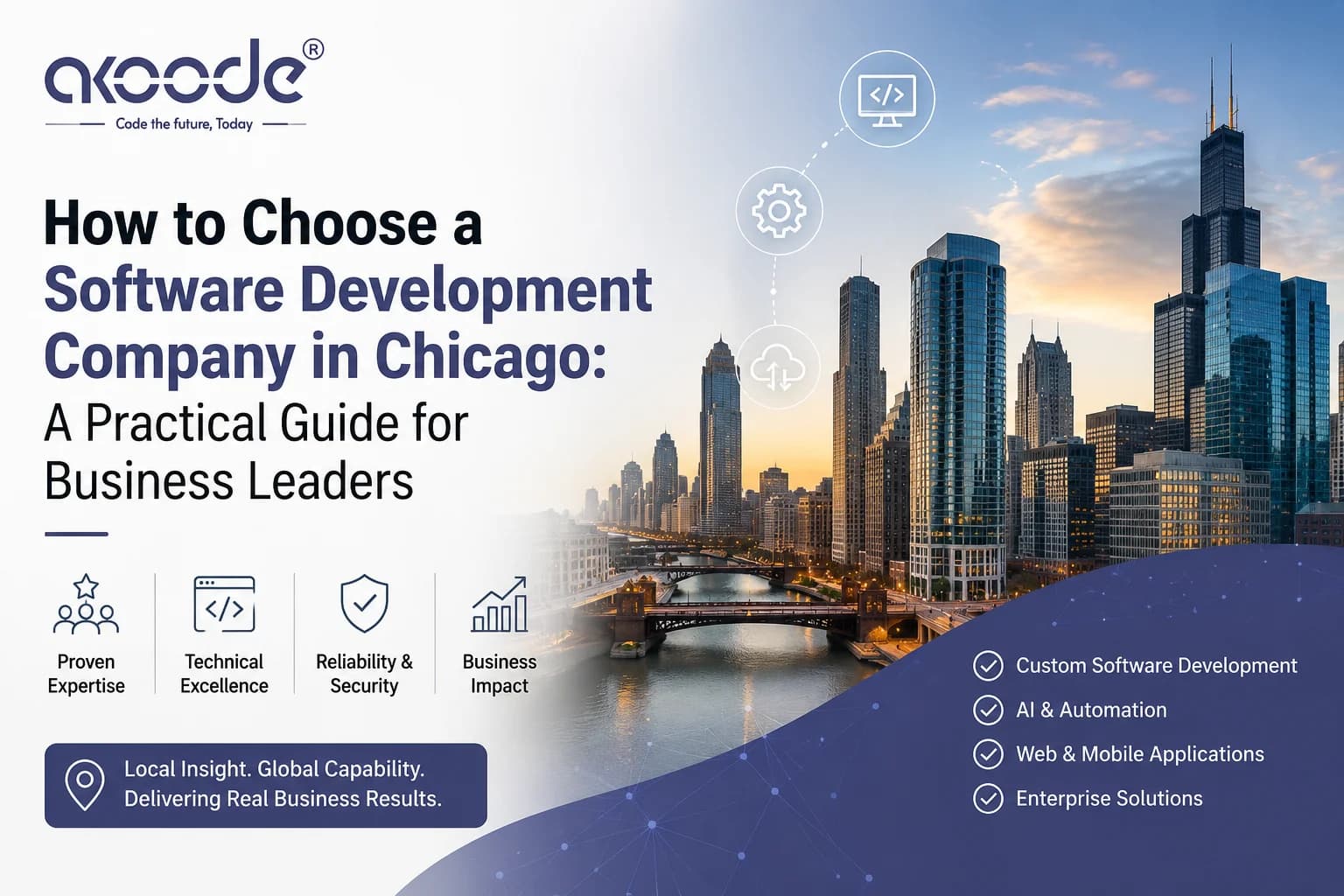
How to Choose a Software Development Company in Chicago: A Practical Guide for Business Leaders
Chicago is not a city that adopts technology for the sake of it. Businesses here build software because it has to move freight, process claims, clear trades, or keep a production line running. That pragmatism shapes how companies in the region buy software development — and it should shape how you evaluate a software development company in Chicago before you sign anything.
This guide walks through everything that matters in that decision: how the local market actually works, what different types of partners cost, the questions that expose weak vendors, and the mistakes that quietly sink projects. It draws on patterns we see repeatedly at Akoode Technologies while delivering custom software and AI systems for mid-size businesses and enterprises across the US, including clients in Illinois.
If you're a CEO, CTO, or founder trying to separate genuine engineering partners from agencies that outsource everything behind the curtain, this is written for you.
Why Chicago Companies Are Investing Heavily in Custom Software
Chicago's economy is unusually diversified. Unlike coastal tech hubs built around a single dominant industry, the region spreads its weight across manufacturing, healthcare, financial services, logistics, and professional services. That diversity has a direct consequence: software demand in Chicago is driven by operational problems, not product trends.
A few forces are accelerating that demand right now:
Legacy system pressure. Many established Illinois manufacturers and insurers still run core operations on systems built 15–25 years ago. Modernization isn't optional anymore — integration requirements, security expectations, and talent availability for legacy platforms are all working against the status quo.
AI moving from pilots to production. Chicago enterprises spent 2023–2025 experimenting with generative AI. The conversation in 2026 is different: leaders want AI agents and automation embedded in real workflows — claims triage, demand forecasting, freight matching, document processing — with measurable ROI.
Margin pressure in logistics and manufacturing. Chicago sits at the center of American freight. When margins compress, operational software (visibility platforms, warehouse systems, route optimization) becomes the cheapest lever for efficiency.
Healthcare digitization. With major systems like Northwestern Medicine, Rush, and UChicago Medicine anchoring the region, the healthcare software ecosystem around interoperability, patient engagement, and clinical workflow tooling keeps expanding — and it pulls a long tail of vendors, clinics, and health-tech startups along with it.
The takeaway for buyers: the best software development services in Chicago tend to be judged on business outcomes — throughput, cost per transaction, hours saved — rather than demos. Hold your shortlist to that standard.
Understanding Chicago's Tech and Business Ecosystem
Knowing the local landscape helps you calibrate expectations on talent, pricing, and specialization.
The innovation core
The Loop and River North concentrate financial services, trading firms, and corporate IT. Proximity to CME Group, Cboe, and a dense cluster of banks and insurers means fintech and trading-adjacent engineering talent is unusually strong here.
Fulton Market and the West Loop have become the visible face of Chicago tech — Google's Midwest office anchors the neighborhood, surrounded by startups, agencies, and corporate innovation teams that migrated west from the Loop.
1871, one of the best-known startup incubators in the country, has pushed thousands of founders through its programs and gives the city a steady pipeline of early-stage product companies.
The suburban engine
Chicago's software economy doesn't stop at the city limits. Naperville and Schaumburg host large corporate IT operations, and the broader suburban corridor is dense with manufacturing headquarters and distribution operations — exactly the companies now modernizing ERP integrations, plant-floor systems, and B2B commerce.
Universities and talent
The University of Chicago, Northwestern, UIC, Illinois Tech, and DePaul collectively graduate a deep bench of computer science and data science talent every year. That academic base is one reason Chicago has produced credible AI and data companies — from health-AI firms to supply-chain visibility platforms like project44 and FourKites — rather than just consumer apps.
What this means for buyers
Two practical implications:
Specialized domain talent exists locally, particularly in fintech, logistics, healthcare, and industrial software. If a vendor claims deep experience in one of these, Chicago is a market where that claim is verifiable — ask for local references.
Pure local staffing is expensive. Senior Chicago engineers command Bay-Area-adjacent compensation. That's why the dominant delivery model for mid-market projects has become hybrid: US-based leadership and architecture combined with global engineering teams. More on the economics of that below.
Types of Software Development Partners: What You're Actually Choosing Between
"Hire a software development company" hides four very different options. Each has a legitimate use case — problems start when a company picks the wrong model for its situation.
Model | Best for | Typical hourly cost | Biggest risk |
|---|---|---|---|
Freelancers / contractors | Small, well-defined tasks; augmenting an existing team | $50–$150 | No continuity, no accountability beyond the individual |
Local boutique agency | Design-heavy products, workshops, projects needing frequent in-person work | $150–$275 | High burn rate; small bench limits scale and specialization |
Large consultancy / GSI | Enterprise programs with heavy compliance and change management | $200–$400+ | Cost, slow ramp, junior staff doing the actual work |
Hybrid onshore-offshore firm | Custom software and AI builds where budget efficiency and senior oversight both matter | $40–$120 blended | Quality varies widely between firms — vetting is everything |
A few honest observations from inside the industry:
Freelancers are underrated for maintenance and overrated for builds. A solo developer maintaining a stable internal tool is efficient. A solo developer building your core revenue system is a single point of failure.
Big consultancies are buying insurance, not speed. If your board needs a name-brand logo on the engagement, that's a real consideration — but expect to pay 2–4x for comparable output, and ask explicitly who will write the code.
The hybrid model won the mid-market for a reason. When it's done well — senior architects and project leadership accountable in US time zones, engineering execution distributed globally — it delivers enterprise-grade output at 40–60% of pure onshore cost. When it's done badly, it's a sales office forwarding your requirements to a team you'll never meet. The evaluation criteria below are largely about telling those two apart.
A Decision Framework: 8 Criteria for Evaluating a Chicago Software Development Partner
Most vendor evaluations collapse into portfolio browsing and price comparison. Both matter, but neither predicts project success. These eight criteria do.
1. Domain fluency, not just technical skill
A team that has built logistics software understands EDI, dock scheduling, and carrier APIs before your kickoff call. A team that hasn't will bill you to learn. Ask vendors to describe a past project in your industry in operational detail — the ones with real experience talk about business constraints, not just tech stacks.
2. Discovery process quality
Weak vendors quote fast. Strong vendors interrogate your requirements first — because they know the initial spec is always partly wrong. A structured discovery phase (workshops, user interviews, technical audit, prioritized backlog) is the single best predictor of on-budget delivery. Treat a same-day fixed quote on a complex build as a red flag, not a convenience.
3. Who actually does the work
Ask three questions directly:
Who is the architect responsible for technical decisions, and can I speak to them before signing?
What percentage of the delivery team are direct employees vs. subcontractors?
Will the people in the sales process be involved in delivery?
Bait-and-switch staffing — senior people in pre-sales, junior people post-signature — is the most common quality failure in outsourced development.
4. AI capability that goes beyond wrappers
In 2026, every agency claims AI expertise. Test it. Ask how they handle retrieval accuracy, hallucination control, model evaluation, and cost management in production LLM systems. Firms doing serious AI development can answer in specifics — evaluation datasets, guardrail layers, human-in-the-loop design. Firms reselling API wrappers cannot.
5. Engineering process maturity
Minimum bar for any partner touching business-critical systems:
Version control with code review on every merge
Automated testing and CI/CD pipelines
Staging environments that mirror production
Documented deployment and rollback procedures
Security practices appropriate to your data (encryption standards, access controls, dependency scanning)
None of this is exotic. A vendor that can't describe its process crisply doesn't have one.
6. Communication structure
For US clients working with distributed teams, insist on: a named project manager, guaranteed overlap hours with Central Time, sprint demos every 1–2 weeks, and a shared tracker you can see (Jira, Linear, Azure DevOps). Silence between milestones is how projects drift.
7. IP, code ownership, and exit terms
Non-negotiables in the contract: you own the code and IP on payment, you have repository access throughout the engagement (not just at handover), and there's a defined transition process if you part ways. Any hesitation here ends the conversation.
8. Commercial transparency
Fixed-price, time-and-materials, and dedicated-team models all have legitimate uses (compared below). What matters is that the vendor explains the tradeoffs honestly and shows you exactly what drives cost — team composition, rates, and assumptions — rather than quoting a single opaque number.
Rule of thumb: If a vendor is more comfortable talking about your business problem than their technology stack, keep them on the shortlist. If it's the reverse, be careful.
Industry-Specific Considerations for Chicago Businesses
Because Chicago's demand is concentrated in a handful of sectors, it's worth naming what "good" looks like in each.
Manufacturing
The suburban manufacturing corridor is mid-modernization: connecting plant-floor data to ERPs, replacing spreadsheet-driven planning with real software, adding predictive maintenance. Evaluate partners on integration experience — SAP, Oracle, Epicor, and the messy middleware between machines and business systems. A beautiful UI on top of broken data flows is worthless in a plant.
Healthcare
HIPAA compliance is table stakes, not a differentiator. Deeper questions: HL7/FHIR interoperability experience, familiarity with EHR integration (Epic and Cerner ecosystems), and how they handle PHI in development environments. Chicago's dense provider and payer landscape means experienced healthcare software teams exist — don't settle for a generalist learning compliance on your dime.
Financial services and fintech
Chicago's trading and lending heritage sets a high bar: low-latency architecture, audit trails, SOC 2 posture, and regulatory awareness (from lending rules to data residency). Ask about performance engineering specifically — fintech is where "it works" and "it works at scale under load" diverge fastest.
Logistics and supply chain
Visibility, optimization, and integration dominate. Strong partners have worked with TMS/WMS platforms, carrier and telematics APIs, and real-time event processing. Given Chicago's role as the nation's freight hub, this is one of the deepest local talent pools — use references aggressively.
Retail and eCommerce
The battleground is unified commerce: inventory accuracy across channels, personalization, and automation of fulfillment operations. Composable architecture experience (headless commerce, API-first platforms) matters more than familiarity with any single storefront tool.
What Does Software Development Cost in Chicago in 2026?
Honest ranges, because "it depends" isn't useful:
Project type | Typical range | Timeline |
|---|---|---|
MVP / v1 product for a startup | $40,000 – $120,000 | 3–5 months |
Custom internal business application | $60,000 – $200,000 | 3–6 months |
Enterprise web platform / customer portal | $150,000 – $500,000 | 6–12 months |
Mobile app (iOS + Android) | $60,000 – $250,000 | 4–8 months |
AI/automation system (production-grade) | $50,000 – $300,000+ | 3–9 months |
Legacy system modernization | $200,000 – $1M+ | 9–24 months |
Ranges assume a competent hybrid-delivery firm. Pure onshore boutique or consultancy pricing typically runs 1.5–3x higher for equivalent scope; pure offshore with no US accountability layer runs lower but carries the failure risk that makes it a false economy for anything business-critical.
What actually drives cost
Scope ambiguity — the #1 driver, and the one buyers control. Vague requirements get priced with risk padding or blow up mid-project.
Integrations — every external system (ERP, EHR, payment rails, carrier APIs) adds discovery, edge cases, and testing.
Compliance requirements — HIPAA, SOC 2, PCI each add architecture and process overhead.
Team seniority mix — a team of seniors costs more per hour and less per outcome.
AI components — model evaluation, data pipelines, and guardrails add real engineering beyond the visible feature.
Engagement models compared
Model | How it works | Choose it when | Watch out for |
|---|---|---|---|
Fixed price | Defined scope, defined cost | Scope is genuinely stable and well-specified | Change-order friction; incentive to cut corners |
Time & materials | Pay for effort, scope flexes | Product is evolving; discovery is ongoing | Requires active oversight and trust |
Dedicated team | Monthly rate for a stable, full-time team | Long-term product development or multiple workstreams | Underutilization if your roadmap stalls |
Most successful engagements we see start with a fixed-price discovery phase (2–4 weeks), then move to time & materials or a dedicated team once both sides understand the terrain.
7 Common Mistakes Companies Make When Hiring Developers
Choosing on price alone. The cheapest bid usually excludes the testing, project management, and rework that the realistic bids included. You pay either way.
Skipping the reference calls. Portfolios are marketing. Fifteen minutes with a past client — ask "what went wrong, and how did they handle it?" — tells you more than any case study.
Signing without meeting the delivery team. If you've only spoken to salespeople, you don't know who you hired.
Writing a 40-page spec and calling it done. Over-specified upfront requirements are as dangerous as vague ones; they lock in assumptions before anyone has learned anything. Specify outcomes and priorities; let design and development iterate.
Ignoring maintenance from day one. Software is a living asset. If there's no post-launch plan — support model, SLAs, ownership of updates — you're buying a depreciating one.
Treating AI as a feature checkbox. "Add AI" without a defined workflow, success metric, and data readiness assessment produces expensive demos, not value.
No internal owner. Even the best partner fails without a decision-maker on your side who can answer questions weekly and kill scope creep. Assign one before kickoff.
Best Practices for a Successful Partnership
A short operating manual for getting what you paid for:
Start smaller than you want to. A 4–8 week first phase (discovery + a working slice of the product) tests the partnership at low risk before you commit the full budget.
Demand working software every sprint. Progress measured in documents is not progress.
Keep a single prioritized backlog. One list, ruthlessly ordered. When everything is priority one, nothing is.
Review the code, not just the screens. If you lack technical staff, pay an independent architect for a half-day review at each major milestone. It's the cheapest insurance in software.
Put metrics on the outcome. Hours saved, error rates, processing time, conversion — agree on the number the software must move before you build it.
Plan the handover from the start. Documentation, admin access, deployment knowledge — accumulating these throughout the project costs little; reconstructing them at the end costs a lot.
Pre-signature checklist
Spoke with at least two reference clients
Met the actual architect and project manager
Reviewed a discovery/proposal document specific to our business (not a template)
Contract confirms our IP ownership and ongoing repository access
Security and compliance practices match our data sensitivity
Communication cadence and time-zone overlap defined in writing
Post-launch support model and pricing agreed
Internal project owner assigned on our side
Where Akoode Technologies Fits
Akoode Technologies is an AI-powered software development company serving businesses across the US, including the Chicago market, alongside clients in India and the UK. Our model is the hybrid approach described above, done properly: senior architects and accountable project leadership working directly with your stakeholders, backed by full engineering teams that keep costs 40–60% below pure onshore rates.
What we build:
Custom software development — internal platforms, customer portals, enterprise systems, and SaaS products designed around your workflows rather than forcing your business into off-the-shelf constraints
AI development — production-grade AI agents, generative AI applications, and business automation with the evaluation and guardrail engineering that separates working systems from demos
Industry solutions for manufacturing, healthcare, logistics, and financial services — the sectors that drive Chicago's economy
With 100+ delivered projects across 15+ industries and strong client ratings on Clutch, GoodFirms, and Google, we're comfortable being evaluated against every criterion in this guide — including the reference calls.
If you're comparing options, our software development company in Chicago page covers local engagement details, and the framework above will serve you well whoever you ultimately choose.
Frequently Asked Questions
How much does it cost to hire a software development company in Chicago?
Custom projects typically range from $40,000 for a startup MVP to $500,000+ for enterprise platforms. Hybrid onshore-offshore firms deliver most mid-market projects for 40–60% less than pure local agencies at comparable quality.
How do I verify a software development company's quality before hiring?
Three checks: call at least two reference clients and ask what went wrong on their project, meet the actual architect who'll lead your build, and review their engineering process (code review, testing, CI/CD). Vendors that resist any of these are telling you something.
Should I choose a local Chicago agency or a distributed team?
Choose local when frequent in-person collaboration genuinely matters (design workshops, sensitive stakeholder work). For most builds, a hybrid team with US-based leadership and Central Time overlap delivers equal quality at substantially lower cost.
How long does custom software development take?
A focused MVP takes 3–5 months. Internal business applications typically run 3–6 months. Enterprise platforms and legacy modernization run 6–24 months. Any vendor promising a complex system in a few weeks is describing a prototype, not a product.
What industries do Chicago software developers specialize in?
The deepest local expertise clusters around the region's economy: manufacturing, healthcare, financial services and trading, logistics and supply chain, and retail. Domain experience in your sector should be a primary selection criterion.
Is custom software worth it compared to off-the-shelf tools?
Buy off-the-shelf for commodity functions (email, accounting, CRM basics). Build custom when the workflow is your competitive advantage, when integration gaps between existing tools cost real money, or when licensing fees for a large team exceed build costs over 3–5 years.
What is the difference between fixed-price and time-and-materials contracts?
Fixed price locks scope and cost — best for well-defined projects but rigid when requirements evolve. Time & materials bills for actual effort — more flexible, but requires active oversight. Many successful projects start fixed-price for discovery, then shift to T&M for the build.
How do I protect my intellectual property when outsourcing development?
Your contract should state that all code, designs, and IP transfer to you upon payment, and you should hold repository access throughout the engagement — not just at handover. Sign an NDA before sharing sensitive details, and confirm the vendor's subcontracting policy.
Can a software development company help with AI and automation?
Serious firms can — but test the claim. Ask how they evaluate model accuracy, control hallucinations, and manage inference costs in production. Firms with real AI delivery experience answer specifically; firms reselling API wrappers stay vague.
What should be included in a software development proposal?
A credible proposal includes: your business problem restated in the vendor's words, a phased scope with assumptions listed, named team composition, timeline with milestones, itemized pricing, and post-launch support terms. A single number with a generic scope paragraph is a template, not a proposal.
How involved do I need to be during development?
Plan for a few hours weekly: attending sprint demos, answering clarification questions, and making priority decisions. Projects with an engaged internal owner ship dramatically closer to expectations than those handed off entirely.
What happens after the software launches?
Expect a stabilization period (bug fixes, performance tuning), then ongoing maintenance — security patches, dependency updates, and iterative improvements. Budget roughly 15–20% of build cost annually for healthy upkeep, and agree the support model before launch, not after.
Also read related article - software-development-chicago-2026
and
Software Development Cost in Chicago: A Realistic 2026 Pricing Guide
Ready to Build? Let's Talk
The right development partner turns software from a cost center into the most leveraged investment your business makes. The wrong one costs you a budget cycle and a year of momentum. The difference is almost entirely determined before the contract is signed — by the questions you ask and the standards you hold.
If you're a Chicago business leader evaluating options, we'll happily be measured against everything in this guide. Book a free 30-minute consultation with Akoode Technologies — we'll review your requirements, give you honest feasibility and budget guidance, and show you exactly how we'd approach your build.
Schedule your free consultation →
Or explore our Chicago software development services to see how we work with businesses across Illinois.
Get In Touch Now
View More Our Blog