



 October 16, 2026
Do You Need Blockchain? The Short Answer
You need a blockchain only when several organizations that do not fully trust each other must write to one shared record, no single party can be the operator everyone accepts, and outsiders need to verify the history without asking permission. If you control the data, or every participant already trusts you, a conventional database with a good audit log is cheaper, faster and easier to change.
That answer disappoints a lot of boardrooms, so it is worth showing the work. This guide gives you a seven-question test, a side-by-side comparison of databases, ledger databases and blockchains, the cheaper middle options most teams never evaluate, and a clear view of where blockchain is paying for itself in 2026. If you already know you need a build partner, our blockchain development services page covers how we scope and deliver. If you are still deciding whether to build at all, start here.
Why So Many Blockchain Projects Fail Before the Code Is Written
Look at the well-known failures and the technology is rarely the culprit. TradeLens, the shipping platform built by Maersk and IBM, was shut down in early 2023 after the two companies said it had not reached the level of commercial viability and industry-wide collaboration it needed. The software worked. Competing carriers simply did not want to run their data through a platform controlled by one of their rivals. The Australian Securities Exchange scrapped its blockchain-based replacement for the CHESS settlement system in late 2022 and wrote off hundreds of millions of Australian dollars, again after years of work on a system that was technically feasible.
The pattern is governance and incentives. A shared ledger only works when the participants agree who can write, who can change the rules, who pays for the infrastructure and what happens when members disagree. A database never asks you those questions because one owner answers them by default. That is exactly why a database is the right choice more often than the industry likes to admit.
The Seven-Question Test
We run every inbound blockchain brief through the same seven questions before anyone discusses networks or tokens. Answer them about your actual process, not the version in the pitch deck.
# | Question | Points toward blockchain when |
|---|---|---|
1 | Do multiple independent parties need to write to the same data? | Three or more organizations update the record, and none of them is a clear owner. |
2 | Is there a trusted operator everyone would accept? | No. A regulator, a platform or a lead company would be rejected by at least one participant. |
3 | Is removing an intermediary the point of the project? | Yes. Peer-to-peer settlement, escrow-free exchange or automated payouts are the whole value. |
4 | Must outsiders verify the history without trusting you? | Yes. Auditors, counterparties or the public need proof that records were not altered after the fact. |
5 | Can the data live with being permanent? | Yes. You do not need to edit or delete records, and personal data can stay off-chain. |
6 | Is moderate throughput and cost per write acceptable? | Yes. You are recording state changes and settlements, not millions of sensor readings a minute. |
7 | Will the participants actually govern the network together? | Yes. There is a realistic plan for membership, upgrades and dispute handling. |
Our working rule, which is a heuristic and not a law of nature: three or fewer yes answers means use a database. Four or five means prototype with a ledger database or an anchored audit log first and see whether anyone still asks for more. Six or seven means blockchain is probably justified, and the real work moves to governance and architecture. Notice that questions one, two, four and seven are about people, not code.
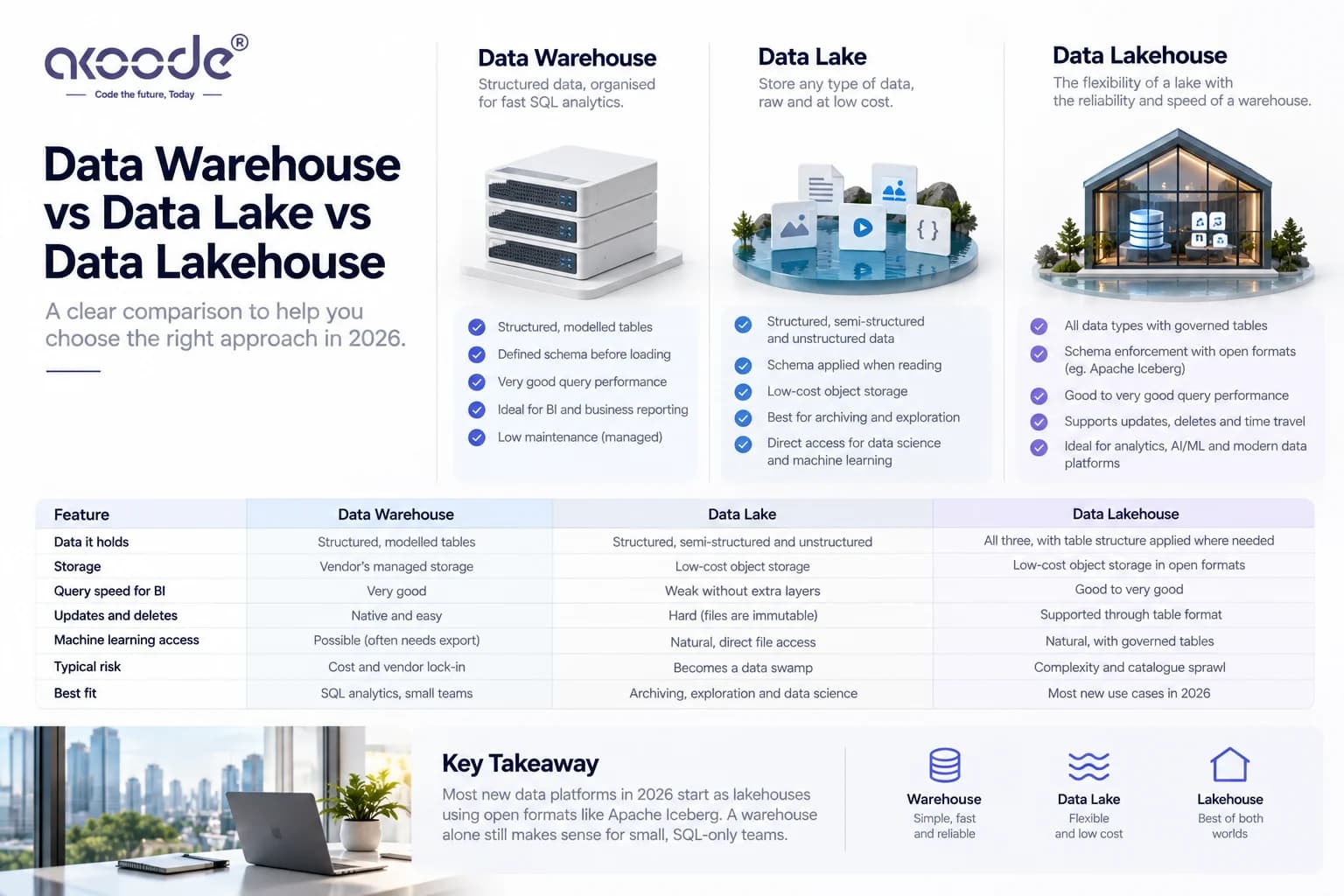
Blockchain vs Database: What Actually Differs
Dimension | Conventional database | Ledger database or hash-chained log | Blockchain |
|---|---|---|---|
Who operates it | One organization | One organization | Many parties, or the public |
Who must trust whom | Users trust the operator | Users trust the operator, but can detect tampering | Nobody has to trust a single operator |
Edit and delete | Free | Edits are recorded, history is preserved | Effectively append-only |
Third-party verification | Not possible without access | Possible with exported proofs | Built in |
Throughput and latency | Highest | High | Lower, set by consensus and network |
Cost to run | Lowest | Low | Highest, with fees or validator infrastructure |
Privacy controls | Fine-grained | Fine-grained | Needs deliberate design |
Best for | Systems you own | Audit-heavy systems you own | Shared systems with no neutral owner |
The Middle Options Most Teams Skip
A large share of "we need a blockchain" requests are really "we need tamper-evident records." You can get that without a distributed network.
The simplest version is a hash-chained audit log: each entry stores the hash of the one before it, so changing any past entry breaks every hash after it. Some databases ship this natively. SQL Server and Azure SQL offer ledger tables, and Oracle offers blockchain tables, both of which give you cryptographic tamper evidence inside a normal database engine. If you need stronger external proof, compute a Merkle root of the day's records and publish just that fingerprint to a public chain on a schedule. Anyone can later prove a record existed in that state on that date, and you pay for one small transaction a day instead of running a network.
For credentials, certificates and licenses, signed records using W3C verifiable credentials often solve the "employer can verify without calling the university" problem with no shared ledger at all. Blockchain becomes useful there only if you also need a public, neutral registry of issuers or revocations.
Public, Private or Consortium: Choose After the Fit, Not Before
Once the test says yes, network type follows from who needs write access and who needs to read.
A permissioned network such as Hyperledger Fabric suits a known group of companies that need privacy between members, such as a supply chain with a dozen vendors. A public network suits cases where anyone must be able to verify or participate, such as open settlement or consumer-facing assets. The old objection to public chains, cost, has weakened. The Ethereum Foundation's 2026 builder guide notes that after the Pectra and Fusaka upgrades, base-layer fees run in the range of cents per transaction under normal load, and that for many apps the real question is now whether a specific Layer 2 offers a distribution, liquidity or user-experience advantage worth the added moving parts. Our guide to real-world asset tokenizationgoes deeper on how that choice plays out for regulated assets.
The Immutability Problem: Privacy Law and Permanent Records
Blockchains are built to resist edits. Privacy law is built to demand them. The EU's GDPR gives people a right to erasure, and India's DPDP Act gives people rights to correction and erasure as well. A design that writes personal data directly onto an immutable ledger can put you in conflict with both from day one.
The usual pattern is to keep personal data in an ordinary, access-controlled database and put only a salted commitment, a signature or a status flag on-chain. A plain hash of personal data can still count as personal data if it can be reversed by guessing, so the salt and the original values stay off-chain. When a deletion request arrives, you delete the off-chain record and the key that links it, and what remains on-chain is meaningless. Decide this before you pick a network, because retrofitting it is painful. This is also a good moment to involve counsel in each market you serve.
Where Blockchain Is Earning Its Cost in 2026
The strongest evidence this year is financial. Tokenized real-world assets, mostly U.S. Treasury products and private credit, stood at roughly $38.8 billion in distributed value in mid-September 2026 according to rwa.xyz figures, and the Depository Trust and Clearing Corporation has slated a tokenization service launch for October 2026. Those are cases where multiple regulated parties, round-the-clock settlement and programmable ownership all matter at once.
The weaker cases are just as common. Single-company loyalty points, internal inventory tracking, and most e-voting pitches fail the test because one party controls the data or because the actual need is an audit trail.
Industry | Where blockchain usually fits | Where it usually does not |
|---|---|---|
Stablecoin and tokenized-asset settlement, multi-party lending | Internal ledgers a single bank controls | |
Shipments crossing many independent custodians | One company tracking its own fleet | |
Fractional ownership and multi-party title records, where the law supports it | Listing and CRM workflows | |
Parametric payouts triggered by trusted data feeds | Claims that need human judgment | |
A neutral registry of issuers and revocations | Credentials one institution can simply sign | |
Integrity proofs across providers that share no system | Storing patient records on-chain |
What a Feasibility Sprint Should Produce
A proper feasibility engagement takes about two to four weeks and ends with a decision, not a slide deck of possibilities. You should walk away with the seven-question scoring for your real process, a map of which parties would write and which would only read, a recommended network type and consensus model if the answer is yes, a data-privacy design that keeps personal data off-chain, and a clear list of what happens off-chain, in your existing systems. If the answer is no, you should get the cheaper design that solves the actual problem and a plain statement that blockchain is not needed yet.
When the answer is yes, the next stages are contract development with an independent audit, then application and integration work. Timelines are in the same range we publish openly: roughly four to eight weeks for a single well-defined smart contract use case including audit, and three to six months for a full dApp with custom network and integrations. We do not compress the audit to hit a date. For the security side, read our smart contract audit guide.
Common Mistakes That Sink the Business Case
Picking the chain first and the use case second.
Assuming immutability is a feature when your process needs corrections and reversals.
Putting personal or commercially sensitive data directly on a shared ledger.
Building a consortium network without agreeing who pays, who governs and how members leave.
Treating the token as the product when the real product is the workflow around it.
Skipping integration, so the blockchain runs beside the business instead of inside it. Our software development and cloud and DevOps teams handle the systems the ledger has to plug into.
Frequently Asked Questions
What is the main difference between a blockchain and a database?
A database is run by one party who can change or delete records. A blockchain is run by many parties, records are effectively append-only, and anyone with access can verify the history independently. That makes blockchain slower and costlier, and useful only when no single trusted operator exists.
When should a business use blockchain instead of a database?
Use blockchain when multiple parties who do not fully trust each other must share one record, when removing an intermediary is the goal, or when outsiders must verify history without relying on you. If you control the data and everyone trusts you, use a database.
Can a database be made tamper-evident without blockchain?
Yes. Hash-chained audit logs, ledger tables in SQL Server and Azure SQL, and Oracle blockchain tables provide cryptographic tamper evidence. Publishing a Merkle root to a public chain on a schedule adds independent proof for the cost of one small transaction.
Is blockchain compatible with GDPR and India's DPDP Act?
It can be, if you design for it. Keep personal data in an off-chain database, store only salted commitments or status flags on-chain, and delete the off-chain record and linking key when someone exercises their erasure rights. Writing personal data directly to a public ledger is the design to avoid.
How long does a blockchain feasibility study take?
Typically two to four weeks. It should end with a go or no-go decision, a recommended architecture if the answer is yes, and a cheaper alternative if the answer is no.
How much does blockchain development cost?
It depends on network type, smart contract complexity, audit depth and compliance scope, so any number quoted before the use case is understood is a guess. Book a call with our founder and we will give you a fixed estimate after scoping.
Will you tell me if I do not need blockchain?
Yes, in the first conversation. We would rather point you to a better-fitting service, or tell you not to build yet, than take a project that will not pay back.
Next Step: Get an Honest Answer Before You Spend a Rupee or a Dollar
Akoode is a software development company with offices in Gurugram, India and Jenks, Oklahoma, serving clients across India, the UK and the USA. We hold a 4.9 rating on Google from 126 reviews and a 5.0 out of 5 on GoodFirms, and we have shipped 180+ projects across 15+ industries. We do not yet have a published blockchain case study, and we will say so plainly in a scoping call rather than dress up adjacent work.
If you want a verdict on your specific use case, book a conversation with Akhil Verma, or review the full scope on our blockchain development company page. The logical next read is our guide to how smart contract audits work and what they miss.
Get In Touch Now
View More Our Blog