

 October 16, 2026
The Short Answer
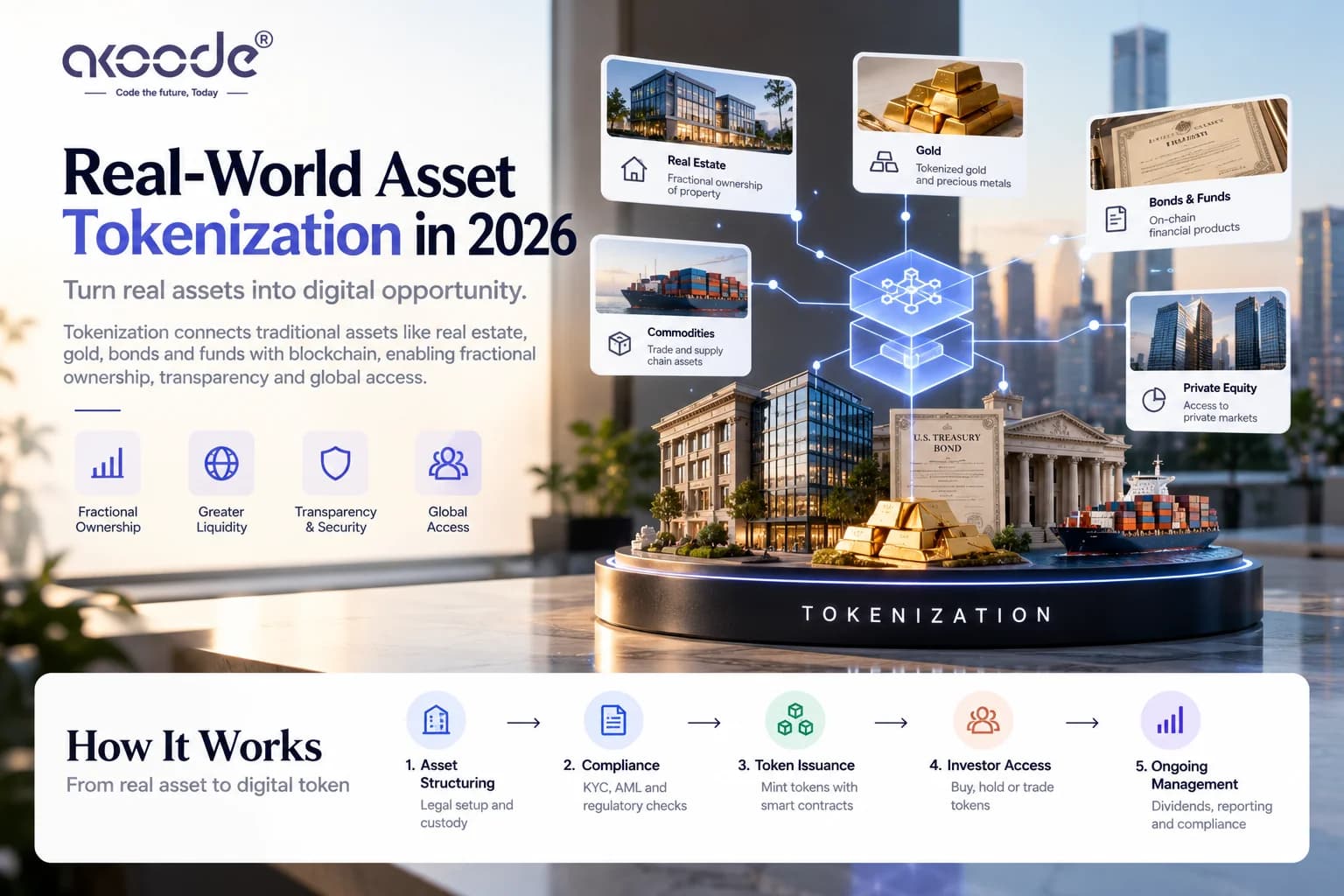
Real-world asset (RWA) tokenization is the process of representing a legal claim on an off-chain asset, such as a Treasury bill, a loan, a building or a bar of gold, as a token on a blockchain. The token is only as good as the legal structure behind it. The smart contract automates ownership records, transfers and payouts, while custody, law and compliance still happen in the real world.
This guide is for founders, product leads and finance teams deciding whether and how to tokenize. It covers the 2026 market, the architecture layers, token standards, chain choice, compliance by region, asset-by-asset realities and a launch plan. We also say where tokenization is still thin, because the hype outruns the data in some segments. For delivery details, see our blockchain development services.
The RWA Market in 2026: Real Growth, Messy Numbers
Different trackers measure different things, so quoted totals vary. According to rwa.xyz figures reported in mid-September 2026, tokenized real-world assets stood at about $38.8 billion in distributed on-chain value, excluding stablecoins, against hundreds of billions in represented underlying asset value. A mid-2026 Stobox analysis noted that on-chain value roughly tripled from about $11.8 billion a year earlier, and that Ethereum held about 48 percent of RWA value, with BNB Chain, Solana and Stellar following. Early in the year, tokenized funds, gold and equities were driving growth, with tokenized Treasuries passing $10 billion in February.
Forecasts for 2030 disagree wildly. McKinsey's base case sits near $2 trillion and BCG's near $16 trillion, an eightfold gap. Treat any single projection as a scenario, not a plan. What matters for a builder is that large institutions now run live products, and the Depository Trust and Clearing Corporation has slated a tokenized securities service for October 2026, which pulls settlement-layer tokenization toward mainstream market infrastructure.
The weak spot is liquidity. Much activity is still mint-and-redeem rather than active secondary trading, and real estate is the hardest segment to measure: rwa.xyz showed only about $226 million in distributed tokenized real estate against $1.34 billion represented in September 2026. If a pitch promises instant liquidity for fractional property, ask who the buyers are.
Tokenization Starts With the Legal Wrapper, Not the Token
A token does not make you the owner of anything. The legal structure does. In most compliant deals, the asset sits in a special purpose vehicle or trust, and the token represents an interest in that entity, with rights defined in offering documents. Get this wrong and you have a digital collectible with no enforceable claim. Before any code, settle who legally holds the asset, what token holders are entitled to, how redemptions work, who the transfer agent is and which securities exemption applies. Treat counsel as a founding member of the project.
The Six Layers of a Tokenization Platform
Layer | What it does | Common failure |
|---|---|---|
Legal and custody | Holds the asset, defines investor rights | Token not tied to an enforceable claim |
Identity and compliance | KYC, AML, accreditation, jurisdiction rules | Checks done off-chain and not enforced on transfer |
Token contract | Issuance, transfer restrictions, dividends, corporate actions | Admin keys too powerful, no recovery path |
Data and oracles | Prices, NAV, proof of reserves, asset status | Stale or single-source feeds |
Issuance and investor apps | Onboarding, subscription, redemption, reporting | Clunky wallets that lose retail users |
Integration | Banks, payment rails, ERP, cap table, registrar | A chain that never connects to operations |
The last layer is the one projects skip. A tokenized fund that cannot reconcile with the administrator's books is a liability. This is the integration work our software development team handles alongside the on-chain components.
Token Standards Worth Knowing
Standard | Use it for | Notes |
|---|---|---|
ERC-20 with an allowlist | Simple permissioned tokens | Easy, but compliance logic is custom and easy to get wrong |
ERC-3643 (T-REX) | Regulated securities with on-chain identity | Transfers blocked unless the receiver is verified and rules pass |
ERC-1400 family | Security tokens with partitions and forced transfers | Older, still seen in legacy deployments |
ERC-4626 | Yield-bearing vault shares, tokenized funds | Mind rounding and first-depositor attacks |
ERC-7540 | Vaults with asynchronous deposits and redemptions | Fits assets that cannot redeem instantly |
ERC-721 or ERC-1155 | Unique assets such as a specific property or artwork | Pair with a legal wrapper, not a metadata link |
Whatever you choose, regulators expect the issuer to be able to freeze, recover or force-transfer tokens in defined cases, such as court orders or lost keys. That requires privileged functions, and those privileged functions are exactly what attackers target. Read our smart contract audit guide on why admin key security caused most stolen value in 2026, and plan multisig control, timelocks and monitoring for every privileged role.
Choosing a Chain for Tokenized Assets
The question is no longer simply "which blockchain." The Ethereum Foundation's 2026 builder guide notes that base-layer fees are now in the cents-per-transaction range under normal load, after the Pectra and Fusaka upgrades, and that account abstraction through EIP-7702 and ERC-4337 lets ordinary wallets offer batching, gas sponsorship and passkey-style recovery. For many issuers, Ethereum mainnet is back on the table, with a Layer 2 chosen only for a clear distribution, liquidity or cost advantage.
Option | Strengths | Trade-offs |
|---|---|---|
Ethereum mainnet | Deepest liquidity and tooling, largest RWA share | Public data, some cost at scale |
Ethereum Layer 2 | Lower fees, familiar tooling | Bridging and sequencer assumptions to review |
Solana | Fast, low fee, growing tokenized equity activity | Different tooling and standards |
Stellar | Payments and asset-issuance focus | Smaller DeFi ecosystem |
Permissioned network (for example Hyperledger Fabric) | Privacy between known members | Limited outside liquidity |
Decide from your investors' wallets, your liquidity plan and your privacy needs, not from chain loyalty. If counterparties are known banks that need confidentiality, permissioned may win. If you want open access and composability, public wins.
Compliance by Region: A Starting Map, Not Legal Advice
Rules change quickly and depend on the asset and the investor. This is orientation only, and you need local counsel in every market you sell to.
United States. Most tokenized securities are offered under exemptions such as Regulation D or Regulation S, with transfer restrictions and a registered transfer agent where applicable. Payment stablecoins have their own federal framework. Broader market-structure legislation was moving through the Senate in spring 2026, so check its current status before you finalize a design.
European Union. MiCA covers crypto-assets that are not financial instruments. Tokenized securities generally fall under existing financial-instrument rules and the DLT Pilot Regime instead, so classification comes first.
United Kingdom. The Digital Securities Sandbox lets firms test tokenized securities under supervised conditions.
Hong Kong and UAE. Both are building structured pathways, and the Hong Kong Monetary Authority runs live pilots for tokenized deposits and funds.
India. Rules for tokenized securities and crypto-assets remain unsettled, so treat any India-facing offering as a case-by-case legal question.
Whatever the region, KYC and AML checks should be enforced by the token contract on every transfer, not just at onboarding. Personal data stays off-chain, with only verification status or a commitment on the ledger, which is the same privacy pattern we describe in our guide on when you need blockchain versus a database.
Asset-by-Asset Reality Check
Asset class | Where it stands in 2026 | Main challenge |
|---|---|---|
Treasuries and money market funds | Largest segment, live products from major managers | Distribution and differentiation, yields are commoditized |
Private credit and trade finance | Substantial and growing, thousands of assets tracked | Off-chain default handling and data quality |
Commodities such as gold | High trading volumes in tokenized gold | Custody audits and redemption terms |
Equities | Fast-growing, especially on Solana and BNB Chain | Corporate actions, jurisdiction limits, voting rights |
Real estate | Small on-chain footprint relative to the market | Title law, local registries, thin secondary demand |
Insurance-linked and parametric products | Early, promising for automatic payouts | Trusted trigger data |
If your sector is real estate, finance and banking, logistics or insurance, the use case often works best when it solves a settlement, transparency or fractional-access problem that exists today, not when it is added to an asset because tokens are fashionable.
Build, Buy or Combine
Issuance platforms such as Securitize and Tokeny offer ready-made compliance and issuance tooling, and they can be the fastest route for a standard fund or equity token. Custom builds make sense when your asset has unusual economics, you need deep integration with existing systems, you want control of the investor experience, or platform fees and lock-in would hurt at your scale. Many projects combine both, using a compliance framework such as ERC-3643 and building custom investor apps and integrations on top. We will tell you in a scoping call if an off-the-shelf platform fits better than a build.
A Practical Launch Plan
Validate the case. Confirm tokenization solves a real settlement, access or cost problem. A feasibility and architecture engagement typically takes two to four weeks.
Fix the legal structure. Choose the wrapper, the exemption, the jurisdictions and the transfer agent arrangement.
Model the economics. Supply, fees, redemption mechanics and what holders can actually do with the token, stress-tested against realistic behavior.
Select the standard and chain. Based on compliance needs, investors and liquidity.
Build the contracts and compliance layer. Specification first, with security built into the code from the first line.
Audit independently. A single well-defined contract set, including audit, usually runs four to eight weeks, and we do not compress the audit.
Build apps and integrations. Investor onboarding, admin tooling, reporting and connections to banks and back-office systems. A full platform with custom components typically runs three to six months.
Launch with monitoring. On-chain alerts, key management procedures, an incident plan and a path for upgrades.
Where Akoode Fits, and Where We Are Honest About Limits
Akoode builds software, AI and blockchain systems from offices in Gurugram, India and Jenks, Oklahoma, for clients in India, the UK and the USA. We hold a 4.9 rating on Google from 126 reviews and 5.0 out of 5 on GoodFirms. We do not have a published tokenization case study. Our nearest public work is in real estate software, such as the real estate CRM we built for WeGrow InfraVentures, which is adjacent to this field and not a tokenization project. What we bring to tokenization is engineering discipline: scoping against a validated use case, security review separate from development, and integration into the systems your business already runs. If a tokenized structure is the wrong answer for your asset, we will say so.
Frequently Asked Questions
What is real-world asset tokenization?
It is representing a legal claim on an off-chain asset, such as a bond, loan, property or commodity, as a blockchain token. The token's value depends on the legal structure and custody behind it.
How big is the tokenized RWA market in 2026?
rwa.xyz figures reported in mid-September 2026 put distributed on-chain value at about $38.8 billion excluding stablecoins. Totals vary by tracker and by whether you count distributed or represented value.
Which asset classes are tokenized most today?
U.S. Treasury and money market products lead, followed by private credit, tokenized gold and commodities, and tokenized equities, which are the fastest growing. Real estate remains small on-chain compared with its size off-chain.
Which token standard should I use for a regulated asset?
ERC-3643 is a common choice for securities because it enforces identity and compliance rules on every transfer. Tokenized funds often use ERC-4626 or ERC-7540 vaults. The right choice depends on your legal structure and asset.
Is tokenization legal in my country?
It depends on the asset, the investors and the jurisdiction. The United States, European Union, United Kingdom, Hong Kong and UAE have defined pathways to varying degrees, while other markets, including India, remain unsettled. Get local legal advice before you design the product.
How long does it take to build a tokenization platform?
Feasibility takes about two to four weeks, a well-defined contract set with audit about four to eight weeks, and a full platform with custom components three to six months, depending on complexity and compliance scope.
How much does tokenization cost?
Cost depends on network, contract complexity, audit depth and regulatory scope. We give a fixed estimate after scoping. Book a call with our founder to start.
Does tokenization guarantee liquidity?
No. Tokenization makes transfer technically easier, but liquidity needs buyers, market makers and permitted venues. Many tokenized products still rely mainly on issuer minting and redemption.
Next Step: Test the Idea Before You Build It
If you are weighing a tokenized product, the cheapest step is a scoping conversation that tests the legal structure, the economics and the architecture together. Book time with Akhil Verma or see the full scope on our blockchain development company page. If you are earlier than that, start with our guide on whether you need blockchain at all. The next piece worth reading in this cluster is on Layer 2 selection for enterprise products.
Get In Touch Now
View More Our Blog