


 October 16, 2026
Short answer
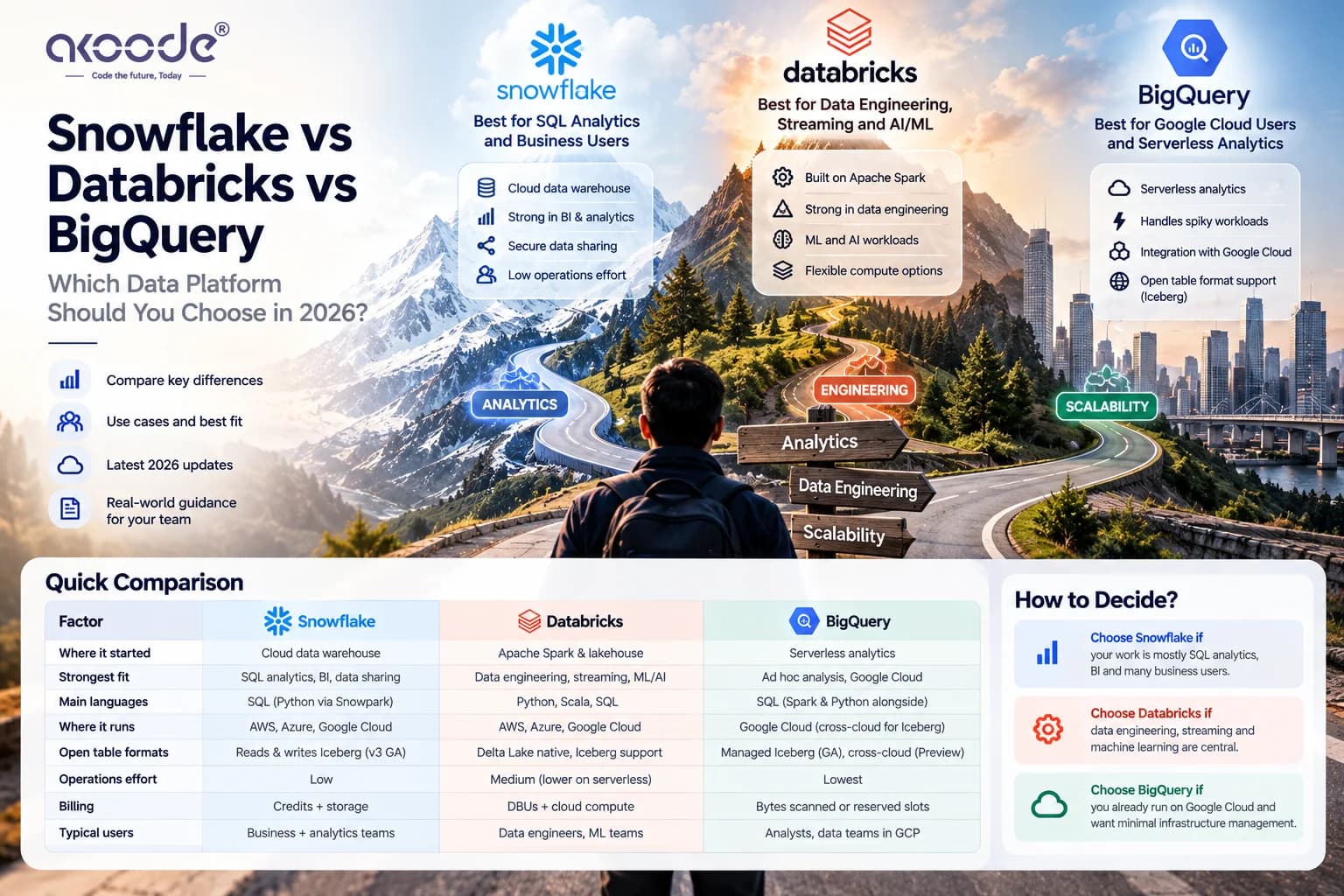
Pick Snowflake when your work is mostly SQL analytics for many business users. Pick Databricks when data engineering, streaming and machine learning sit at the centre and your team writes Spark or Python. Pick BigQuery when you already run on Google Cloud and want very little infrastructure to manage. All three now read Apache Iceberg, so the choice is less permanent than it was two years ago, and governance matters more than the logo.
Last updated 16 October 2026. Vendor figures come from company announcements and Reuters reporting, linked where used.
Why This Question Is Harder to Answer in 2026
Two years ago you could say "warehouse or lakehouse" and get a clear answer. Today every platform does a bit of everything. Snowflake runs Python and machine learning. Databricks sells a SQL warehouse that has become a serious business of its own. BigQuery reads open table files that sit in someone else's cloud. The feature lists overlap so much that comparing them line by line tells you very little.
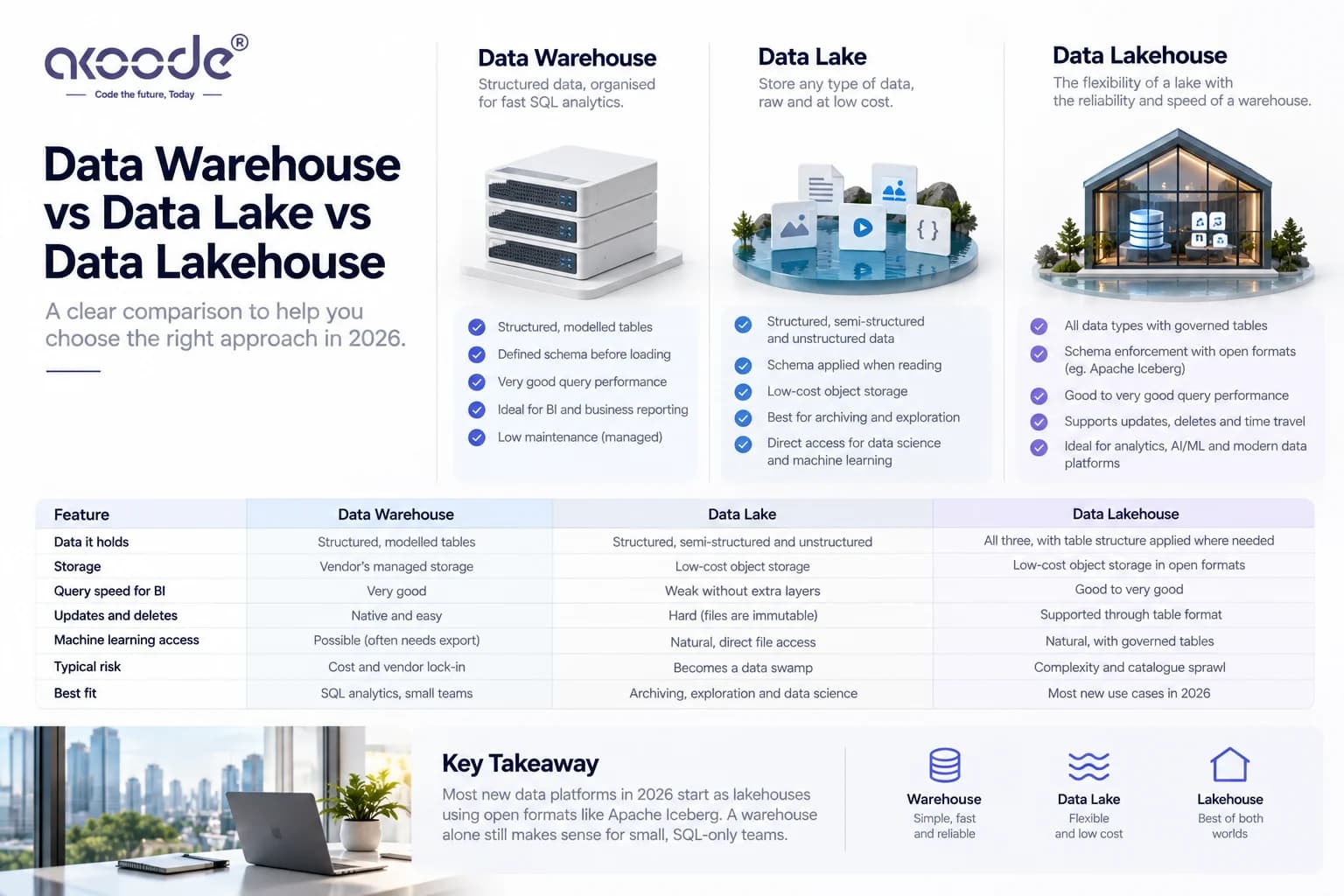
What still differs is where each platform started, and that origin shows up in how your team feels working on it six months in. This guide is written from the delivery side: the choices that change how long a build takes, what it costs to run, and how painful it is to change your mind later. If you are still deciding how your storage should be shaped, start with our guide to data lake vs data warehouse vs data lakehouse, then come back here.
What Changed in the Last Six Months
Three developments matter for a buying decision.
Databricks moved into warehouse territory at speed. On 13 August 2026 the company told Reuters it had raised USD 5 billion at a USD 190 billion valuation, passed a USD 7 billion annualised revenue run-rate, and grown more than 80% year on year in its second quarter. Its Lakehouse data warehousing business crossed a USD 1.5 billion run-rate, and its serverless Postgres product, Lakebase, passed USD 100 million.
Snowflake accelerated instead of slowing. For the quarter ended 31 July 2026, Snowflake reported product revenue of USD 1.49 billion, up 37%, and raised its full-year product revenue guidance to USD 6.07 billion. Multiplied by four, that quarter lands near USD 6 billion a year, which puts the two companies at broadly similar scale.
A caution on those numbers. Databricks reports an annualised run-rate, which flatters fast growth. Snowflake reports recognised revenue for a quarter. Do not treat them as a like-for-like scoreboard. The useful reading is simpler: both are growing quickly because AI projects need a trustworthy place to read data from, so spending on data platforms is rising on both sides.
Google rebuilt the BigQuery lakehouse story. On 20 April 2026 Google renamed BigLake to Lakehouse for Apache Iceberg. Its release notes show a cross-cloud Lakehouse in Preview from 22 April, which lets BigQuery query Iceberg data held in other clouds and catalogs, including Databricks Unity Catalog on AWS and, from June, AWS Glue. Preview features should be tested before they are trusted in production.
Snowflake, Databricks and BigQuery Side by Side
Question | Snowflake | Databricks | BigQuery |
|---|---|---|---|
Where it started | Cloud data warehouse | Apache Spark and the lakehouse | Serverless analytics on Google Cloud |
Strongest fit | SQL analytics, BI, governed data sharing | Heavy data engineering, streaming, ML and AI workloads | Ad hoc analysis, spiky query loads, Google Cloud estates |
Main language of the team | SQL first, Python through Snowpark | Python, Scala and SQL, notebook driven | SQL first, with Spark and Python alongside |
Where it runs | AWS, Azure, Google Cloud | AWS, Azure, Google Cloud | Google Cloud, with cross-cloud access to open table data |
Open table format support | Reads and writes Iceberg; Iceberg v3 reported generally available in May 2026 | Delta Lake native, Iceberg supported, Unity Catalog exposes Iceberg to other engines | Managed Iceberg tables generally available since April 2026; cross-cloud features partly in Preview |
Operations effort | Low | Medium, lower on serverless compute | Lowest |
Billing unit | Credits for warehouse run time, plus storage | DBUs by workload, plus cloud compute on classic clusters | Bytes scanned (on demand) or reserved slot capacity |
Streaming and ML depth | Growing, strongest in SQL-adjacent work | Deepest of the three | Strong with BigQuery ML and Vertex AI |
Treat the table as a starting point. Feature status changes monthly, and the regional availability of new features can lag in some Indian cloud regions, so confirm each feature you depend on for the region you will use.
Where Snowflake Fits Best
Snowflake is the easiest of the three to hand to an analytics team that lives in SQL. You size a warehouse, point your BI tool at it, and most people never think about clusters. It separates storage from compute cleanly, so a finance dashboard and a data science job can run on different warehouses without fighting for resources.
It is also strong when data has to be shared with partners, customers or other business units under tight control, because sharing is built into the product and not bolted on. Teams with many business users and few platform engineers tend to be happy here.
Where it pinches: heavy, code-first engineering and large-scale model training are possible but are not what the product was shaped around, and the bill can drift upward if warehouses are left running or sized generously for every query. Cost control becomes an ongoing habit, not a one-time setup.
Where Databricks Fits Best
Databricks suits teams whose hard problems come before the dashboard: ingesting messy data at volume, streaming, feature engineering and training models. Engineers work in notebooks and code, and the same platform that transforms the data can train and serve a model on it. If your roadmap includes machine learning in production, that single workspace removes a lot of glue code.
It asks more of your team. Someone has to understand cluster sizing, job orchestration and permissions at a deeper level than a pure warehouse needs. Business analysts can use Databricks SQL, but the culture of the product leans toward engineers. A team without in-house data engineering skill can get lost, which is where a delivery partner or a short staff augmentation engagement earns its fee.
Where BigQuery Fits Best
BigQuery has the least to operate. There are no clusters to size, storage and compute scale on their own, and a team can run its first useful query within an hour of loading data. It handles unpredictable workloads well, such as a marketing team that runs enormous queries on Monday and none on Tuesday.
It is the natural home if your applications, analytics and AI work already run on Google Cloud. It reads Google Analytics, Firebase and Ads data with very little plumbing, which matters for consumer apps and e-commerce. The caution: on-demand pricing by bytes scanned punishes careless queries, so a poorly partitioned table can produce a surprising bill. Capacity pricing exists to cap that, and it needs a little forecasting.
How Pricing Works on Each, Without the Numbers That Go Stale
Vendor price lists change often and rarely reflect what you will actually pay, so we describe the shape of each bill instead. The shape is what surprises people.
Snowflake bills credits for the time warehouses run, plus storage. Costs rise when warehouses are oversized, left running idle, or shared by workloads that should be separate. Databricks bills DBUs according to the type of workload, and on classic compute you also pay your cloud provider for the underlying machines, so two bills have to be read together. Serverless options fold these together. BigQuery bills either for bytes processed or for reserved capacity, so the cost follows how well your tables are partitioned and how disciplined your analysts are.
In every case the cheapest platform on paper is the one your team can operate without waste. A mid-sized team that already knows SQL will usually spend less on Snowflake or BigQuery than on a Spark-based stack it has to learn. A team shipping ML products may find the reverse. For a wider view of how data and engineering budgets behave, see our software development cost guide.
Iceberg Made the Format Less Important and Governance More Important
For years the first argument in any lakehouse project was Iceberg versus Delta Lake versus Hudi. That argument has mostly ended. Industry coverage in July 2026 described Iceberg as the default for new open lakehouses, with Snowflake, Databricks and Amazon all supporting version 3, and with Delta tables readable as Iceberg through a compatibility layer.
This helps you. If your data sits in open files in your own cloud storage, you can point more than one engine at it, and moving off a platform no longer means rewriting your tables. It does not make lock-in disappear. The same coverage made the point that an open format does not automatically protect you, because the catalog that holds permissions, lineage and table metadata is now where dependence lives. Ask each vendor where your access rules and lineage are stored, and whether you can export them.
Six Questions That Decide It
1. What does your team write all day? SQL points to Snowflake or BigQuery. Python, Scala and notebooks point to Databricks.
2. Which cloud are you already committed to? A large existing Google Cloud estate pulls toward BigQuery. A committed spend agreement with AWS or Azure is easier to use through the platforms that run natively there.
3. How much machine learning will run in production? If the answer is a lot, the single-workspace advantage of Databricks counts for more.
4. Is your load steady or spiky? Steady loads favour reserved capacity. Spiky, ad hoc loads favour BigQuery on-demand or Snowflake with auto-suspend.
5. How many outside parties need governed access to your data? Heavy partner sharing favours Snowflake's sharing model.
6. Who will run it after we leave? This is the question most teams skip. The most capable platform is the wrong one if nobody on your side can operate it.
A Two-Week Bake-Off That Settles the Argument
Comparison articles, including this one, only get you to a shortlist of two. A short proof-of-concept on your own data does the rest. Pick three workloads that represent your real week: a heavy transformation job, a dashboard with realistic concurrent users, and one feature-engineering or model-scoring job. Load the same data subset into each finalist and run all three workloads for two weeks.
Record four things: cost per run, the 95th percentile response time for dashboard queries, engineer hours needed to build each workload, and the number of times something broke. Cost per run and engineer hours together usually decide it, and they often overturn the choice people arrived with.
What Indian and Global Teams Should Check First
Data residency. All three platforms can run in Indian cloud regions through AWS, Azure or Google Cloud. If your sector rules or policy require data to stay in India, confirm that every feature you need is available in the Indian region, not just the US one.
DPDP readiness. India's DPDP Rules were notified in November 2025, with most obligations applying from 13 May 2027. Check how each platform handles row-level deletion for erasure requests, retention policies, and audit logging. Deleting a row is easy in a warehouse. Making sure it is also gone from time-travel history and old file versions takes deliberate settings on every platform.
Skills and support hours. Check how many engineers you can realistically hire or contract for each platform in your city, and whether vendor support overlaps your working hours.
Exit cost. Ask what it would take to move to another engine. With open Iceberg tables and an exportable catalog the answer is far better than with proprietary storage.
Frequently Asked Questions
Is Databricks better than Snowflake in 2026?
Neither is better in general. Databricks suits engineering-heavy teams doing streaming and machine learning. Snowflake suits SQL-first analytics with many business users. Databricks reported a USD 7 billion run-rate and Snowflake reported USD 1.49 billion of product revenue in its latest quarter, so both are growing fast and both are safe choices. Fit to your team decides it.
Is BigQuery cheaper than Snowflake?
It depends on usage pattern. BigQuery is often cheaper for spiky, occasional workloads, because you pay for bytes scanned or reserved capacity and do not keep warehouses running. Snowflake can be more economical for steady, well-managed workloads. Poorly partitioned tables on BigQuery and idle warehouses on Snowflake both inflate bills, so cost control habits matter more than the list price.
Can I use Snowflake and Databricks together?
Yes, and many companies do. Because both support Apache Iceberg, one team can store data in open files and query it from both engines. A common split is Databricks for engineering and machine learning and Snowflake for governed analytics and sharing. Running two platforms adds cost and governance work, so do it for a reason, not by default.
Which data platform is best for a small or mid-sized company?
Smaller teams usually do best with the platform that needs the least operating effort, which is often BigQuery on Google Cloud or Snowflake. Choose Databricks at this size only if machine learning or heavy engineering is central to the business. Whichever you choose, start with one use case and one dashboard, not a platform-wide migration.
Does Apache Iceberg remove vendor lock-in?
It reduces it for your data files, because multiple engines can read the same tables. It does not remove lock-in for the catalog, permissions, lineage and platform-specific features. Before committing, ask where access rules and lineage live and whether they can be exported.
How long does it take to migrate to a new data platform?
A focused migration of a few sources and one dashboard layer often takes weeks. A full warehouse migration with many pipelines and reports usually takes several months. Google has said cloud-to-cloud moves now average around nine months, down from multi-year projects. Your own timeline depends on data quality, the number of pipelines and how many reports must be rebuilt.
Next Step
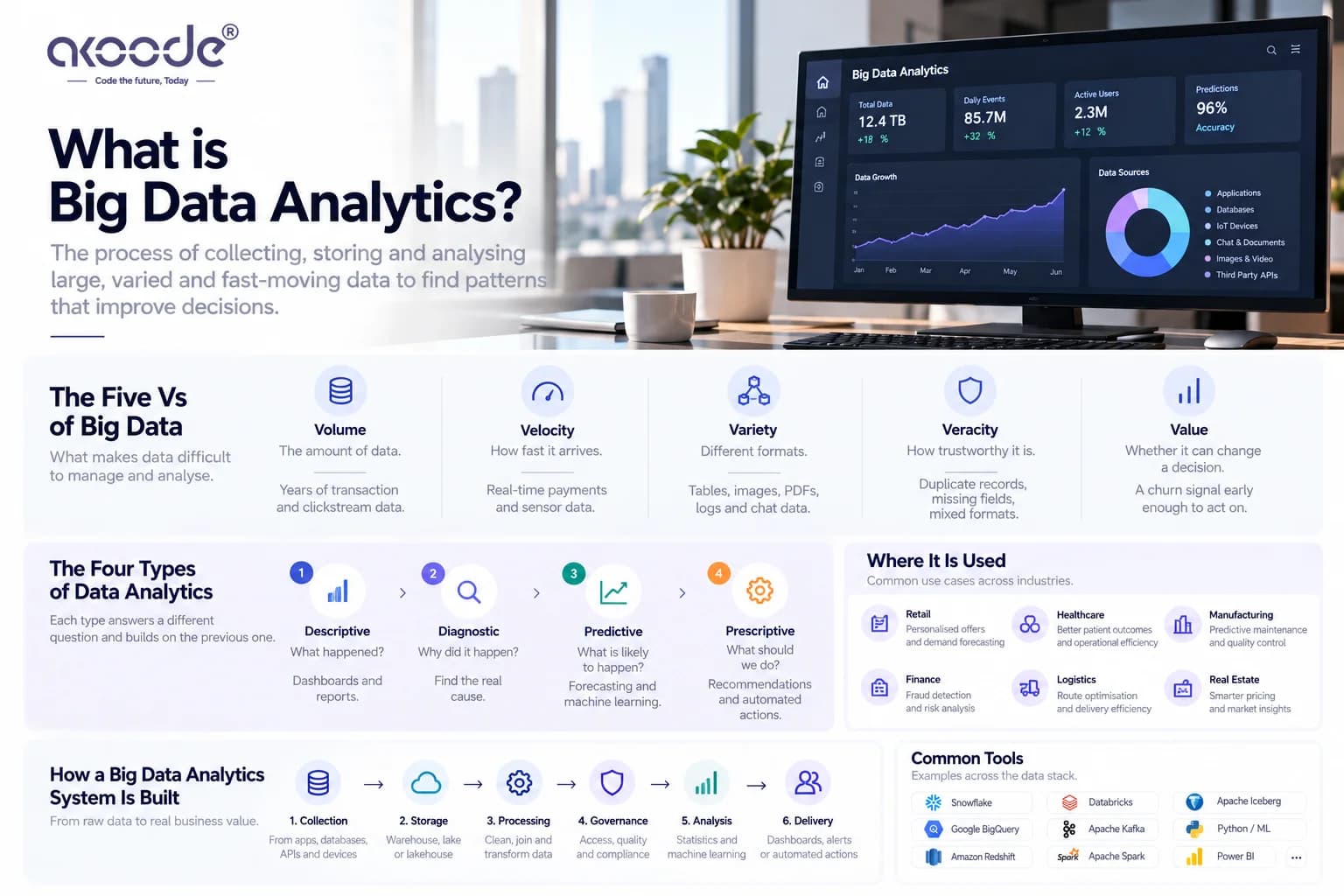
If you are choosing a platform and want a second opinion on your own workloads, our team will help you design the two-week bake-off and read the results with you. See our big data and data analytics services, or book a free assessment call. The best article to read next is what big data analytics is and how the pieces fit together.
Get In Touch Now
View More Our Blog