


 July 17, 2026
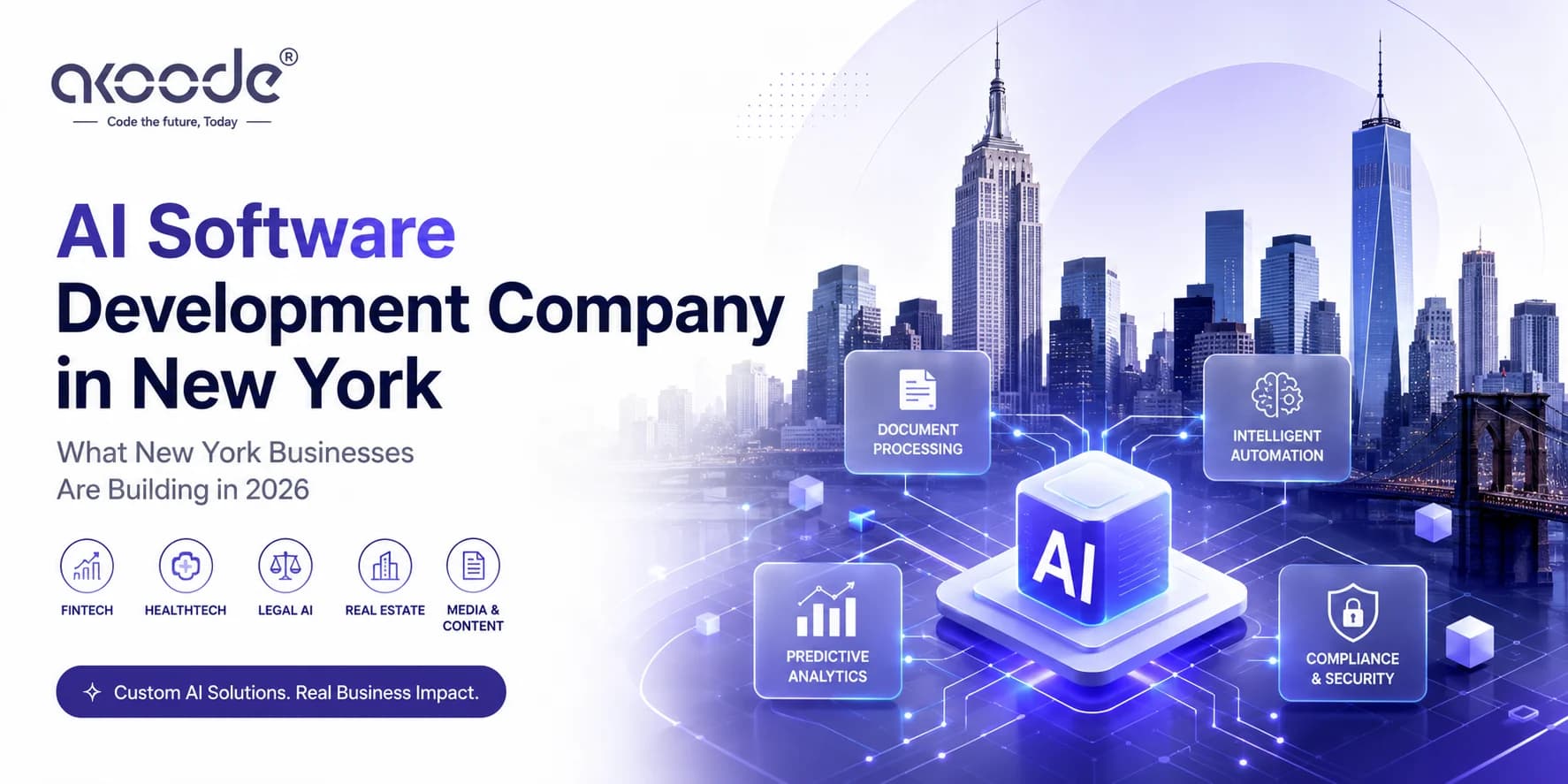
AI Software Development Company in New York: What New York Businesses Are Building in 2026
New York didn't try to become an AI city. It became one anyway.
While San Francisco chased foundation models, New York did what New York always does — it took the technology and pointed it at money. Trading desks. Claims processing. Clinical documentation. Lease abstraction. Compliance review. The unglamorous, expensive, headcount-heavy work that runs the industries this city already dominates.
Enterprise AI and B2B software now account for roughly 35% of total AI capital raised in NYC, with FinTech AI as the second-largest category. Unlike San Francisco, which concentrates on foundation models, NYC AI companies build applied, vertical AI for industries where New York already leads — finance, media, healthcare, and real estate.
That distinction matters enormously if you're a New York business trying to hire an AI software development company. Because the AI work happening in this city isn't research. It's applied engineering — connecting large language models to your actual data, your actual workflows, your actual compliance obligations, and getting something into production that a regulator won't kill.
This guide covers what's genuinely being built in New York right now, what it costs, what the compliance landscape looks like, and how to evaluate an AI development partner without getting sold a demo that never ships.
The New York AI Market in 2026: What the Money Says
Follow the funding and you'll see the shape of the market immediately.
In the first half of 2026, companies primarily building AI and enterprise software attracted roughly $500 million — nearly 45% of all seed funding raised in New York during that period. That's not a bubble metric. That's capital allocating toward applied problems.
The sector breakdown tells you more:
FinTech AI reflects New York's position as the global financial capital. HealthTech AI, legal AI, and AI infrastructure companies make up the remaining major clusters. Series A rounds for NYC AI companies have ranged from $10 million to $75 million, with a median around $20–30 million. AI-focused companies at the seed stage receive valuations approximately 42% higher than non-AI peers.
Financial technology alone accounted for roughly $150 million in seed funding in H1 2026 — and today's founders are focused less on consumer banking and more on infrastructure: modernizing payments, wealth management, accounting, embedded finance, and financial operations.
And on the health side: 113 New York-based health tech companies raised $4 billion in 2024 — the highest total since 2021 and a 60% increase from 2023, with AI driving much of that growth through clinical documentation tools, diagnostic platforms, and care coordination software.
Here's the read: New York is not building AI for the sake of AI. It's building AI to compress the cost of work that currently requires expensive humans in expensive buildings in expensive zip codes. That's a fundamentally different engineering problem than what the Bay Area is solving — and it requires a different kind of development partner.
What New York Businesses Are Actually Building With AI
Forget the demos. Here's what's in production and what's getting funded across New York's core sectors.
Finance and Wall Street
This is the deepest AI market in the city, and it's moved from experimentation to deployment fast.
The AI wave has hit back-office operations hardest. Rillet and similar AI-based upstarts are competing with legacy businesses like Oracle's NetSuite to offer a faster way for companies to balance their books. DataSnipper organizes and digitizes transaction information from receipts and bank statements for auditors. New York-based Rogo, founded by former investment bankers still in their 20s, uses AI to run financial models, make slide decks and handle the rote duties that have had investment banking analysts spending late nights in the office for decades.
The compliance side is even more active. Banks and fintechs run large teams of human analysts conducting manual checks and reviews — AI agents are now automating roughly 80% of that manual work for faster financial crime (AML) reviews. Screening AI can discount 91% of screening alerts, KYB/C AI speeds up onboarding, and transaction monitoring AI handles AML alerts. It's a $24B opportunity in the US alone.
What that means for a New York financial services firm evaluating AI: the highest-ROI use cases are not customer-facing. They're internal — document processing, alert triage, reconciliation, report generation, and analyst workflow compression.
Fintech companies have actually been slower to adopt AI than many other tech sectors, partly due to the high-stakes nature of financial transactions and strict regulations. But those that have are reaping the benefits.
That gap is the opportunity. If you're a mid-market financial firm in Manhattan and you haven't deployed AI into your document-heavy workflows yet, you're not late — you're in the majority. But the window is closing.
Healthcare
New York's healthcare AI market is dense and moving quickly, and it's almost entirely about administrative burden rather than diagnosis.
AI phone agents for healthcare providers now automate manual, time-intensive workflows like patient scheduling, balance reminders, claims status checks, benefit verification, and prior authorizations. That's the workload that consumes front-office staff at every practice and hospital system in the five boroughs.
Other New York healthcare AI companies are building governance infrastructure — vetting AI tools that fill clinical gaps, running evaluations, monitoring every model for drift and compliance, and locking every decision in an immutable audit trail. Real-time AI assistants are being built directly into ambulance reporting systems, guiding medics as they document care and instantly flagging errors.
The pattern is consistent: AI is being deployed where documentation, verification, and coordination consume clinician time. Not where it replaces clinical judgment.
Akoode's healthcare software development work follows the same logic — HIPAA-compliant AI agents for scheduling, intake, prior authorization, and patient communication, with mandatory human escalation on anything clinical.
Media and Entertainment
New York is the media capital, and AI is reshaping production and distribution workflows across publishing, advertising, broadcast, and streaming.
What's actually being built: automated content tagging and metadata generation for archives, AI-assisted editing workflows, personalized content recommendation engines, ad creative generation at scale, rights and licensing document analysis, and audience intelligence platforms.
The media AI opportunity in New York is less about generating content and more about managing the enormous volume of content that already exists.
Real Estate
New York real estate runs on documents. Leases, appraisals, title reports, zoning filings, inspection reports, and offering memoranda — all dense, all unstructured, all currently read by humans.
AI use cases with real traction: lease abstraction and clause extraction, automated property valuation models, tenant screening and application processing, maintenance request triage and routing, and investment memo generation from raw property data.
Our real estate software practice has built AI systems that cut lease abstraction time from hours to minutes — which, at Manhattan portfolio scale, translates directly into headcount economics.
Legal
Legal AI is one of NYC's major AI clusters — unsurprising given the density of law firms in Midtown and the Financial District.
Production use cases: contract review and clause comparison, discovery document classification, legal research assistance, due diligence document processing, and compliance monitoring across regulatory changes.
Retail and E-commerce
New York's DTC and luxury retail scene is deploying AI across customer support, personalization, inventory forecasting, and creative production. The AI customer support agent category alone is resolving 65–85% of tier-1 queries for well-implemented deployments.
What AI Software Development Actually Costs in New York
Here's where the conversation gets real for most businesses.
New York agency rates run $130–$220/hour for general software development. AI specialists sit above that — AI engineers earn about 20% more than general software engineers in comparable roles, according to Robert Half's 2026 Salary Guide, and in New York that premium stacks on an already elevated baseline. Senior AI engineers at NYC agencies routinely bill $210–$300/hour.
Here's what complete AI projects cost:
AI Project Type | NYC Agency | Global Partner (Akoode) | Timeline |
|---|---|---|---|
AI chatbot / support agent | $60,000–$180,000 | $20,000–$60,000 | 6–14 weeks |
Document processing / extraction system | $80,000–$220,000 | $30,000–$75,000 | 8–16 weeks |
LLM-powered internal tool (RAG) | $90,000–$250,000 | $35,000–$85,000 | 10–20 weeks |
Custom ML model (training + deployment) | $150,000–$400,000 | $50,000–$140,000 | 14–24 weeks |
AI-integrated enterprise platform | $300,000–$800,000+ | $110,000–$280,000 | 6–18 months |
Computer vision system | $150,000–$350,000 | $55,000–$130,000 | 12–24 weeks |
Two things worth understanding about those numbers.
The gap isn't a quality gap. It's a geography gap. A senior AI engineer working with GPT-4o, LangChain, and Pinecone produces the same architecture whether they're in Midtown or Gurugram. What changes is what they need to earn to live where they live.
Ongoing costs are separate and permanent. LLM API fees, vector database hosting, infrastructure, and monitoring run $1,000–$25,000/month depending on volume. Model maintenance and retraining adds another 15–20% of build cost annually. Any AI vendor who doesn't raise this in your first conversation is deferring a cost, not eliminating it.
For a fuller breakdown of how NYC pricing works across all software categories, our guide to software development cost in New York covers rate cards by role, project budgets, and the hidden costs that don't appear in agency proposals.
The Compliance Layer Nobody Budgets For
New York doesn't just have federal compliance obligations. It has its own, and they're aggressive.
NY DFS Cybersecurity Regulation (23 NYCRR 500) applies to any financial services company licensed in New York — banks, insurers, mortgage lenders, and increasingly fintechs. It mandates specific technical controls, a designated CISO, annual certification, and incident reporting within 72 hours. An AI system touching regulated financial data must be architected to satisfy this from day one.
The SHIELD Act requires any business handling New York residents' private information to implement reasonable cybersecurity safeguards. Broader than most people realize — it applies whether or not you're headquartered here.
HIPAA for healthcare AI. This adds roughly 20–25% to base development cost: HIPAA-eligible infrastructure, BAAs with every vendor touching PHI (including your LLM provider), encryption, audit logging, and access controls.
NYC Local Law 144 — this one catches people. If you're using AI in hiring or promotion decisions for New York City roles, you must conduct an annual independent bias audit and publish the results. Enforcement is active.
SEC and FINRA obligations for investment advisers and broker-dealers using AI in client-facing recommendations. Explainability isn't optional here.
The practical implication: compliance architecture is 20–30% of your AI project cost in regulated New York industries. It is dramatically cheaper to design it in than to retrofit it after your first audit. Any AI development company that doesn't surface this during scoping either doesn't know the New York regulatory environment or is choosing not to complicate the proposal.
Our finance and banking practice builds AI systems with DFS and SEC requirements baked into the architecture — audit trails, explainability layers, and mandatory human escalation on regulated decisions.
Build vs. Buy: When Custom AI Actually Makes Sense
Not every New York business needs a custom AI system. Some genuinely don't.
Buy an existing platform when:
Your use case is standard — general customer support, basic document summarization, standard CRM enrichment
Speed matters more than fit
Your data volume is modest and workflows are simple
You're validating whether AI helps at all before committing budget
Build custom when:
Your AI needs to read and act on proprietary systems — your OMS, your EHR, your legacy core banking platform
Compliance requires architecture decisions a SaaS vendor can't accommodate
Your data is your competitive advantage and you're not putting it in a shared model
The AI needs to take actions, not just generate text
Per-seat or per-resolution SaaS pricing becomes punishing at your scale
The workflow you're automating is specific to how your business operates
The break-even for most New York mid-market companies lands around 12–18 months. Beyond that, custom wins on both economics and capability ceiling — a pattern we cover in depth in our custom software vs SaaS analysis.
How to Evaluate an AI Software Development Company in New York
Most of the standard vendor evaluation criteria apply — we cover the full process in our guide to hiring a software development company in New York. But AI adds specific questions that general software evaluation misses entirely.
Ask these six AI-specific questions
1. "Show me an AI system you built that's been in production for 12+ months."
Demos are trivially easy with modern LLMs. Production AI is not. Ask what broke, how they monitored it, what they had to fix, and how model performance changed over time. The answer separates teams who ship from teams who prototype.
2. "Walk me through your RAG architecture decisions."
If they can't discuss chunking strategy, embedding model selection, retrieval top-k tuning, and evaluation methodology with fluency — they haven't built production RAG systems. These are table-stakes skills for AI development in 2026.
3. "How do you prevent hallucination in a regulated environment?"
The right answer involves RAG grounding, confidence thresholds, response filtering, and mandatory escalation paths. The wrong answer is "we use GPT-4, it's very accurate."
4. "What's your model evaluation process before deployment?"
Serious AI teams have a testing framework: golden datasets, accuracy benchmarks, adversarial testing, and red-teaming. Teams without one are shipping on vibes.
5. "How do you handle model drift and retraining?"
AI systems degrade. Data distributions shift. If the vendor's engagement ends at deployment, your system's performance will quietly decay and nobody will notice until a customer complains.
6. "Have you worked under [DFS / HIPAA / SEC] requirements?"
Not "can you." Have you. There's a large difference between reading the regulation and having shipped under it.
The AI-specific red flags
They lead with the model, not your problem. "We use GPT-4o" is not a solution. It's a component.
No discussion of data quality. AI projects live or die on data. A vendor who doesn't assess your data before quoting hasn't thought about your project.
They promise accuracy numbers before seeing your data. Nobody can. Anyone who does is guessing or lying.
No evaluation framework. How will you know if it works?
Compliance is an afterthought. In New York, it's an architecture decision.
They don't mention ongoing costs. LLM APIs, vector DB hosting, and monitoring are permanent line items.
NYC AI Agency vs. Global AI Partner: The Honest Comparison
Factor | NYC AI Agency | Global Partner (Akoode) |
|---|---|---|
Senior AI engineer rate | $210–$300/hr | $45–$75/hr |
Typical AI project cost | Baseline | 55–70% lower |
LLM/RAG expertise | Strong at good firms | Equivalent — verify per vendor |
NY compliance knowledge | Generally strong | Strong at US-focused firms — verify |
Access to AI research talent | Real advantage for novel research | Not the strength |
Production AI application delivery | Excellent | Excellent |
Time zone | Same hours | 3–4 hr overlap, async otherwise |
Scaling the team | Constrained by NYC hiring market | Faster — deeper talent pool |
Best fit | Novel research, on-site required, unlimited budget | Production AI applications, cost-conscious builds |
Here's the honest read.
If you're building genuinely novel AI — new model architectures, proprietary foundation models, research-grade ML — New York and the Bay Area have talent concentrations that don't exist elsewhere at the same density. Pay for it.
But that's not what most New York businesses need. What they need is applied AI: an LLM connected to their knowledge base, their CRM, their document store, doing real work in a compliant architecture. That engineering is widely available globally, and the quality ceiling is identical.
The $200,000 difference between an NYC AI agency and a global partner on the same project isn't quality. It's rent.
What Working With Akoode Looks Like
Akoode Technologies builds AI systems for New York businesses across finance, healthcare, media, real estate, and retail. 100+ projects delivered across 15+ industries. 4.9/5 on Google. 5.0/5 on Clutch.
Our AI engineers work with the same stack as any Bay Area or NYC team — GPT-4o, Claude, Gemini, LangChain, Pinecone, Supabase, and production deployment on AWS, GCP, and Azure. Our AI development practice covers everything from focused AI agents to full enterprise AI platforms.
What we do differently: we start with a paid discovery phase before quoting a build. We assess your data before promising anything about accuracy. We surface compliance requirements in the first conversation, not the third invoice. And we'll tell you when a SaaS platform solves your problem better than a custom build would — because sending you to a $200/month tool instead of a $60,000 project is occasionally the honest answer.
We're also upfront about where our engineers sit. India-based senior teams, US presence, NYC-hours communication overlap. No Manhattan address masking offshore delivery at a 4x markup. What you see is what you're buying.
Review our case studies or read more about how we work.
Frequently Asked Questions
How much does an AI software development company in New York cost?
NYC AI agencies bill $210–$300/hour for senior AI engineers. Complete projects run $60,000–$180,000 for an AI chatbot or support agent, $90,000–$250,000 for an LLM-powered internal tool with RAG architecture, and $300,000–$800,000+ for a full AI-integrated enterprise platform. Global partners deliver equivalent scope at 55–70% less. Budget separately for ongoing LLM API and infrastructure costs of $1,000–$25,000/month.
What are New York businesses building with AI in 2026?
Applied, vertical AI rather than foundation models. In finance: AML compliance automation, document processing, and analyst workflow tools. In healthcare: clinical documentation, prior authorization, and patient scheduling agents. In real estate: lease abstraction and valuation models. In media: content tagging, metadata generation, and personalization. In legal: contract review and discovery classification. The common thread is compressing document-heavy, headcount-heavy work.
Do I need a New York-based AI company or can I work with a global partner?
If you need genuinely novel AI research, on-site collaboration, or your contracts mandate US-based vendors, hire locally. For production AI applications — LLM integration, RAG systems, AI agents, document processing — a transparent global partner delivers equivalent outcomes at 55–70% lower cost. The one thing to avoid is a firm with a Manhattan address that quietly delivers offshore at NYC rates.
What compliance requirements affect AI development in New York?
NY DFS Cybersecurity Regulation (23 NYCRR 500) for financial services. The SHIELD Act for any business handling New York residents' data. HIPAA for healthcare AI, adding roughly 20–25% to build costs. NYC Local Law 144 requires annual bias audits for AI used in hiring decisions. SEC and FINRA explainability obligations for investment advisers. Compliance architecture typically adds 20–30% to AI project costs in regulated industries.
How long does it take to build an AI system for a New York business?
A focused AI agent or chatbot takes 6–14 weeks. An LLM-powered internal tool with proper RAG architecture takes 10–20 weeks. A custom ML model with data pipeline work takes 14–24 weeks. Full enterprise AI platforms run 6–18 months. These timelines assume your data is available and reasonably clean — data preparation frequently adds weeks that founders don't anticipate.
What is RAG and why does every AI vendor mention it?
Retrieval-Augmented Generation grounds AI responses in your actual business data rather than the LLM's training data. Instead of the model guessing, it retrieves relevant content from your knowledge base at query time and answers from that. It's what prevents hallucination — the AI confidently inventing facts. For any New York business in a regulated industry, RAG isn't a feature. It's a requirement.
Should I build custom AI or use an existing platform?
Buy a platform if your use case is standard, speed matters more than fit, and you're still validating whether AI helps. Build custom if your AI needs to integrate with proprietary systems, compliance requires specific architecture, your data is a competitive advantage, or per-seat SaaS pricing becomes punishing at your scale. The break-even for most mid-market companies is 12–18 months.
How do I know if an AI development company is legitimate?
Ask for a live AI system they built that's been in production 12+ months — not a demo. Ask them to walk through their RAG architecture decisions. Ask how they prevent hallucination and what their model evaluation process looks like. Ask whether they've shipped under your specific compliance regime. Vendors who can't answer these fluently haven't built production AI, regardless of what their website says.
What ongoing costs come with an AI system?
LLM API fees scale with usage — $200/month for a small deployment, $20,000+/month at enterprise volume. Vector database hosting runs $70–$2,000+/month. Infrastructure adds $100–$10,000/month. Model monitoring and retraining costs 15–20% of build cost annually. These start at launch and never stop. Any vendor who doesn't discuss them upfront is deferring the conversation, not the cost.
Why is New York AI different from Silicon Valley AI?
Unlike San Francisco, which concentrates on foundation models, NYC AI companies build applied, vertical AI for industries where New York already leads — finance, media, healthcare, and real estate. That means the engineering problem is integration and compliance rather than research. Which, practically, means you need a partner who understands your industry's workflows and regulations more than one who publishes ML papers.
What to Do Next
If you're a New York business evaluating AI, the single most useful thing you can do this week isn't shortlisting vendors.
It's writing down the specific workflow you want to compress. Not "we want to use AI." Something like: "Our analysts spend 14 hours a week extracting terms from lease documents, and 80% of those documents follow three standard formats."
That sentence changes every vendor conversation you'll have. It gives an AI team something real to scope against, and it lets you evaluate proposals on substance instead of enthusiasm.
Then check your data. Is it accessible? Is it structured? Is it clean enough that a model could learn from it or retrieve against it? Most AI projects that fail in New York fail on data, not on models.
And then talk to two or three teams — including at least one that will tell you honestly whether your project is worth doing at all.
Also read related Article - Software Development Cost in New York
Talk to Akoode About Your New York AI Project
We'll review your workflow, assess your data, surface the compliance requirements you'll hit, and give you a straight answer on scope, cost, and whether AI is even the right tool for what you're trying to solve.
Sometimes the answer is a $40,000 AI agent. Sometimes it's a $200/month SaaS tool. We'll tell you which.
Book a free 45-minute AI consultation → calendly.com/akhil-akoode/ak
AI software development company in New York | akoode.com | contact us | info@akoode.com
Get In Touch Now
View More Our Blog