


 July 16, 2026
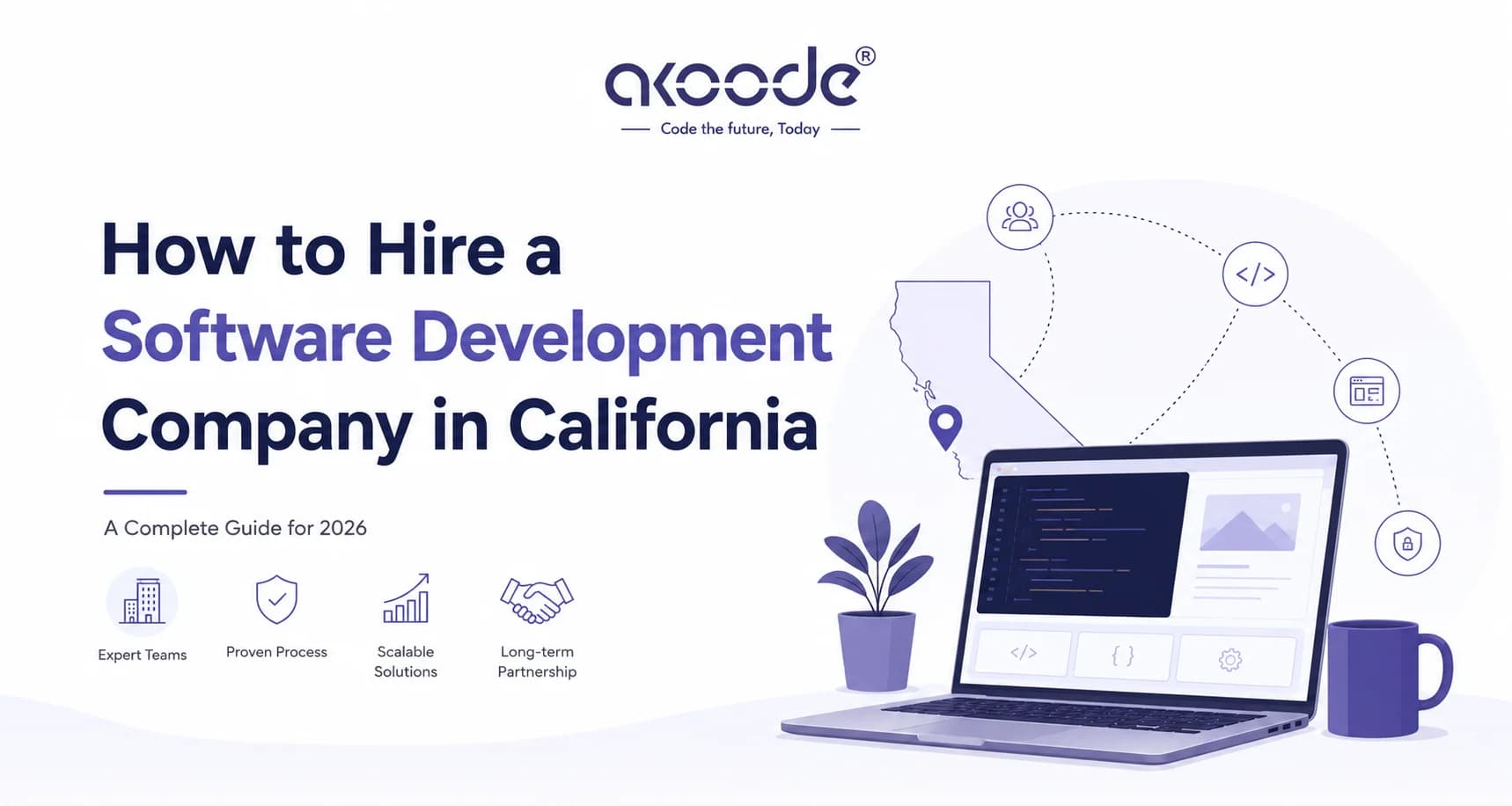
How to Hire a Software Development Company in California (2026 Complete Guide)
Hiring a software team in California is a different game than doing it almost anywhere else in the country. You're not just picking from a handful of local shops — you're choosing from thousands of agencies, freelance collectives, boutique studios, and enterprise consultancies scattered across a state that includes Silicon Valley, Los Angeles, San Diego, Sacramento, and a dozen smaller tech pockets in between. That much choice sounds like an advantage, and eventually it is one, but in the short term it usually just means decision fatigue.
I've watched founders spend six weeks going back and forth between three nearly identical proposals because nobody had a framework for actually comparing them. I've also watched a mid-sized healthcare company sign with a firm that looked great on paper and then spend a year untangling a codebase nobody could explain. The difference between those two outcomes almost never comes down to talent — California has no shortage of talented engineers. It comes down to process: how you evaluate, what questions you ask, and whether you understand what you're actually paying for.
This guide walks through all of it — why California's market works the way it does, when custom software actually makes sense for your business, the exact hiring process to follow, the questions worth asking, the red flags worth walking away from, realistic pricing for 2026, and how to think about local versus offshore versus hybrid teams. If you want to skip ahead and just talk to a team, you can go straight to Akoode's California software development company page. Otherwise, let's get into it.
1. Why California Is Still the Center of Gravity for Software Talent
There's a reason "built in California" still carries weight, even after years of companies talking about relocating to Austin or Miami. The state's software ecosystem is layered in a way most other markets aren't.
Silicon Valley set the culture, and it stuck. Decades of venture capital, engineering talent, and product culture concentrated in the Bay Area created habits that spread statewide — rigorous code review, obsession with user experience, and a bias toward iterative shipping over big-bang launches. Even development shops far from San Francisco tend to inherit some of that discipline.
Los Angeles brought entertainment, media, and consumer tech together. Streaming platforms, gaming studios, and a huge creator economy have made LA one of the strongest markets in the country for consumer-facing product work — apps that need to handle scale, media, and engagement at a level most B2B software never touches.
San Diego quietly became a biotech and life sciences powerhouse. That's produced development teams with real, hard-won experience in regulated environments — clinical trial software, medical device integration, lab data systems — work that punishes sloppy engineering fast.
The Central Valley and agricultural regions have driven serious ag-tech innovation. Sensor networks, yield prediction, supply chain tracking for produce — it's less visible than consumer apps, but it's a real and growing niche with its own specialized development talent.
Aerospace and defense contractors around Southern California have created a pipeline of engineers used to rigorous documentation, security clearances, and systems where a bug isn't just an inconvenience — it's a serious problem. That discipline shows up in how some California teams approach QA and architecture generally.
And then there's AI. California, more than any other state, has become the default home for AI research and applied AI product work. If you're trying to integrate a genuine AI feature into your product — not just a thin wrapper around a chat API, but something trained, tuned, and tested for your actual use case — the depth of talent available in California is hard to match anywhere else in the country.
All of this variety is exactly why picking a software development company in California takes more discipline than picking one almost anywhere else. The pool is enormous, the quality range is enormous too, and industry-specific experience genuinely matters more here than in a smaller, more homogeneous market.
2. When Should a Business Actually Hire a Software Development Company?
Most businesses don't wake up one day and decide "we need custom software." It usually creeps up on them. Here are the situations that, in practice, almost always mean it's time.
Your team is duct-taping spreadsheets together to run the business. If three different departments each keep their own version of "the real numbers" in separate spreadsheets, and someone has to manually reconcile them every week, you're already paying the cost of not having custom software — you're just paying it in labor hours instead of a project invoice.
Your current system is old enough that people are scared to touch it. Legacy platforms built on outdated frameworks tend to accumulate a kind of institutional fear — nobody wants to be the one who breaks the thing that "mostly works." That fear is expensive. It slows every future decision down.
Growth has outpaced your tools. A workflow that was fine at 20 employees or 200 customers can completely fall apart at 10x that size. If your operations team is manually patching over software limitations just to keep things moving, that's a sign the system needs to change, not the process around it.
You have a genuinely repetitive manual task eating hours every week. Approval chains, data entry between disconnected systems, manual report generation — these are usually the highest-ROI first projects for a business that's never worked with a development partner before, because the payback period is short and easy to measure.
You want AI in your product or your operations, and you don't have anyone in-house who can build it properly.This is probably the single fastest-growing reason companies are reaching out to development partners right now — everything from an AI-powered support agent to internal tools that summarize, triage, or predict based on your existing data.
Your CRM doesn't actually match how your team sells. A lot of companies are quietly fighting their own CRM every day, forcing their sales process into software that assumes a different one. A custom build, or heavy customization of an existing platform, often pays for itself within a year just in reduced friction.
You need a mobile app and you've never built one before. Mobile development has its own rules — offline handling, platform review guidelines, performance constraints on older devices — and a general web team without dedicated mobile experience will usually underestimate the work involved.
You need an internal tool that will never exist as an off-the-shelf product. Scheduling systems built around your specific shift rules, inventory dashboards tailored to your warehouse layout, reporting tools that match your actual KPIs — sometimes the fastest path is just building the thing yourself instead of stitching together four SaaS tools that each get you 70% of the way there.
If two or three of these sound familiar, you're past the point where a structured hiring process is optional.
3. The Hiring Process, Step by Step
Step 1 — Get specific about the business outcome you actually want. Not "we need an app." Something closer to "we want customers to be able to reschedule appointments without calling us, because that's currently 30% of our support volume." A vendor can price and plan around that. They can't do much with "we need an app."
Step 2 — Write down your requirements, even roughly. You don't need a formal spec. You need enough clarity on core features, users, integrations, and any compliance requirements (California's privacy law comes up a lot here — more on that in Section 11) that a serious vendor can give you a real estimate instead of a guess.
Step 3 — Set a budget based on real numbers, not a hopeful one. Section 8 has current California pricing. Walking into vendor conversations with a number that's a fraction of what the project actually costs just filters your options down to the vendors willing to overpromise.
Step 4 — Decide on your engagement model up front. Fixed price, time-and-materials, or a dedicated team — each fits different situations, and deciding early narrows your vendor search meaningfully (Section 9 breaks these down in detail).
Step 5 — Build a shortlist of five to eight companies. Cast a slightly wider net than you think you need, because a good chunk of them will drop off during the next few steps.
Step 6 — Actually look at their past work, not just the case study summary. Ask for examples close to your project's size and complexity. A beautifully designed portfolio piece for a five-page marketing site tells you nothing about whether a team can build a multi-tenant SaaS platform.
Step 7 — Read reviews carefully, including the critical ones. Clutch, GoodFirms, and Google reviews all matter, but pay closer attention to how a company responded when something went wrong than to how many five-star reviews they've collected.
Step 8 — Push past the sales conversation into a technical one. Ask specifically to talk with an engineer or technical lead, not just an account manager, before you commit to anything.
Step 9 — Meet the actual people who'll work on your project. Sales teams are often smoother talkers than the engineers who'll be writing your code — and that's fine, but you need to meet both.
Step 10 — Get a proposal that breaks down scope and cost line by line. A single lump-sum number with no detail underneath it is a red flag on its own (more in Section 5).
Step 11 — Compare vendors against identical scope. If three proposals have wildly different prices, the first thing to check is whether they're actually quoting the same thing. Usually they aren't.
Step 12 — Start with a paid discovery phase before the full build. This is, without much competition, the single strongest signal that you're working with a serious team. A vendor willing to map requirements and architecture properly before quoting a full project is a vendor who's actually planning to deliver what they promise.
4. The Questions You Need to Ask Before Signing Anything
Bring these into every call, and pay attention not just to the answers but to how comfortable the vendor is answering them:
Show me a project you've done that's similar in size and complexity to mine.
Who specifically will work on my project, day to day?
Will I have one dedicated point of contact, or will I be routed between people?
Walk me through your discovery process.
What happens if I need to change scope halfway through?
How often do you release or demo progress?
How do you approach testing — manual, automated, both?
What documentation will I actually receive at the end?
Who legally owns the code once the project is done?
If I want to bring development in-house later, how difficult does your codebase make that?
What's your approach to data security specifically?
Have you worked with [your specific compliance requirement] before?
What tools do you use for day-to-day communication and project tracking?
How accurate have your estimates historically been compared to final delivery?
If a deadline is at risk, when do I find out, and how?
Do you offer maintenance and support after launch, and what does that cost?
In a time-and-materials contract, what happens to unused budgeted hours?
Can you connect me with a current or recent client as a reference?
What tech stack would you recommend for this project, and why that one specifically?
If a team member leaves mid-project, what's your continuity plan?
What exactly is included in this quote, and just as importantly, what isn't?
5. Red Flags That Should End the Conversation
A price that's dramatically lower than every other quote. Someone is always cutting a corner to hit that number — usually it's testing, documentation, or the seniority of the people actually assigned to your project.
A fixed-price quote with no discovery phase. That's not an estimate. That's a guess with a dollar sign in front of it.
No single point of contact. If you're not sure who owns your project on their side, communication gaps are coming.
Slow or vague answers during the sales process. This is genuinely the best version of how they'll communicate with you — it only gets harder to get answers once you've signed.
No real testing process. "We test as we build it" without any structure is how bugs make it to production.
No documentation habits. Undocumented systems become someone else's expensive problem eventually — usually yours.
Hand-wavy answers about security. Especially disqualifying if you're dealing with customer data, health information, or payments.
No support plan after launch. A team that disappears the day you go live isn't a long-term partner, no matter how good the build was.
6. How to Actually Evaluate Technical Skill (Not Just Sales Talk)
Frontend engineering. Don't just ask what framework they use — ask how they think about component reusability, performance under load, and accessibility. The answers tell you more than the framework name ever will.
Backend engineering. Look for real experience designing APIs and database schemas meant to hold up under growth, not just get a demo working.
Cloud infrastructure. Ask directly about AWS, Azure, or Google Cloud experience relevant to your use case. Teams that talk comfortably about infrastructure-as-code and cost management tend to be more mature operationally.
AI capability. This is worth being skeptical about right now, because "AI experience" gets claimed loosely. Ask specifically whether they've built, fine-tuned, or evaluated models in production — not just integrated a third-party API and called it done.
DevOps maturity. Automated deployment pipelines and real monitoring practices are a good proxy for a team that ships reliably instead of just quickly.
QA discipline. Ask exactly when testing happens in their process and whether it's automated, manual, or both.
Security practices. Code review standards, dependency scanning, and secure authentication design should be baseline practices, not a premium add-on they mention only if you ask.
Architectural thinking. The strongest signal of seniority is a team that can explain why they'd structure your specific system a certain way — not just describe a generic architecture diagram they use for every client.
7. Agile, Scrum, Kanban, Waterfall — What They Actually Mean for You
Methodology | Best Fit | Flexibility | How Involved You'll Be | Common Use Case |
|---|---|---|---|---|
Agile | Requirements that will evolve as you learn | High | Continuous, ongoing | Most modern product development |
Scrum | Teams that want structured, predictable iteration cycles | Medium-High | Reviews every 1–2 weeks | Product builds with regular releases |
Kanban | Ongoing support and maintenance work | High | As-needed, lighter touch | Maintenance, bug fixes, continuous small features |
Waterfall | Fixed, fully defined requirements that won't change | Low | Mostly upfront, then at delivery | Regulatory or tightly scoped fixed-deliverable projects |
For most California businesses building new products — especially anything involving AI, or any startup product where requirements are still settling — Agile or Scrum wins out almost every time, simply because real user feedback tends to reshape what "done" even means partway through the project.
8. What Software Development Really Costs in California in 2026
California rates run higher than most of the country, largely due to cost of living and the concentration of senior engineering talent. Here's a realistic range for 2026:
Project Type | Typical Cost Range | Typical Timeline |
|---|---|---|
Discovery / Requirements Workshop | $4,000 – $15,000 | 1–3 weeks |
MVP (Minimum Viable Product) | $30,000 – $90,000 | 2–4 months |
Startup Product (Full V1) | $70,000 – $220,000 | 4–9 months |
Enterprise Platform | $180,000 – $600,000+ | 6–18 months |
AI Integration / AI Feature | $20,000 – $120,000+ | 1–5 months |
Ongoing Maintenance | $2,500 – $18,000/month | Ongoing |
What actually moves the number up or down:
Number of distinct user roles and permission levels
Integration complexity — payment processors, ERPs, existing CRMs
Compliance requirements, particularly around California's own privacy regulations
Whether design work is bundled in or handled as a separate track
Seniority of the assigned team, and whether it's fully local, offshore, or blended
Whether you're building standard functionality or genuine custom AI/ML work
If a quote for a California-based custom software development project comes in dramatically outside these ranges, that's worth a direct conversation before you sign anything, not after.
9. California Company vs. Offshore Team vs. Hybrid Model
Factor | California-Based Company | Offshore Team | Hybrid Model |
|---|---|---|---|
Communication | Same time zone, easy in-person meetings if local | Time zone gaps can slow real-time back-and-forth | Local oversight with distributed execution |
Cost | Highest average rates in the country | Generally the lowest cost per hour | Balances cost against local strategic input |
Talent Depth | Extremely deep, especially in AI, biotech, media | Varies enormously by provider and country | Combines local seniority with offshore scale |
Speed to Scale Team | Can be constrained by local hiring competition | Often faster to add engineers quickly | Flexible scaling with local quality control |
Domain Expertise | Strong across entertainment, biotech, aerospace, AI | Depends heavily on the specific provider | Best of both when structured well |
Best Fit For | High-complexity, compliance-heavy, high-touch projects | Cost-sensitive projects with a clearly defined scope | Businesses wanting cost efficiency without losing oversight |
Neither end of this table is automatically "right." A fully California-based team makes sense when a project is complex, regulated, or benefits heavily from in-person collaboration. A well-run offshore team, especially one with strong project management, can deliver excellent results at meaningfully lower cost. Increasingly, businesses are landing on the hybrid model — a California-based team providing architecture, oversight, and client-facing communication, paired with distributed engineering capacity to keep costs sane without losing quality control.
10. Why Communication Style Matters More Than People Think
This is the part that gets underrated during the sales process and then becomes the single biggest source of frustration six weeks into a project.
Look for a team that runs regular status meetings — not just at milestones, but weekly, so small issues get caught before they become expensive ones. Look for sprint planning that actually involves you, not just a schedule handed down. Make sure there's a real-time channel — Slack or Teams — for the small questions that don't deserve a scheduled meeting. Confirm they track work in something like Jira so you can see exactly what's happening without having to ask. And insist on written documentation for decisions, not just verbal agreements that get fuzzy three months later.
Full project transparency — being able to check status any time without chasing someone down for an update — is one of the clearest signs you're working with a team that has nothing to hide.
11. Security, Privacy, and Compliance in California
California businesses face a genuinely different privacy landscape than most of the country, which makes this section worth extra attention if you're building here.
California's state privacy law — often the first thing out-of-state vendors underestimate — governs how consumer data is collected, used, and disclosed, and it applies more broadly than many businesses assume.
HIPAA — essential for anything touching protected health information, and especially relevant given California's large healthcare and biotech sector.
SOC 2 — increasingly a baseline expectation for enterprise clients evaluating any vendor that touches their data.
Encryption — data should be encrypted in transit and at rest as a default, not something you have to specifically request.
NDAs — a serious vendor signs one without hesitation, before any real requirements conversation starts.
Code ownership — get this in writing. Assume nothing based on a verbal conversation.
IP protection — contracts should clearly separate pre-existing components and libraries from the custom IP built specifically for you.
Given how much regulatory attention California gets on data privacy specifically, this is one area worth pushing harder on than you might in a different state.
12. Why the Relationship Shouldn't End at Launch
Launch day feels like the finish line, but it isn't. The businesses that get the most value out of custom software treat the relationship as ongoing, because:
Support and maintenance needs don't stop. Real users find edge cases nobody anticipated during development, and having a team that already understands the system fixes those faster than starting from scratch with someone new.
Scaling decisions get easier with existing context. A team that built the original architecture makes better calls about how to scale it than a team seeing the codebase for the first time.
Feature roadmaps evolve based on actual usage. What you thought users wanted at launch and what the data shows six months later are rarely identical, and a team already embedded in your product adapts to that faster.
Performance tuning is ongoing, not one-and-done. As usage grows, systems need continuous attention — this isn't a single task you check off after launch.
A development partner thinking multiple years ahead, not just to the delivery date, tends to build differently from the very first sprint.
13. A Practical Hiring Checklist
Business goal and success metric written down clearly
Requirements documented, even informally
Budget researched against real 2026 California ranges
Engagement model chosen before vendor outreach starts
Shortlist of 5–8 vendors built
Portfolios reviewed for comparable scale and complexity
Reviews checked on Clutch, GoodFirms, and Google — including negative ones
Direct conversation held with engineers, not just sales
Line-item proposal received, not a single lump sum
Estimates compared against truly identical scope
Paid discovery phase scheduled before full commitment
Communication tools and cadence agreed on in advance
Security and compliance practices verified, including California-specific privacy requirements
Code ownership and IP terms confirmed in writing
Post-launch support and maintenance plan agreed upon
References contacted directly
14. Frequently Asked Questions
1. How do I actually find a good software development company in California? Build a shortlist based on relevant industry experience, then filter through direct technical conversations and a paid discovery phase — not just portfolio screenshots and a sales pitch.
2. Why is software development more expensive in California than other states? Higher cost of living and a concentration of senior engineering talent both push rates up, though the depth of expertise — especially around AI and regulated industries — often justifies the premium for complex projects.
3. Should I hire a local California team or go offshore? It depends on your priorities. Local teams offer easier real-time communication and in-person collaboration; a well-managed offshore or hybrid team can deliver similar quality at a lower cost.
4. How long does a typical software project take in California? An MVP generally takes 2 to 4 months, while a full enterprise platform can run 6 to 18 months depending on scope and integration complexity.
5. Do I automatically own the code my developer writes? Not automatically — only if your contract explicitly says so. Confirm this in writing before the project starts, not after it's finished.
6. What's a discovery workshop, and is it really necessary? It's a short, focused phase to properly map requirements and technical architecture before a full build begins, and it's one of the clearest signs of a mature development partner.
7. How do I know if a vendor's engineers are actually skilled? Talk to them directly, ask about past projects of similar scale, and listen for specific architectural reasoning rather than generic buzzwords.
8. What does California's privacy law mean for my software project? It affects how consumer data is collected, stored, and disclosed, and it applies more broadly than many out-of-state vendors initially assume — worth confirming directly with any vendor you're evaluating.
9. Can a small business realistically afford custom software in California? Yes — many start with a focused MVP or a single automation project in the $30,000–$60,000 range rather than committing to a full platform build immediately.
10. What industries in California most commonly need custom software? Biotech, entertainment and media, aerospace, agriculture technology, and AI-driven products are all especially strong demand areas in the state right now.
11. How do I fairly compare quotes from different vendors? Confirm every vendor is estimating against the exact same documented scope — most "surprising" price gaps actually come from different assumptions, not different value.
12. How do I add AI features to my existing product? Most successful AI integrations start narrow — a specific use case like support automation or predictive analytics — rather than a full platform rebuild, which keeps both cost and risk manageable.
13. What's the most common mistake businesses make when hiring a developer? Choosing based purely on the lowest price, without checking discovery process quality, communication style, or long-term support capability.
14. What happens after my software actually launches? A solid vendor should offer ongoing maintenance, bug fixes, and a feature roadmap — launch is the beginning of the relationship, not the end of it.
15. Is a hybrid team (local plus offshore) actually a good idea? For a lot of California businesses, yes — it combines local architectural oversight and client communication with the cost efficiency of a larger distributed engineering team.
Conclusion
California's software talent pool is deep enough that the hard part was never finding a development company — it's finding the right one for your specific project, budget, and industry. The businesses that get this right treat hiring as a real process: clear goals, a genuine discovery phase, direct technical vetting, and a vendor who's thinking about year three of the relationship, not just the delivery date.
If you'd rather skip the trial and error, Akoode's California software development team can walk you through exactly how this would work for your project — no pressure, just a real conversation about scope, cost, and timeline.
Also read related article - Software Development Cost In California - Full Guide 2026
and Why California Businesses Choose Custom Software Over SaaS 2026
Get In Touch Now
View More Our Blog