


 July 16, 2026
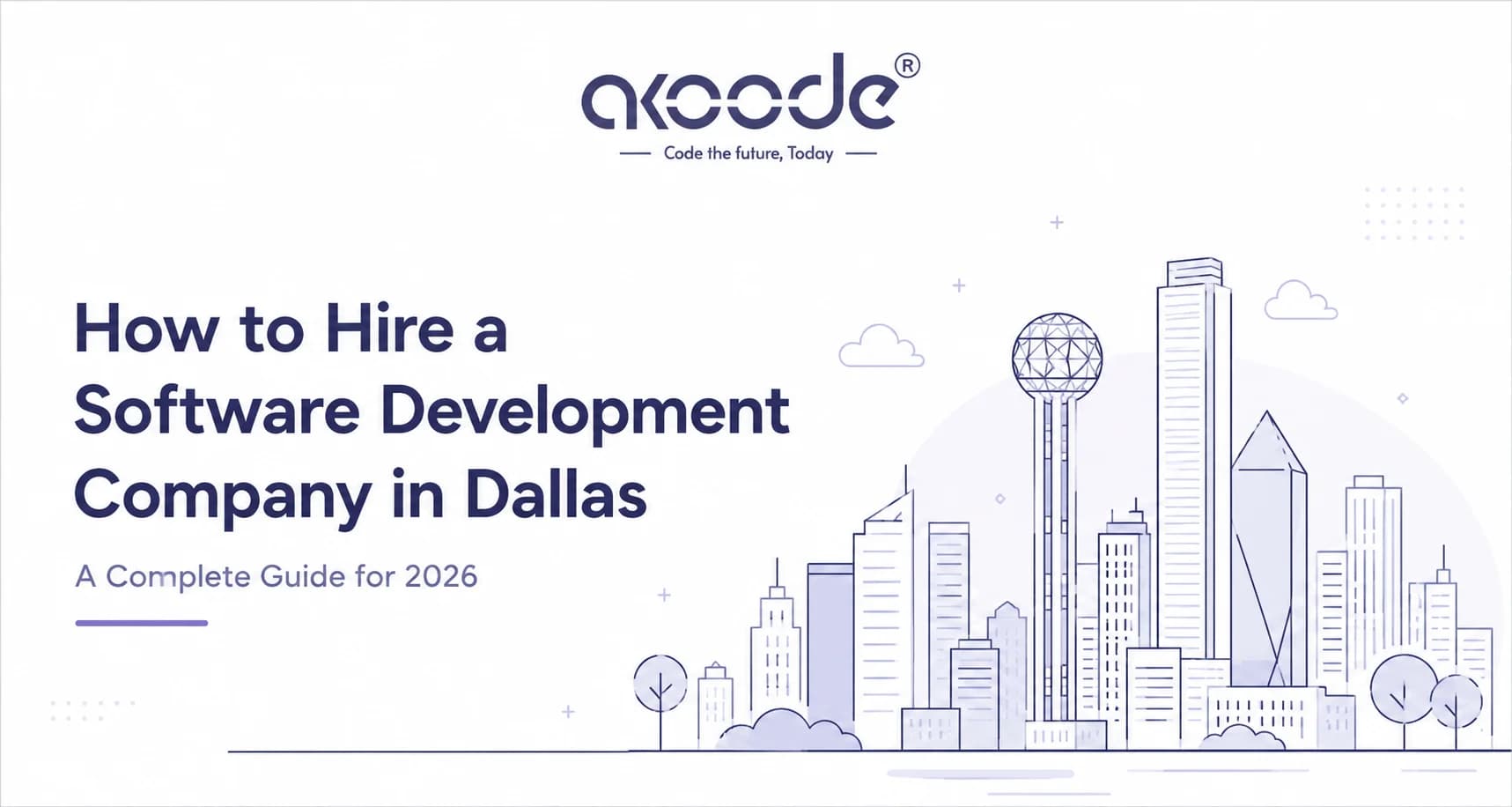
How to Hire a Software Development Company in Dallas (2026 Complete Guide)
If you've ever typed "best software development company in Dallas" into Google at 11 p.m. while trying to figure out why your last vendor blew through the budget and shipped half a product, you're not alone. Hiring the wrong software partner is one of the most expensive mistakes a growing business can make — not just in dollars, but in months of lost momentum, frustrated customers, and a product that never quite works the way it was supposed to.
The right partner, on the other hand, becomes an extension of your team. They understand your business goals, ship on realistic timelines, write code someone else can maintain in three years, and tell you the truth even when it's inconvenient.
This guide is built for founders, CTOs, operations leaders, and enterprise decision makers who are trying to make that call the right way. We'll walk through why Dallas has become such a strong market for software talent, when it actually makes sense to bring in outside development help, exactly how to run the hiring process step by step, the questions you should be asking in every vendor call, the red flags that should make you walk away, and realistic 2026 pricing so you're not negotiating blind.
1. Why Dallas Has Become One of America's Fastest Growing Technology Hubs
Dallas-Fort Worth isn't just a business-friendly city anymore — it's quietly become one of the most important software markets in the country, and that matters directly to anyone trying to hire development talent here.
A deep and diverse enterprise base. DFW is home to a dense cluster of Fortune 500 headquarters spanning telecom, banking, energy, and retail. That enterprise density means the region has spent decades building a talent pool that understands large-scale systems, compliance-heavy environments, and mission-critical uptime requirements — not just consumer app development.
A genuinely active startup ecosystem. Dallas has grown a real startup scene over the last several years, with accelerators, venture activity, and a growing number of founders choosing to build here instead of relocating to the coasts. That's created demand — and supply — for teams comfortable moving at startup speed while still building things properly.
Healthcare and life sciences. With major hospital systems and a growing health-tech sector, Dallas has development shops with real experience in HIPAA-compliant systems, patient data handling, and clinical workflow software — a very different skill set than building a marketing website.
Logistics and supply chain. Sitting at the center of the country with major freight and distribution infrastructure, DFW has a strong concentration of logistics, fleet, and supply chain software work. If you're building anything touching inventory, routing, or fulfillment, this is a market with real domain experience.
Manufacturing and industrial tech. Texas manufacturing has been modernizing fast, and that's created steady demand for IoT integration, predictive maintenance software, and legacy system modernization — work that requires patience and deep technical grounding, not just fast shipping.
Finance and fintech. Dallas has a long-standing financial services presence, which means a meaningful number of local developers have direct experience with the kind of security, auditability, and regulatory rigor that fintech products require.
AI and automation adoption. Like most of the country, Dallas businesses are moving quickly to integrate AI into existing products and internal tools — customer support automation, predictive analytics, document processing, and AI-assisted operations. The companies that can genuinely deliver production-grade AI, not just a wrapper around an API call, are becoming some of the most sought-after partners in the region.
All of this matters because it shapes who you're choosing from. A market with this much industry diversity means you can actually find a team with relevant domain experience — you just have to know how to evaluate for it, which is what the rest of this guide covers.
2. When Should a Business Hire a Software Development Company?
Not every business problem needs a custom development team. But there's a fairly predictable set of situations where bringing in a dedicated software development company in Dallas stops being optional and starts being the obvious move.
You're running critical processes through spreadsheets or manual work. If your team is manually reconciling data between systems, copy-pasting information across tools, or tracking core operations in a shared spreadsheet that "someone updates every morning," you've outgrown ad hoc solutions. This is one of the most common (and expensive) triggers.
Your existing software is legacy and holding you back. Old systems that are slow to change, hard to secure, or built on unsupported frameworks quietly cost businesses far more than a modernization project would. If every small change takes weeks and requires "the one person who understands that code," it's time.
You're scaling faster than your internal tools can handle. Growth exposes cracks. Systems that worked fine at 50 customers often fall apart at 500. If your ops team is compensating for software limitations with manual workarounds, that's a scaling tax you don't need to keep paying.
You need to automate a manual workflow. Automation projects — approval flows, data entry elimination, document generation, internal notifications — tend to have very clear, measurable ROI and are a natural first custom software project for many businesses.
You want to integrate AI into your product or operations. This is one of the fastest-growing reasons companies are hiring outside development help right now. Whether it's an AI customer support agent, an internal AI-assisted research tool, or predictive analytics layered onto existing data, most businesses don't have in-house AI engineering depth and don't need to hire it permanently.
You need a CRM or internal tool that fits how you actually work. Off-the-shelf CRMs are great until your sales process doesn't match the tool's assumptions. A custom-built or heavily customized CRM can save enormous time versus forcing your process into someone else's box.
You need a mobile app. Whether it's a customer-facing app or an internal field-service tool, mobile development requires specific expertise in platform guidelines, performance, and offline handling that general web teams don't always have.
You need internal business tools nobody else is going to build for you. Inventory dashboards, internal reporting tools, employee scheduling systems — these rarely exist as a perfect off-the-shelf product, and building something custom is often cheaper over three years than paying for five different SaaS subscriptions that almost fit.
If you recognize your business in more than one of these, it's a strong signal that a structured hiring process (not a rushed one) is worth the time investment.
3. Step-by-Step Hiring Process
Here's the process, in order, that consistently produces good outcomes.
Step 1: Define Your Business Goals
Before you look at a single vendor, write down what success actually looks like. Not "build an app" — but "reduce order processing time by 40%" or "let customers self-serve refunds without calling support." Vendors can't estimate a vague goal well, and you can't evaluate proposals against a goal you haven't defined.
Step 2: Prepare Requirements
You don't need a 40-page spec document, but you do need clarity on:
Core features and must-haves vs. nice-to-haves
Who the users are and how they'll use it
Any systems it needs to integrate with
Compliance requirements (HIPAA, SOC 2, etc.)
Rough timeline expectations
Step 3: Set a Realistic Budget
Research typical pricing (Section 8 covers Dallas-specific ranges) before you start conversations. Going in with a budget that's 5x too low wastes everyone's time and attracts vendors willing to overpromise.
Step 4: Choose Your Engagement Model
Decide whether you want fixed-price, time-and-materials, dedicated team, or staff augmentation (more detail in Section 9's comparison table). This decision affects which vendors are even a good fit.
Step 5: Research Agencies
Build a shortlist of 5–8 companies. Look at Dallas software developers with relevant industry experience, not just generic development capability.
Step 6: Review Portfolios
Look for projects similar in scale and complexity to yours — not just polished screenshots, but evidence of real production systems, ideally with measurable outcomes.
Step 7: Read Reviews
Check Clutch, GoodFirms, and Google reviews. Pay attention to how companies respond to criticism, not just star ratings.
Step 8: Evaluate Technical Expertise
Go beyond the sales conversation — talk to actual engineers if possible (more in Section 6).
Step 9: Interview the Team
Ask to meet the people who would actually work on your project, not just the salesperson.
Step 10: Request a Detailed Proposal
A good proposal breaks down scope, timeline, cost, and assumptions clearly — not just a total number.
Step 11: Compare Estimates Apples-to-Apples
Make sure every vendor is quoting against the same scope. Wildly different numbers often mean wildly different assumptions, not wildly different value.
Step 12: Start With a Discovery Workshop
The best engagements almost always start with a paid discovery phase — a short, focused engagement to map requirements, technical architecture, and risks before committing to the full build. This is one of the single best signals of a mature development partner.
4. Questions Every Business Should Ask Before Hiring
Bring this list into every vendor call:
Can you walk me through a project similar to mine, start to finish?
Who exactly will be on my team, and what are their backgrounds?
Will I have a dedicated project manager or single point of contact?
What does your discovery process look like?
How do you handle scope changes mid-project?
What's your typical sprint or release cadence?
How do you handle QA and testing?
What does your documentation process look like?
Who owns the code and IP once the project is complete?
What happens if I want to bring development in-house later?
What's your approach to security and data protection?
Do you have experience with [your specific compliance requirement]?
What communication tools and cadence do you use?
How do you estimate projects, and how accurate are your estimates historically?
What happens if a deadline is at risk?
Do you offer post-launch support and maintenance?
What's your policy on unused hours or budget in time-and-materials contracts?
Can I speak to a past or current client as a reference?
What technologies do you recommend for this project, and why?
How do you handle team turnover mid-project?
What's included in your quoted price, and what's explicitly not included?
5. Red Flags to Avoid
Some warning signs are subtle. Others are obvious once you know to look for them.
Unrealistically low pricing — a quote significantly below every other vendor usually means corners will be cut, scope will balloon later, or the team is far less experienced than advertised.
No discovery process — a company willing to quote a fixed price without understanding your requirements in depth is guessing, not estimating.
No dedicated project manager — without one, communication gaps and missed details become the norm.
Poor or slow communication during sales — if it's this hard to get a straight answer before you've signed anything, it won't improve afterward.
No structured testing process — "we test as we go" without a defined QA approach is a reliability risk.
No documentation practices — undocumented code becomes a liability the moment anyone else needs to touch it.
Vague or absent security practices — especially disqualifying if you handle customer data, payments, or health information.
No maintenance or support plan — a vendor who disappears at launch leaves you without a safety net for bugs or scaling issues.
6. How to Evaluate Technical Skills
A polished sales deck tells you nothing about whether a team can actually build. Here's what to probe in each area:
Frontend. Ask about component architecture, performance optimization, and accessibility practices — not just which framework they use.
Backend. Look for experience designing APIs, database schemas, and systems that scale beyond the initial version.
Cloud. Ask specifically about AWS, Azure, or GCP experience relevant to your needs — infrastructure-as-code, cost optimization, and deployment automation are good signals of maturity.
AI. Distinguish between teams that can genuinely build and fine-tune production AI systems versus teams that plug in an off-the-shelf API and call it "AI-powered."
DevOps. CI/CD pipelines, automated deployments, and monitoring practices indicate a team that ships reliably, not just quickly.
QA. Ask whether testing is manual, automated, or both, and at what stage testing happens in their process.
Security. Look for practices like code review, dependency scanning, and secure authentication design as a baseline, not an afterthought.
Architecture. A team that can explain why they'd structure your system a certain way — not just how — usually has the seniority to handle complexity as your product grows.
7. Development Methodologies
Methodology | Best For | Flexibility | Client Involvement | Typical Use Case |
|---|---|---|---|---|
Agile | Evolving requirements, iterative delivery | High | Ongoing, continuous | Most modern software projects |
Scrum | Teams needing structured iteration cycles | Medium-High | Sprint reviews every 1-2 weeks | Product development with regular releases |
Kanban | Continuous flow, ongoing support work | High | As-needed | Maintenance, support, ongoing feature work |
Waterfall | Fixed, well-defined requirements | Low | Mostly upfront and at delivery | Regulatory or compliance-heavy fixed-scope projects |
For most custom software projects — especially anything involving AI integration, evolving business requirements, or startup products — Agile or Scrum tends to produce better outcomes because requirements almost always shift once real users start interacting with the product.
8. How Much Does Software Development Cost in Dallas?
Pricing varies significantly based on scope, but here are realistic 2026 ranges for the Dallas market:
Project Type | Typical Cost Range | Typical Timeline |
|---|---|---|
Discovery / Requirements Workshop | $3,000 – $12,000 | 1–3 weeks |
MVP (Minimum Viable Product) | $25,000 – $75,000 | 2–4 months |
Startup Product (Full V1) | $60,000 – $180,000 | 4–8 months |
Enterprise Platform | $150,000 – $500,000+ | 6–18 months |
AI Integration / AI Feature | $15,000 – $100,000+ | 1–5 months |
Ongoing Maintenance | $2,000 – $15,000/month | Ongoing |
Factors that move the price:
Number of user roles and permission levels
Third-party integrations (payment processors, CRMs, ERPs)
Compliance requirements (HIPAA, SOC 2)
Whether design is included or handled separately
Team seniority and location (local Dallas rates vs. blended offshore models)
Whether the project needs custom AI/ML work versus standard CRUD functionality
Businesses evaluating software development cost in Dallas should treat any quote significantly outside these ranges — in either direction — as a reason to ask more questions before signing.
9. Local Dallas Company vs. Offshore Company
Factor | Local Dallas Company | Offshore Company |
|---|---|---|
Communication | Same time zone, easier in-person meetings | Time zone gaps can slow real-time collaboration |
Cost | Generally higher hourly/project rates | Often lower cost per hour |
Domain Knowledge | Stronger grasp of local industry and regulatory context | Varies widely by provider |
Quality Control | Easier to visit, audit, and build direct relationships | Requires more rigorous vetting |
Speed of Response | Faster during business hours overlap | May have delayed response windows |
Scalability | Can be limited by local hiring pool | Often easier to scale team size quickly |
Cultural/Business Alignment | Typically closer alignment with US business norms | Can vary; strong providers bridge this well |
Best Fit For | Compliance-heavy, high-touch, complex enterprise projects | Cost-sensitive projects with clear specs and strong PM oversight |
The honest answer: neither option is universally better. A well-managed offshore or hybrid team with strong US-based project management can deliver excellent results at a lower cost, while a purely local team offers convenience but at a premium. Many businesses land on a hybrid model — local strategic oversight paired with a distributed engineering team — to get both cost efficiency and communication quality.
10. The Importance of Communication
Even the most technically capable team fails without strong communication practices. Look for:
Weekly status meetings to keep momentum and surface blockers early
Sprint planning sessions so priorities are clear and mutually agreed
Real-time channels like Slack or Teams for quick questions
Structured project tracking in tools like Jira, so you can see exactly what's in progress
Written documentation for decisions, not just verbal agreements
Full project transparency — you should always be able to see current status without having to ask
If a vendor can't clearly describe their communication rhythm before you sign, it won't magically appear afterward.
11. Security and Compliance
If your product touches customer data, payments, or health information, security can't be an afterthought.
GDPR — relevant if you serve customers in the EU, covering data handling and user rights.
HIPAA — required for any system touching protected health information in the US.
SOC 2 — a common enterprise requirement showing a vendor follows established security and operational controls.
Encryption — data should be encrypted both in transit and at rest as a baseline, not a premium feature.
NDAs — a mature vendor will sign one without friction, before any detailed requirements are shared.
Code ownership — confirm in writing that you own all code and IP produced, not just a license to use it.
IP protection — make sure contracts explicitly address ownership of pre-existing components, libraries, and any custom-built IP.
12. Why Long-Term Partnership Matters
Launch day isn't the finish line — it's closer to the starting line. The businesses that get the most value from custom software treat their development partner as a long-term relationship, not a one-time transaction, because:
Support and maintenance needs don't disappear after launch; bugs, edge cases, and performance issues surface once real users show up.
Scaling a product often requires architectural decisions that are easier to make with a team that already understands the original system.
Feature roadmaps evolve as the business learns from real usage data, and a team with existing context moves faster than one starting from scratch.
Performance optimization is an ongoing discipline, not a single project — as usage grows, systems need continuous tuning.
A vendor who thinks in terms of a multi-year relationship, not just a signed contract, tends to build differently from day one — with maintainability and scalability in mind rather than just hitting the delivery date.
13. Software Development Hiring Checklist
Use this before signing with any vendor:
Business goals and success metrics clearly defined
Core requirements documented
Realistic budget researched and set
Engagement model chosen (fixed price, T&M, dedicated team)
Shortlist of 5–8 vendors researched
Portfolios reviewed for relevant, similar-scale work
Reviews checked on Clutch, GoodFirms, and Google
Technical team interviewed directly (not just sales)
Detailed, itemized proposal received
Estimates compared against identical scope
Discovery workshop scheduled before full commitment
Communication cadence and tools confirmed
Security and compliance practices verified
Code ownership and IP terms confirmed in writing
Post-launch support and maintenance plan agreed upon
References checked with past or current clients
14. Frequently Asked Questions
1. How do I find the best software development company in Dallas? Start by shortlisting vendors with relevant industry experience, then evaluate through portfolio review, direct technical conversations, and a paid discovery phase before committing to a full engagement.
2. How much does custom software development cost in Dallas? Costs typically range from $25,000 for a basic MVP to $500,000+ for a full enterprise platform, depending on scope, integrations, and compliance requirements.
3. Should I hire a local Dallas company or an offshore team? It depends on your priorities. Local teams offer easier communication and in-person collaboration; offshore or hybrid teams often offer lower cost with the right project management in place.
4. How long does a typical software project take? An MVP usually takes 2–4 months, while a full enterprise platform can take 6–18 months depending on complexity.
5. What's the difference between fixed price and time-and-materials contracts? Fixed price works best for well-defined, unchanging scope; time-and-materials suits projects where requirements are expected to evolve.
6. Do I own the code my development company writes? You should — but only if the contract explicitly states it. Always confirm code and IP ownership in writing before starting.
7. What is a discovery workshop, and do I really need one? It's a short, focused engagement to map requirements and architecture before the full build starts. It's one of the strongest signals of a mature vendor and significantly reduces costly mid-project surprises.
8. How do I know if a vendor has good technical skills? Ask to speak directly with engineers, request examples of similar past projects, and probe specifics on architecture decisions rather than relying on marketing materials.
9. What questions should I ask before signing a contract? Cover team composition, communication cadence, QA process, code ownership, security practices, and what happens if timelines slip — see Section 4 for a full list.
10. Can a small business afford custom software development? Yes — many small businesses start with a focused MVP or automation project in the $25,000–$50,000 range rather than a full platform build.
11. What industries in Dallas commonly need custom software? Healthcare, logistics, finance, manufacturing, and retail are among the strongest demand sectors in the DFW market.
12. How do I integrate AI into my existing software? Most AI integration projects start with a specific use case — like customer support automation or predictive analytics — rather than a full platform overhaul, keeping cost and risk manageable.
13. What's the biggest mistake businesses make when hiring a developer? Choosing based on price alone, without evaluating discovery process, communication practices, or long-term support capability.
14. How do I compare quotes from different vendors? Make sure every vendor is estimating against the exact same documented scope — differences in assumptions, not just price, usually explain wide quote gaps.
15. What happens after my software launches? A good vendor offers ongoing maintenance, bug fixes, and a feature roadmap — treating launch as the start of the relationship, not the end.
Als Read Related Articles
AI Software Development in Dallas
and Software development cost in Dallas - Complete latest details
Conclusion
Hiring a software development company is a decision that shapes your product's cost, timeline, and long-term success far more than most businesses expect going in. The good news is that the process doesn't have to be a guessing game. Define your goals clearly, run a structured evaluation, ask the hard questions early, and prioritize vendors who treat discovery, communication, and long-term partnership as seriously as the code itself.
If you're ready to talk through your project with a team that builds this way, Akoode's Dallas software development team is a good place to start the conversation.
Get In Touch Now
View More Our Blog