



 May 15, 2026
Most software projects that fail do not fail because of bad code. They fail because the team built the wrong thing and discovered it too late.
A business spends six months defining requirements. Another six months in development. The product launches. Users give feedback that invalidates three core assumptions. By this point, changing direction costs as much as starting over.
Agile software development exists to prevent this. It is a methodology that replaced the big-bang delivery model with something far more practical. Build a little. Show it to users. Learn. Adjust. Repeat.
The results are measurable. Seventy-one percent of companies now use agile methodology. 98 percent of those companies report successfully completing and improving their software projects as a result. The failure rate for products built using an agile process is 8 percent, which is among the lowest in the industry.
This guide explains what agile software development is, how it works, what the process steps look like in practice, and which companies have used it to build products at scale.
What Is Agile Software Development?
Agile software development is an iterative approach to building software. Instead of planning the entire product upfront and delivering it all at once, teams work in short cycles. Each cycle produces a working piece of software. Users and stakeholders review it. Feedback shapes the next cycle.
The agile software development methodology was formally defined in the Agile Manifesto, published in 2001 by a group of software engineers who had grown frustrated with rigid, documentation-heavy development processes. The manifesto established four values that still govern agile practice today.
People and interaction matter more than processes and tools. Working software matters more than comprehensive documentation. Collaboration with customers matters more than contract negotiation. Responding to change matters more than following a fixed plan.
These values do not mean process, documentation, contracts, or plans are irrelevant. They mean that when a conflict arises between the two sides, agile teams prioritise the left side of each statement.
The practical result is a development culture that treats requirements as evolving rather than fixed, delivers working software frequently rather than all at once, and treats user feedback as the primary input for what to build next.
How Does Agile Software Development Work?
Agile works by breaking a large product into small, deliverable units called iterations or sprints. Each sprint is typically one to four weeks long. At the end of every sprint, the team delivers a working piece of software that can be tested, reviewed, and used.
This cycle runs continuously throughout the project. Requirements evolve based on what users actually do with the software. Priorities shift as the team learns more. The product improves incrementally rather than appearing all at once after months of invisible work.
Here is what makes agile software development fundamentally different from traditional approaches. In a waterfall model, you complete one phase entirely before moving to the next. Requirements are done before design. Design is done before development. Development is done before testing. If a requirement was wrong, you discover the problem at the end, when fixing it is most expensive.
In agile, all of these activities happen within every sprint. The team plans, designs, builds, tests, and reviews in each cycle. Problems surface within two weeks, not six months. The cost of fixing a wrong assumption is one sprint of rework, not a full project restart.
What Are the Agile Software Development Process Steps?
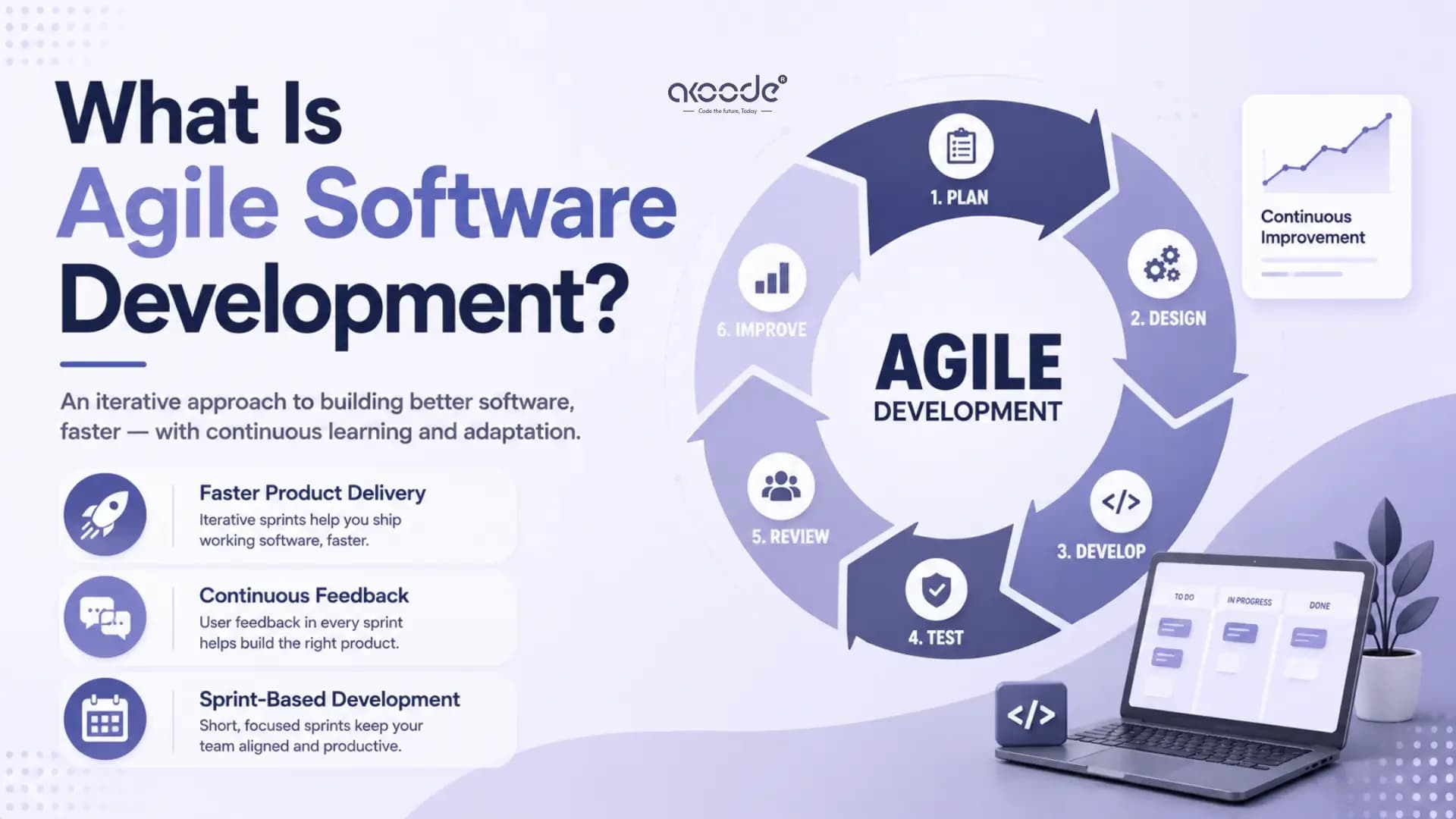
The agile software development process runs through six clear stages. These stages repeat in every iteration throughout the project lifecycle.
Stage 1: Concept and Planning
The product owner defines the project scope. Stakeholders, developers, and business teams align on goals, user needs, and success metrics. A product backlog is created. This is a prioritised list of features and requirements ordered by business value. The most important items go first.
Stage 2: Requirements and Backlog Refinement
The team breaks down high-priority backlog items into specific, actionable user stories. Each user story describes a feature from the user's perspective. The team estimates effort for each story and plans which ones to tackle in the upcoming sprint.
Stage 3: Sprint Planning and Development
The team selects a set of user stories from the backlog for the sprint. Developers design, build, and integrate the selected features. Work happens in short, focused cycles. Progress is visible daily through standup meetings where each team member shares what they completed, what they are working on, and whether anything is blocking them.
Stage 4: Testing and Quality Assurance
Testing is not a separate phase in agile. It happens within every sprint. QA engineers test features as they are built. Bugs are identified and resolved within the same cycle rather than accumulating and being addressed at the end.
Stage 5: Review and Stakeholder Feedback
At the end of each sprint, the team demonstrates working software to stakeholders. Real users or business owners interact with what was built. Feedback is collected. The product backlog is updated to reflect what was learned. This feedback loop is the central mechanism through which agile improves product quality over time.
Stage 6: Retrospective and Continuous Improvement
The team reviews how the sprint went, not just what was built. What worked well? What slowed the team down? What should change in the next sprint? This retrospective is how agile teams improve their own process continuously alongside the product itself.
This six-stage cycle repeats for every sprint until the product reaches the desired state or the project timeline concludes.
What Is Agile Software Development Methodology in Practice? Scrum, Kanban, and XP
Agile is a philosophy, not a single rigid process. Several specific frameworks implement agile values in different ways. Here are the most widely used ones.
Scrum
Scrum is the most widely adopted agile framework. It organises work into fixed-length sprints, typically two to four weeks. Three roles define a Scrum team. The Product Owner owns the backlog and prioritises requirements. The Scrum Master facilitates the process and removes blockers. The Development Team builds the software.
Scrum ceremonies give teams a predictable rhythm. Sprint planning happens at the start. Daily standups keep the team aligned. Sprint reviews demonstrate progress to stakeholders. Retrospectives close each sprint with a structured improvement conversation.
Scrum works well for product teams where requirements evolve regularly and stakeholder involvement is ongoing. It creates visibility, accountability, and a predictable delivery cadence.
Kanban
Kanban organises work as a continuous flow rather than fixed sprints. Work items move through columns on a Kanban board from To Do to In Progress to Done. The key principle is limiting work in progress. No team member takes on a new task until a current one is complete.
Kanban suits teams running ongoing operations, support functions, or maintenance work where the volume and nature of incoming tasks is unpredictable. It provides excellent visibility of workflow but less structure around planning and review than Scrum.
Extreme Programming (XP)
XP is an agile framework focused specifically on engineering practices. It emphasises short development cycles, test-driven development, pair programming, and continuous integration. XP works well for teams building technically complex products where code quality and refactoring discipline are critical.
SAFe (Scaled Agile Framework)
For large organisations running multiple agile teams simultaneously, SAFe provides a structure for coordinating agile delivery at enterprise scale. It is more process-heavy than Scrum or Kanban but addresses coordination challenges that arise when hundreds of developers work on interconnected systems.
What Are Real-World Agile Software Development Examples?
The agile methodology is not limited to startups or small teams. Some of the world's most complex and high-profile software products are built using agile principles.
Spotify built its entire engineering culture around agile principles, organising development into autonomous squads that each own a specific feature area. Each squad operates like a small startup within the larger company. This structure allowed Spotify to scale from a streaming MVP to a platform with over 600 million users while maintaining fast delivery cycles.
Microsoft adopted agile practices across its Windows and Office product lines after years of waterfall-based development that produced notoriously long release cycles. Moving to rolling updates and continuous delivery improved product quality and allowed Microsoft to respond faster to competitive changes in the market.
Amazon is one of the most cited examples of agile software development at scale. The company deploys software changes to production thousands of times per day. This is only possible because of deeply embedded agile practices including continuous integration, automated testing, and small autonomous delivery teams.
Netflix uses agile extensively for its streaming platform engineering. Frequent releases, A/B testing of features with real user populations, and rapid rollback capability are all enabled by the agile practices embedded in its engineering culture.
These examples share a common pattern. Agile did not just make these companies faster. It made them more responsive to what users actually needed rather than what product managers predicted they would need months in advance.
How Does Agile Compare with Waterfall Development?
Factor | Agile | Waterfall |
|---|---|---|
Planning approach | Iterative, evolves throughout | Fixed upfront, comprehensive |
Delivery cadence | Working software every 1 to 4 weeks | Single delivery at project end |
User involvement | Continuous throughout the project | Primarily at the start and end |
Response to change | Built into the process | Difficult and expensive mid-project |
Risk discovery | Early, within each sprint | Late, at testing or launch stage |
Best for | Evolving requirements, complex products | Fixed scope, compliance-heavy projects |
Team structure | Cross-functional, collaborative | Sequential, phase-based |
Waterfall is not obsolete. It is appropriate for projects with clearly defined, stable requirements and compliance-driven delivery. Government procurement contracts, regulated manufacturing systems, and large infrastructure builds sometimes suit waterfall better than agile.
For most modern software products, particularly those with digital users and evolving requirements, agile consistently outperforms waterfall on delivery speed, user satisfaction, and cost of rework.
Why Do Companies Use Agile Software Development?
The business case for agile is built on outcomes rather than philosophy.
Working software reaches users faster. Agile teams deliver usable increments every one to four weeks. Users get value months before a waterfall project would reach its first delivery milestone.
Errors are cheaper to fix. Defects found within a sprint cost a fraction of what they cost to fix after a full product build. The earlier a problem is caught, the lower the cost of correction.
Products match real user needs. Continuous feedback loops mean that what gets built reflects actual user behaviour rather than initial assumptions that may have been wrong. This directly reduces the rate of product failure.
Teams are more productive. Agile teams work on clearly prioritised tasks with visible progress. There is less time spent on low-value work and more time on features that move business metrics.
Change is managed rather than resisted. Business priorities shift. Markets change. Competitors release new products. Agile teams absorb these changes within the sprint cycle rather than treating them as project risks that threaten the plan.
Sixty percent of companies report increased revenue after adopting agile practices. That outcome is a direct consequence of building products that users actually want, delivered at a speed that keeps pace with market expectations.
When Does Agile Software Development Work Best?
Agile is not universally superior. It works best in specific conditions.
Requirements are expected to change. If the product vision is clear but the exact features are not, agile's flexibility is an asset rather than a risk.
Stakeholder involvement is available. Agile requires regular engagement from product owners and business stakeholders. Teams without accessible decision-makers struggle to maintain direction between sprints.
The team is cross-functional. Agile works best when developers, designers, QA engineers, and product owners work together throughout each sprint rather than in sequential handoffs.
The project is complex enough to benefit from iteration. Very small, simple projects with fixed scope sometimes deliver faster under a straightforward plan-and-build model. Agile overhead is only justified when the product has enough moving parts to benefit from iterative refinement.
For founders building MVPs, the agile methodology is especially well-suited. The how to build an MVP guide covers how agile sprint cycles apply directly to the MVP build and validation process, including how to scope the first sprint and what to measure before the second one begins.
What Should You Look for in an Agile Software Development Partner?
Choosing a development partner that genuinely practises agile rather than using agile vocabulary while running a waterfall project matters significantly for outcomes.
Ask how they structure sprints and what deliverables you can expect at the end of each cycle. A real agile team delivers working, demonstrable software every sprint, not a progress report.
Ask how they handle requirement changes mid-project. An agile partner should have a clear process for evaluating and incorporating changes through the backlog rather than treating every change as a project risk.
Ask to speak with a previous client about their experience of the sprint review process. Client access to the team during development, not just at delivery, is a marker of genuine agile practice.
For businesses in India and internationally looking for an experienced agile software development partner, the software development company in India guide covers what to evaluate and what separates companies that deliver consistently from those that do not.
Conclusion
Agile software development is not a trend or a label. It is a proven methodology that has produced more successful software projects than any approach that preceded it. The numbers are clear. The examples are real. The logic is sound.
Build in short cycles. Deliver working software often. Involve users throughout. Respond to what you learn. That sequence, repeated deliberately across every sprint, is how the most successful software products in the world are built and improved.
The methodology works whether you are building a startup MVP, a B2B SaaS platform, or an enterprise system serving thousands of users. What changes is the team size, the sprint cadence, and the complexity of the backlog. The underlying discipline stays the same.
Akoode Technologies is a leading AI and software development company headquartered in Gurugram, India, with a US office in Oklahoma. Every software development engagement at Akoode follows agile principles, from the first sprint to the final release. Whether you need end-to-end tailored software solutions or a focused build for a specific product challenge, Akoode serves startups, SMEs, and enterprises across 15+ industries globally. If you want a development partner that ships working software every sprint rather than promising results at the end of a long runway, that conversation starts here.
Frequently Asked Questions
1. What is agile software development in simple terms?
Agile software development is a way of building software in short cycles called sprints, typically one to four weeks long. At the end of each cycle, the team delivers working software. Stakeholders review it, give feedback, and the team uses that feedback to shape the next cycle. It replaces the big-bang delivery model with continuous, incremental progress.
2. What are the main steps in the agile software development process?
The six main steps are concept and planning, requirements and backlog refinement, sprint planning and development, testing and QA within the sprint, stakeholder review and feedback, and team retrospective. These steps repeat in every sprint throughout the project.
3. What is the difference between agile and waterfall software development?
Waterfall completes each phase before moving to the next and delivers the full product at the end. Agile delivers working software every sprint and incorporates feedback continuously. Waterfall suits fixed-scope, compliance-heavy projects. Agile suits products with evolving requirements and ongoing user involvement.
4. What are real examples of companies using agile development?
Spotify, Microsoft, Amazon, and Netflix all use agile practices extensively. Spotify organised engineering around autonomous squads. Microsoft moved from long release cycles to rolling updates. Amazon deploys software thousands of times per day. Netflix uses rapid releases and real user A/B testing as core product practices.
5. What is the agile software development methodology definition?
The agile software development methodology is an iterative, incremental approach to building software based on the 2001 Agile Manifesto. It prioritises working software over documentation, customer collaboration over contracts, and responding to change over following a fixed plan. Common frameworks that implement agile include Scrum, Kanban, and Extreme Programming.
6. Why do companies choose agile software development?
Companies choose agile because it delivers working software faster, catches errors earlier and at lower cost, aligns products more closely with real user needs, and allows teams to respond to market changes without restarting from zero. Sixty percent of companies report increased revenue after adopting agile practices.
Get In Touch Now
View More Our Blog