


 July 17, 2026
How to Hire a Software Development Company in New York: The 2026 Buyer's Guide
There are more than 2,000 companies in the New York metro area that will tell you they can build your software. Maybe 200 of them actually can. And maybe 40 of those are a genuine fit for your specific project, budget, and timeline.
Your job is to find one of the 40 without burning six months and a six-figure deposit finding out you picked from the wrong group.
That's what this guide is for. Not a listicle of agency names. A working process — the same one we'd walk a client through in a private advisory session — for evaluating, questioning, and selecting a software development partner in the most crowded, most expensive, most variable market in the country.
A founder in Midtown told us last year that she'd interviewed nine agencies before signing with one. Seven of the nine gave her nearly identical pitches. The two that didn't were the only two worth talking to. By the end of this article, you'll know how to spot that difference in the first call instead of the ninth.
Why This Decision Is Different in New York
Hiring a development partner is hard everywhere. New York adds three complications that don't exist at the same intensity anywhere else.
The volume problem. Search "software development company New York" and you'll get thousands of results — Clutch alone lists over 1,500 firms serving the NYC market. That's not choice. That's noise. And noise favors whoever spends the most on marketing, which has no correlation with whoever writes the best code.
The pricing spread. NYC agency rates run from $130 to $220+ per hour at the credible end of the market. But you'll also get quotes at $60/hour from firms with Manhattan addresses, and quotes at $300/hour from firms with impressive lobbies. The spread between the cheapest and most expensive quote for the same project can be 5x. Without a framework for evaluating what's behind each number, price tells you almost nothing.
The offshore-in-disguise problem. This one catches more New York buyers than any other. A meaningful percentage of "New York software agencies" are a sales office in Manhattan and a delivery team somewhere else entirely — sometimes disclosed, often not. You pay NYC rates. The work happens offshore at offshore costs. The margin between those two numbers goes to the agency, and you get none of the benefit.
To be clear: offshore development done honestly is a legitimate, often smart choice. We'll make that case later in this guide, because Akoode Technologies is a global firm serving New York clients, and we're upfront about exactly where our teams sit and what that means for your budget. The problem isn't offshore. The problem is paying local prices for offshore delivery without knowing it.
So the New York market demands more diligence than most. Here's how to do it properly.
The Step-by-Step Hiring Process
Step 1: Define Your Project Before Talking to Anyone
Most buyers get this backwards. They start taking sales calls to "figure out what's possible," and by call three, their project scope has been reshaped around whatever each vendor happens to sell.
Before a single conversation, write down:
The business problem you're solving — not the features you want, the problem. "Our operations team loses 20 hours a week to manual order reconciliation" is a problem. "We want a dashboard" is a feature someone talked you into.
What success looks like in numbers. Ticket volume down 40%. Checkout conversion up 2 points. Onboarding time cut from 3 weeks to 3 days.
Your real budget range — including the 20–25% you should hold in reserve for scope changes and the 15–20% annual maintenance cost that starts at launch.
Your honest timeline and what's driving it. A funding milestone? A contract commitment? A competitor launch?
What already exists — current systems, data, integrations the new software must connect to.
One page. That's all it needs to be. But that page changes every conversation that follows, because vendors respond to specificity with specificity. Vague briefs get vague proposals, and vague proposals are where budget overruns are born.
Step 2: Understand the Vendor Landscape
We break down the full taxonomy in the next section, but the short version: New York has six distinct types of development company, and they are not interchangeable. A boutique DUMBO studio and a global IT firm can both technically build your app. The experience, cost, and outcome will be completely different. Know which category fits your project before you start collecting names.
Step 3: Build Your Candidate List From Real Sources
Where the credible candidates actually come from, in order of signal quality:
Referrals from founders and CTOs who've shipped. The single best source. Ask specifically: "Would you hire them again, and what went wrong?" Everyone has a "what went wrong" — the honest ones tell you.
Clutch and GoodFirms verified reviews. Read the 3- and 4-star reviews, not the 5-star ones. That's where the real texture lives. Look for patterns across reviews, not individual complaints.
LinkedIn — but look at the engineers, not the company page. A firm's company page is marketing. Its engineers' profiles are evidence. Check tenure, seniority, and whether the team the sales deck describes actually exists.
Portfolio products you can touch. If a firm built something you can download or sign up for, do it. Ten minutes inside a live product tells you more than an hour of case study PDFs.
Aim for a list of 6–8 candidates. More than that and your evaluation gets shallow. Fewer and you have no basis for comparison.
Step 4: Evaluate Portfolios Like an Investigator, Not a Tourist
Everyone "reviews portfolios." Almost nobody does it usefully. Here's the difference.
Don't ask: "Do these projects look good?"
Ask instead:
Is the product still live? Dead links in a portfolio are a signal. Products get discontinued for business reasons, sure — but a portfolio where half the work no longer exists deserves a direct question.
What was this firm's actual role? "We built the Uber of X" sometimes means "we built one microservice for a subcontractor of the Uber of X." Ask exactly what they designed, built, and shipped.
Does the portfolio show projects at your scale? A firm whose showcase is all Fortune 500 work is structurally mismatched to your $90K startup build — and vice versa.
Is there anything in your industry? Not mandatory, but a firm that has shipped in healthcare knows what a BAA is before you explain it. That knowledge is worth real money in avoided mistakes.
Tip: Ask every finalist for one reference from a project that had problems. How a firm handles a rocky project tells you far more than how they handle an easy one. Firms that claim they've never had a difficult project are telling you something — just not what they think.
Step 5: Run a Lightweight RFP — Not a 40-Page One
Enterprise-style RFPs kill good conversations and reward firms with proposal-writing departments rather than engineering departments. What works better for most New York businesses is a 2–3 page brief containing:
Your one-page project definition from Step 1
Your target timeline and budget range (yes, share the range — hiding it wastes everyone's time and gets you quotes calibrated to nothing)
Five specific questions you want answered in writing
A request for a rough phased approach, not a detailed spec
Send it to your 6–8 candidates. What comes back will sort them fast. Firms that respond with thoughtful questions about your business are engaging with your problem. Firms that respond with a templated capabilities deck are running a volume sales process, and you're a lead in a funnel.
Step 6: The Discovery Calls — What to Actually Listen For
You'll take calls with 4–5 firms. The specific questions to ask are in the "20 Questions" section below. But beyond the answers, listen for these patterns:
Who does the talking? If it's 100% a salesperson and zero engineers, ask to meet the technical lead before a second call. Firms confident in their engineering put engineers in front of clients early.
Do they push back on anything? A firm that agrees with every idea you float isn't evaluating your project — they're closing a deal. The best partners we've seen (and the standard we hold ourselves to at Akoode) will tell you in the first call which of your assumptions look shaky.
Do they talk about your business or their process? Some process talk is fine. But a firm that spends 40 minutes on their methodology and 5 minutes on your problem has revealed their priorities.
Step 7: Reading Proposals — Where the Truth Hides
Proposals are sales documents, but they leak information if you know where to look.
Compare scope line-by-line, never headline price. Two proposals $80,000 apart are almost never quoting the same thing. Build a spreadsheet: discovery, design, frontend, backend, QA, DevOps, PM, post-launch support. Mark what's included in each. The "cheap" proposal usually stops being cheap in this exercise.
Look for named assumptions. Good proposals state their assumptions explicitly: "Assumes client provides API documentation for the existing inventory system." Proposals without assumptions haven't thought hard enough about your project to have any — which means the assumptions exist, they're just unspoken, and unspoken assumptions become change orders.
Check what happens after launch. If the proposal ends at deployment, the relationship is designed to end at deployment. Software doesn't work that way. Someone has to fix the bug you find in week three.
Step 8: Contract Structure — What to Negotiate
The contract terms that actually matter, from watching dozens of these go right and wrong:
IP assignment on payment, not on project completion. You should own the code you've paid for, even if the engagement ends early.
Source code access from day one. Your repo, or at minimum full access to theirs. Never accept an arrangement where you see the code only at handoff.
A defined change-order process with rates. Not "changes will be scoped separately" — actual rates and turnaround expectations in writing.
Key personnel clauses for larger projects. If you're buying a team partly because of a specific technical lead, the contract should say so.
A clean exit clause. 30 days' notice, orderly handover, payment for work completed. Both sides deserve a graceful way out.
Payment structure: milestone-based for fixed-price work, monthly for dedicated teams. Never more than 25–30% upfront. A firm demanding 50% deposit before discovery has a cash flow problem or a churn problem, and either one is now your problem too.
Step 9: Onboarding — What Good Looks Like in Week One
The first two weeks predict the whole engagement. A well-run firm will, without being asked:
Set up shared project management (Jira, Linear, Asana) with you inside it — not receiving weekly PDF exports of it
Establish a communication rhythm: standups or async updates, a weekly review, a named point of contact
Run a structured kickoff that revisits scope and surfaces open questions
Get development environments and repo access sorted in days, not weeks
If week one is silence followed by a status email, you've learned something important early. Say so immediately. How they respond to that feedback is the second data point.
Step 10: Know When to Walk Away
Sunk-cost thinking destroys more software budgets than bad code does. Walk away — before signing or even after — when:
The team that shows up isn't the team that was sold
Estimates change materially before work has even started
Your questions get answered with charm instead of specifics
Basic communication is already slow during the sales process (it only gets worse after they have your deposit)
Your gut says no and you're constructing reasons to override it
A Brooklyn e-commerce founder we spoke with put it well: "Every red flag I ignored in the sales process showed up again in month two, except bigger." That's the pattern. Sales-stage behavior is the best behavior you will ever see from a vendor.
The Six Types of Software Development Companies in New York
Large IT services firms. Accenture, Cognizant, and their peers all have major New York operations. Right for: Fortune 1000 companies buying multi-year, multi-system transformation with procurement departments to manage it. Wrong for: almost everyone else. You'll pay for structure you don't need and move at a pace you can't afford.
Mid-size specialist agencies. 50–300 people, real engineering leadership, sector focus. The sweet spot for most funded startups and mid-market companies. Expect $140–$200/hour and genuine competence — at genuine NYC cost.
Boutique studios. 5–25 people, often design-led, concentrated in DUMBO, SoHo, and Williamsburg. Superb for design-heavy consumer products and brand-critical builds. Risky for complex backend systems, and vulnerable to key-person dependency — if their one senior architect leaves, your project feels it.
Freelancer networks and dev shops. Loose collectives fronted by a project manager. Cheapest local option, highest variance. Fine for small, contained builds. Dangerous for anything requiring sustained, coordinated engineering over months.
Offshore-disguised-as-local. The Manhattan address with the undisclosed delivery team abroad. The issue isn't where the engineers sit — it's the opacity and the fact that you're paying a 3–4x markup on the actual labor. One direct question filters these: "Where, specifically, will the engineers on my project be located, and can I meet them?" Watch what happens next.
Global firms with transparent New York delivery. Companies that serve New York clients from global engineering centers — openly. This is Akoode's model: senior teams in India, US presence, NYC-hours communication overlap, and rates 50–65% below local agencies because the economics are passed to you rather than absorbed as margin. Right for: businesses that care about outcomes and total cost more than office geography. Wrong for: projects that genuinely require in-person, on-site collaboration — and some do.
Red Flags to Watch For
They quote a price before understanding your project. A real estimate requires discovery. A number in the first call is a sales tactic calibrated to what they think you'll pay.
The portfolio is all NDA-protected. Some confidential work is normal. An entire portfolio you can't verify is not.
You never meet an engineer during the sales process. The people building your product are hidden for a reason.
"Yes" to everything. Every scope idea, every timeline, every budget. Real engineering involves trade-offs; a firm that surfaces none is either inexperienced or dishonest.
The proposal has no assumptions section. The assumptions still exist. They'll surface later as change orders.
50%+ deposit before any discovery work. Standard is 25–30% against a defined first milestone.
They resist giving references from imperfect projects. Perfect track records don't exist past a handful of engagements.
Vague answers about team location. "We have a global presence" is not an answer to "where will my engineers be?"
High turnover visible on LinkedIn. If engineers last 8 months at this firm, your project will outlive several of its own developers.
They trash every previous vendor you mention. Occasionally a prior firm really did fail. A pattern of blaming others is a pattern.
The contract has no exit clause, or a punitive one. A partner confident in their work doesn't need to trap you.
Slow, sloppy communication during sales. This is their best behavior. It degrades from here.
Green Flags — Signs You've Found the Right Partner
They ask questions that make you think. About your users, your revenue model, your data — questions you hadn't considered.
They tell you what not to build. Descoping advice against their own short-term revenue is the strongest trust signal in this industry.
Engineers join the second call without you asking.
They propose a paid discovery phase before committing to a full estimate. This is what rigor looks like, not an upsell.
Their proposal names risks — including risks on their side.
References answer the "what went wrong" question honestly, and the story ends with the firm fixing it.
They're transparent about team location and let you meet the actual developers.
They discuss post-launch support unprompted. They're thinking about your product's life, not just its launch.
Their questions in week one are about your business logic, not just your feature list.
The 20 Questions to Ask Before Signing
Who exactly will work on my project, and can I meet them before signing? — Confirms the sold team is the delivered team.
Where are those people located? — Surfaces the offshore-in-disguise model immediately.
Show me a live product you built that's been in production 12+ months. — Separates shippers from demo-makers.
What was your role on it, specifically? — Filters inflated portfolio claims.
What's your average variance from original estimates, and why? — Honest firms have a number and a reason. "We always deliver on time" is a lie.
Walk me through a project that went badly. What did you change? — The single most revealing question on this list.
What does your discovery phase produce, and what does it cost? — Tests whether they scope with rigor or guesswork.
How do you price change requests? — Get rates and process in writing before you need them.
Who owns the IP, and when does ownership transfer? — Should be you, on payment.
Do I get repo access from day one? — Non-negotiable. Any hesitation is a red flag.
What's your QA process — and who does it? — "Developers test their own code" is not a QA process.
How do you handle security, and have you worked under [your compliance regime]? — SHIELD Act, HIPAA, PCI-DSS, SOC 2 as relevant to you.
What's your team's average tenure? — Predicts continuity on your project.
What happens if my technical lead leaves mid-project? — They should have a real answer, because it happens.
What tools will I have direct access to during the build? — You want to be inside the project, not receiving reports about it.
What does week one look like? — Firms with a real onboarding process describe it instantly.
What does post-launch support cost, and what's included? — Budget 15–20% of build cost annually; get their number.
What would make you turn down this project? — Firms with standards have answers. Firms without standards say "nothing."
What's the exit process if this isn't working? — Both sides should know the fire escape before there's a fire.
Why are you the wrong choice for some clients? — Honest self-awareness here predicts honest communication everywhere.
Local NYC Agency vs. Global Partner: The Honest Comparison
Factor | Local NYC Agency | Global Partner (e.g., Akoode) |
|---|---|---|
Hourly cost | $130–$220+ | $30–$60 |
Total project cost | Baseline | Typically 50–65% lower |
Time zone | Same hours | 3–4 hr daily overlap, async otherwise |
In-person meetings | Easy | Rare / video-first |
Communication | Native, immediate | Excellent at good firms — verify per vendor |
Portfolio depth | Often NYC-vertical focused | Broader industry range |
US compliance knowledge | Generally strong | Strong at US-focused firms — verify |
Scaling team up/down | Constrained by local hiring market | Fast — deeper talent pool |
Engagement models | Fixed price, T&M | Fixed, T&M, dedicated teams |
Primary risk | Cost; offshore-in-disguise markup | Vendor quality variance; management discipline required |
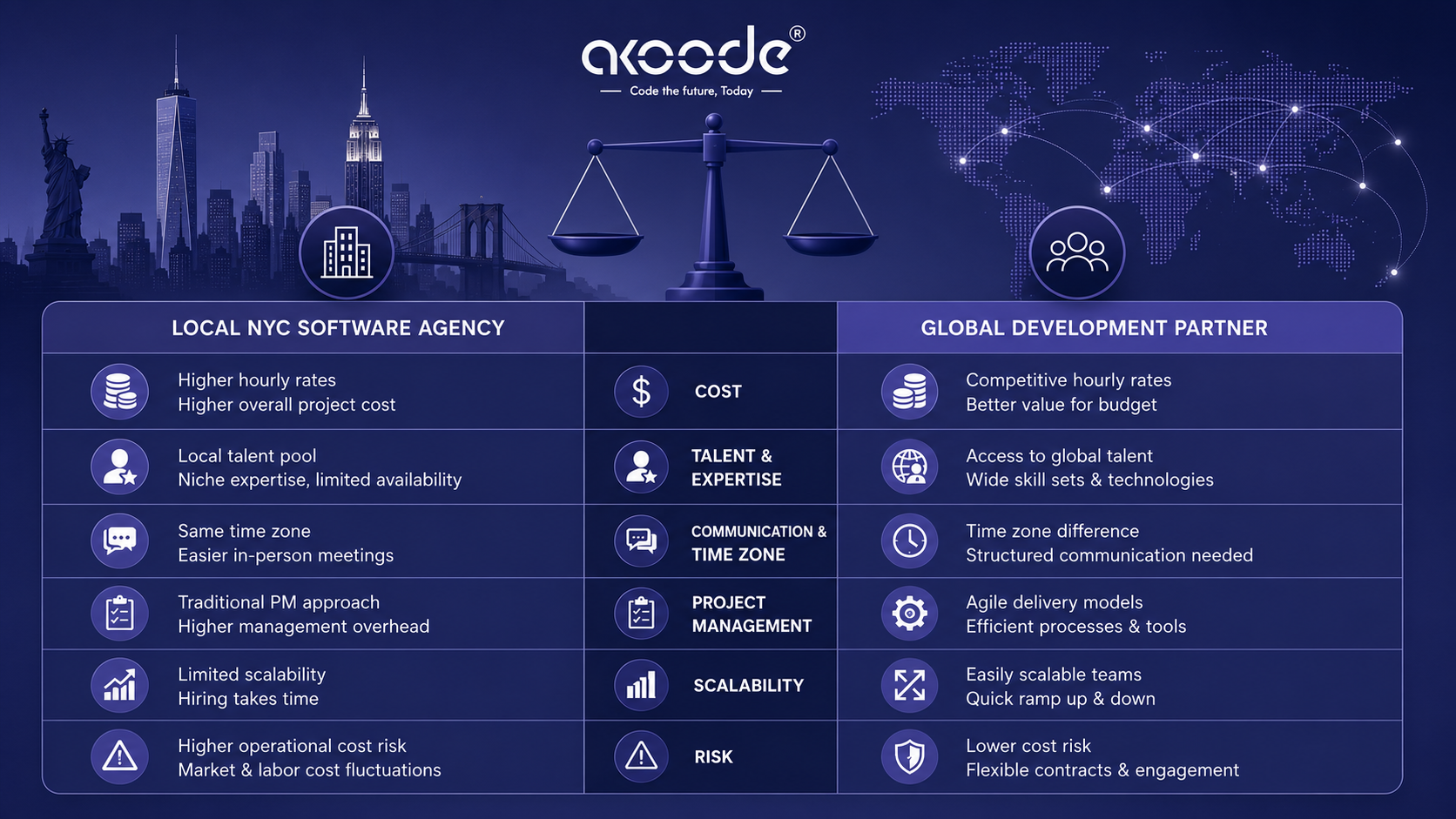
The honest read: neither column wins outright. The right answer depends on your project — which is what the decision framework below is for.
Pricing Reality Check: What Quotes Should Look Like
Use these ranges to sanity-check any New York quote you receive. Rates assume the credible NYC market at $130–$220/hour.
Project | NYC Agency Range | Global Partner Range |
|---|---|---|
MVP web app | $60,000–$150,000 | $25,000–$60,000 |
Mobile app (cross-platform) | $80,000–$200,000 | $35,000–$85,000 |
SaaS platform (v1) | $150,000–$400,000 | $60,000–$150,000 |
AI application (LLM/RAG) | $80,000–$250,000 | $30,000–$100,000 |
Enterprise platform | $300,000–$700,000+ | $120,000–$300,000 |
Two calibration rules:
A quote far below these ranges is missing scope. Discovery, QA, DevOps, or post-launch support has been quietly excluded, and it will reappear as invoices.
A quote far above them needs a specific justification. Sometimes there is one — unusual compliance, legacy integration hell, extreme scale requirements. Make the vendor articulate it.
And whatever number you land on: add 20–25% for your internal budget, and plan for 15–20% of build cost annually in maintenance from launch day.
The Decision Framework
Answer these five questions:
Does your project require regular in-person collaboration? (On-site integration, physical hardware, contractually mandated US presence)
Do your enterprise contracts require US-based vendors or onshore data handling?
Is your timeline under 10 weeks with fully locked scope?
Is your budget genuinely unconstrained relative to project scope?
Do you lack any internal capacity to manage a vendor relationship with structured communication?
Three or more yes → local NYC agency. Pay the premium; for your situation it's buying something real.
Zero to one yes → global partner. You'd be paying $100,000+ for geography you don't need. Put it into product instead.
Two yes → hybrid. Fixed-price discovery with a firm you can meet, then a global dedicated team for the build. Increasingly the default structure for experienced New York buyers, and one we run regularly for custom software, mobile, and AI projects.
Frequently Asked Questions
How much does it cost to hire a software development company in New York?
Credible NYC agencies bill $130–$220 per hour in 2026. Complete projects run from $60,000 for an MVP web application to $700,000+ for enterprise platforms. Global partners serving New York deliver equivalent scope at 50–65% less. Whatever you're quoted, budget an additional 20–25% for scope evolution and 15–20% of build cost annually for maintenance.
How do I verify a software development company is legitimate?
Four checks: verified Clutch/GoodFirms reviews (read the 3–4 star ones), live production products you can personally test, engineer profiles on LinkedIn showing real tenure, and a reference call where you ask what went wrong on a past project. A firm that passes all four is almost certainly real. A firm that dodges any of them deserves more questions.
Should I hire a local New York agency or an offshore company?
It depends on five factors: need for in-person work, contractual US-vendor requirements, timeline, budget constraints, and your capacity to manage a structured vendor relationship. Genuinely need local presence? Pay for it. Otherwise, a transparent global partner delivers the same outcome at roughly half the cost. The one option to avoid entirely is the undisclosed middle — NYC rates for hidden offshore delivery.
How long does it take to hire a software development company?
Run properly: 3–5 weeks. One week defining your project, one building a candidate list, one to two for calls and proposals, one for references and contract. Compressing this into a week is how buyers end up in the wrong engagement. The diligence period is cheap insurance on a six-figure decision.
What questions should I ask before hiring a development agency?
The twenty in this guide, but if you only ask three: Who exactly will build my product and where are they located? Show me something live that's been in production a year. Tell me about a project that went badly and what you changed. Those three surface more truth than most full RFP processes.
What are the red flags when hiring a software company?
The big ones: pricing before discovery, no engineers in sales calls, an unverifiable portfolio, agreement with everything you say, proposals without stated assumptions, 50%+ deposits, and evasiveness about team location. Any one is a caution. Two or more is a pattern, and patterns don't improve after signing.
How much should I pay upfront to a software development company?
25–30% against a defined first milestone is market standard. Dedicated team engagements typically bill monthly with no large deposit at all. A firm demanding half or more upfront before discovery has cash flow or client-retention problems — neither of which should become yours.
Do New York software companies outsource their work?
Many do, and the practice itself isn't the problem — global delivery is how modern software gets built. The problem is concealment: paying $180/hour for work performed at $40/hour by a team you were never told about. Ask directly where your engineers will sit and whether you can meet them. Transparent firms answer in one sentence.
What is the best way to find software developers in New York?
Founder referrals first — with the "would you hire them again" question. Then Clutch and GoodFirms verified reviews, then LinkedIn diligence on the actual engineering staff, then hands-on testing of portfolio products. Build a list of 6–8, run the process in this guide, and let structured comparison do the work that gut feel can't.
Is it worth hiring a software development company instead of freelancers?
For anything beyond a small, contained build — yes. A company gives you coordinated engineering, QA, project management, and continuity when someone gets sick or leaves. Freelancers are excellent for narrow, well-defined tasks. They're a structural risk for a six-month product build where one departure can stall everything.
What to Do in the Next 48 Hours
If you're serious about hiring, don't start by Googling agencies. Start with the one-page project definition from Step 1. Business problem, success metrics, budget range, timeline, existing systems. Ninety minutes of work that will improve every conversation you have for the next month.
Then build your list of 6–8 candidates from referrals and verified reviews — not from whoever ranks highest in paid search results.
Then start conversations, with the 20 questions in hand.
And if you want one of those conversations to be with a team that will give you a straight answer on scope, cost, and whether we're even the right fit — including telling you when a local NYC agency serves you better — we're easy to reach.
Read Related Article - Software Development Cost in New York - 2026 Guide
and AI Software Development Company in New York: What NY Businesses Are Building in 2026
Talk to Akoode About Your New York Project
Akoode Technologies builds custom software, mobile apps, and AI systems for New York businesses — 100+ projects delivered across 15+ industries, 4.9/5 on Google, 5.0/5 on Clutch. Senior engineering teams, transparent global delivery, NYC-hours communication, and rates 50–65% below local agencies.
Review our case studies, or skip straight to a conversation about your project.
Book a free 45-minute consultation → calendly.com/akhil-akoode/ak
Or reach us anytime via akoode.com | contact us
Get In Touch Now
View More Our Blog