


 July 16, 2026
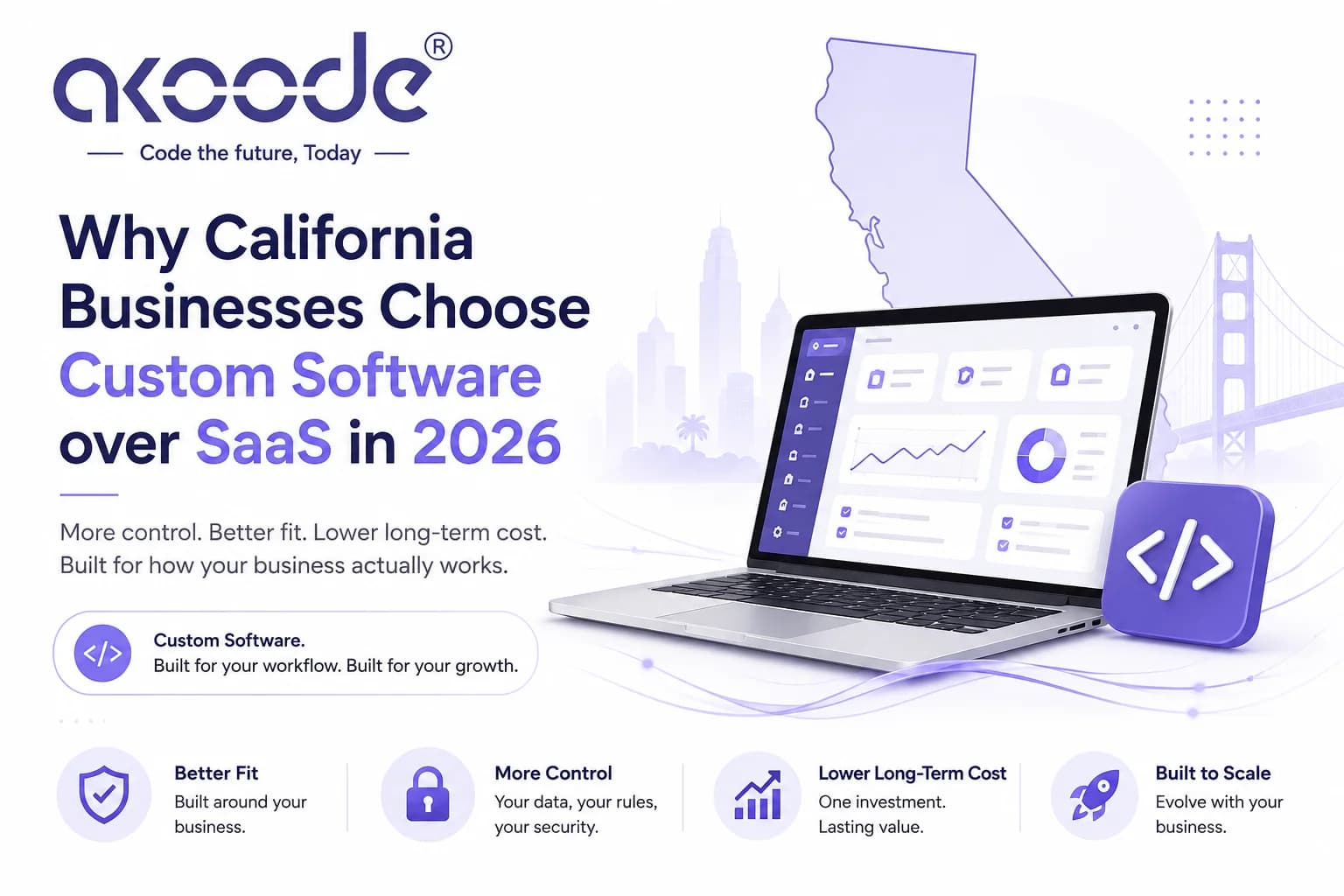
Why California Businesses Choose Custom Software Over SaaS in 2026
There's a specific moment a lot of California business owners hit, usually around their third or fourth SaaS subscription for the same general problem. They're paying for a CRM that almost fits, a project tool that almost fits, an inventory system that almost fits, and a reporting dashboard that stitches together data from all three because none of them talk to each other properly. Nobody signed up for that. It just happened, one "good enough for now" tool at a time.
That moment is exactly why custom software has quietly become the default choice, not the exception, for a growing number of California companies in 2026. This isn't an anti-SaaS argument — plenty of SaaS products are genuinely excellent and the right call for plenty of businesses. But there's a real and specific set of reasons California companies, more than businesses in a lot of other states, are increasingly deciding to build rather than subscribe. This article walks through exactly what's driving that shift, when it makes sense for your business specifically, and what the actual tradeoffs look like — not the sanitized version you'd get from a sales deck.
1. The SaaS Fatigue Nobody Talks About Directly
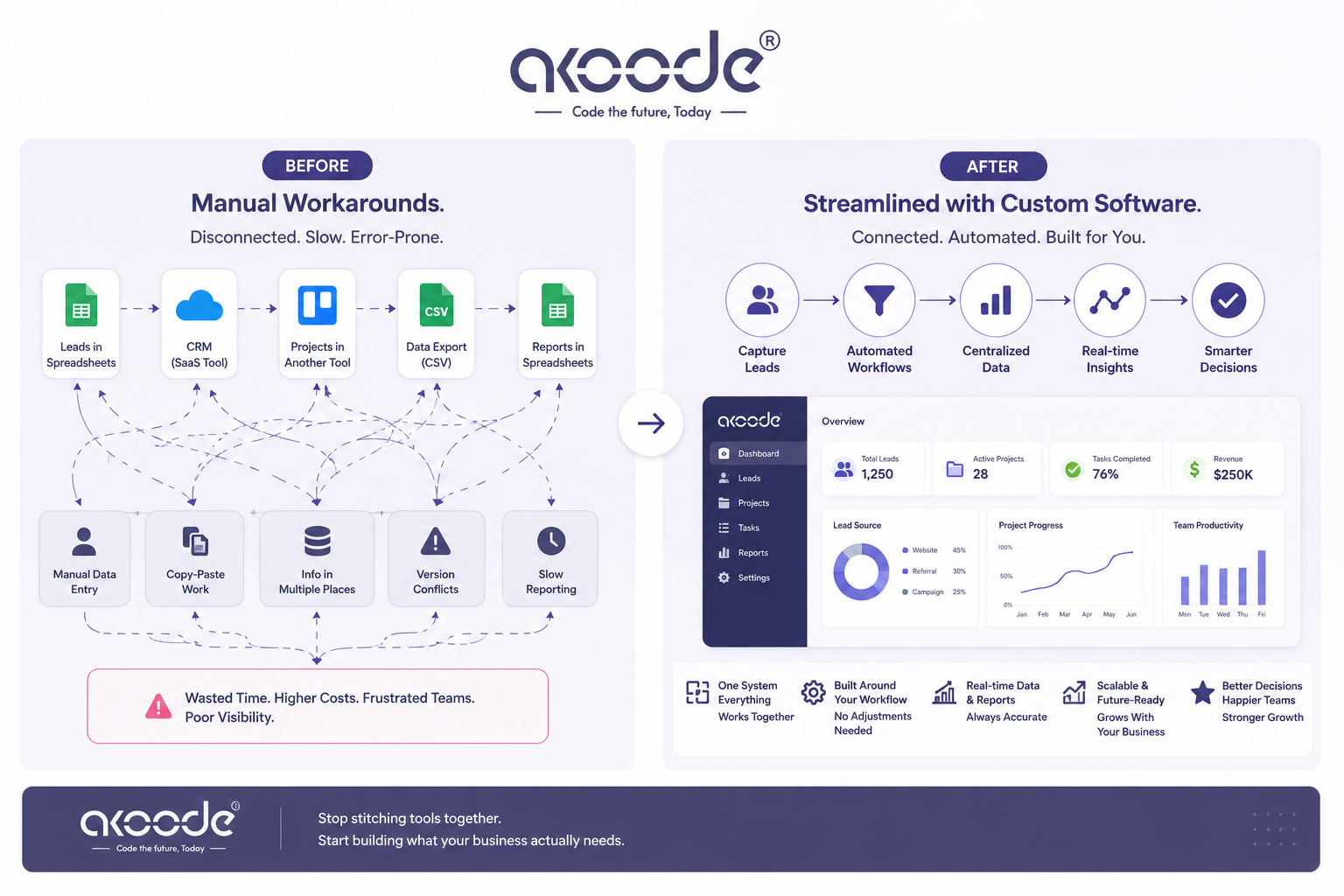
Every SaaS product starts out solving a real problem well. That's how it gets adopted in the first place. The trouble shows up later, after a business has been using it for two or three years and has grown, changed direction, added a new revenue line, or started serving a different kind of customer than the one the software was originally built for.
At that point, most companies discover the same thing: the tool that was flexible enough at the start has quietly become the thing dictating how the business operates, instead of the other way around. Sales processes get bent to match what the CRM allows. Customer onboarding gets awkward because the platform doesn't support the exact sequence the team actually wants. Someone builds a workaround using a spreadsheet, then another workaround on top of that workaround, and eighteen months later nobody remembers why things are done the way they're done — they just know changing it feels risky.
None of this is a knock on the SaaS companies themselves. It's just the nature of a one-size-fits-most product. It has to serve thousands of different businesses with different workflows, which means the deeper you get into any specific business's actual process, the more that generic tool starts to strain.
Custom software doesn't have that constraint, because it was never trying to serve anyone but you.
2. Why This Shift Is Happening Faster in California Than Elsewhere
A few things are converging in California specifically that make this trend more visible here than in most other states.
Businesses here are used to fast growth, and fast growth breaks generic tools quickest. A startup going from 50 to 5,000 customers in eighteen months puts far more strain on off-the-shelf software than a business growing steadily over a decade. California has an unusually high concentration of companies moving at that pace, especially in tech, biotech, and consumer products.
There's simply more access to strong engineering talent here. Custom software used to be something only large enterprises could realistically afford, mostly because good engineers were scarce and expensive everywhere. That's still true to some degree, but California's density of skilled development teams — including firms that specialize in working with growing businesses rather than just Fortune 500 companies — has made custom builds meaningfully more accessible than they were five years ago.
California's own privacy regulations have made "just use whatever SaaS tool" a riskier default. The state has some of the strictest consumer data rules in the country, and a lot of general-purpose SaaS tools weren't built with those specific requirements in mind. Businesses handling sensitive customer data are increasingly deciding it's safer to control exactly how that data is stored and processed than to trust a third-party platform's general compliance posture.
AI has changed what "custom" even means, and California is where that shift is happening fastest. A few years ago, building something custom meant building it entirely from scratch, which was slow and expensive. Now, AI-assisted development and increasingly capable AI features mean a custom build can move faster and do more than it used to — something we'll get into in detail in Section 5.
And there's a straightforward cultural factor too. A lot of California founders and operators came up in environments where "we'll just build it" was a normal sentence, not an intimidating one. That mindset spreads.
None of this means California businesses are somehow smarter about this decision than businesses elsewhere. It just means the specific conditions here — growth pace, talent access, regulatory pressure, and AI maturity — are pushing more companies toward the same conclusion, faster.
3. SaaS vs. Custom Software: A Real Comparison
Here's the honest version of this comparison, without the marketing spin either direction usually gets.
Factor | SaaS Platform | Custom Software |
|---|---|---|
Upfront Cost | Low — usually a monthly or annual subscription | Higher — real development investment upfront |
Long-Term Cost | Adds up steadily, especially as seats/usage scale | Often lower per year once built, though maintenance is ongoing |
Fit to Your Process | You adapt your workflow to the tool | The tool is built around your actual workflow |
Flexibility | Limited to what the vendor's roadmap supports | Whatever you decide to build |
Data Ownership | Data typically lives on the vendor's infrastructure | You control exactly where and how data is stored |
Integration With Other Systems | Depends entirely on the vendor's available integrations | Can be built to integrate with anything you need |
Speed to Launch | Immediate — sign up and start using it | Weeks to months, depending on scope |
Scalability | Bound by the vendor's pricing tiers and platform limits | Scales exactly as far as your architecture is designed to |
Competitive Differentiation | None — your competitors can use the same tool | Software built around your specific process can become a real advantage |
Vendor Risk | You're dependent on their pricing changes, roadmap, and continued existence | You own the outcome, for better or worse |
Neither column is universally "better." A five-person business that just needs basic project tracking has no business building custom software — that's a SaaS tool, full stop. But a business whose core operational process is genuinely specific to how they work, or whose growth trajectory means today's SaaS tool will be outgrown in eighteen months anyway, is looking at a very different calculation.
4. The Specific Triggers That Push a Business Toward Custom Software
In practice, it's rarely one big dramatic reason. It's usually one or two of these becoming impossible to ignore.
You've customized a SaaS tool so heavily it barely resembles the default product anymore. If your team has built elaborate workarounds, automation chains, and manual patches just to make an off-the-shelf tool behave the way you need, you're already paying custom-software-level effort — you're just not getting a custom-software-level result for it.
Your pricing scales against you as you grow. A lot of SaaS platforms charge per seat or per usage tier, which means the tool that felt cheap at 10 employees can become one of your largest line items at 100. At a certain size, building your own version stops being the expensive option.
You need to combine data from multiple disconnected tools into one coherent picture. If your team spends real hours every week manually pulling numbers from three different platforms into one spreadsheet just to get a straight answer to a simple question, that's a strong signal a unified custom system would pay for itself quickly.
Your industry has specific requirements no general SaaS tool handles well. Healthcare, biotech, logistics, and finance all have workflows and compliance needs that most general-purpose software wasn't built around. Teams in these industries frequently find themselves fighting their tools instead of being helped by them.
You want your software to be a genuine competitive advantage, not just infrastructure. If two competitors are both using the same off-the-shelf platform, that platform isn't helping either of them stand out. Custom software built around a genuinely better process can become something a competitor literally can't copy by signing up for the same subscription.
You need real AI capability, not a generic AI feature bolted onto a SaaS tool. This is quickly becoming one of the most common triggers, and it deserves its own section.
5. Where AI Changes the Calculation Entirely
This is probably the single biggest shift in the SaaS-versus-custom conversation over the last two years, and it cuts in an interesting direction — AI actually makes custom software more attractive, not less.
The old argument for SaaS was speed: subscribing to an existing tool was always going to be faster than building something from zero. That's still generally true for simple, generic needs. But AI has changed the math in two important ways.
First, AI-assisted development has genuinely sped up custom builds. Teams that know how to use AI well throughout their development process — for scaffolding, testing, documentation, and iteration — can move meaningfully faster than a traditional custom build used to take. The gap between "sign up for SaaS today" and "have working custom software in a few weeks" has narrowed more than most business owners realize.
Second, and more importantly, most SaaS platforms can only offer generic AI features. A CRM's built-in "AI assistant" has to work reasonably well for every single customer using that CRM, which means it's tuned to be broadly useful rather than deeply useful for your specific business. If you want AI that actually understands your product catalog, your customer history, your specific support scenarios, or your internal documents — the kind of AI that feels like it actually knows your business instead of giving generic responses — that almost always requires something built and tuned specifically for you.
This is showing up constantly in California right now: businesses that adopted a SaaS tool's generic AI feature, found it underwhelming, and then invested in a custom AI integration instead — often a support agent trained on their actual documentation, or an internal tool that understands their specific data in a way no off-the-shelf assistant ever could.
6. The Hidden Costs of "Just Use a SaaS Tool"
The sticker price of a SaaS subscription is the easiest number to see and the least complete picture of what it actually costs a business.
The workaround tax. Every manual patch a team builds to compensate for a tool's limitations is a recurring cost, paid in labor hours, forever, until someone finally fixes the underlying problem.
The switching cost that grows every year you wait. The longer a business operates inside a SaaS platform's specific data structure and workflow assumptions, the more painful it becomes to eventually move off of it — which paradoxically makes businesses stay with tools they've outgrown, simply because leaving feels harder every year.
The opportunity cost of a process shaped by software limitations instead of business logic. When your actual operating process is quietly dictated by what a SaaS tool allows rather than what would genuinely serve your customers best, that's an invisible tax on performance that never shows up on an invoice.
The compounding subscription cost across a growing tool stack. Most businesses don't replace SaaS tools as they grow — they add more of them. Five years in, it's common to find a company paying for a dozen overlapping subscriptions that collectively cost more than a single well-built custom system would have.
None of this means SaaS is a trap. It means the true cost comparison has to include more than the monthly invoice.
7. When SaaS Is Still the Smarter Choice
In the interest of being straight about this: custom software isn't the right call for everyone, and a good development partner should tell you that directly instead of pushing a build just because you asked about one.
SaaS still makes more sense when:
Your need is genuinely generic — accounting, basic email marketing, standard project tracking for a small team
You're pre-product-market-fit and still figuring out your actual process, which means building custom software now would mean building around assumptions likely to change soon
Your budget genuinely can't support a real development investment right now, and a decent SaaS tool gets you 80% of the value at a fraction of the cost
Your requirements are simple enough that a well-configured off-the-shelf tool covers essentially everything you need without meaningful workarounds
The honest version of this decision isn't "custom software is always better." It's "custom software becomes the better choice at a specific point — usually when your process, your growth, or your industry has outgrown what a generic tool can reasonably offer."
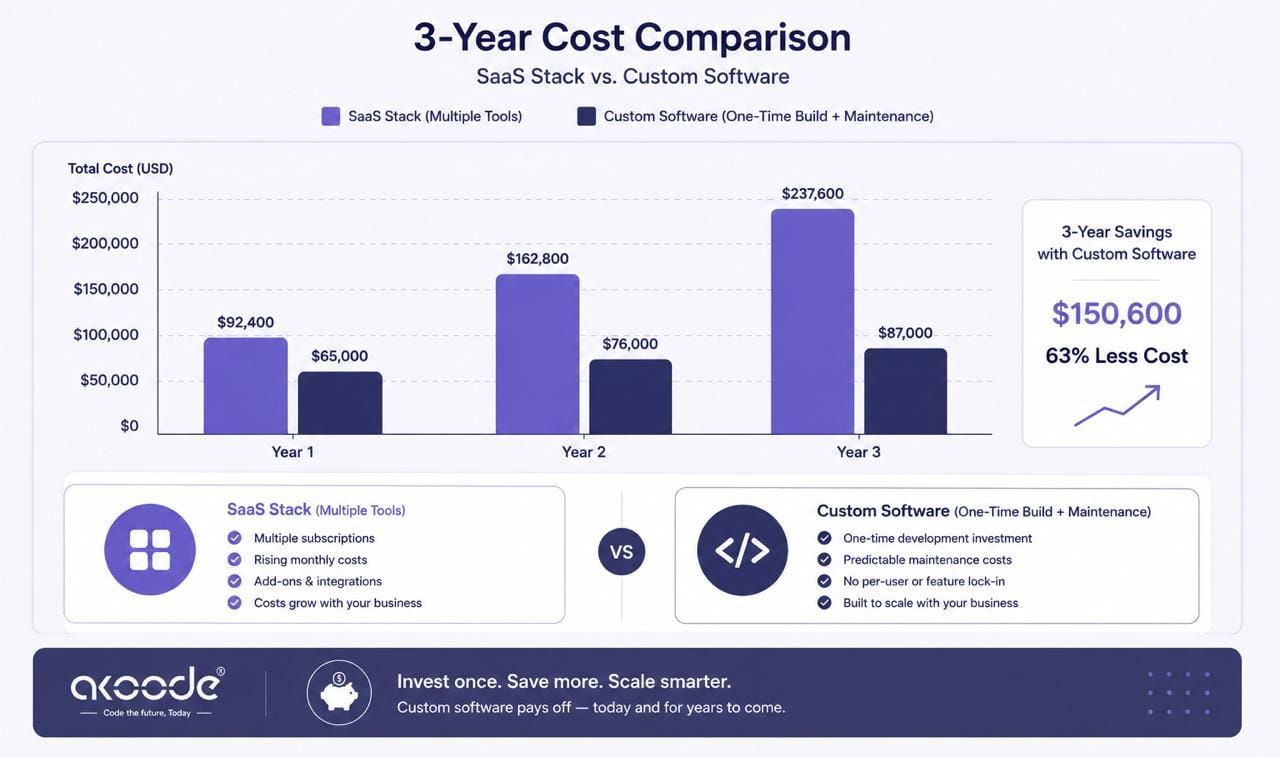
8. What Custom Software Actually Costs vs. What You'd Spend on SaaS Over 3 Years
Here's a realistic side-by-side for a mid-sized California business, using 2026 numbers.
SaaS Approach (3-Year Total) | Custom Software Approach (3-Year Total) | |
|---|---|---|
Initial Setup | $0 – $5,000 | $60,000 – $150,000 (build) |
Ongoing Subscriptions (multiple tools) | $45,000 – $150,000 (3 years, growing with seats/usage) | $0 |
Workaround Labor Cost | $30,000 – $90,000+ over 3 years (estimated hours) | Minimal, if built around actual workflow |
Maintenance & Support | Included in subscription | $18,000 – $60,000 over 3 years |
Data Ownership | Vendor-controlled | Fully owned |
Approximate 3-Year Total | $75,000 – $245,000+ | $78,000 – $210,000 |
The numbers land closer together than most people expect, which is exactly the point — the decision shouldn't be made purely on sticker price. It should be made on fit, control, and whether your process is specific enough that a custom build actually earns its higher upfront cost.
9. How California Companies Are Actually Making This Decision
In practice, the businesses making this call well tend to follow a similar pattern, regardless of industry.
They start by mapping their actual process in detail — not the idealized version, the real one, including every workaround currently in place. That mapping alone often reveals just how much hidden cost the current SaaS-based approach is carrying.
They then price out a genuine build against their actual current spend across every overlapping tool, not just the one they're most annoyed with. A single SaaS subscription rarely looks expensive in isolation. The full stack, added up, usually tells a different story.
They talk to a development partner early — often well before they're ready to commit to a full build — specifically to get a realistic discovery-phase estimate rather than guessing. This is one of the more consistently smart moves companies make in this process: getting a real, scoped estimate before deciding anything, instead of either assuming custom software is unaffordable or assuming it's obviously worth it.
If you're at that stage — trying to figure out whether your business has actually outgrown its current tools — Akoode's California software development company team runs exactly this kind of discovery conversation regularly, and it costs nothing to have the conversation and see real numbers before deciding either way.
10. A Practical Decision Framework
Ask these questions honestly before deciding either direction:
How much are we currently spending, in total, across every SaaS tool solving a version of this problem?Add it all up. The number is almost always higher than anyone expects.
How many hours per week does our team spend on manual workarounds for this specific process?Multiply by a fully loaded hourly cost, then multiply by 52.
Is our process genuinely specific to our business, or is it actually pretty standard? Standard processes rarely justify custom software. Specific ones almost always do, eventually.
Are we still figuring out our process, or has it stabilized? Building custom software around a process that's still changing every month is usually premature.
Would owning this software give us a real competitive advantage, or is it just infrastructure? Infrastructure can stay as SaaS longer. Anything close to your actual differentiation is worth owning.
Do we have specific compliance or data control requirements a general SaaS tool wasn't built around? If yes, that alone often settles the decision.
Do we want AI that's genuinely tuned to our business, or is a generic AI feature good enough? If you need the former, custom is very likely the only real path.
If most of your honest answers point toward "specific," "stabilized," and "yes, this matters for our competitive position," that's a business that's outgrown SaaS for this particular problem, even if it took a while to notice.
11. What to Look for in a Development Partner for This Kind of Project
This isn't a generic "how to hire a developer" list — it's specifically about what matters for a SaaS-to-custom transition project.
Experience actually migrating businesses off existing SaaS tools, not just building greenfield products from scratch. Migration has its own challenges — data export limitations, workflow continuity, training your team on something new without disrupting operations.
A genuine discovery process that maps your current workarounds, not just your stated requirements. The workarounds are usually where the real requirements are hiding.
Direct, specific experience with AI integration, if that's part of why you're considering a custom build — and enough honesty to tell you when a simpler, non-AI solution would actually serve you better.
A track record with businesses at a similar stage to yours. A firm that mostly works with early-stage startups may not be the right fit for a company migrating off five years of accumulated enterprise tooling, and vice versa.
Clear thinking about long-term ownership, including what happens if you eventually want to bring development in-house, and what your contract says about code and IP ownership from day one.
A team like Akoode's California software development company that specializes in exactly this kind of transition — helping growing businesses move from a patchwork of SaaS tools to something built specifically around how they actually operate — tends to ask sharper questions in the first conversation than a generalist shop would, simply because they've seen this exact pattern play out many times before.
12. Frequently Asked Questions
1. Is custom software actually cheaper than SaaS long-term? It depends on your specific situation, but for businesses paying for multiple overlapping SaaS tools plus significant workaround labor, the 3-year total cost often lands close to or below the SaaS approach, while giving you full ownership of the result.
2. How do I know if my business has actually outgrown SaaS tools? Signs include heavily customized SaaS tools that barely resemble the default product, growing per-seat costs, and a team spending real weekly hours on manual workarounds just to make existing tools function the way you need.
3. Does custom software take much longer to launch than SaaS? Yes, initially — SaaS is immediate while custom software typically takes weeks to months depending on scope. AI-assisted development has narrowed that gap somewhat, but it's still a real tradeoff to weigh.
4. Can custom software really include AI as good as what big SaaS platforms offer? In many cases it can be considerably better for your specific use case, because it's tuned to your actual data and workflows rather than built to work reasonably well across thousands of different businesses.
5. Is custom software only for large enterprises? No — a growing number of small and mid-sized California businesses build custom software today, often starting with a single high-impact automation project rather than a full platform replacement.
6. What happens to our existing SaaS data if we move to custom software? A good development partner handles data migration as part of the discovery and build process, mapping your existing data structure to the new system before the switch happens.
7. Do we have to fully replace every SaaS tool at once? No, and most businesses shouldn't. A common approach is replacing the single most painful or expensive tool first, then evaluating the rest over time.
8. How does California's privacy law affect this decision? Businesses handling sensitive customer data increasingly prefer custom software specifically because it puts them in direct control of data storage and processing, rather than relying entirely on a third-party SaaS vendor's compliance posture.
9. What's the biggest risk in moving from SaaS to custom software? Building around a process that hasn't stabilized yet. If your workflow is still changing significantly month to month, it's often smarter to wait until it settles before investing in a custom build.
10. How do I get a realistic cost estimate for my specific situation? Start with a discovery conversation with a development partner experienced in SaaS-to-custom transitions — a real scoped estimate based on your actual process is far more useful than a generic online calculator.
Conclusion
The shift toward custom software in California isn't really about SaaS being bad — it's about businesses reaching a specific point where a generic tool stops fitting the way they actually operate, and where owning the software becomes worth more than renting it. Growth, industry-specific requirements, genuine AI needs, and California's own data privacy landscape are all pushing more companies toward that point faster than in most other states.
If you're wondering whether your business has hit that point, the honest first step isn't guessing — it's getting real numbers. Akoode's software development company in California runs exactly this kind of discovery conversation, mapping your actual process and current spend before recommending anything, so you can make this decision based on your specific numbers rather than a general argument either direction.
Also Read Related Article - How to hire a software development company in California
and Software development cost in California
Get In Touch Now
View More Our Blog