


 July 18, 2026
AI Software Development Company in Dallas: What DFW Businesses Are Building in 2026
The most interesting AI work in Dallas isn't happening in glass towers full of machine learning PhDs.
It's happening inside hospitals, insurance carriers, logistics operations, and manufacturing floors — where AI is being retrofitted into the massive, existing systems that already run the Dallas-Fort Worth economy. Fraud detection at a Plano fintech. Diagnostic support at a Dallas health system. Route optimization at a logistics operation moving freight through one of the busiest inland ports in the country.
That's the shape of Dallas AI in 2026. Applied, not experimental. Practical, not academic. Built to solve expensive problems in industries the region already dominates.
If you're a Dallas business trying to figure out what AI can actually do for you — and how to choose a software development company that can build it — this guide covers what's genuinely being deployed, what it costs, and how to separate the firms that ship AI in production from the ones that demo it and disappear.
Why Dallas Became a Serious AI Market
Dallas didn't chase the AI hype. It grew into the market the way it grows into everything — through enterprise weight and sector depth.
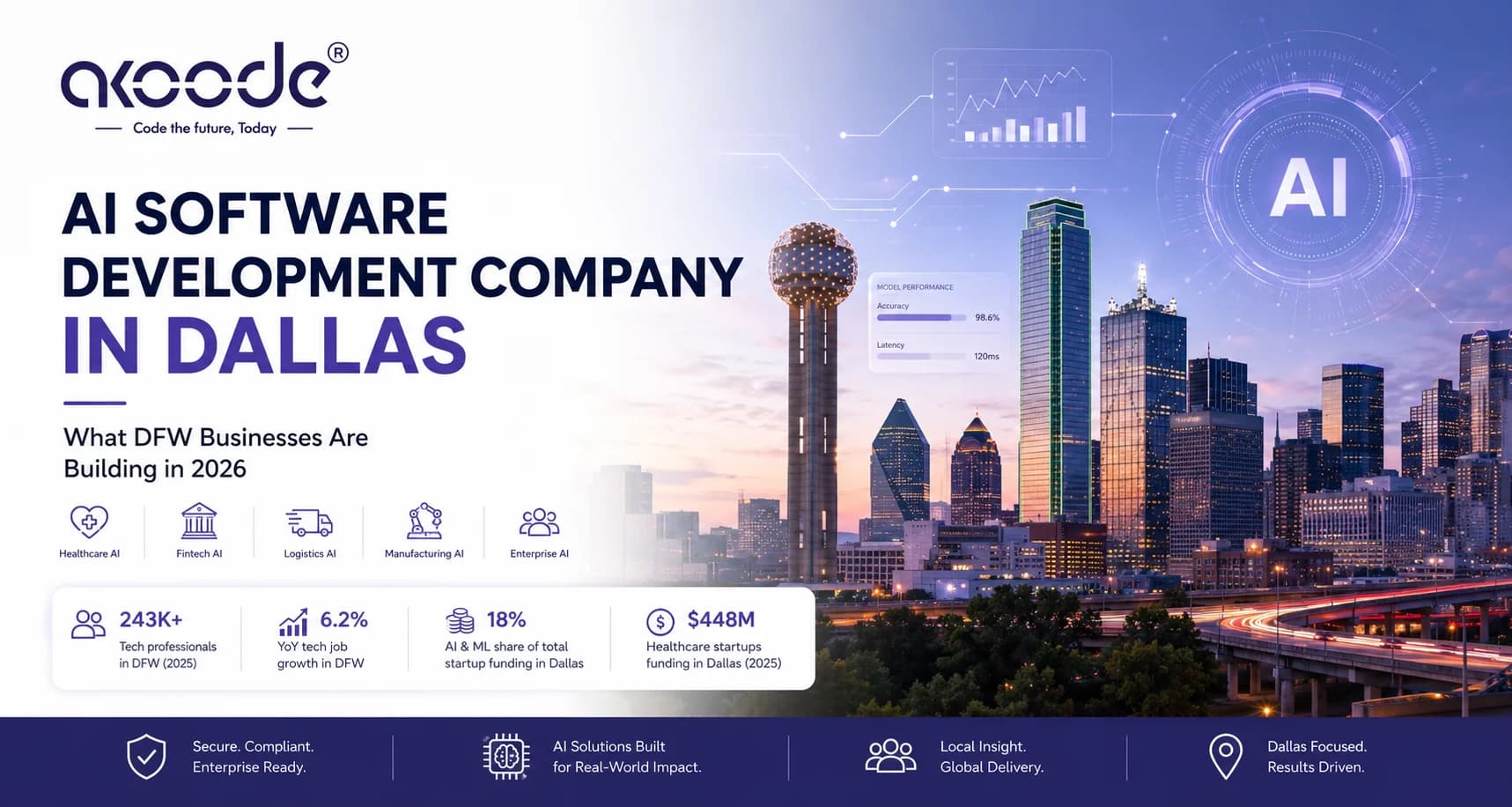
The numbers tell the story. Dallas-Fort Worth added over 14,000 new tech jobs in 2025, a 6.2% jump that brought total tech employment to roughly 243,000 — more than 7% of the entire regional workforce. Key growth sectors: cloud computing, AI, cybersecurity, software development, and fintech.
And the investment is following. Artificial intelligence and machine learning captured 18% of all Dallas startup funding in 2025, sitting right behind healthcare technology (28%) and fintech (22%). Those three sectors aren't separate stories — they're the same story. Most Dallas AI funding is going into healthcare AI and fintech AI, because those are the industries the region was already built on.
There's also a real economic advantage that shapes who builds here. The median pre-money valuation for Series A companies in Dallas was $18 million in 2025, compared to $25 million in San Francisco and $22 million in New York. Combined with no state income tax and a lower cost of living, that means AI companies can build here for less — and that advantage flows to you when you're hiring a development partner.
Dallas offers something the coasts increasingly can't: mature enterprise infrastructure, deep sector expertise, and genuine AI talent, without Silicon Valley's cost structure. That's why the market matters.
What Dallas Businesses Are Actually Building With AI
Forget the demos. Here's what's in production across the sectors that define the DFW economy.
Healthcare AI
Healthcare is the largest sector in Dallas by funding volume, with local healthcare startups raising $448 million in 2025. And AI isn't doing paperwork here — it's solving clinical problems.
Across Dallas health systems, AI is being deployed for diagnostic support, medical imaging analysis, clinical documentation, patient risk stratification, care coordination, and administrative automation like prior authorization and claims processing. The combination of world-class medical institutions, a large insured population, and strong technical talent has made Dallas one of the best environments in the country for healthcare AI.
The critical constraint: HIPAA compliance isn't optional, and it shapes the entire architecture. Our healthcare software development work builds AI systems with HIPAA-eligible infrastructure, full audit trails, and mandatory human oversight on anything clinical — because in healthcare AI, a system that can't pass an audit can't ship.
Fintech and Financial Services AI
Dallas's heritage as a financial services center runs deep — Citi's North Texas campus in Irving alone employs thousands of technology professionals, and Capital One, JPMorgan Chase, and Goldman Sachs all maintain significant DFW engineering operations.
That density has spawned a serious fintech AI market. Top fintech AI experts in Dallas can earn up to $427,960 — a signal of just how high the stakes and the expertise run in this sector.
What's being built: real-time fraud detection, AML and transaction monitoring, credit risk modeling, automated underwriting, algorithmic compliance review, and customer-facing wealth management tools. Companies like Bestow (insurance), Yendo (automotive lending), and Gig Wage (gig-worker payroll) are all building AI-driven financial products from Dallas.
Our finance and banking practice builds fintech AI with the compliance and explainability layers these systems require — because in financial services, "the model said so" isn't an answer a regulator accepts.
Logistics and Supply Chain AI
Dallas sits at the center of North American logistics. AI is being retrofitted across the sector for route optimization, demand forecasting, warehouse automation, predictive maintenance, and real-time shipment tracking. This is the "shower of sparks where AI meets steel beams" — practical intelligence embedded into physical operations that move real goods.
Manufacturing and Aerospace AI
With major employers like Texas Instruments, Lockheed Martin, and a dense manufacturing base, Dallas has strong demand for industrial AI — computer vision for quality control, predictive maintenance, production optimization, and supply chain intelligence. Aerospace AI roles at firms like Lockheed Martin pay up to $191,820, reflecting the complexity and value of the work.
Retail, Telecom, and Enterprise AI
Dallas's enterprise base — AT&T, Southwest Airlines, and a deep bench of Fortune 500 operations — drives demand for AI across customer service automation, personalization, network optimization, and enterprise workflow intelligence. The AI customer support agent category alone resolves 65–85% of tier-1 queries for well-built deployments.
What AI Software Development Costs in Dallas
Let's get to the numbers, because this is where most Dallas AI content stays frustratingly vague.
AI engineers command a premium over general developers — roughly 20% or more — and in Dallas, senior AI/ML engineers bill $190–$260/hour at agencies. That's below coastal rates but firmly in "Silicon Prairie" territory for genuine expertise.
Here's what complete AI projects cost:
AI Project Type | Dallas Agency | Global Partner (Akoode) | Timeline |
|---|---|---|---|
AI chatbot / support agent | $50,000–$150,000 | $20,000–$60,000 | 6–14 weeks |
Document processing / extraction | $70,000–$200,000 | $30,000–$75,000 | 8–16 weeks |
LLM-powered tool (RAG) | $80,000–$220,000 | $35,000–$85,000 | 10–20 weeks |
Custom ML model (train + deploy) | $130,000–$350,000 | $50,000–$140,000 | 14–24 weeks |
Computer vision system | $120,000–$320,000 | $55,000–$130,000 | 12–24 weeks |
AI-integrated enterprise platform | $250,000–$700,000+ | $110,000–$280,000 | 6–18 months |
Two things to understand about these numbers.
The gap between Dallas agency and global partner pricing isn't a quality gap. A senior AI engineer working with GPT-4o, Claude, LangChain, and Pinecone produces the same architecture whether they're in Plano or Gurugram. What changes is the local salary they're built on.
And ongoing costs are separate and permanent. LLM API fees, vector database hosting, infrastructure, and monitoring run $1,000–$25,000/month depending on volume. Model retraining adds 15–20% of build cost annually. Any AI vendor who doesn't raise this in the first conversation is deferring a cost, not eliminating it.
For the full picture on general development pricing in the region, our guide to software development cost in Dallasbreaks down rates by role, project budgets, and Texas-specific compliance costs.
The Texas Compliance Layer Most Vendors Skip
Dallas AI projects carry compliance obligations that generic national estimates ignore. Being specific here is how you avoid a five-figure surprise mid-build.
The Texas Data Privacy and Security Act (TDPSA) governs how businesses handle Texas residents' personal data — consent requirements, data minimization, consumer rights around access and deletion, and opt-out mechanisms for data sales and targeted advertising. Any AI system trained on or processing Texas consumer data needs these controls built into the architecture from Phase 1.
HIPAA for the enormous Dallas-Plano healthtech corridor. This adds roughly 15–20% to build costs — HIPAA-eligible infrastructure, Business Associate Agreements with every vendor touching PHI including your LLM provider, encryption, and audit logging.
PCI-DSS for the region's fintech and payment-processing systems.
Texas Connected Vehicle and IoT privacy standards — an emerging factor for the logistics, automotive, and connected-device projects that are common in the DFW market, protecting driver and device data from unauthorized access.
The practical implication: compliance architecture adds 15–25% to AI project costs in Dallas's dominant sectors. It's dramatically cheaper to design in than to retrofit after your first audit. A software development company that doesn't surface this during scoping either doesn't understand the Texas regulatory environment or is choosing not to complicate the proposal.
What Makes the Best Software Company in Dallas for AI Work
The Dallas market has plenty of firms claiming AI capability. The gap between claiming it and delivering it in production is enormous. Here's how to tell the difference.
As one Dallas AI review put it bluntly: listing "healthcare" or "fintech" as a target market on a services page means nothing. What matters is a track record of embedding AI into systems clients actually use daily — not isolated AI experiments that impress in a demo and break in production.
The six questions that separate real AI firms from the rest
1. "Show me an AI system you built that's been in production for 12+ months."
Modern LLMs make demos trivially easy. Production AI is hard. Ask what broke, how they monitored performance, and what they fixed after launch. This single question filters most of the field.
2. "Walk me through your RAG architecture decisions."
If they can't discuss chunking strategy, embedding model selection, retrieval tuning, and evaluation methodology fluently, they haven't built production RAG systems. These are standard skills in 2026, not advanced ones.
3. "How do you prevent hallucination in a regulated environment?"
The right answer involves RAG grounding, confidence thresholds, response filtering, and mandatory human escalation. The wrong answer is "we use GPT-4, it's accurate."
4. "What's your model evaluation process before deployment?"
Serious teams have a framework: golden datasets, accuracy benchmarks, adversarial testing, red-teaming. Teams without one are shipping on hope.
5. "How do you handle model drift and retraining?"
AI systems degrade as data shifts. If the engagement ends at deployment, performance decays quietly until a customer notices.
6. "Have you shipped under HIPAA, PCI-DSS, or TDPSA requirements?"
Not can you. Have you. Reading a regulation and shipping compliant software under it are different skills entirely.
AI-specific red flags in the Dallas market
They lead with the model, not your problem. "We use GPT-4o" is a component, not a solution.
No discussion of your data. AI lives or dies on data quality. A vendor who quotes before assessing your data hasn't thought about your project.
They promise accuracy numbers before seeing your data. Nobody can. Anyone who does is guessing.
No evaluation framework. How will you know if it works?
Compliance is an afterthought. In Texas, it's an architecture decision.
The portfolio is all demos, no production deployments.
For a complete vendor evaluation process, our guide to hiring a software development company covers the full framework — from RFP to contract.
Build Custom AI vs. Buy a Platform: The Dallas Decision
Not every Dallas business needs custom AI. Some genuinely don't.
Buy an existing platform when:
Your use case is standard — general customer support, basic document summarization
Speed matters more than fit
Your data volume is modest and workflows are simple
You're still validating whether AI helps at all
Build custom when:
Your AI needs to integrate with proprietary systems — your EHR, your core banking platform, your logistics management system
Compliance requires architecture decisions a SaaS vendor can't accommodate
Your data is a genuine competitive advantage
The AI needs to take actions, not just generate text
Per-seat SaaS pricing becomes punishing at your scale
For most Dallas mid-market companies, the break-even lands around 12–18 months. Beyond that, custom wins on both economics and capability. Our AI development practice builds custom AI for exactly this situation.
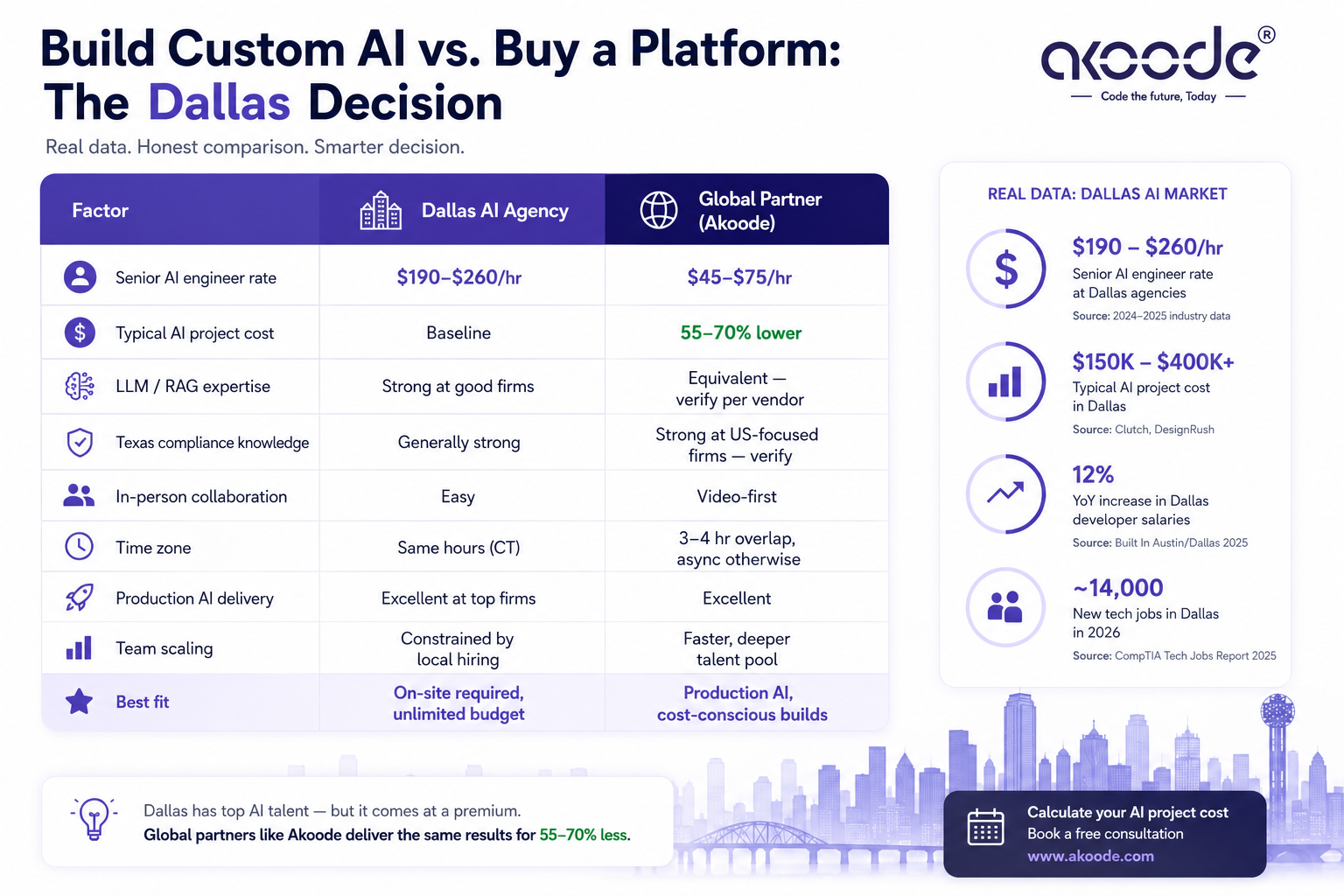
Dallas Agency vs. Global AI Partner: The Honest Comparison
Factor | Dallas AI Agency | Global Partner (Akoode) |
|---|---|---|
Senior AI engineer rate | $190–$260/hr | $45–$75/hr |
Typical AI project cost | Baseline | 55–70% lower |
LLM / RAG expertise | Strong at good firms | Equivalent — verify per vendor |
Texas compliance knowledge | Generally strong | Strong at US-focused firms — verify |
In-person collaboration | Easy | Video-first |
Time zone | Same hours (CT) | 3–4 hr overlap, async otherwise |
Production AI delivery | Excellent at top firms | Excellent |
Team scaling | Constrained by local hiring | Faster, deeper talent pool |
Best fit | On-site required, unlimited budget | Production AI, cost-conscious builds |
The honest read: for genuinely novel AI research, local talent concentration has value. But most Dallas businesses need applied AI — an LLM connected to their systems, doing real work, in a compliant architecture. That engineering is available globally at equivalent quality. The cost difference is geography, not capability.
Why Dallas Businesses Work With Akoode
Akoode Technologies builds AI systems and custom software for Dallas businesses across healthcare, fintech, logistics, manufacturing, and enterprise services.
The track record: 100+ projects delivered across 15+ industries. 4.9/5 on Google. 5.0/5 on Clutch. 5.0/5 on GoodFirms.
The stack: The same tools any top Dallas or coastal AI team uses — GPT-4o, Claude, Gemini, LangChain, Pinecone, Supabase — with production deployment on AWS, GCP, and Azure. Our AI development services span AI agents, RAG systems, computer vision, document processing, and full enterprise AI platforms.
What we do differently:
We run a paid discovery phase before quoting a build. We assess your data before promising anything about accuracy. We surface Texas compliance requirements in the first conversation, not the third invoice. And we'll tell you when a SaaS platform solves your problem better than a custom build — because occasionally that's the honest answer.
We're also transparent about where our engineers sit. Senior teams delivering to US standards, with Central Time communication overlap for Dallas clients. No inflated local markup on offshore delivery.
Review our case studies or read more about how we work.
Frequently Asked Questions
How much does an AI software development company in Dallas cost?
Dallas AI agencies bill $190–$260/hour for senior AI engineers. Complete projects run $50,000–$150,000 for an AI chatbot or support agent, $80,000–$220,000 for an LLM-powered tool with RAG, and $250,000–$700,000+ for a full enterprise AI platform. Global partners deliver equivalent scope at 55–70% less. Budget separately for ongoing LLM API and infrastructure costs of $1,000–$25,000/month.
What is the best software company in Dallas for AI development?
The best AI software company depends on your project, but the qualifying criteria are consistent: a track record of AI in production for 12+ months, fluency in RAG architecture, a real model evaluation framework, and demonstrated experience under Texas compliance regimes like HIPAA and TDPSA. Firms that only demo AI without production deployments should be treated cautiously regardless of marketing claims.
What are Dallas businesses building with AI in 2026?
Applied, vertical AI across the region's dominant sectors. Healthcare: diagnostic support, clinical documentation, prior authorization. Fintech: fraud detection, AML monitoring, credit risk modeling. Logistics: route optimization, demand forecasting, predictive maintenance. Manufacturing: computer vision quality control and production optimization. The common thread is retrofitting AI into existing enterprise systems.
How much does AI development cost compared to regular software in Dallas?
AI development carries a premium. AI/ML engineers bill roughly 20% more than general developers, and complex AI projects require additional work in data engineering, model evaluation, and monitoring. A comparable-scope AI project typically costs 20–40% more than standard software development, plus ongoing LLM and infrastructure costs that standard software doesn't incur.
What compliance requirements affect AI development in Dallas?
The Texas Data Privacy and Security Act (TDPSA) governs Texas residents' personal data. HIPAA applies to the large Dallas-Plano healthtech sector, adding 15–20% to build costs. PCI-DSS applies to fintech and payment processing. Texas Connected Vehicle standards affect logistics and IoT projects. Compliance architecture adds 15–25% to AI project costs in regulated sectors.
Should I hire a Dallas AI company or a global partner?
If you need on-site collaboration, US-vendor contract requirements, or genuinely novel AI research, hire locally. For production AI applications — LLM integration, RAG systems, AI agents, document processing, computer vision — a transparent global partner delivers equivalent outcomes at 55–70% lower cost with Central Time communication overlap.
How long does it take to build an AI system in Dallas?
A focused AI agent takes 6–14 weeks. An LLM-powered tool with proper RAG takes 10–20 weeks. A custom ML model with data pipeline work takes 14–24 weeks. Enterprise AI platforms run 6–18 months. These timelines assume your data is available and reasonably clean — data preparation frequently adds weeks founders don't anticipate.
What is RAG and why do AI vendors keep mentioning it?
Retrieval-Augmented Generation grounds AI responses in your actual business data rather than the model's training data. It retrieves relevant content from your knowledge base at query time and answers from that, which prevents hallucination — the AI confidently inventing facts. For any Dallas business in healthcare or fintech, RAG isn't a feature. It's a requirement.
Does Dallas have good AI talent?
Yes. Dallas added 14,000+ tech jobs in 2025, with AI as a key growth sector. Major employers like Texas Instruments, AT&T, Citi, and Capital One anchor a deep talent pool, and DFW universities feed a steady pipeline. Fintech AI experts can earn up to $427,960 locally — a signal of the depth of expertise in the region.
What ongoing costs come with an AI system?
LLM API fees scale with usage — $200/month for a small deployment to $20,000+/month at enterprise volume. Vector database hosting runs $70–$2,000/month. Infrastructure adds $100–$10,000/month. Model monitoring and retraining costs 15–20% of build cost annually. These start at launch and never stop.
What to Do Next
If you're a Dallas business evaluating AI, the most useful thing you can do this week isn't shortlisting vendors.
It's writing down the specific, expensive problem you want AI to solve. Not "we want to use AI." Something like: "Our claims team spends 30 hours a week manually reviewing prior authorization requests, and 70% follow predictable patterns."
That sentence transforms every vendor conversation. It gives an AI team something concrete to scope against, and it lets you evaluate proposals on substance instead of enthusiasm.
Then check your data. Is it accessible? Structured? Clean enough for a model to learn from or retrieve against? Most AI projects that fail in Dallas fail on data, not models.
Then talk to two or three teams — including at least one that will tell you honestly whether your project is worth doing at all.
Read Related Articles
Software Development Cost in Dallas
and How to Hire Software Development Company in Dallas - Full Guide
Talk to Akoode About Your Dallas AI Project
We'll review your workflow, assess your data, surface the Texas compliance requirements you'll hit, and give you a straight answer on scope, cost, and whether AI is even the right tool for the problem.
Sometimes the answer is a $40,000 AI agent. Sometimes it's a SaaS tool. Sometimes it's a local Dallas agency. We'll tell you which.
Book a free 45-minute AI consultation → calendly.com/akhil-akoode/ak
Software Development Company in Dallas | akoode.com | contact us | info@akoode.com
Get In Touch Now
View More Our Blog