


 July 18, 2026
Software Development Cost in Dallas: What You're Actually Paying For in 2026
Dallas has quietly become one of the most important software markets in the country, and the pricing reflects that shift.
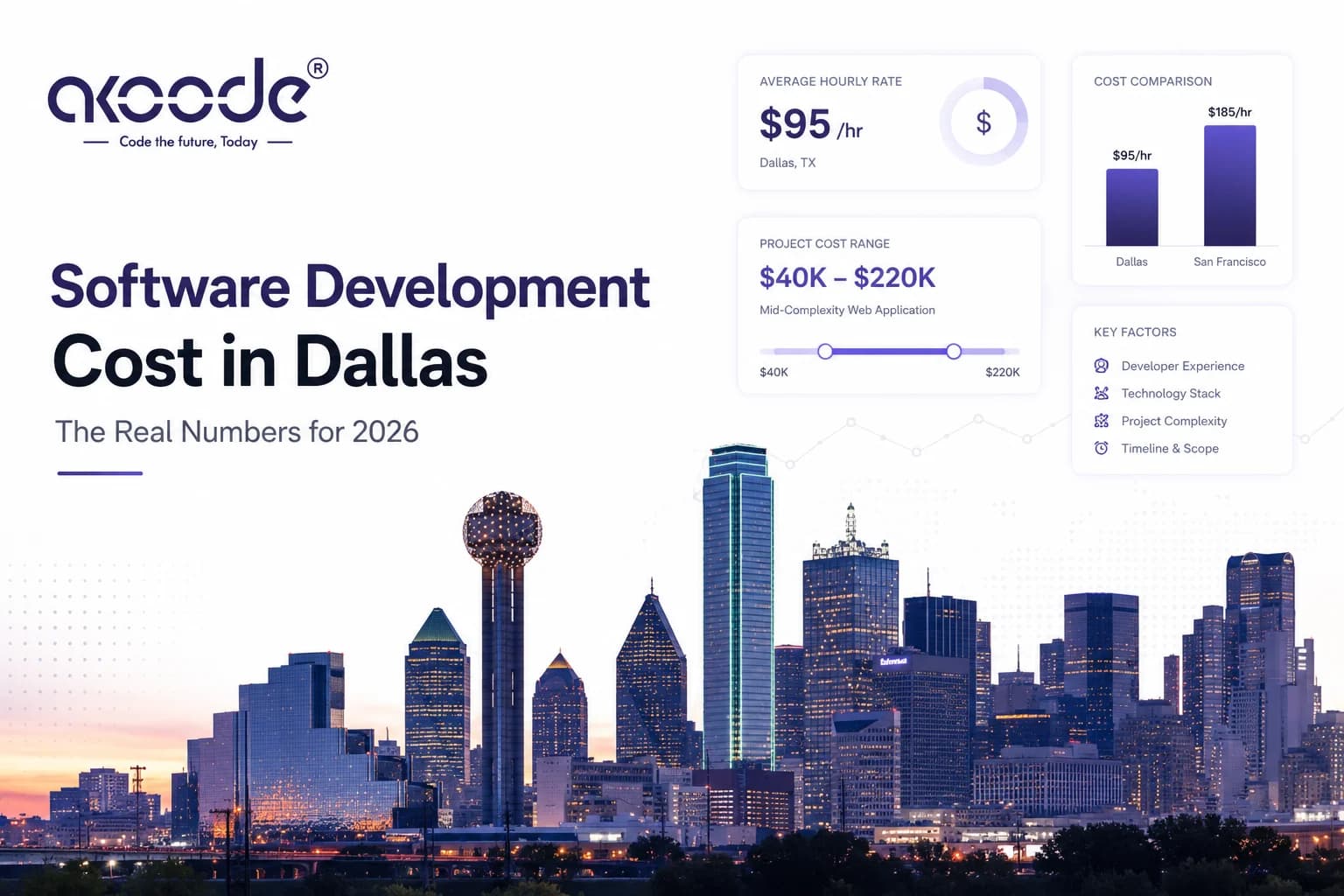
Depending on which developer you ask and what you're building, software development in Dallas runs anywhere from $85 to $210 per hour in 2026. That's a wide range — and the reason it's so wide is exactly what most business owners misunderstand before they start collecting quotes.
A mid-complexity web application in the Dallas-Fort Worth metroplex will cost you $90,000–$220,000 with a local agency. The same project scope, built by a senior-led offshore team, runs $40,000–$85,000.
The gap isn't about quality. It's about geography, salary, and overhead. And whether the Dallas premium is worth paying depends entirely on your project — which is what this guide is going to help you figure out.
If you're planning a software project in or for the Dallas market, here are the actual numbers you need before you talk to a single vendor.
Why Dallas Became a Serious Software Market
For years, "Texas tech" meant Austin. That's changing fast.
The Dallas-Fort Worth metroplex is now a primary North American technology hub, and the talent pool is expanding rapidly. Dallas alone is adding nearly 14,000 new tech jobs in 2026 — a growth rate that's pulling engineering talent from more expensive coastal markets and building genuine depth across fintech, telecom, healthcare, and enterprise software.
There's a specific economic reason companies and engineers are moving here. Texas has no state income tax. For a developer, that means take-home pay stretches further, which lets Dallas companies offer competitive compensation without matching San Francisco's brutal salary numbers. Texas-based salaries typically run 30–40% below San Francisco or New York for equivalent roles.
But — and this matters — Dallas developer salaries rose 12% since 2024. The cost advantage over the coasts is real, but it's narrowing. The "Silicon Prairie" is no longer the bargain it was five years ago.
That's the context behind every quote you'll receive. Dallas is cheaper than the coasts, more expensive than it used to be, and home to genuinely strong engineering talent — particularly in the sectors that dominate the local economy.
Dallas Developer Salaries: What the Data Actually Says
Before we get to agency rates, it helps to understand what developers themselves earn — because that's the foundation every quote is built on.
The numbers vary by source, which tells you something about how much seniority and specialization matter:
ZipRecruiter puts the average Dallas software developer salary at $107,589/year ($51.73/hour)
Glassdoor reports $121,303/year ($58/hour) for the DFW metro
Salary.com lands higher at $127,675/year ($61/hour)
The spread across those sources — roughly $107K to $128K — reflects real differences in how each measures experience and role. What's consistent: mid-level Dallas developers earn in the $105,000–$128,000 range, with top earners (90th percentile) hitting $145,000–$182,000.
Here's the part business owners miss. That's the salary. What you pay an agency is a different number entirely.
When a developer earning $120,000 joins an agency, the company adds roughly 30–40% in benefits costs, plus employer taxes, office space, project management, sales overhead, and margin. A mid-level developer earning $120,000 base actually costs approximately $156,000–$168,000 fully loaded — before recruiting costs. By the time that rolls into a client rate card, you're looking at agency billing rates well above the raw salary math.
Dallas Software Development Hourly Rates: The Full Breakdown
Dallas sits in an interesting middle tier nationally. It's meaningfully cheaper than the coasts but commands what locals call "Silicon Prairie rates" — premium pricing for genuine expertise.
National benchmarks put Dallas/Houston custom software development at $85–$155/hour. But that's the broad market average. For senior enterprise work, the numbers climb higher — senior full-stack developers in Dallas command $165–$210/hour for contract-based enterprise work, and local agency rates for high-level strategy and architecture range from $140 to $210/hour.
Here's a fuller picture by role and seniority:
Role | Junior (0–2 yrs) | Mid-Level (3–5 yrs) | Senior (6+ yrs) |
|---|---|---|---|
Frontend Developer | $65–$90/hr | $90–$130/hr | $130–$175/hr |
Backend Developer | $70–$100/hr | $100–$140/hr | $140–$190/hr |
Full-Stack Developer | $70–$95/hr | $95–$135/hr | $135–$210/hr |
Mobile Developer (iOS/Android) | $75–$105/hr | $105–$145/hr | $145–$200/hr |
UI/UX Designer | $60–$90/hr | $90–$125/hr | $125–$165/hr |
DevOps / Cloud Engineer | $80–$115/hr | $115–$155/hr | $155–$205/hr |
AI / ML Engineer | $100–$145/hr | $145–$190/hr | $190–$260/hr |
QA Engineer | $55–$80/hr | $80–$110/hr | $110–$150/hr |
Technical Project Manager | $85–$120/hr | $120–$155/hr | $155–$195/hr |
Two things worth flagging.
Mobile engineers cost more than generalists. Mobile Software Engineer roles in Dallas pay roughly 15% more than the average software developer — which flows directly into higher billing rates for app projects.
And AI talent carries the steepest premium. AI/ML engineers command 20% or more over general developers, and that gap is widening as demand outpaces the available specialist pool.
What Complete Projects Cost in Dallas
Hourly rates are just inputs. What you actually need to budget is total project cost — and that depends on scope, complexity, team size, and timeline.
Web Application Development
Project Type | Complexity | Cost Range | Timeline |
|---|---|---|---|
Marketing website / landing pages | Simple | $8,000–$25,000 | 3–6 weeks |
MVP / proof of concept web app | Simple-Medium | $30,000–$70,000 | 6–12 weeks |
Business web application | Medium | $70,000–$160,000 | 3–6 months |
SaaS platform | Medium-High | $130,000–$320,000 | 5–10 months |
Enterprise web platform | Complex | $280,000–$650,000+ | 8–18 months |
Mobile App Development
Dallas mobile app costs have shifted in one important way for 2026: you can no longer launch on a single platform. Investors want to see iOS and Android, and most Dallas startups now use cross-platform frameworks like Flutter and React Native, which offer roughly 30% savings over separate native builds.
App Type | Cost Range | Notes |
|---|---|---|
Simple MVP (cross-platform) | $50,000–$90,000 | Investors expect iOS + Android from launch |
Mid-complexity app | $90,000–$180,000 | Integrations, custom UI, backend |
Complex / enterprise app | $180,000–$450,000+ | Real-time data, security, multi-role |
A realistic MVP entry point in Dallas today is around $50,000 — that's the floor for something secure and scalable, not a bargain-basement build.
Custom Software and Enterprise Systems
Project Type | Cost Range |
|---|---|
CRM or internal operations tool | $40,000–$120,000 |
Custom ERP system | $150,000–$450,000+ |
Healthcare platform (HIPAA-compliant) | $110,000–$400,000 |
Fintech application | $130,000–$450,000 |
AI-integrated business application | $80,000–$320,000 |
Fintech and healthtech are enormous in the Dallas-Plano corridor, and both require strict security standards. You should budget roughly 15% more for compliance auditing on any project in these sectors.
Where Your Budget Actually Goes
One of the most common surprises for first-time software buyers is how little of the budget goes toward the code users actually see. Understanding this breakdown prevents the scope shock that kills projects mid-build.
Here's how a $150,000 Dallas software project typically distributes:
Phase | Budget Share | What It Covers |
|---|---|---|
Discovery & strategy | 8–12% ($12K–$18K) | Requirements, architecture, user research |
UI/UX design | 18–25% ($27K–$37K) | Wireframes, prototypes, testing, design system |
Frontend development | 25–35% ($37K–$52K) | UI build, responsive design, state management |
Backend & APIs | 20–30% ($30K–$45K) | Server, database, auth, integrations |
QA & testing | 8–12% ($12K–$18K) | Functional, performance, security testing |
Deployment & PM | 10–15% ($15K–$22K) | DevOps, cloud setup, project management |
The takeaway: on a $150,000 project, you're spending $27,000–$37,000 on design and $30,000–$45,000 on backend infrastructure before a single user-facing screen ships. These aren't optional line items. Cut them and you get software that doesn't work, doesn't scale, or doesn't get used.
The Hidden Costs Dallas Agencies Rarely Quote Upfront
This is where projects blow past budget — not from dishonesty, but from costs that don't appear in the initial proposal.
Third-party services start immediately and never stop. Stripe for payments, Twilio for SMS, AWS or Azure for hosting, SendGrid for email, mapping and analytics APIs. These recurring costs scale with your users. Budget $500–$10,000/month from launch day depending on your application.
Post-launch maintenance is permanent. Plan for 15–20% of your build cost annually. For a $200,000 Dallas project, that's $30,000–$40,000 every year in updates, bug fixes, dependency management, and OS compatibility. Most founders leave this out of their financial model entirely and then scramble twelve months after launch.
Texas compliance is a real line item. More on this below — but the Texas Data Privacy and Security Act now requires strict handling of local user data, and for fintech and healthtech projects, compliance auditing adds meaningful cost.
The scaling wall catches teams that skip early architecture. One Dallas enterprise project we've seen referenced hit a "scaling wall" at month five — costs jumped $120,000 because the team had to re-architect the data ingestion layer to meet Texas privacy standards and handle 500 concurrent users. The lesson every experienced buyer learns eventually: localized compliance and high-concurrency testing belong in Phase 1, not patched in at Phase 3.
Always keep a 15% budget buffer. Unforeseen technical issues will happen during integration. Third-party software connections are more volatile than they used to be. Every experienced Dallas CTO builds this reserve into the plan from the start.
Dallas vs. Other Markets: The Honest Comparison
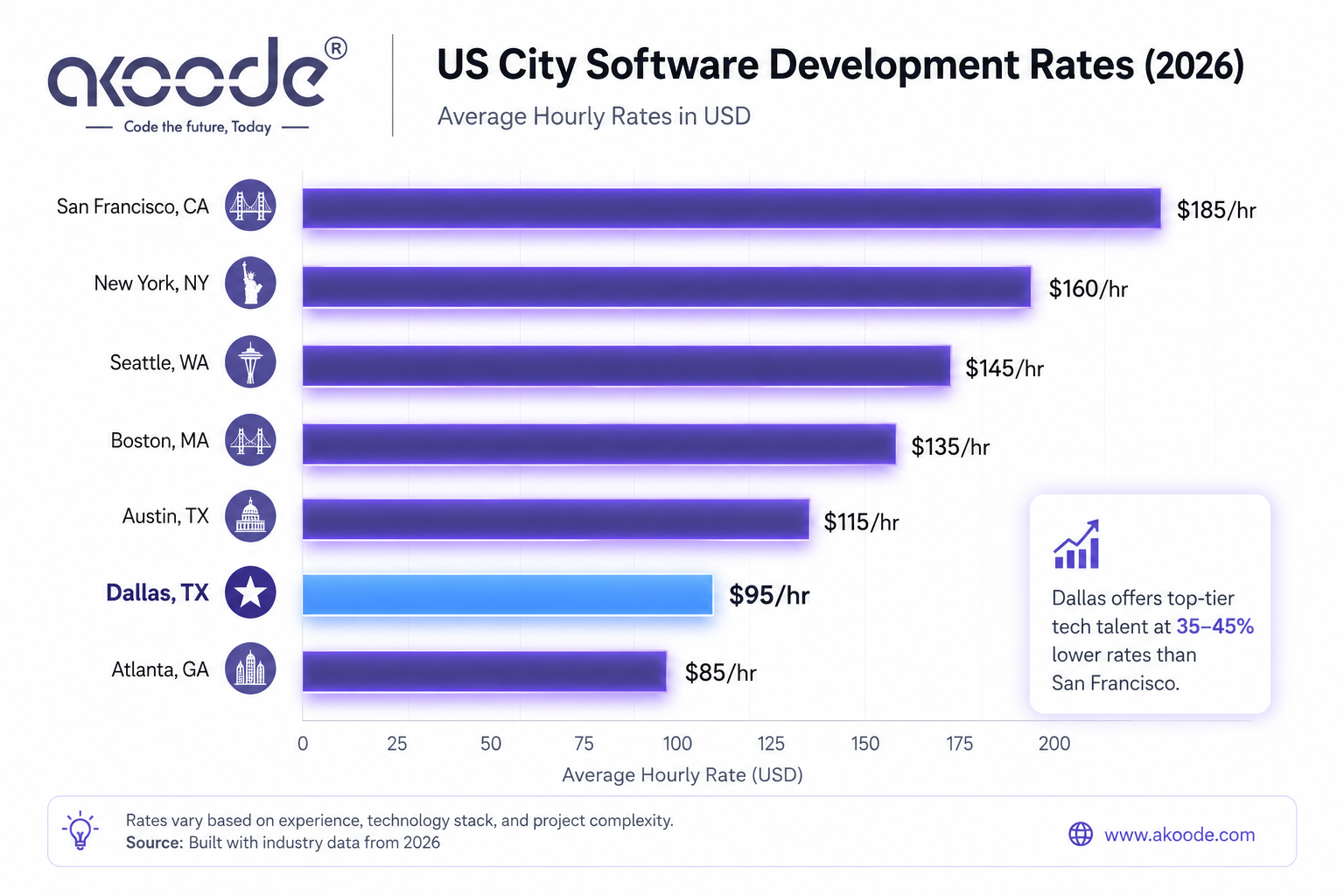
Dallas is cheaper than the coasts but not the cheapest option available. Here's where it sits nationally and globally.
National city comparison for custom software development:
Market | Hourly Rate |
|---|---|
San Francisco / Silicon Valley | $150–$250/hr |
New York City | $130–$220/hr |
Seattle | $120–$200/hr |
Austin, TX | $90–$160/hr |
Dallas / Houston, TX | $85–$155/hr |
Atlanta | $80–$140/hr |
Nearshore (Latin America) | $40–$80/hr |
Offshore (South Asia) | $25–$55/hr |
Now let's put it in project terms. A mid-complexity SaaS platform requiring 2,000 hours:
Team Location | Avg Rate | Total Cost |
|---|---|---|
Dallas agency (senior) | $175/hr | $350,000 |
Dallas agency (blended) | $120/hr | $240,000 |
Nearshore (LatAm) | $65/hr | $130,000 |
Offshore (India, senior) | $45/hr | $90,000 |
Here's the honest nuance that most offshore-vs-local content skips: cheaper hourly rates don't automatically mean lower total cost of ownership.
Complex Dallas enterprise projects have a real TCO consideration. Communication lags across time zones, coordination overhead, and rework from misaligned requirements can erode the savings on genuinely complex builds if the offshore relationship isn't managed well.
That said — the companies that have bad offshore experiences almost always made one of two mistakes: they chose a vendor on price alone without evaluating quality, or they treated it as a set-and-forget arrangement without active management. Neither of those is a geography problem. A well-managed offshore engagement with a senior team and disciplined communication routinely delivers Dallas-equivalent quality at 50–70% less.
Akoode Technologies works with Dallas businesses at a fraction of local agency rates — with the communication discipline and senior engineering that makes the cost advantage actually stick, rather than evaporate in rework.
Texas Compliance: What It Adds to Your Dallas Project
This is where Dallas differs from generic national cost estimates, and where the newer competitor content mostly stays vague. Let's be specific.
The Texas Data Privacy and Security Act (TDPSA) took effect and now requires strict handling of Texas residents' personal data. It applies to businesses that process or sell personal data, with specific obligations around consent, data minimization, consumer rights (access, deletion, correction), and opt-out mechanisms for targeted advertising and data sales. Any consumer-facing software handling Texas user data needs these controls architected in — and retrofitting them after launch costs far more than building them in from the start.
HIPAA applies to the Dallas-Plano healthcare corridor's many health tech projects. This adds roughly 15–20% to base development cost — HIPAA-eligible infrastructure, Business Associate Agreements with every vendor touching PHI, encryption, audit logging, and access controls.
PCI-DSS governs any application processing payment card data — relevant to Dallas's substantial fintech and e-commerce sectors.
Texas "Connected Vehicle" and IoT privacy standards are an emerging consideration for automotive, logistics, and connected-device projects — protecting driver and device data from unauthorized access.
The practical point: compliance auditing and architecture add 15% or more to project costs in Dallas's dominant sectors. A software development company that doesn't raise this in the scoping phase either doesn't know the Texas regulatory environment or is choosing not to complicate the proposal. Both are worth a direct question.
When Dallas Rates Are Worth Paying
Let's be straight about this rather than pretending offshore is always the answer.
Pay Dallas rates when:
You need regular in-person collaboration — on-site integration, workshops, physical hardware, or stakeholder sessions that genuinely benefit from being in the room.
Your enterprise contracts require US-based vendors or on-shore data handling. Some regulated industries and larger clients mandate this contractually.
Your project is short and tightly scoped — under 10 weeks — where offshore coordination overhead could offset the cost savings.
You're building something specific to the Dallas or Texas market and local knowledge is genuinely part of the product.
You want same-time-zone communication and value the speed of a same-day, in-person meeting over cost savings.
Consider alternatives when:
Your requirements are clearly defined and the engineering is standard — web apps, mobile apps, SaaS platforms, standard integrations.
Your project runs longer than 3–4 months, where the cost differential compounds significantly.
Your team can manage an offshore relationship properly with clear documentation, regular reviews, and an engaged product owner.
Budget genuinely matters to your business — where the difference between a $300,000 build and a $90,000 build funds additional runway, marketing, or hiring.
A Practical Budget Framework for Dallas Software Projects
Before you talk to any vendor, run this exercise. It makes every subsequent conversation sharper.
Step 1: Define your project tier. MVP to test a hypothesis? Production system replacing something existing? Net-new enterprise platform? Each has a different cost floor and a different risk profile if you underinvest.
Step 2: Separate must-have from nice-to-have. List every feature. Mark which ones need to exist on day one versus which can ship in v2. Descoping is the highest-leverage cost tool you have, and it's free.
Step 3: Add 15–20% for hidden costs and a buffer. Whatever you're quoted, add reserve for third-party services, compliance, and the technical surprises that always emerge during integration.
Step 4: Budget maintenance from day one. 15–20% of build cost annually, starting at launch. If this changes your project economics, better to know now.
Step 5: Get three quotes and compare scope, not price. Two quotes $100,000 apart are almost never quoting the same thing. Ask each vendor to itemize what's included. The "cheap" quote usually stops being cheap once you compare line by line.
Frequently Asked Questions
How much does software development cost in Dallas in 2026?
Dallas software development runs $85–$210/hour depending on seniority, with senior enterprise developers at the top of that range. Complete projects run $30,000–$70,000 for an MVP web app, $130,000–$320,000 for a SaaS platform, and $280,000–$650,000+ for enterprise systems. A realistic mobile app MVP starts around $50,000.
What is the average hourly rate for a software developer in Dallas?
Dallas software developers earn an average base salary of $107,000–$128,000/year, which works out to roughly $51–$61/hour in salary terms. Agency billing rates run higher once overhead and margin are added — typically $85–$155/hour for the general market and $140–$210/hour for senior enterprise contract work.
Is software development cheaper in Dallas than in New York or California?
Yes. Dallas rates ($85–$155/hour) run meaningfully below New York ($130–$220) and San Francisco ($150–$250). Texas has no state income tax and a lower cost of living, so Texas developer salaries typically run 30–40% below coastal markets for equivalent roles. However, Dallas rates rose 12% since 2024 — the gap is narrowing.
How much does a mobile app cost to build in Dallas?
A cross-platform mobile app MVP in Dallas starts around $50,000. Mid-complexity apps with integrations and custom UI run $90,000–$180,000. Complex enterprise apps with real-time data and advanced security run $180,000–$450,000+. Most Dallas startups now use Flutter or React Native, saving roughly 30% versus separate native iOS and Android builds.
What compliance requirements affect software development in Dallas?
The Texas Data Privacy and Security Act (TDPSA) governs handling of Texas residents' personal data, requiring consent, data minimization, and consumer rights controls. HIPAA applies to the large Dallas-Plano healthtech sector, adding 15–20% to costs. PCI-DSS applies to payment processing. Budget roughly 15% more for compliance auditing in fintech and healthtech projects.
How much does software maintenance cost after launch in Dallas?
Plan for 15–20% of your original build cost annually, starting from launch day. For a $200,000 Dallas project, that's $30,000–$40,000 per year covering updates, bug fixes, dependency management, security patches, and OS compatibility. This is a permanent expense most founders forget to budget.
Should I hire a Dallas software company or go offshore?
It depends on your priorities. If you need in-person collaboration, US-vendor requirements, or a short tightly-scoped project, local makes sense. For standard web, mobile, and SaaS work where engineering quality matters more than geography, a well-managed offshore partner like Akoode Technologies delivers equivalent outcomes at 50–70% lower cost. The key word is "well-managed" — offshore done carelessly erodes its own savings.
How long does software development take in Dallas?
Timelines depend on scope, not location. A simple web app MVP takes 8–14 weeks. A mid-complexity SaaS platform takes 4–8 months. An enterprise platform takes 8–18 months. A well-managed offshore team in a compatible working window delivers equivalent timelines.
Why did Dallas become a major software development hub?
No state income tax, lower cost of living, and aggressive tech-sector growth. Dallas is adding nearly 14,000 tech jobs in 2026, pulling talent from expensive coastal markets. The DFW metroplex has particular strength in fintech, telecom, healthcare, and enterprise software — with major employers like AT&T, JPMorgan Chase, and others anchoring the ecosystem.
What's the cheapest way to build software without sacrificing quality?
Scope discipline first — a tight MVP that does three things well costs far less than a sprawling product doing twelve things adequately. Team location second — a quality offshore partner delivers equivalent output at 50–70% less than Dallas rates. Engagement model third — a dedicated team for a long project costs less over 12 months than repeated fixed-price engagements with ramp-up costs each time.
Also Read Related Article - AI Software Development in Dallas: What DFW Businesses Are Building in 2026
and How to hire a software development company Dallas - Full Guide
The Bottom Line
Dallas earned its place as a serious software market. The talent is real, the sector depth in fintech and healthtech is genuine, and the cost advantage over the coasts — while narrowing — still exists.
But "cheaper than San Francisco" isn't the same as "the right price for your project." For most software work, technical quality comes down to the team's experience, process discipline, and communication — not their zip code.
If you need in-person collaboration, Texas-specific expertise, or your contracts require US-based vendors, a Dallas team makes sense. If you're building standard software and your budget could stretch twice as far with a well-managed offshore partner, that Silicon Prairie premium deserves a hard look.
The single best move before committing to any budget is getting a clear, itemized picture of what you're actually buying — including the discovery phase, the Texas compliance architecture, the maintenance costs, and the third-party services that won't appear in any proposal until after you've signed.
That's the conversation we're happy to have with any Dallas business weighing its options.
Book a free consultation → calendly.com/akhil-akoode/ak
No pitch. No pressure. Just a straight conversation about what your project needs and what it should realistically cost.
Explore our work: Software Development Company in Dallas | akoode.com | AI development | custom software | mobile apps
Get In Touch Now
View More Our Blog