


 July 23, 2026
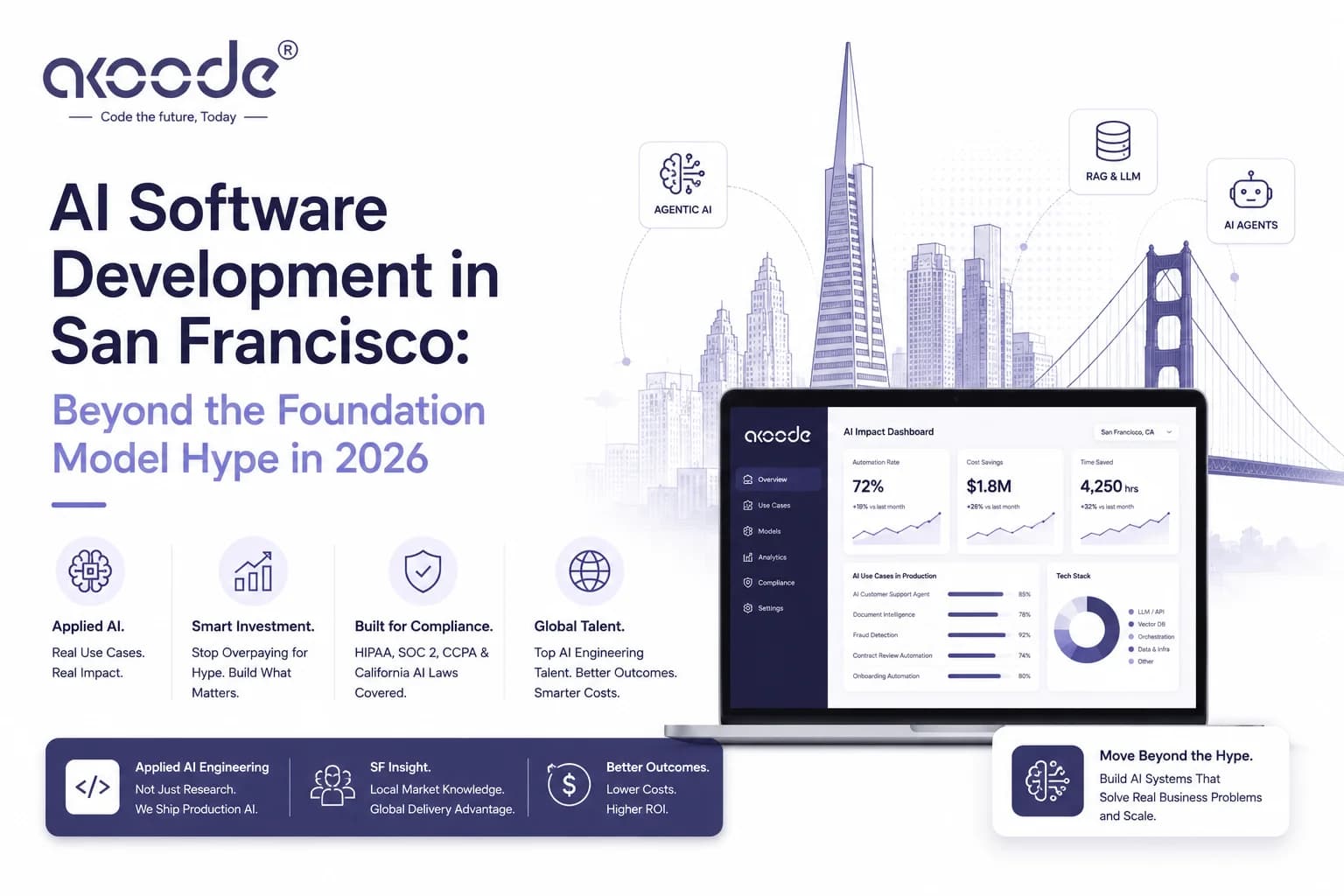
AI Software Development in San Francisco: Beyond the Foundation Model Hype in 2026
San Francisco has a strange problem: it's so good at frontier AI that most local businesses can't tell what kind of AI they actually need.
This is the city where OpenAI and Anthropic are headquartered. Where frontier labs pay engineers $400K–$600K+ packages. Where every coffee shop conversation within a mile of the Mission includes the word "agentic." The gravitational pull of the research economy is so strong that ordinary businesses — the SaaS company in SoMa, the health system across the bridge, the fintech in the Financial District — absorb its pricing, its hiring assumptions, and its vocabulary by osmosis.
And then they overpay. Badly.
Because here's the distinction the local market blurs better than anywhere on earth: frontier AI research and applied AI engineering are different disciplines with different talent pools and different price tags. One genuinely requires San Francisco. The other is available globally at a fraction of local rates — with identical stacks and identical outcomes.
This guide is about knowing which one your project is. It covers what SF businesses are actually deploying (as opposed to what's being demoed at meetups), what applied AI genuinely costs here versus globally, the California compliance layer that shapes all of it, and how to choose a partner that ships production systems rather than research theater.
The Two AI Economies of San Francisco
Every city we've written about has some version of two AI economies. San Francisco has the most extreme version — because the first economy actually lives here.
The frontier economy builds foundation models, novel architectures, and research-grade ML. It's OpenAI, Anthropic, xAI, the university labs, and the research-adjacent startups orbiting them. It employs a small number of extraordinarily compensated researchers, consumes enormous capital, and produces the models everyone else builds on. If your product's moat is novel AI research, this economy is your talent pool — and its prices are the cost of admission.
The applied economy takes those finished models — GPT-4o, Claude, Gemini — and wires them into business workflows: support agents, document intelligence, RAG-grounded knowledge tools, in-product copilots, compliance automation. This is engineering, not research. Its raw materials are APIs, orchestration frameworks, and vector databases. Its skills exist globally at scale.
Here's what makes San Francisco uniquely distorting: because the frontier economy is physically here, its salary gravity inflates the applied economy's rates far beyond what the work requires. Senior AI engineers at SF agencies bill $235–$300+/hour — the highest applied-AI rates on the planet — to do integration work whose global rate is $45–$75/hour with the same stack and the same outcome.
The most expensive mistake an SF business can make in 2026 isn't choosing the wrong model. It's paying frontier-research prices for applied engineering.
What San Francisco Businesses Are Actually Deploying
Strip away the demo-day noise, and the AI in production across SF's business economy looks remarkably practical.
SaaS and Technology Companies
The city's largest applied category, under the most competitive pressure anywhere:
In-product AI copilots — no longer differentiators, now table stakes. SF SaaS buyers ask about AI capabilities in every evaluation, and products without them lose deals silently
AI customer support agents resolving 65–85% of tier-1 volume — the mechanics are covered in our guide to AI customer support agents
Onboarding automation and churn prediction from usage signals
AI-assisted sales intelligence — call summarization, pipeline analysis, outreach drafting
For SF SaaS companies the stakes are doubled: AI is simultaneously an internal cost lever and a product requirement, and the product pressure is existential in this market.
Fintech and Financial Services
The Financial District's fintech cluster deploys fraud detection, transaction monitoring, automated underwriting assistance, and LLM-powered compliance review — all with the explainability layers regulators demand. "The model said so" isn't an answer the SEC accepts, which shapes architecture from day one. Our finance and banking practice builds these systems with audit trails and human escalation designed in.
Health Tech
Bay Area health systems and digital-health startups are deploying AI against administrative burden: prior authorization automation, clinical documentation that returns hours to physicians, patient scheduling agents, and claims denial management. All under HIPAA — which must be architected in, not bolted on. Our healthcare AI work designs that compliance from Phase 1.
E-commerce, Consumer, and Marketplaces
Personalization engines, AI-generated creative at scale, conversational shopping, inventory forecasting, and trust-and-safety automation for marketplaces. In SF's design-obsessed consumer market, the bar for customer-facing AI is the highest anywhere — a clumsy chatbot damages a brand competing on experience.
Professional Services and Legal
The city's law firms, agencies, and consultancies deploy contract review, discovery classification, research assistance, and proposal automation — document-heavy work that compresses beautifully.
The pattern across every sector: repetitive, document-heavy, or headcount-scaling work. And in the most expensive labor market in America — where a fully loaded support hire costs $85,000+ and an engineer costs $250,000+ — avoided headcount is worth more in San Francisco than anywhere else on the planet. The AI ROI math that's compelling in Dallas is overwhelming here.
What AI Development Actually Costs: SF vs. Global
Concrete numbers, because SF's rate distortion makes vague pricing especially dangerous here.
Senior AI/ML engineers at SF agencies bill $235–$300+/hour. Here's what complete projects run:
AI Project Type | SF Agency | Global Partner (Akoode) | Timeline |
|---|---|---|---|
AI chatbot / support agent | $70,000–$200,000 | $20,000–$60,000 | 6–14 weeks |
Document processing / extraction | $90,000–$240,000 | $28,000–$75,000 | 8–16 weeks |
LLM-powered internal tool (RAG) | $100,000–$280,000 | $32,000–$85,000 | 10–20 weeks |
In-product AI copilot feature | $110,000–$300,000 | $35,000–$95,000 | 10–20 weeks |
AI agent (action-taking) | $120,000–$320,000 | $40,000–$110,000 | 10–22 weeks |
Custom ML model (train + deploy) | $180,000–$450,000 | $50,000–$140,000 | 14–24 weeks |
Enterprise AI platform | $350,000–$900,000+ | $110,000–$280,000 | 6–18 months |
That's a 60–70% gap — the widest of any US market — for identical work. A senior engineer wiring Claude into your knowledge base with LangChain and Pinecone produces the same architecture in Gurugram as in SoMa. The stack is identical. The deployment targets are identical. The evaluation methods are identical. What differs is the salary gravity of having OpenAI as the employer down the street.
When the SF premium is genuinely worth it: novel model architectures, research-grade ML, products where the AI research is the moat, and work requiring the specific researcher network that only exists here. That's real — and rare.
Ongoing costs, anywhere in the world: LLM API fees ($200–$20,000+/month scaling with usage), vector database and infrastructure hosting ($100–$5,000/month), and model monitoring plus retraining (15–20% of build cost annually). Any vendor who doesn't surface these in the first conversation is deferring the discussion, not the cost. And note: at SF rates, that annual maintenance percentage is priced at $235+/hour forever — the build-rate decision compounds for the product's entire life.
For the full picture on general development pricing, see our San Francisco software development cost guide.
The California Compliance Layer
AI projects touching California users carry the most aggressive privacy regime in America.
CCPA and CPRA give California residents rights over their personal data — access, deletion, correction, opt-out of sale and sharing. Any AI system trained on or processing California consumer data needs these controls architected in from Phase 1. This gets sharper with AI specifically: training data provenance, the right to deletion from datasets, and automated decision-making disclosures are active regulatory territory in 2026.
HIPAA for health tech: 15–25% added build cost, BAAs with every vendor touching PHI — including your LLM provider — encryption, and audit logging.
SOC 2 — effectively mandatory for any B2B SaaS selling into enterprise, and AI features expand the audit surface: model access controls, data handling in prompts, and vendor sub-processing all come into scope.
SEC and FINRA explainability obligations for financial services AI.
The practical point: compliance architecture adds 15–25% to AI project costs in SF's regulated verticals — and it's dramatically cheaper designed in than retrofitted after your first enterprise security review kills a deal. A vendor who doesn't surface this during scoping either doesn't know the California environment or is choosing not to complicate the proposal.
How to Choose an AI Partner in San Francisco
The general vendor process — red flags, contract terms, references — is covered in our guide to hiring a software development company in San Francisco. AI adds specific filters, and they matter more in SF than anywhere — because this market has the highest density of impressive-sounding AI theater in the world.
The six questions that cut through it
"Show me an AI system you built that's been in production 12+ months." In the city of demos, this question is devastating. Ask what broke, how they monitored it, what they fixed. Production scars are the only credential that matters.
"Walk me through your RAG architecture decisions." Chunking strategy, embedding model selection, retrieval tuning, evaluation methodology. Fluency here separates engineers from prompt enthusiasts.
"How do you prevent hallucination in a regulated environment?" Right answer: grounding, confidence thresholds, response filtering, mandatory human escalation. Wrong answer: "We use the latest model."
"What's your model evaluation process before deployment?" Golden datasets, accuracy benchmarks, adversarial testing. No framework means shipping on vibes — at $250/hour.
"How do you handle model drift and retraining?" If the engagement ends at deployment, performance decays quietly until a customer notices.
"Have you shipped under CCPA / HIPAA / SOC 2?" Not can you. Have you.
The SF-specific red flags
Research cosplay. Vendors leading with papers, benchmarks, and model names instead of your problem. "We fine-tune our own models" is frequently a premium justification for work that RAG solves better and cheaper.
Frontier pricing for integration work. $280/hour to wire GPT-4o into a support workflow is the signature SF overcharge. Ask what specifically about your project requires research-grade talent.
Team churn risk. SF agency AI engineers are the most poached humans in the economy. Ask about tenure; negotiate key personnel clauses.
Quoting before assessing your data. AI projects live or die on data. Nobody can promise accuracy before seeing yours.
Demos without deployment stories. In this market especially, a beautiful demo means nothing. Fifteen minutes inside a system that's survived twelve months of real users means everything.
SF AI Agency vs. Global Partner: The Honest Comparison
Factor | SF AI Agency | Global Partner (Akoode) |
|---|---|---|
Senior AI engineer rate | $235–$300+/hr | $45–$75/hr |
AI project cost | Baseline | 60–70% lower |
Frontier research capability | Unmatched — the genuine article | Not the strength |
Applied AI delivery (LLM, RAG, agents) | Excellent | Excellent — identical stack |
California compliance fluency | Generally strong | Strong at US-focused firms — verify |
Engineer retention | Worst in the world — labs poach constantly | Materially lower risk |
Time zone | Local | 3–4 hr Pacific overlap, async otherwise |
Best fit | Novel ML research, research-adjacent products | Production AI applications |
The honest read, stated plainly: San Francisco is the only city where "you need local AI talent" is sometimes literally true — for frontier work. And it's simultaneously the city where that argument is most abused to justify $300/hour integration engineering.
Classify your project first. Research → pay the premium; it's real. Applied → the premium buys proximity to a talent pool your project doesn't draw from.
Akoode Technologies serves San Francisco businesses on the applied side: production AI depth — GPT-4o, Claude, Gemini, LangChain, Pinecone, deployments across SaaS, fintech, healthcare, and e-commerce — through our AI development services, at global economics with US presence and Pacific-hours communication overlap. Full transparency about where every engineer sits. No SF markup on globally available skills.
How to Start Without Funding Research Theater
Step 1: Name the specific, expensive problem. Not "we need an AI strategy." Something like: "Our support team spends 140 hours a week on tickets, and 75% follow twenty patterns." In SF's vocabulary-saturated environment, this discipline is rarer and more valuable than anywhere.
Step 2: Classify honestly — research or applied? Does your project require inventing anything, or connecting proven models to your data? Be brutal about this. The answer determines your talent pool and roughly triples or thirds your budget.
Step 3: Check your data before anything else. Accessible? Digitized? Structured enough to retrieve against? Most AI failures are data failures.
Step 4: Start with one workflow, not a platform. A focused $50,000 system that automates one painful process beats a $400,000 "AI transformation" — and in SF, the transformation quote will be $700,000.
Step 5: Demand a paid discovery phase. Proper data assessment, success metrics, realistic scope. Vendors who skip it to quote fast are guessing with your money — at the highest rates on earth.
Frequently Asked Questions
How much does AI software development cost in San Francisco?
SF AI agencies bill $235–$300+/hour for senior AI engineers — the highest rates anywhere. Complete projects: $70,000–$200,000 for an AI support agent, $100,000–$280,000 for an LLM-powered tool with RAG, $120,000–$320,000 for an action-taking agent, and $350,000–$900,000+ for enterprise AI platforms. Global partners deliver identical applied scope 60–70% lower. Ongoing costs run $300–$25,000/month plus 15–20% of build cost annually.
Do I need a San Francisco AI company for my project?
Only if your project is genuinely research — novel model architectures, frontier ML, products where the AI research is the moat. For applied AI — LLM integration, RAG systems, support agents, document intelligence, in-product copilots — the skills are globally available with identical stacks at $45–$75/hour versus $235–$300+ locally. Most business AI projects, including most in San Francisco, are applied.
What's the difference between frontier AI and applied AI?
Frontier AI invents: new model architectures, research-grade ML, foundation models. It requires rare talent concentrated in SF and a handful of labs. Applied AI connects: proven models (GPT-4o, Claude, Gemini) wired into business workflows via RAG, orchestration frameworks, and APIs. It's engineering, not research, and its talent exists globally at scale. Confusing the two is the most expensive mistake in the SF market.
What are San Francisco businesses actually building with AI?
In production: in-product SaaS copilots (now table stakes in competitive evaluations), support agents resolving 65–85% of tier-1 volume, fintech compliance and fraud systems with explainability layers, health tech prior authorization and clinical documentation under HIPAA, e-commerce personalization, and legal document intelligence. The common thread: repetitive, document-heavy, headcount-scaling work — and in America's most expensive labor market, avoided headcount is worth more here than anywhere.
What compliance affects AI projects in San Francisco?
CCPA/CPRA for anything touching California residents' data — with AI-specific pressure on training data provenance, dataset deletion rights, and automated decision-making disclosures. HIPAA adds 15–25% for health tech with BAAs required for every vendor touching PHI, including your LLM provider. SOC 2 is effectively mandatory for B2B SaaS, and AI features expand the audit surface. Compliance adds 15–25% to costs and must be designed in from Phase 1.
How do I evaluate an AI vendor in San Francisco?
Six filters: production proof (a system live 12+ months — devastating in the city of demos), RAG architecture fluency, a hallucination-prevention approach, a pre-deployment evaluation framework, a model drift process, and compliance regime experience. SF-specific red flags: research cosplay (papers and model names instead of your problem), frontier pricing for integration work, and engineer churn — ask about tenure and negotiate key personnel clauses.
Is AI worth it for a small San Francisco business?
The ROI math is stronger here than anywhere because labor costs are the highest anywhere. A focused AI agent handling support or document processing starts around $20,000–$60,000 with a global partner — a fraction of one fully loaded SF hire. Start with one workflow, win, and expand. The businesses that fail bought "AI transformation" at $280/hour; the ones that succeed automated one expensive process first.
How long does AI development take?
Geography changes cost, not physics: a focused AI agent takes 6–14 weeks, an LLM-powered tool with RAG 10–20 weeks, custom ML models 14–24 weeks, enterprise platforms 6–18 months. Data preparation is the most common timeline extender — check your data readiness before anything else.
What ongoing costs come with an AI system?
LLM API fees scale with usage: $200/month for small deployments to $20,000+/month at enterprise volume. Vector database hosting runs $100–$5,000/month. Model monitoring and retraining costs 15–20% of build cost annually — and if an SF agency built it, that percentage is priced at $235+/hour forever. The build-rate decision compounds for the product's entire life.
Should my SaaS company build AI features into our product?
In the SF market, this has moved past "should" — in-product AI copilots are table stakes in competitive evaluations, and products without them lose deals silently. The build runs $110,000–$300,000 locally or $35,000–$95,000 with a global partner. Start with the capability your users request most, not the one that demos best.
The Bottom Line
San Francisco's relationship with AI is unlike any other city's: the frontier is genuinely here, its gravity is real, and its prices leak into everything.
Which makes the essential skill for an SF business unusually specific: classification. Is your project research or applied? A small minority genuinely need what only this city has — and for them, the premium is the honest price of the world's densest research talent. The overwhelming majority need proven models wired competently into their workflows — and for them, the premium buys proximity to a talent pool their project never draws from.
The businesses getting this right share one habit: they named a specific expensive problem, checked their data, classified honestly, and built one focused system. The ones getting it wrong funded research theater at $280/hour.
If you're weighing where your project falls, that's a conversation worth having before you commit to anything.
Book a free 45-minute AI consultation → calendly.com/akhil-akoode/ak
We'll review your workflow, assess your data, classify your project honestly, and give you a straight answer on scope, cost, and whether AI is even the right tool. Sometimes the answer is a $40,000 focused system. Sometimes it's a SaaS tool. Sometimes it genuinely is SF research talent. We'll tell you which.
Explore: Software Development Company in San Francisco | AI development services | SF software costs | akoode.com | contact us
Get In Touch Now
View More Our Blog