


 July 23, 2026
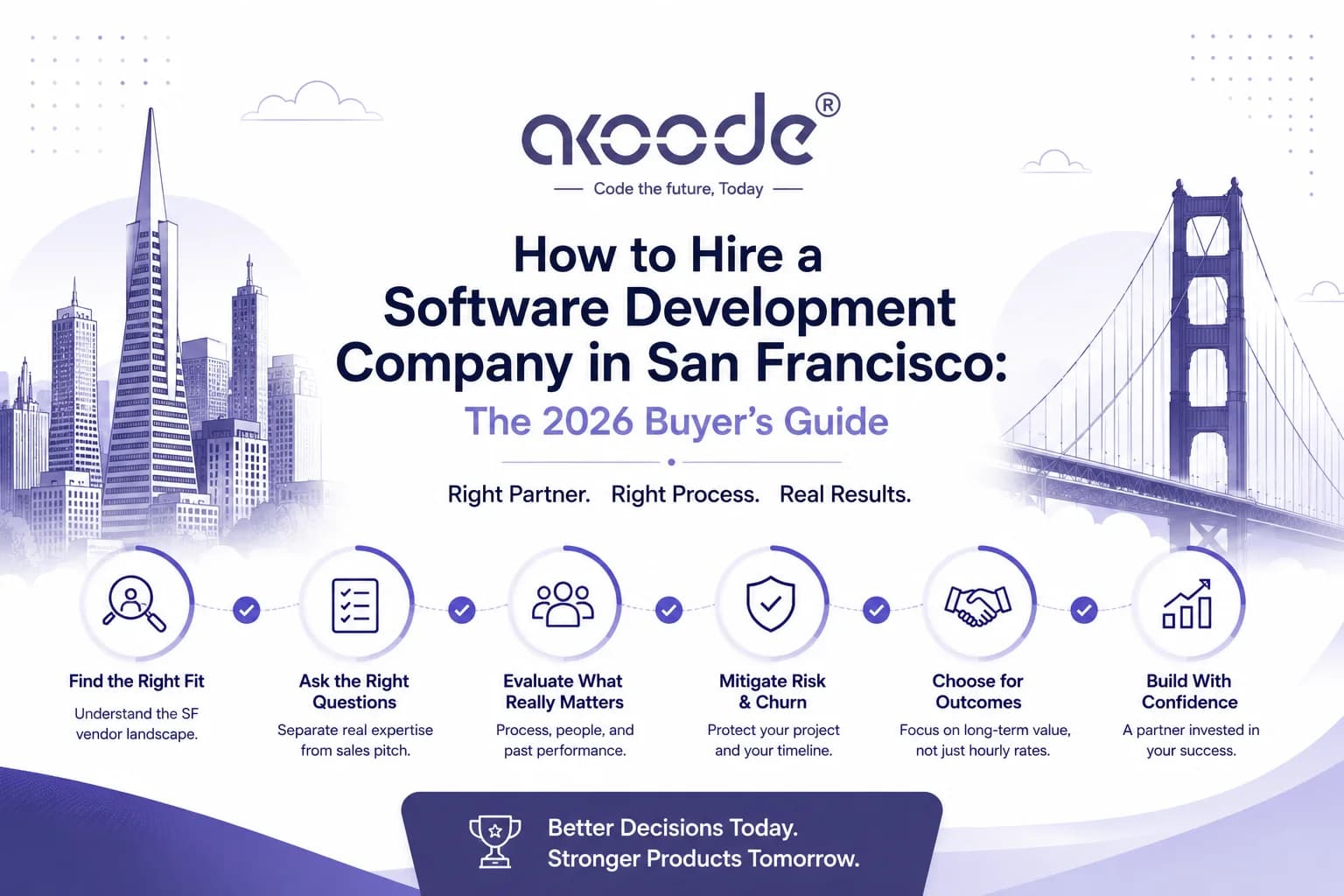
How to Hire a Software Development Company in San Francisco: The 2026 Buyer's Guide
Hiring a software development company in San Francisco means shopping in the world's deepest talent pool — through the world's most distorted market.
The distortion isn't quality. SF agencies employ genuinely excellent engineers. The distortion is everything around them: rates of $150–$250/hour inflated by frontier AI labs paying $400K–$600K packages down the street, agency teams churning faster than anywhere on earth as those same labs poach them, a thick layer of offshore-disguised firms riding the "San Francisco address" premium, and a sales culture so polished that theater and substance are nearly indistinguishable in a first call.
The result: the same project gets quoted at $120,000 by one credible-sounding vendor and $500,000 by another, and the price tells you almost nothing about which one will actually ship.
A founder in SoMa told us she'd interviewed eight agencies before signing. Six pitched nearly identical decks. The seventh quoted double the others "because of our process." The eighth — the one she hired — was the only one that put an engineer on the first call and told her one of her core features shouldn't be built at all.
By the end of this guide, you'll know how to find the eighth vendor without sitting through the other seven. It's the evaluation process we'd walk an SF founder through in a private session: how the market actually segments, the churn risk no proposal mentions, the questions that expose weak vendors in one call, and an honest framework for local versus global versus hybrid.
The San Francisco Vendor Landscape: Six Types, Not Interchangeable
Elite product studios ($200–$250+/hour). The genuine top tier — ex-FAANG leadership, successful-exit alumni, mature design and engineering culture. They're real, and for the right project (venture-backed products where craft is the moat) they earn their rates. Two cautions: their delivery teams churn like everyone else's here, and their process-heavy pitch sometimes sells maturity your project doesn't need.
Standard agencies ($150–$200/hour). The broad middle. Quality varies enormously within this band — some are excellent value by SF standards; others are learning on your budget at the highest prices in the country. This is the segment where disciplined evaluation pays for itself many times over.
YC-adjacent and startup-scene shops. Small teams orbiting the accelerator ecosystem, often founded by technical alumni. Strong on modern stacks and startup velocity; thin on QA discipline, documentation, and continuity. Right for scrappy MVPs; risky for anything an enterprise buyer will security-review.
Contractor collectives. A growing SF pattern: an "agency" that's actually a rotating bench of independent contractors under one brand. The individuals are often superb — but nobody on your project is an employee, continuity depends on gig economics, and the bench reshuffles monthly. Ask directly: "How many people on my proposed team are W-2 employees?"
Offshore-disguised firms. SF has the highest concentration in America, because the address premium is the highest in America. A Market Street suite, a local phone number, an undisclosed delivery team abroad — you pay $180/hour for work performed at $35/hour, and the spread goes to the middleman. The issue isn't offshore work; it's the concealment and the markup you absorb without benefit.
Global firms with transparent delivery. Akoode's model: global engineering disclosed openly, at 55–70% below SF rates, with US presence, Pacific-hours communication overlap, and full clarity about where every engineer sits. Right for: applied builds where outcomes matter more than office geography. Wrong for: projects genuinely requiring in-person collaboration or frontier research talent.
One question sorts the disguised from the transparent in thirty seconds:
"Where, specifically, will the engineers on my project be located — and can I meet them before we sign?"
Transparent firms answer in one sentence. Everyone else starts explaining their "global delivery model."
The Churn Problem: SF's Unique Hiring Risk
Before the process steps, one risk deserves its own section — because it's worse here than anywhere on the planet, and no proposal will mention it.
San Francisco agency engineers are the most recruited humans in the economy. Frontier AI labs, FAANG, and funded startups poach them constantly with packages no agency can match. Practical consequences for you:
The team you're sold is provisional. The senior architect in the sales deck may be gone before your kickoff.
Mid-project departures are normal, not exceptional. Each one costs 2–4 weeks of knowledge transfer — billed at your rate.
Tenure is checkable. Before signing anything over three months, look up the delivery team on LinkedIn. If engineers average under a year at the firm, your project will outlive several of its own developers.
Three contract protections, non-negotiable on larger SF engagements: a key personnel clause naming your technical lead, documentation requirements so knowledge lives in the repo rather than in heads, and repo access from day oneso a departure never holds your code hostage.
This risk, more than rates, is the strongest argument for either the elite tier (better retention economics) or a global partner (deeper bench, materially lower poaching pressure). The vulnerable middle — standard SF agencies paying SF salaries without elite-tier equity upside — is where churn hits hardest.
Step-by-Step: How to Run the Hiring Process
Step 1: Write Your One-Page Project Definition First
Before any vendor call:
The business problem — not the feature list. "Enterprise deals stall in security review because our permissions model is a mess" is a problem. "We want a rebuild" is a solution someone sold you.
Success in numbers. Security review pass rate. Onboarding time. Support volume.
Your real budget range — including the 20–25% reserve experienced buyers hold, and the 15–25% annual maintenance that starts at launch. Sanity-check everything against our San Francisco cost guide.
Research or applied? If AI is in scope, classify honestly — it determines your talent pool and roughly triples or thirds your budget. Our SF AI guide covers the distinction in depth.
What already exists — systems, data, integrations.
Vague briefs get vague proposals. In SF, vague proposals are where the $120K-vs-$500K spread is born.
Step 2: Build a Candidate List From Real Sources
Founder referrals — the best signal in a market saturated with polish. Ask: "Would you hire them again, and what went wrong?" Everyone has a "what went wrong." Honest ones tell you.
Clutch and GoodFirms verified reviews — read the 3- and 4-star reviews, where the texture lives.
LinkedIn — the engineers, not the company page. Tenure especially. This is your churn-risk check, and it takes ten minutes.
Live portfolio products. Ten minutes inside something they shipped beats an hour of case study PDFs.
Aim for 5–7 candidates. Include at least one global partner — otherwise you're only comparing SF premiums against each other and calling the cheapest one "reasonable."
Step 3: Evaluate Portfolios Like an Investigator
Is the product still live?
What was the firm's actual role? In SF especially, "we built X for [famous startup]" often means one contractor touched one module for one quarter.
Is anything at your scale and in your vertical? A vendor with real fintech or health tech delivery knows what SOC 2 and HIPAA actually require. That knowledge is avoided rework.
Ask for one reference from a project that had problems. How a firm handles a rocky project tells you more than any success story. Firms claiming zero difficult projects are telling you something — just not what they think.
Step 4: Run Discovery Calls and Listen for Patterns
Who talks? If it's 100% salesperson and zero engineers, ask to meet the technical lead before a second call. In SF's theater-rich market, this filter works overtime.
Do they push back? The founder's story above is the pattern: the vendor worth hiring told her what not to build. A firm that loves every idea is closing a deal, not evaluating a project.
Do they talk about your business or their process? SF's elite tier is particularly prone to process-as-pitch. Sometimes you need that maturity. Often you're paying $60,000 extra for ceremony.
Step 5: Read Proposals Where the Truth Hides
Compare scope line-by-line, never headline price. Spreadsheet it: discovery, design, frontend, backend, QA, DevOps, PM, post-launch support. The cheap quote almost always excludes three of these; the expensive one sometimes double-counts ceremony.
Look for named assumptions. Proposals without an assumptions section haven't thought hard enough to have any — which means they exist unspoken and will resurface as change orders at $200/hour.
Check what happens after launch. A proposal ending at deployment describes a relationship designed to end at deployment — and SF maintenance rates compound forever.
Check the compliance line items. CCPA/CPRA controls, SOC 2 readiness, HIPAA architecture where relevant. If your project needs them and the proposal doesn't itemize them, they're coming later as expensive surprises.
Step 6: Negotiate the Contract Terms That Actually Matter
IP assignment on payment, not project completion
Source code access from day one — non-negotiable
Key personnel clause — more important in SF than any market on earth
A defined change-order process with rates in writing
A clean exit clause — 30 days' notice, orderly handover, payment for work completed
Payment structure: 25–30% against a defined first milestone. A firm demanding 50%+ before discovery has cash flow or churn problems — about to become yours. And in SF, decline any arrangement where the agency asks for equity unless you've independently decided you want them as a long-term stakeholder; "cash plus equity" pricing is a local pattern that usually favors the agency.
Red Flags Worth Walking Away From
A price in the first call. Real estimates require discovery.
No engineers anywhere in the sales process.
"Yes" to everything. Real engineering involves trade-offs.
No assumptions section in the proposal.
50%+ deposit before discovery.
Won't share a reference from an imperfect project.
Evasive about team location. "Global presence" is not an answer.
Engineer tenure under a year on LinkedIn. Your project will outlive its own team.
The delivery team is all contractors — ask the W-2 question directly.
The portfolio is all NDA-protected. Some confidential work is normal; an entirely unverifiable portfolio is not.
Name-dropping instead of role clarity. "We worked with [unicorn]" without specifics of what they built.
Slow, sloppy communication during sales. This is their best behavior. It degrades from here.
The 15 Questions to Ask Before Signing
Who exactly will work on my project, and can I meet them before signing?
Where are those people located? — The disguise-filter.
How many of them are W-2 employees versus contractors? — The SF-specific structural question.
What's your team's average tenure, and what happens if my technical lead leaves? — They should have a real answer, because in SF it will happen.
Show me a live product you built that's been in production 12+ months.
What was your specific role on it?
What's your average variance from original estimates, and why? — "We always deliver on time" is a lie.
Tell me about a project that went badly. What changed afterward? — The single most revealing question here.
What does your discovery phase produce and cost? — Expect $15,000–$30,000 in SF. Skipping it defers cost into change orders.
How do you price change requests? — Rates and turnaround in writing.
Who owns the IP and when does it transfer? — You, on payment.
Do I get repo access from day one? — Non-negotiable, and your churn insurance.
What's your QA process, and who does it? — "Developers test their own code" is not a QA process.
Have you shipped under CCPA / SOC 2 / HIPAA? — Not can you. Have you.
Why would you be the wrong choice for some clients? — Honest self-awareness predicts honest communication.
SF Agency vs. Global Partner: The Honest Comparison
Factor | SF Agency | Global Partner (Akoode) |
|---|---|---|
Standard rate | $150–$200/hr | $45–$75/hr |
Elite tier | $200–$250+/hr | — |
Total project cost | Baseline | 55–70% lower |
Time zone | Local | 3–4 hr Pacific overlap, async otherwise |
In-person meetings | Easy | Video-first |
Frontier AI research access | Genuine, unique | Not the strength |
Applied engineering quality | Excellent | Excellent — identical stack |
Engineer retention | Worst in the world | Materially lower risk |
CA compliance fluency | Generally strong | Strong at US-focused firms — verify |
Team scaling | Brutal local hiring market | Faster — deeper bench |
The honest read: SF's elite studios deliver genuine craft, and frontier research genuinely requires this city. But for applied engineering — web, mobile, SaaS, LLM integration, RAG systems — the $300,000+ gap between an SF build and a well-managed global build buys geography and churn exposure, not quality. A senior engineer produces the same architecture in Gurugram as in SoMa.
Many experienced SF buyers land on a hybrid: local discovery and design direction where in-person adds value, global delivery for the build. It captures both advantages — and sidesteps the churn problem almost entirely.
The Decision Framework
Five questions:
Is your project genuinely frontier research — novel ML, research-adjacent product — rather than applied engineering?
Do your contracts require US-based vendors or onshore data handling?
Does your project require regular in-person collaboration?
Is your project under 10 weeks with fully locked scope?
Is design craft your competitive moat, with budget genuinely comfortable at elite-tier rates?
Three or more yes → SF agency (elite tier if questions 1 or 5 drove it). The premium is buying something real — protect yourself with key personnel clauses.
Zero or one yes → global partner. You'd be paying $300,000+ for a zip code and inheriting the worst retention risk in the industry.
Two yes → hybrid. Local discovery, global build. Increasingly the default for experienced SF buyers.
Frequently Asked Questions
How do I hire a software development company in San Francisco?
Start with a one-page project definition — business problem, success metrics, budget range, and (if AI is in scope) an honest research-versus-applied classification. Build a list of 5–7 candidates from founder referrals and verified reviews, including at least one global partner as a price baseline. Run discovery calls with the 15 questions in this guide, check engineer tenure on LinkedIn, compare proposals line-by-line on scope, and verify references with the "what went wrong" question.
How much does it cost to hire a software development company in San Francisco?
Standard SF agencies bill $150–$200/hour; elite studios bill $200–$250+. Complete projects run $50,000–$120,000 for an MVP, $120,000–$280,000 for a business application, and $200,000–$475,000 for a SaaS platform. Global partners deliver equivalent scope 55–70% lower. Full benchmarks in our SF cost guide.
How do I verify an SF software company is legitimate?
Five checks: verified Clutch/GoodFirms reviews (read the middle-star ones), a live production product you can personally test, engineer LinkedIn profiles showing real tenure, the W-2-versus-contractor question, and a reference call asking what went wrong on a past project. In SF specifically, the tenure check is the single highest-value ten minutes in your entire process.
Why is engineer turnover such a big risk with SF agencies?
Because frontier AI labs and FAANG pay $400K–$600K packages no agency can match, SF agency engineers are the most poached in the world. Mid-project departures cost 2–4 weeks of knowledge transfer at your billing rate, and the team you're sold is provisional. Protect yourself with key personnel clauses, documentation requirements, day-one repo access — or a global partner where the poaching pressure is materially lower.
How much should I pay upfront to a software development company?
25–30% against a defined first milestone is market standard. Dedicated teams bill monthly with no large deposit. A firm demanding 50%+ before discovery has cash flow or churn problems that shouldn't become yours. And be cautious of SF's "cash plus equity" pricing pattern — only grant equity if you independently want the agency as a long-term stakeholder.
Do San Francisco software companies outsource their work?
Many do — and SF has the highest concentration of undisclosed offshore delivery in America, because the address premium is the highest. Disclosed global delivery is legitimate; paying $180/hour for concealed $35/hour work is not. Ask directly where your engineers will sit and whether you can meet them. Transparent firms answer in one sentence.
Should I hire an elite SF studio or a standard agency?
Elite studios ($200–$250+/hour) earn their rates when design craft is your competitive moat and process maturity matters — venture-backed consumer products, brand-critical builds. For internal tools, B2B applications, and most SaaS, a standard team or global partner delivers the same outcome for 40–70% less. A paid discovery phase usually reveals which tier your project actually needs.
What should an SF software development contract include?
IP assignment on payment, source code access from day one, a key personnel clause (more important here than anywhere), a defined change-order process with rates, post-launch support terms, and a clean exit clause. Payment at 25–30% against a first milestone. Skip equity components unless independently desired.
How long does it take to hire a software development company in San Francisco?
Run properly: 3–5 weeks. One week defining your project, one building the list, one to two for calls and proposals, one for references and contract. SF's dense market means more filtering, not less — and the tenure checks and W-2 questions add a day that saves months.
Is it better to hire local in San Francisco or go global?
For frontier AI research, in-person collaboration needs, or US-vendor contract requirements — local, with churn protections. For applied engineering — the overwhelming majority of projects — a transparent global partner like Akoode Technologies delivers equivalent outcomes at 55–70% less, with Pacific-hours overlap and materially lower retention risk. Many experienced buyers hybrid: local discovery, global build.
What to Do in the Next 48 Hours
If you're serious about hiring, don't start by Googling agencies and calling whoever ranks first.
Write the one-page project definition. Including the research-versus-applied classification if AI is in scope. Ninety minutes that improves every conversation for a month.
Run the tenure check. Pull up the LinkedIn profiles of any firm already on your radar. Ten minutes per firm. It will eliminate candidates faster than any sales call.
Build your list of 5–7 — referrals and verified reviews, with at least one global partner included so your comparison has a real baseline instead of SF premiums against each other.
Then start conversations with the 15 questions in hand — including at least one vendor who will tell you what not to build. That's the one worth trusting with what you do build.
Talk to Akoode About Your San Francisco Project
Akoode Technologies builds custom software, mobile apps, and AI systems for San Francisco businesses — 100+ projects delivered across 15+ industries, 4.9/5 on Google, 5.0/5 on Clutch. Global engineering economics, US presence, Pacific-hours communication, full transparency about where every engineer sits — and a bench deep enough that poaching never becomes your problem.
Review our case studies, our custom software, AI development, and mobile app services — or skip straight to a conversation.
Book a free 45-minute consultation → calendly.com/akhil-akoode/ak
Get In Touch Now
View More Our Blog